
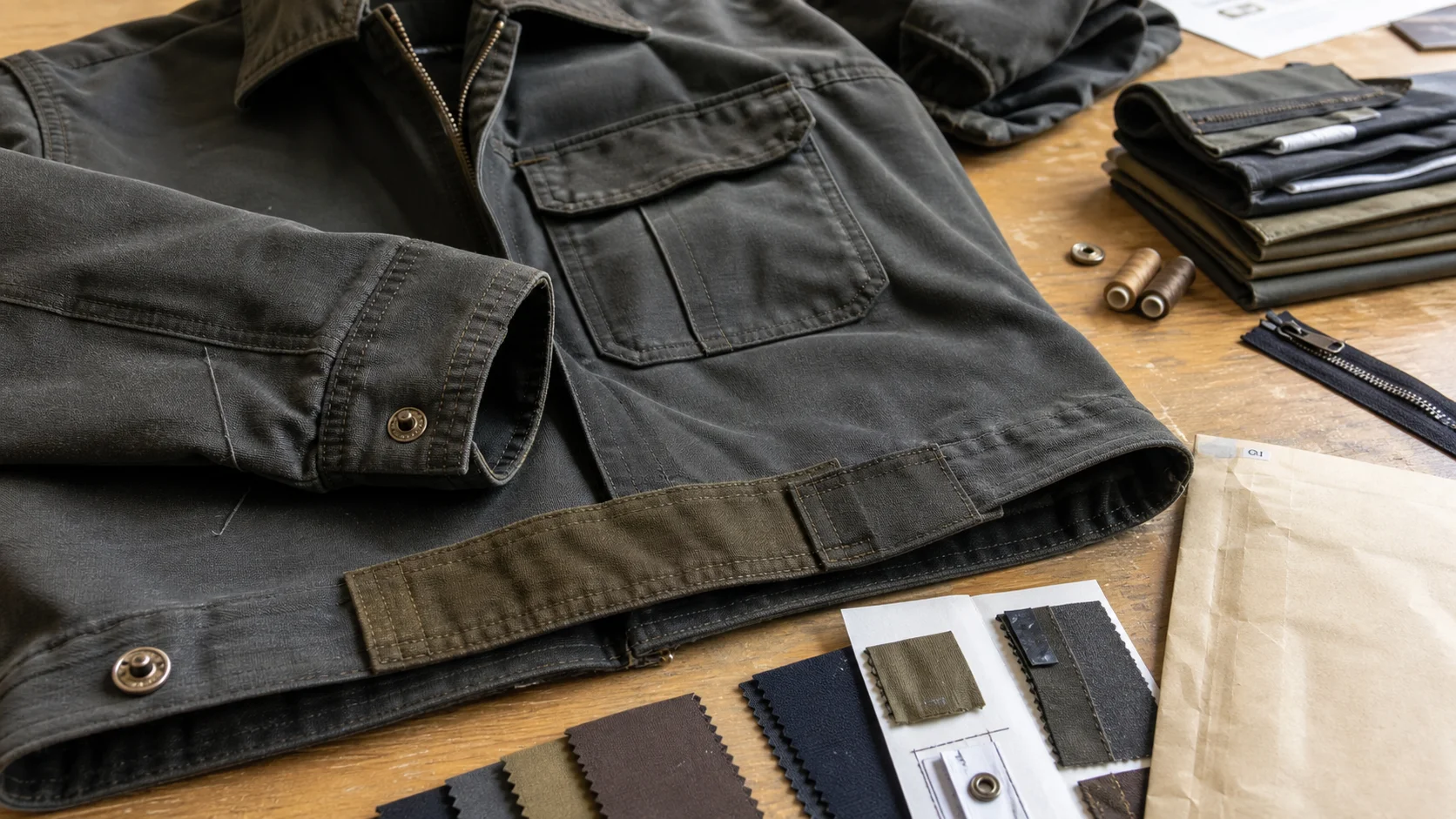
A facilities-manager focused review of sourcing durable, replaceable trims for bulk repairable work jackets, with sustainability, maintenance, and lifecycle cost considerations.
Repairable Work Jacket Trim Sourcing Review - Fabrikn production reference
For facilities managers, the trim package on a work jacket is not a cosmetic detail. Zippers, snaps, rib knit, drawcords, cuff bindings, storm flaps, pocket reinforcements, labels, and reflective tape decide whether the jacket survives repeated wear, can be repaired in the field or in-house, and stays in circulation long enough to justify a sustainable purchase. A repairable work jacket trim sourcing review needs to focus on durability, replacement availability, stitch compatibility, and the real cost of keeping garments serviceable over time.
This review is written for bulk buyers who need reliable volume, controlled quality, and predictable replenishment. Sustainable fashion claims matter, but they only hold up when the trim specification supports repair, not disposal. In practice, the best sourcing decision is the one that reduces returns, simplifies maintenance, and avoids custom components that become stranded inventory.
Most work jackets fail at the trim before the shell fabric wears out. A broken zipper slider, a snapped snap cap, or a frayed cuff binding can send a jacket into the discard pile even when the body panel is still serviceable. That is poor value for any operation, and it is hard to defend under a sustainability program.
Repairable trim sourcing starts with one practical question: can the component be replaced quickly, locally, and at a known cost? If the answer is no, the jacket is only “repairable” in theory. Facilities teams should treat trim as an operational system, not a design accent. The goal is to keep the garment in service, reduce waste, and avoid dependency on proprietary parts that are hard to reorder.
That means the trim package should favor standard sizes, common colors, and repeatable construction methods. A garment with a standard #5 or #8 coil zipper, conventional sew-on snaps, and accessible seam construction is easier to maintain than one built around unusual closures or highly customized branding parts. The same logic applies to labels, Velcro, toggles, and reflective elements.
Zippers are the most common repair point on work jackets. Coil zippers are usually softer and more flexible, while molded plastic zippers can offer better tooth strength for heavier applications. Metal zippers are durable but can feel stiffer and may corrode in harsh conditions if the finish is poor. For repairability, the priority is not only strength. It is also availability.
Standardizing on a common zipper gauge and closure length helps future replacement. A #5 zipper may be adequate for light to medium-duty jackets, while a #8 is often preferred for heavier workwear. Ask whether the supplier can source the same chain profile, slider type, and puller style across replenishment orders. A mismatch can create unnecessary repair friction.
Best practice is to request zipper performance details in the spec sheet: cycle test targets, tape composition, slider finish, and whether the zipper is reverse coil or standard coil. If the jacket is meant for wet conditions, a storm flap and zipper tape with consistent wash performance matter as much as the chain itself.
Snaps are fast to replace, but they can fail early if the metal plating is weak or if the setting process is inconsistent. Sew-on buttons are simple and repairable, yet they can be a weak choice for industrial use unless button thread and attachment method are reinforced. Hook-and-loop can be practical for cuffs and pockets, though lint buildup and reduced grip over time should be expected.
For bulk sourcing, standardize closure types and avoid mixing too many fastener families on one jacket. Each added closure variant creates a separate spare-parts problem. Facilities managers should favor closures that can be repaired with basic tools and stocked in common replacement bins.
Rib knit cuffs and waistbands are frequent wear points. A dense knit with good recovery holds shape longer and reduces the risk of bagging. Acrylic, polyester, cotton blends, and elastane blends all have different tradeoffs. Pure cotton feels comfortable, but it can lose recovery faster. Blends usually improve elasticity retention, but composition should be tested under wash and dry conditions that match real use.
Ask for measured GSM, stitch density, and shrinkage data. A trim component that looks acceptable on a sample rack may fail after several industrial wash cycles. If cuffs stretch out or pill heavily, the jacket loses appearance and fit even when the shell remains sound.
Bindings and seam tape influence both durability and repair path. A bound edge can reinforce stress points, but poor tape quality may peel or harden after laundering. If the jacket includes reinforced pocket openings or hem tape, inspect the bonding method carefully. Heat-applied components must be tested for wash durability, while sewn bindings need strong thread and consistent stitch density.
For safety-oriented workwear, reflective tape is often non-negotiable. Repairability is more complex here because replacing reflective tape to maintain compliance can be time-consuming. The tape must stay bright after laundering, abrasion, and flexing. Buyers should verify whether the proposed trim meets the relevant visibility standard for the jobsite, then check how repairs affect that standard after field replacement.
When reflective placement is integral to compliance, partial repairs may not be enough. That is a sourcing risk worth flagging early because it can determine whether a jacket remains fit for service after a trim failure.
Labels are often ignored in sourcing reviews, but they matter in repairable programs. Care labels, size labels, and brand labels should be durable enough to survive repeated laundering without becoming unreadable. If replacement labels are needed, they should be easy to source and consistent in format. A care label that fades or detaches creates compliance and inventory problems.
A good trim spec is specific enough to prevent substitution, but not so rigid that it blocks supply continuity. Facilities managers should insist on a complete bill of materials for the jacket, including trim codes, compositions, dimensions, colors, finishes, and approved alternates. That document becomes the backbone of repairability and replenishment.
Useful trim spec details include:
Color control matters more than many teams expect. A repair part that is technically correct but visually off can make the jacket look mismatched and hasten replacement. Standardize approved color families and ask for shade banding tolerance where applicable. For black, navy, grey, and hi-vis trims, small deviations can be obvious under natural light.
Thread selection deserves special attention. Strong trim attached with weak thread is still weak. Polyester core-spun or other durable industrial threads often outperform basic sewing thread in high-stress areas. The supplier should define ticket size, color, and whether topstitching will be single or double needle. Repairability is better when the original construction can be reproduced with common shop equipment.
Repairable workwear is usually won or lost on the standardization of small parts. The more custom the trim package, the more expensive the repair system becomes.
Designing for repair requires a different mindset from designing for first sale. The garment should be easy to open, access, and re-sew without destroying adjacent panels. That means leaving enough seam allowance around high-wear trim, avoiding buried components that require major disassembly, and using closures that can be replaced with ordinary tools.
A repair-friendly jacket often includes accessible zipper tape, reinforced stitch paths, and modular trim placements. Pocket trims, cuff bindings, and hood components should be attached in a way that allows replacement without disturbing the shell fabric. This is especially important for facilities managing large fleets of outerwear. The difference between a simple repair and a full rework can determine annual cost.
There is a tradeoff, of course. More repair-friendly construction can add cost at the sample stage and may increase sewing time. That cost is usually justified if the jacket is issued in volume, exposed to routine wear, or part of a sustainability commitment. The wrong approach is to pursue low unit price while ignoring maintenance cost. That creates a false economy.
One useful sourcing rule is to keep spare trim inventory rational. If the jacket uses rare hardware, replacement stock becomes expensive to hold and easy to mismanage. Common parts are easier to stock, but they may limit design flexibility. The best option is usually a middle path: a standard trim base with only a few controlled branded elements.
Bulk buyers should not treat MOQ as a single number. Trim MOQ often differs from garment MOQ. A zipper supplier may accept lower quantities than a reflective tape mill or a custom snap vendor. For repairable work jackets, a realistic trim MOQ can range from a few hundred pieces for standard stock components to several thousand for custom colors, logos, or special plating.
Sample approval matters more than many purchasing teams allow for. A good sequence is:
Lead time depends on whether the trim is stock or custom. Stock zippers, snaps, and labels can move quickly. Custom-dyed rib knit, proprietary pullers, and specialty reflective tape can add weeks. Buyers should build in time for lab dips, strike-offs, and approval loops. Rush orders often create substitution pressure, and substitution is a risk when repairability depends on exact part matching.
Facilities teams should also ask about replenishment terms. A supplier that can repeat an approved trim specification without retooling or requalifying every time is more valuable than one that only succeeds on the first order. Long-term repair programs depend on continuity.
Inspection should cover more than final appearance. Trim defects often hide in mechanical behavior and wash performance. A zipper can look fine in packed form and still separate under load. A snap can feel secure in hand and loosen after repeated cycles. Rib knit can pass visual checks and then collapse after laundering.
Common failure points include:
Inspection risk rises when the supplier splits trim sourcing across multiple subcontractors. Different trim lots can create inconsistencies in shade, coating, or size. A clear trim control plan reduces surprises. Ask for incoming inspection records, in-process checks, and final AQL targets. For high-volume programs, an AQL alone is not enough. Functional testing on closures and wash durability should be included.
Work jackets used in maintenance, transport, warehouse, or outdoor facility settings face different stress profiles. A jacket for warehouse use may need strong cuffs and repetitive wash stability. A jacket for exposed outdoor work may need better weather protection, abrasion resistance, and reflective retention. That distinction should shape trim selection. One specification should not be forced across all use cases unless it is truly fit for the harshest duty.
Trim sourcing decisions often get reduced to unit price, which is not enough. A cheaper zipper that fails early costs more than a mid-grade zipper that survives repair cycles. A low-cost rib knit that loses recovery can shorten garment life. A trim package that is easy to repair can reduce replacement rate and stock write-offs.
The main tradeoffs are straightforward:
Facilities managers should calculate total cost of ownership, not just purchase price. That includes repair labor, spare parts inventory, inspection time, return rates, and end-of-life disposal. If the jacket is part of a uniform program, the savings from longer wear life are often more meaningful than the savings from a few cents on each trim component.
A conservative buying position is often the best one. Choose common trim families, reserve custom elements for essential branding, and require clear replacement pathways for each critical component. That reduces the chance of being locked into a design that cannot be maintained.
Before placing a bulk order, the sourcing team should confirm the following:
Area What to Verify Why It Matters Closure system Standard zipper size, slider type, replacement availability Affects repair speed and part stocking Trim durability Wash, abrasion, and cycle performance Determines service life under real use Construction access Whether trim can be replaced without major disassembly Reduces labor cost and downtime MOQ and replenishment Minimums for stock and custom parts Impacts inventory planning Color control Shade tolerance across lots Prevents mismatched repairs Compliance Visibility, flame, or other required standards Protects jobsite acceptance Inspection plan AQL, functional testing, and wash testing Reduces defect escapesA well-run sourcing review should also include spare parts policy. The jacket may be repairable, but only if replacement zippers, snaps, and labels are actually stocked or readily reorderable. If the supplier cannot support that, the repair strategy breaks down after the first season.
A supplier for repairable work jacket trims should be judged on repeatability, documentation, and responsiveness. The best indicator is not a polished sales pitch. It is whether they can produce a stable trim package across multiple lots with clear specs and consistent approval records.
Useful supplier questions include:
For teams comparing sourcing partners, it can help to review broader service capability, production coordination, and communication speed. See Fabrikn services for an overview of support areas, then use contact options to request trim and jacket sourcing details. If a supplier background review is needed, about Fabrikn provides a useful starting point for understanding positioning and scope.
Practical judgment still matters more than website claims. A vendor that can explain trim substitution risk, sample sequence, and repair implications is usually more credible than one selling on price alone. For facilities programs, credibility and continuity are worth paying for.
Repairable work jacket trim sourcing is a discipline of constraints. The right trim package is durable, common enough to replenish, and simple enough to repair without special tooling. The wrong package looks attractive at purchase but creates hidden cost in maintenance, downtime, and waste.
The strongest buying strategy is usually conservative. Use standardized zippers and closures, avoid over-customization, insist on documented sample approval, and confirm that trims can be replenished over the full service life of the garment. A jacket that can be repaired twice is more valuable than a jacket that is slightly cheaper and disposable after one defect.
For sustainable fashion programs inside facilities operations, that is the standard that matters. Sustainability is not a claim attached to the order form. It is a result of the trim choices, sewing methods, testing discipline, and replacement planning that keep the jacket in use.
Get a free quote from Fabrikn — your trusted B2B clothing manufacturer with 10+ years of experience. MOQ as low as 200 pieces.
Get a Free Quote →Zippers, snaps, rib knit cuffs, waistbands, reflective tape, labels, and pocket reinforcements are the main trim items that affect repairability. Zippers and cuffs usually create the most maintenance issues.
MOQ varies by component. Stock trims may be available in the low hundreds, while custom colors, branded pullers, or specialty tapes can require several thousand units. Final MOQ depends on the supplier and the level of customization.
Use a staged process: prototype sample, trim swatch approval, pre-production sample, size set review, and bulk approval after testing. That sequence reduces the risk of approving a visually correct but functionally weak jacket.
There is no single best option. Coil zippers are flexible, molded plastic zippers can be robust, and metal zippers can be durable but heavier. The right choice depends on duty level, weather exposure, and whether replacement parts will remain available.
Uneven stitching, zipper failures under load, snap pull-off, rib knit recovery loss, reflective tape delamination, and color variation are the most common issues. Functional testing matters more than appearance alone.
Repairability extends garment life, lowers disposal rates, and reduces replacement purchases. For facilities managers, it also improves budget control and simplifies uniform management over time.
Yes. A repairable program depends on the ability to reorder the same trim specification later. Without that, the jacket may be technically repairable but practically impossible to maintain.
For facilities teams sourcing at scale, repairable work jacket trims are worth treating as a long-term system. The best results come from standard components, clear specs, disciplined sampling, and a supplier that can support repeat orders without drift in quality or fit.