
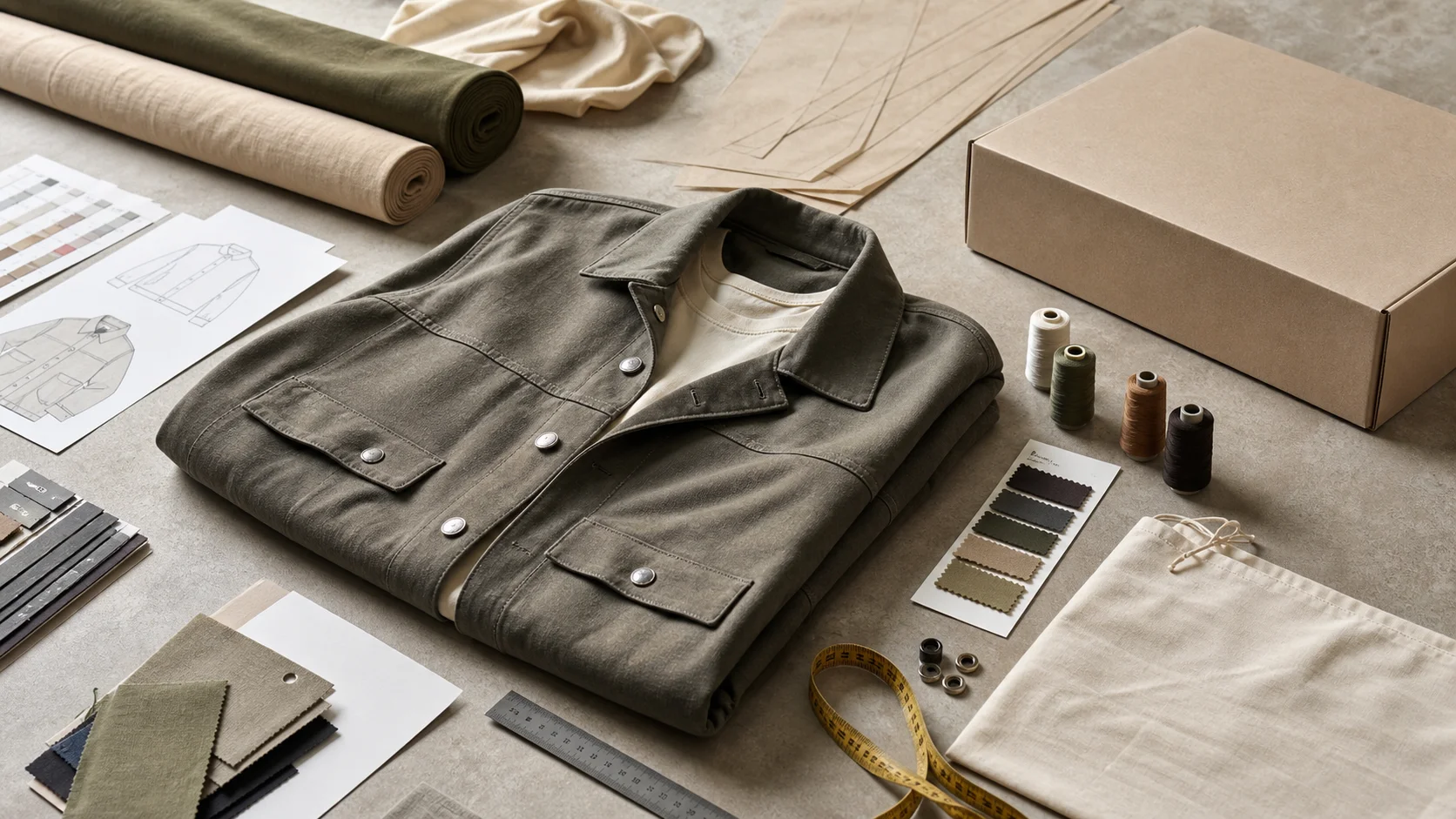
Apparel Manufacturing Partner Selection for Wholesale compared by sample evidence, fabric or trim specs, MOQ, AQL terms, cost lines, delivery timing, and...
Fast answer: Apparel Manufacturing Partner Selection for Wholesale: Tech Pack, Sample Gate, MOQ, and QC Terms should be judged by production evidence, not by a generic sourcing promise. The buyer needs sample proof, cost breakdowns, QC checkpoints, and delivery buffers in writing.
Ask for recent sample photos, measurement tolerances, fabric or print test assumptions, decoration test notes, packing examples, and a named inspection checkpoint. These details show whether the team can repeat an approved sample at bulk volume.
Separate garment cost, decoration, labels, packaging, sampling, testing, freight, and rush charges. Clear cost lines make it easier to reduce colorways, adjust size depth, or reserve more time for sampling.
Choosing the right apparel manufacturing partner is one of the most important decisions a wholesale buyer can make. The supplier you select influences product quality, pricing, lead times, communication, compliance, and ultimately your brand’s reputation in the market. Whether you are sourcing basics, fashion apparel, uniforms, or private label collections, the right manufacturing partner can help you scale efficiently while reducing risk.
This apparel manufacturing partner selection guide for wholesale buyers is designed to help you evaluate suppliers with confidence. It covers the most important criteria to consider, the questions to ask, the red flags to avoid, and the steps you can take to build a long-term, profitable partnership. If you are comparing factories or planning your next sourcing strategy, this guide will help you make a more informed decision.
Wholesale buyers operate in a highly competitive environment. Your margins are often tight, your customers expect consistent quality, and your reorder cycle depends on reliable delivery. A manufacturing partner is not just a vendor; they are an extension of your supply chain.
A poor manufacturing decision can lead to stockouts, defective merchandise, delayed launches, customer complaints, and lost sales. On the other hand, a strong partner can support product development, improve cost efficiency, and help you respond faster to market demand.
For wholesale buyers, the selection process should go beyond price. The best partner is the one that can consistently meet your standards, communicate clearly, and grow with your business.
Before evaluating factories or suppliers, clarify exactly what you need. Different manufacturers specialize in different product types, production volumes, and service levels. A partner that is ideal for premium fashion may not be the right fit for workwear, promotional apparel, or bulk basics.
When you define these details early, it becomes much easier to identify the right manufacturer and avoid wasting time on suppliers that cannot meet your needs.
One of the most important steps in choosing an apparel manufacturing partner is determining whether they have the right capabilities for your product line. A supplier may look professional on paper but still lack the machinery, technical staff, or sourcing network to execute your order properly.
Find out what kinds of garments the factory produces regularly. Experience matters because apparel construction varies widely by category. A manufacturer that specializes in jerseys may not be ideal for structured outerwear, while a factory focused on fashion pieces may not be efficient for high-volume basics.
Some manufacturers only cut and sew, while others offer full-package services that include fabric sourcing, sampling, pattern making, grading, labeling, packaging, and shipment coordination. If you need a more hands-off sourcing process, a full-service partner may be the better option. You can review what a professional supplier can offer by visiting our services page.
The more aligned the factory’s setup is with your product, the more efficient and reliable your production process is likely to be.
Quality control is essential in wholesale apparel sourcing. A small defect rate may seem manageable at first, but even a limited number of poor-quality units can create major problems when distributed at scale. Buyers should evaluate not only final inspection processes but also how quality is managed throughout production.
If you are selling into regulated or brand-sensitive markets, compliance matters just as much as product quality. Depending on your category and market, you may need to evaluate certifications, ethical sourcing practices, labor standards, and material compliance. Ask the supplier how they handle audits, testing, documentation, and traceability.
For wholesale buyers, compliance is not just a box to check. It helps protect your business from legal issues, supply disruptions, and reputational damage.
In apparel sourcing, communication quality can be just as important as technical capability. A manufacturer may have excellent equipment and good pricing, but if they are slow to respond or unclear in their answers, your project may still suffer.
A good manufacturing partner should communicate in a structured, professional way. They should be able to explain timelines, production steps, sample approvals, and cost drivers clearly. If communication is weak during the sales stage, it often becomes worse after the order is placed.
If you want to speak with a team that understands wholesale apparel sourcing, you can contact us here.
Price is always a major factor in wholesale buying, but the lowest quote is not always the best value. Smart buyers evaluate the total cost of working with a supplier, including hidden costs and the potential cost of mistakes.
A slightly higher price may be worthwhile if the supplier provides better consistency, lower defect rates, faster communication, or stronger logistics support. Poor quality, rework, delays, and missed sales can easily outweigh initial savings.
Wholesale buyers should also ask how pricing changes with volume. A manufacturer that offers transparent tiered pricing can help you plan more effectively as your business grows.
Minimum order quantity, production lead time, and scalability all play a major role in supplier selection. A manufacturer may be a strong technical fit but still be impractical if their minimums are too high or if they cannot scale with your business.
MOQs vary widely across the apparel industry. Some factories are designed for large-scale orders, while others can handle smaller test runs. Make sure the supplier’s MOQ aligns with your cash flow, sales forecasts, and inventory strategy.
Ask how long the process takes from sample approval to final shipment. Also confirm whether lead times include fabric sourcing, development, production, quality checks, and packaging. Reliable scheduling is critical if you are launching seasonal collections or replenishing fast-moving products.
Your current order volume may be manageable, but what happens when demand increases? A strong partner should be able to support growth without sacrificing quality or consistency. This is especially important for wholesale buyers who need to replenish core styles regularly.
Sampling is one of the most useful ways to evaluate a potential manufacturing partner. A sample shows you how the supplier interprets your technical requirements and whether they can execute to your standards.
Do not judge a manufacturer based on a single sample alone. Request revisions if needed and evaluate how they respond to feedback. A good supplier will use the sampling stage to refine the product and improve the final result.
If possible, test a small production run before committing to a larger order. This can reveal issues that are not obvious in the sample stage, such as variation in stitching, fabric consistency, or packing accuracy.
Experience is often a strong indicator of reliability. A manufacturer with a history of serving wholesale buyers is more likely to understand ordering cycles, packing requirements, and the importance of consistency across repeat production runs.
Ask for proof of previous work where appropriate. Photos, product samples, customer references, or documented case studies can help you evaluate whether the supplier can deliver at the level you need. If you want to learn more about a manufacturer’s background and values, explore our about us page.
Reputation should also include reliability. A supplier may produce good products, but if they often miss deadlines or struggle with accuracy, they may not be the best long-term partner.
The best apparel manufacturing relationships are built over time. For wholesale buyers, the ideal partner is one that grows with your business, understands your standards, and becomes more efficient with each order.
Long-term partnerships often lead to better pricing, smoother production, priority support, and improved consistency. Manufacturers are more likely to invest in your success when they understand your business and trust your process.
Many wholesale buyers make avoidable sourcing mistakes that lead to frustration and added expense. Understanding these pitfalls can help you choose more wisely.
Low pricing can hide poor materials, weak QC, or unreliable service. Always consider overall value.
Vague instructions can create misunderstandings, delays, and sample revisions. Provide clear specifications from the start.
Slow or unclear communication early on often becomes a bigger issue during production.
Never place a bulk order without testing samples first. Sampling helps prevent costly production errors.
A supplier that can handle your first order may not be able to support growth. Think ahead before committing.
Before selecting your apparel manufacturing partner, review this checklist:
If you can answer yes to most or all of these questions, you are likely on the right track.
Selecting an apparel manufacturing partner is a strategic decision that can affect every part of your wholesale business. By focusing on capabilities, quality, communication, pricing, MOQ, lead times, compliance, and long-term fit, you can choose a supplier that supports both current orders and future growth.
The best partner is not simply the cheapest or the fastest. It is the one that consistently delivers the quality, reliability, and transparency your business needs. Use this guide as a framework, ask the right questions, and build relationships that help your wholesale operation succeed.
Get a free quote from Fabrikn — your trusted B2B clothing manufacturer with 10+ years of experience. MOQ as low as 200 pieces.
Get a Free Quote →The most important factor is overall fit. That includes product expertise, quality control, communication, pricing, lead times, and the ability to scale with your business. For wholesale buyers, reliability is often just as important as cost.
No. The lowest price can come with trade-offs such as weaker quality, poor communication, or higher defect rates. It is better to compare total value, not just unit cost.
Samples let you verify fabric quality, construction, fit, sizing, and finishing before committing to production. They help reduce the risk of costly mistakes in bulk orders.
Ask about their product specialization, MOQ, lead times, quality control process, certifications, pricing structure, sample policy, and ability to scale production.
Look at their responsiveness, sample quality, production transparency, references, and track record. A reliable partner communicates clearly and consistently delivers on commitments.
Yes. Many manufacturers support growing brands and wholesale buyers, especially if the product specifications are clear and the order volume aligns with their capabilities.
Fabrikn supports apparel manufacturing needs with a service-focused approach for brands and wholesale buyers. To learn more, visit our services page or contact us for a conversation about your project.