
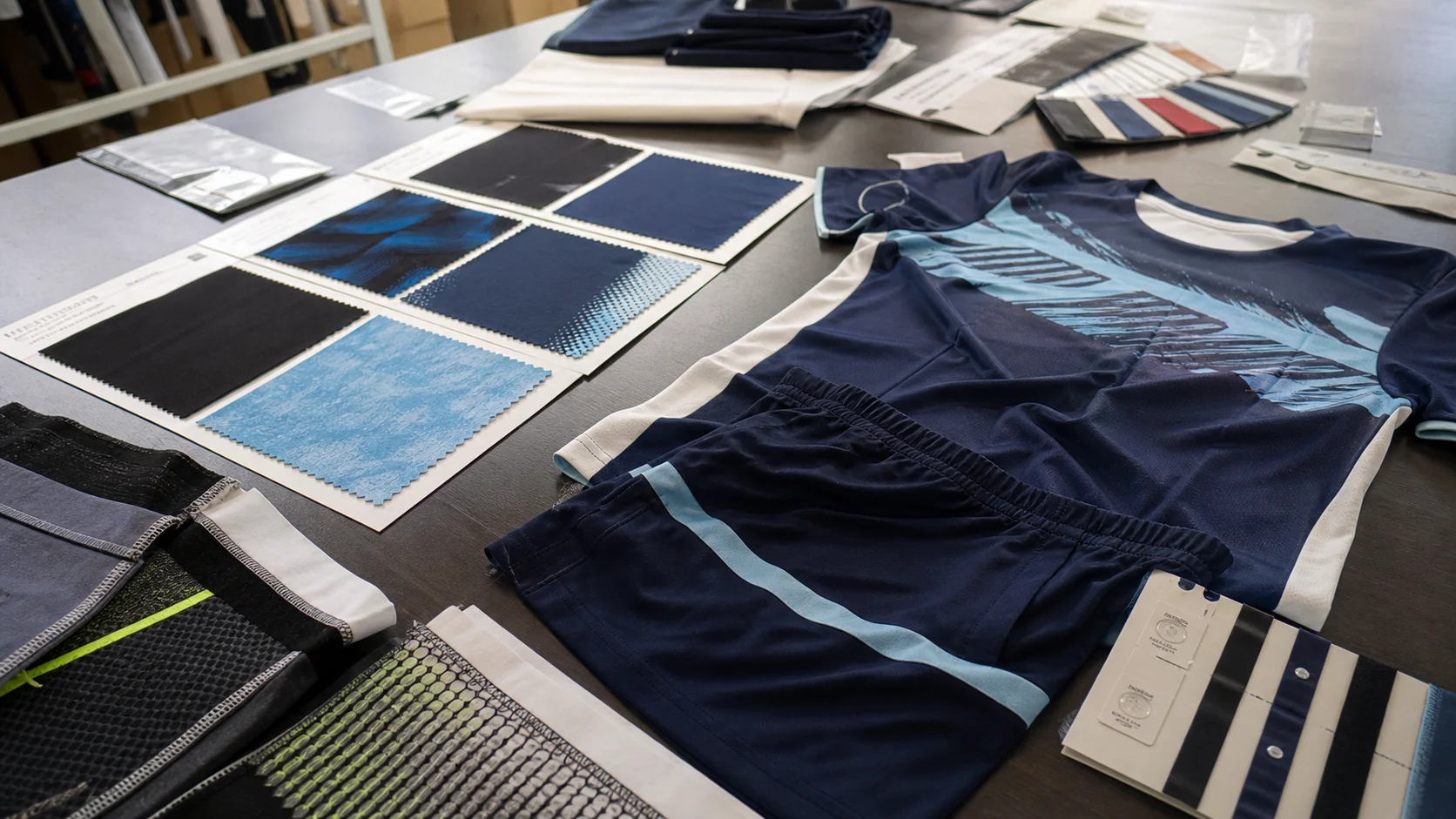
A quality-focused comparison of screen print, heat transfer, and sublimation on size-graded sports kits, with the inspection checks that keep artwork...
Category: Quality & Inspection
Choosing a print method for sports kits is not just a decoration decision. It affects sizing accuracy, repeat order consistency, wash performance, player comfort, and how much risk sits in production. Buyers who compare print methods only by unit cost often miss the real issue: how the artwork behaves when the kit is graded from youth to adult sizes.
That matters because sports kits are built on size ranges that stretch graphics across different body widths, chest lengths, sleeve lengths, and panel shapes. A logo that looks centered on a size M may drift or distort on an XL if the factory has not set the print system, placement rules, and grading plan correctly. The best choice is usually the one that fits the fabric, the order volume, the artwork complexity, and the tolerance for rework.
This guide breaks down the main print methods used in sports kits, what buyers should check during sampling, where quality risk tends to appear, and how size grading changes the decision. It is written for sourcing and inspection teams that need practical answers, not promotional claims. For buyers comparing manufacturing support, it can help to review a supplier’s production scope on services, their company background on about us, and the inquiry process on contact us.
Sports Kit Print Method Comparison for Buyers - Quality & Inspection manufacturing guide
Size grading is the process of scaling a garment pattern across sizes while keeping fit and proportion consistent. On sports kits, grading affects more than seam lengths. It also changes where the print lands relative to the neckline, side panels, sleeve edges, hem curves, and sponsor zones.
A print method that looks clean on a single sample can fail when applied across a full size run. A chest logo may remain stable on a flat front panel, while a sleeve number might warp as the sleeve cap grows. An all-over sublimated graphic can stay visually consistent because the print is applied before cutting, but a screen-printed crest placed after sewing may need size-specific position adjustments.
Buyers should think about three grading questions before approving any method:
The answers shape both quality and cost. A method that is easy to control on flat polyester may become risky on a highly elastic knit. A large logo placed across a side seam is not the same as a small chest mark placed on the front panel. In sportswear, the print method and the grading plan should be reviewed together, not separately.
Screen printing remains common for sports kits that need bold logos, sponsor marks, numbers, and team names. It is suitable for simple artwork with limited colors and works well on polyester blends if the ink system is matched to the fabric. Buyers often choose it for its strong color density and good repeatability on volume orders.
Screen printing is strongest when the print area is flat and the fabric is stable. The method does not like excessive stretch. On an athletic jersey with curved side panels or heavily elastic zones, the print may crack or distort if the wrong ink or curing profile is used. A screen print placed near a seam should be checked carefully for seam shadow, puckering, and placement drift after sewing.
From a grading perspective, screen print layouts should be based on each size’s finished dimensions. A standard chest logo may need different placement offsets for youth and adult sizes, especially when the neckline depth and chest width change. Buyers should ask whether the supplier uses a graded print placement chart or simply scales artwork uniformly. Uniform scaling is often not enough.
Typical MOQ ranges are often moderate. Simple screen-printed kits may start around 100 to 300 sets per design, while multi-color or specialty ink orders can need 300 to 500 sets or more to be economical. Lead time depends on color count, screen setup, curing capacity, and whether the factory is printing before or after cut-and-sew assembly.
Sublimation is widely used for full-print football kits, basketball uniforms, cycling jerseys, and training wear made from polyester. It transfers dye into the fabric fibers, which gives strong wash durability and a soft hand feel. Because the print becomes part of the fabric surface, it is often the best method for complex graphics and all-over designs.
This method is especially relevant to size grading sports kits print method comparison because the design is usually laid out on pattern pieces before cutting. That reduces the risk of artwork drifting during garment assembly. When the factory has a disciplined pattern and cutting system, sublimation can deliver better placement consistency across sizes than post-sew printing.
There is still risk. A design that is not properly mapped to each size can look uneven after grading. Large graphics on the chest or shoulders may move visually as the pattern grows. Some buyers approve one sample and miss the fact that the print alignment no longer looks balanced on larger sizes. Sleeve graphics and panel-matched artwork need separate checks.
Sublimation often works with lower MOQ than screen print for complex designs because there is no need for multiple screens. Typical order sizes can start around 50 to 100 sets for custom teams, though the exact minimum depends on fabric stock, paper output, and cutting efficiency. Lead time is shaped by design approval, fabric supply, print paper scheduling, and the assembly queue.
Heat transfer covers a few different technologies, including vinyl cut letters, transfer films, and digitally printed transfers. Buyers use it for names, numbers, small logos, badges, and short-run custom orders. It is flexible and useful when artwork changes by player or when a team needs variable personalization.
The main strength of heat transfer is control at low volume. It can be practical for promotional kits, school teams, or seasonal programs with changing roster data. It also helps when the factory needs a method that can be applied after sewing without the setup burden of screen printing.
Quality risk sits in adhesion, edge lift, wash durability, and heat damage to the base fabric. A transfer that looks clean at delivery can fail after repeated washing if the film is not matched to the fabric chemistry or if the press temperature is too high. Stretch panels are another issue. Transfers placed on high-movement zones can crack or peel unless the product has been tested under wear.
For size grading, heat transfer is best when the print dimensions are clearly specified for each size. A name or number may remain constant, but its position relative to the garment edges should still be adjusted by size. Buyers should request a placement chart and a production sample on at least the smallest and largest sizes in the range.
MOQ is often lower than screen printing. Some suppliers will accept 20 to 100 sets for transfer-based personalization, while more complex programs may need higher counts to offset application labor. Lead time depends on design prep, film output, and the number of unique names or numbers in the order.
Direct-to-film, often called DTF, has become more common for sports kit decoration because it handles detailed artwork, gradients, and short runs well. It can be used on many garment types and is often selected for names, crests, or mixed-color graphics where screen setup would be inefficient.
Buyers should treat DTF as a practical but carefully controlled option. It is not automatically better than screen print or sublimation. The print can feel heavier than sublimation and may be less breathable on large coverage areas. On performance sportswear, that matters. A small chest badge is one thing; a full-front large-area print is another.
Size grading concerns are similar to those of other post-sew print methods. Placement must be specified for each size, and the factory should confirm how the artwork scales from youth to adult. If the graphic crosses a seam or sits near a curved panel, the buyer should ask for a physical pre-production sample, not only a digital proof.
MOQ is often favorable for test runs or small club orders. Lead times vary depending on film capacity and pressing labor. The method can be efficient for multi-size, multi-name programs, but inspection needs to include adhesion, color consistency, and edge quality after wash and stretch testing.
Specialty decoration can be used on limited-edition sports kits, but it should be judged cautiously. Foil, puff, reflective, metallic, and embossed effects can create strong visual impact, yet they often introduce extra risk in wear and wash performance. These effects are not always the right answer for active sports use.
Buyers should check whether the decoration is intended for match wear, fan wear, or presentation apparel. A premium finish may be acceptable on a sideline top but not on a high-abrasion uniform. If a supplier proposes a specialty effect, the sample should be tested for cracking, peeling, and rub resistance before bulk approval.
For size grading, specialty finishes can be less forgiving than standard print. Their thickness and stiffness may change how the garment hangs. That can matter on slim-fit sports kits where the panel lines are already tight.
Sampling is where many print decisions are either validated or exposed. A clean digital artwork file does not prove that the decoration will survive production, sizing, and washing. Buyers should ask for a complete sample approval process rather than accepting a single showpiece.
A practical approval sequence usually includes a design proof, a material swatch review, a printed strike-off or lab dip where relevant, a size-set sample, and a pre-production sample. For size grading sports kits print method comparison, the size-set sample is the important step. It shows how the artwork behaves on more than one size and reveals whether the print location needs adjustment.
The following checks should be part of sample review:
Buyers should also confirm the fabric basis before approving print. A 100 percent polyester mesh behaves differently from a brushed polyester interlock or a stretch knit with elastane. Print acceptance should be tied to the actual production fabric, not a generic reference sample. Trim matters too. Heat transfer, screen ink, and sublimation paper can all react differently near silicone labels, TPU patches, zippers, and stitched badges.
The simplest sourcing rule is this: approve the print on the actual fabric, at the actual size, on the actual garment shape. Anything less leaves room for avoidable dispute.
Printing cost in sports kits is not driven by decoration alone. It is shaped by setup time, artwork complexity, number of sizes, number of names or numbers, fabric type, and how the print is integrated into the sewing flow. Buyers who understand these drivers can negotiate more intelligently and avoid false comparisons between suppliers.
MOQ is often a function of setup burden. Screen printing usually needs enough volume to justify screens, alignment, and curing. Sublimation can support lower runs when the print is all-over, but it still depends on pattern efficiency and cut planning. Heat transfer and DTF can support smaller orders, though labor can push the unit cost up quickly once personalization expands.
Lead time depends on the slowest part of the chain. If the artwork is final but the fabric is not ready, the order waits. If the print is approved but the size set has not been confirmed, bulk cannot start safely. If the factory is waiting on accessory items such as neck tape, woven labels, or size tags, the print schedule may slip even when decoration itself is simple.
Typical lead-time dependencies include:
For buyers managing seasonal programs, the safest approach is to lock artwork early and request a production calendar that shows sample approval, printing, sewing, packing, and inspection milestones. If a supplier cannot describe the sequence clearly, the risk is usually higher than the quote suggests. This is the point where a direct discussion through contact us is more useful than a price-only exchange.
Quality inspection for printed sports kits should cover both the decoration and the garment construction around it. A print can pass visually and still fail in use if the surrounding panel has wrinkles, seam distortion, or poor registration. Inspection plans should be built around the known failure modes of the selected print method.
Common risks include:
Inspection should not stop at random visual checks. For sports kits, a useful control plan often includes dimensional verification, print position measurement, rub testing, and wash testing where time and budget allow. Buyers placing larger orders should ask whether the factory uses in-process checks on print alignment and whether defective panels can be segregated before sewing. Catching a defect after assembly usually costs more.
There is also a packaging risk. Printed surface-to-surface stacking can create blocking or transfer marks if the ink is not fully cured or if heat transfer films are still sensitive. This matters in humid shipping conditions. If the kit is packed tightly, the supplier should confirm curing and cooling time before folding and boxing.
For club uniforms and school kits, the right choice is usually based on budget, volume, and customization. Screen printing works well for repeated logos and sponsors when the artwork stays stable across the season. DTF and heat transfer are practical if each player needs a unique name or number set. Sublimation is attractive when the team wants a full design and the garment is polyester-based.
Buyers should keep the order structure simple. One garment body, one print plan, one size chart, and one approval flow reduce mistakes. Complex decoration on a small order often creates more risk than value.
Higher-level kits usually require stronger consistency, better hand feel, and more reliable wash performance. Sublimation is often preferred for fully printed performance kits, while screen print remains useful for sponsor marks and badges. The better suppliers will separate decoration zones so the most visible elements receive the most robust method.
At this level, size grading needs careful review. The smallest and largest sizes should both be sampled. Buyers should check the front chest, back number, and sleeve graphics independently. A pattern that looks balanced on medium sizes may appear crowded on youth sizes or too sparse on larger ones.
Fanwear often favors shorter runs, faster turnaround, and more frequent design changes. DTF and heat transfer can make sense here, especially when artwork changes by campaign or player. Sublimation is still useful for all-over fashion sportswear, provided the fit is stable and the brand accepts a softer hand feel than a heavier branded transfer.
For these programs, MOQ flexibility matters, but inspection standards should not be relaxed. Low quantity does not remove quality risk. It only changes where the cost appears.
When comparing print methods for sports kits, buyers should use a simple decision framework:
The point is not to find the cheapest method in isolation. The point is to find the method that stays stable through grading, sewing, packing, shipping, and end use. A slightly higher decoration cost can be the better buy if it reduces rejection, remake, or customer complaint risk.
Suppliers that can explain fabric compatibility, grading logic, and inspection controls clearly are usually easier to manage. Buyers who need manufacturing support can review the provider’s operational scope on services and confirm whether the production setup fits the intended decoration method.
Get a free quote from Fabrikn — your trusted B2B clothing manufacturer with 10+ years of experience. MOQ as low as 200 pieces.
Get a Free Quote →There is no single best method for every order. Sublimation is usually strongest for all-over polyester kits, screen printing works well for simple logos at volume, and heat transfer or DTF suits personalization and short runs. The correct choice depends on fabric, order size, artwork complexity, and how much the print moves during grading.
Garment pattern pieces change shape and proportion as sizes scale. A logo placed at a fixed distance from the neckline on a medium may need different placement on smaller or larger sizes to keep the visual balance consistent.
No. Sublimation is strong for detailed and all-over designs on polyester, but it is not always ideal for every fabric or every brand requirement. It can also be less suitable when the garment needs a premium surface finish, mixed fabric construction, or very small production runs with limited print coverage.
Typical MOQ ranges vary by method and supplier. Screen printing often starts around 100 to 300 sets or higher, sublimation may begin around 50 to 100 sets, and transfer-based methods can sometimes support 20 to 100 sets. The exact minimum depends on setup burden, artwork complexity, and fabric availability.
Check placement, size, color, edge quality, fabric compatibility, and wash or stretch performance. It is safer to approve samples on the actual production fabric and on more than one size, especially when the order uses graded sports kit patterns.
Risk depends on the design and fabric. Sublimation can be low risk on polyester when the pattern and print files are well controlled. Screen print can be stable on simple logos. Heat transfer and DTF need more attention to adhesion and durability. Any method can fail if the sample approval process is weak.
For buyers building a new sports kit program, the safest next step is to align the artwork, size chart, fabric spec, and print method before requesting bulk pricing. That keeps the quote meaningful and reduces the chance of redesign during production. When supplier communication is unclear, a direct enquiry through contact us is usually more efficient than trying to resolve technical gaps after the order is placed.