
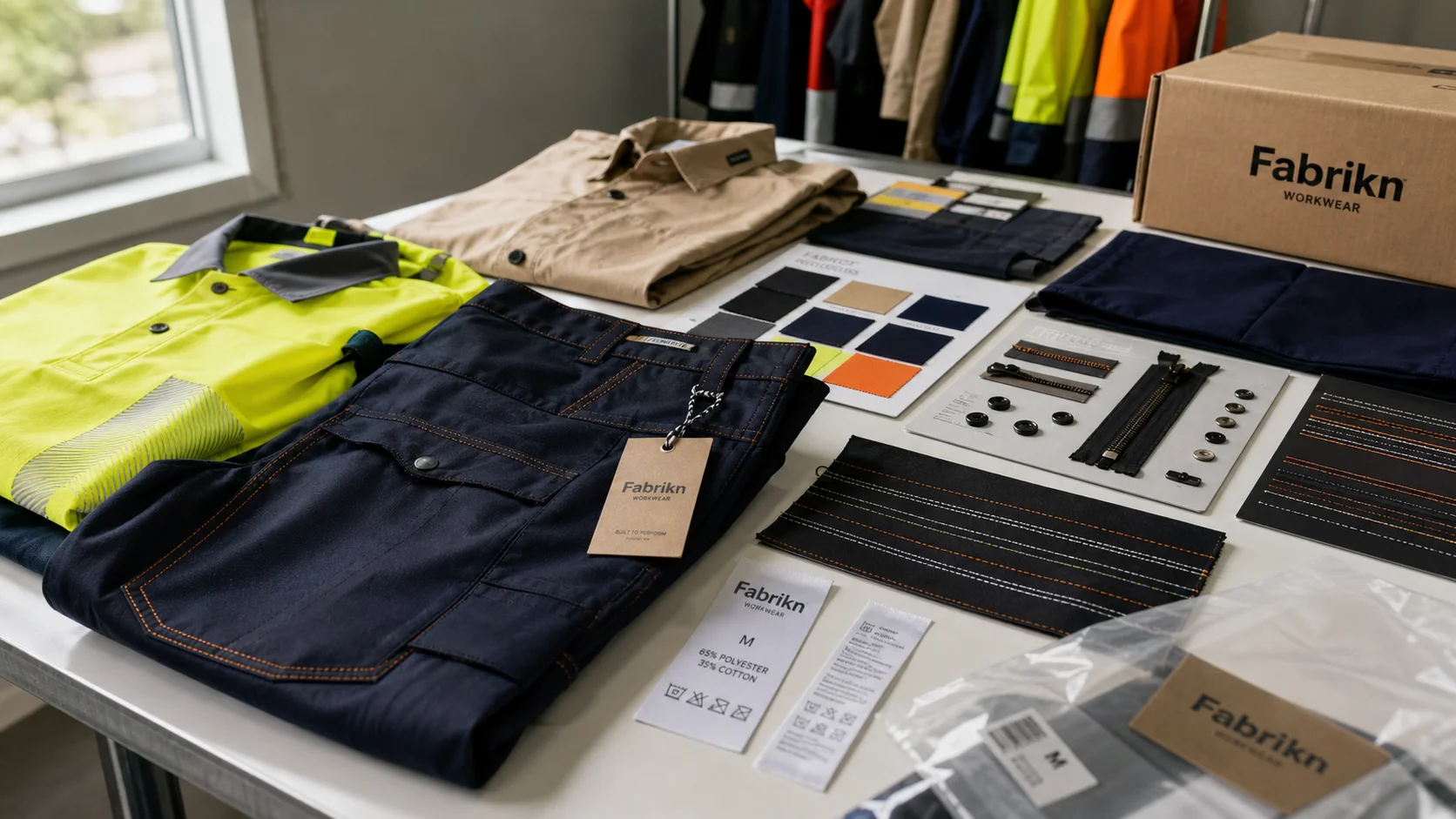
An SEO-focused outline for buyers sourcing bulk workwear coats from a manufacturer for logistics depot outerwear, covering fabric specs, branding, safety...
Bulk Workwear Coats for Logistics Depot Orders - Fabrikn production reference
For logistics depots, outerwear is not a minor uniform add-on. It is a performance item tied to safety, staff comfort, site presentation, and replacement planning. Buyers searching for a bulk workwear coats bulk order manufacturer for logistics depot outerwear usually need more than a basic jacket supplier. They need a private label apparel partner that can translate operational requirements into repeatable production specs, usually with a full tech pack, graded measurement chart, approved trim card, and carton assortment plan before bulk cutting starts.
Depot environments create a specific set of demands. Staff may move between loading bays, open yards, vehicle lanes, cold storage thresholds, and office entry points in the same shift. A coat that works in light yard supervision may fail for pick-and-pack teams exposed to wind, drizzle, abrasion, and frequent movement. A coat that looks sharp for brand consistency may still underperform if the pocket layout, cuff design, zipper grade, or reflective placement is wrong for the job. In practice, common depot coats use 150D to 300D polyester shell fabrics, 5# or 8# resin or coil zippers, and reflective tape widths of 2 inches or 50mm where visibility is required.
This is why bulk ordering needs to be handled with manufacturing discipline, not only merchandising logic. Fabric weight, coating type, seam construction, trim durability, logo application method, and carton assortment all affect the final result. Buyers also need clarity on MOQ, sample stages, production calendars, and inspection checkpoints before issuing a rollout order. Typical checkpoints include lab dip approval if custom color is used, size set approval before bulk, pre-production sample sign-off, in-line inspection at 20% to 30% sewing completion, and final AQL inspection before shipment.
In the private label segment, the strongest manufacturers are not the ones promising every possible feature at the lowest price. The better choice is usually the supplier that can define realistic specifications, identify likely production risks early, and manage consistency across repeat orders. That matters when a depot program may require replenishment every quarter, seasonal top-ups, or size rebalancing after the initial issue. For repeat depot programs, common reorder lead times are around 18 to 22 business days when fabric and trims are in stock, but 35 to 50 days is more typical when custom shell color, reflective trim, or woven labels must be remade.
Companies evaluating sourcing options can start by reviewing a supplier’s broader capabilities at /services/ and use that as a checkpoint for whether the manufacturer understands development, production, and quality control as one connected process.
Bulk depot outerwear orders are usually driven by one of four conditions: new site launches, seasonal issuance, contractor standardization, or brand consolidation across multiple warehouses. In each case, a coat order becomes easier to manage when the product is standardized and built around a technical specification sheet rather than informal visual approval. For most buyers, that means one approved shell fabric code, one insulation specification, fixed logo positions in centimeters from seam points, and a size ratio such as S-XXL packed by wearer count or depot allocation.
Logistics operations often need coats that balance weather protection with active movement. A long, heavy coat may provide coverage but can interfere with lifting, scanning, or climbing in and out of vehicles. A lightweight softshell may feel comfortable indoors yet fail in exposed loading areas during colder months. The practical answer is often to define the coat by use case rather than by a generic fashion category. Common buying briefs separate lightweight softshells at roughly 280gsm to 320gsm, padded jackets with 120gsm to 160gsm fill for mixed indoor-outdoor use, and heavier parkas with 180gsm to 220gsm insulation for low-activity yard supervision.
Bulk purchasing also simplifies stock control. Instead of sourcing outerwear in fragmented local buys, procurement teams can set one approved specification with agreed branding, labeling, packaging, and size ratios. That usually improves consistency and lowers the risk of mismatched colors, variable fit, or incompatible trims between reorders. Typical depot programs also specify spare percentages, often 3% to 5% extra units, to cover onboarding, damages, and early size exchanges.
For logistics depots, the best coat is rarely the most technical item on paper. It is the one that matches the work pattern, survives repeated wear, and can be reordered without specification drift.
In private label apparel, the manufacturer’s role should extend beyond cutting and sewing. For depot outerwear, a capable supplier should help convert operational needs into a documented production standard. That includes fabric selection, trim recommendations, artwork execution, measurement tolerances, and bulk packing plans. Typical outerwear tolerance standards are often set at ±1cm on key body points and ±0.5cm on smaller components such as collar height or pocket flap depth, but the approved tolerance table should be confirmed before sampling.
A practical manufacturer should be ready to support these core steps:
This matters because depot buyers often underestimate where failures happen. Problems are not limited to visible sewing defects. Incorrect zipper specification, weak bartacks at stress points, logo cracking after wash cycles, or carton breakdown caused by poor assortment planning can create real operational cost. Common failure points also include poor seam slippage at armholes, reflective tape edge lifting after 5 to 10 wash cycles, and insufficient SPI consistency on heavy shell seams sewn over padding.
The most useful suppliers will also discuss what should not be added. Extra panels, unnecessary waterproof claims, low-grade reflective trims, or overbuilt padding can increase cost and complexity without improving wear performance. In workwear, specification discipline usually beats feature inflation. A practical supplier should also be able to explain when WRAP or BSCI social compliance, OEKO-TEX Standard 100 chemical safety screening, or GOTS certification for organic cotton components is relevant to the buyer’s policy, even though not every depot coat program requires every certification.
Buyers comparing partners can use a manufacturer’s background page such as /about-us/ to understand whether the business is positioned for development support or only basic order taking.
Fabric and trim decisions drive most of the performance outcome in bulk workwear coats. For logistics depot outerwear, the product brief often starts with weather resistance, durability, ease of movement, and branding compatibility. Those needs can be met in several ways, but every choice carries tradeoffs. In costing terms, shell fabric, insulation, and zipper package commonly account for the largest share of FOB price movement, especially once orders move above 500 to 1,000 pieces.
Common shell fabrics for depot coats include polyester oxford, polyester pongee, mechanical stretch woven fabric, and poly-cotton blends with water-repellent finishing. Heavier fabrics can improve abrasion resistance, but they also raise garment weight and may reduce comfort during active shifts. Lighter fabrics can improve wearability, yet they may show stress faster around cuffs, pockets, and zipper areas if the denier or coating quality is too low. Typical shell specifications include 150D or 300D oxford with PU coating, 75D to 100D pongee with milky or clear coating, and 65/35 poly-cotton twill around 220gsm to 240gsm for more structured workwear styles.
For colder environments, quilted polyester lining with polyfill padding is common. Typical padding weights may range from around 80gsm to 220gsm depending on the intended climate and whether the wearer is stationary or highly active. A heavier fill is not automatically better. Staff who move constantly may overheat in heavily insulated coats, especially when shifting between indoors and outdoors. For many depot programs, 120gsm body fill with 100gsm sleeve fill is a common compromise because it reduces sleeve bulk while keeping core warmth acceptable.
Fleece lining can improve warmth perception and comfort, but it may add bulk and slow drying times compared with simpler quilted linings. Mesh lining can help with breathability in lighter transitional coats but provides limited cold-weather support on its own. Common lining materials include 190T taffeta, 210T polyester lining, anti-pill microfleece at 220gsm to 280gsm, and diamond-quilted constructions sewn on single-needle or computerized quilting machines before panel assembly.
Zippers are a frequent point of failure in workwear. For that reason, buyers should confirm zipper gauge, tape strength, and whether the design uses single or double pullers. A storm flap with snaps or hook-and-loop closure can improve weather protection, but low-grade hook tape may lose performance quickly in lint-heavy or dusty environments. For heavier depot coats, 5# zippers are common on pockets while 8# zippers are commonly preferred on the center front for better durability with gloves.
Needle density, seam type, seam allowance, and reinforcement details are not small factory decisions in workwear outerwear. They directly affect seam strength, appearance, and repeatability in bulk production. Common construction standards include 8 to 10 stitches per inch on outer shell assembly, 1cm to 1.2cm seam allowances on major seams, double-needle topstitching at high-stress zones, and bartacks at pocket corners, sleeve plackets, and side openings. Where water resistance matters, buyers commonly specify seam sealing only on exposed outer-shell seams rather than full waterproof taped construction, because full seam taping adds machine time and cost.
Typical production uses single-needle lockstitch, overlock, feed-off-the-arm, bartack, and computerized pattern sewing machines for repeatable pocket and flap attachment. Inspection checkpoints usually include seam puckering, skipped stitches, SPI consistency, needle damage on coated shells, and sleeve-to-body alignment before garments move to final pressing and packing.
MOQ for depot outerwear depends heavily on whether the buyer uses stock fabric and trims or requires custom color, branded labels, and specific reflective layouts. As a common market range, simple private label coats often start at 300 to 500 pieces per style-color, while more customized programs may require 800 to 1,500 pieces to keep material sourcing efficient. If the order is split across many sizes or multiple logo versions, the practical MOQ per variant usually rises.
Sampling normally moves through several stages: proto sample, fit sample, size set, pre-production sample, and sometimes a sealed shipment sample. Typical sample lead times are around 7 to 10 business days for a proto using available materials, 10 to 14 business days for a corrected fit sample, and another 5 to 7 business days for a size set if pattern grading is straightforward. Delays often come from logo strike-off approval, custom zipper color, shell fabric lab dips, or waiting for branded trims.
Bulk lead times are commonly 18 to 22 business days for repeat orders using in-stock materials, 30 to 45 days for first bulk runs with standard customization, and 45 to 60 days when custom-dyed shell fabric, specialty reflective trims, or multiple inspection holds are involved. Buyers should also ask whether lead time starts from deposit receipt, PP sample approval, or all bulk materials in-house, because factories do not always define the start point the same way.
For smoother planning, common sourcing practice is to backward-schedule from the required wear date and leave at least 7 to 10 business days for approval loops, 3 to 5 days for final inspection and rework reserve, and additional transit time if goods ship by sea or consolidated freight.
Branding on depot coats usually looks simple but creates avoidable production errors if it is not documented precisely. Embroidery, heat-transfer logos, woven badges, and screen print all behave differently on coated shells, padded panels, and fleece-backed fabrics. As a common rule, left-chest embroidery between 7cm and 10cm wide is standard for company logos, while larger back logos often move to heat transfer or printed patches to avoid puckering on insulated garments.
Heat-transfer branding should be tested for adhesion, cracking, and color migration, especially on dark polyester shells. Embroidery on padded outerwear often needs backing adjustments to avoid needle drag and panel distortion. Buyers should normally approve strike-offs or sew-out samples before PP approval, not only artwork files.
Sizing also needs more control than casual apparel. Depot outerwear is often worn over fleece, sweatshirts, or hi-vis layers, so the grading rule should reflect garment-over-garment use. Common size sets include M, XL, and 2XL for review, with chest tolerance, sleeve length, body length, and bicep width checked against the approved spec. Many warehouse programs use size ratios such as 1:2:2:1 across S to XL, but actual ratios should come from wearer data rather than generic apparel assumptions.
Wearer management details also matter in bulk packing. Typical requirements include individual polybag size stickers, barcode labels, carton packing by single size or mixed ratio, and carton marking by depot code or employee issue batch. These details can save significant labor during rollout, especially for first issue programs across several sites.
Quality control for depot coats should cover more than visual appearance at final audit. Common risk points start much earlier: shell fabric shade variance between lots, coating inconsistency, reflective tape mismatch, zipper puller substitution, and measurement drift after line changes. A reliable QC plan usually includes incoming material checks, pre-production review, in-line inspection, and final random inspection under an agreed AQL standard.
Typical incoming checks include fabric GSM, width, color shade against approved standard, coating handfeel, lining and padding verification, zipper function, snap finish, logo position templates, and care-label content accuracy. During sewing, inspectors commonly check SPI, seam slippage, pocket symmetry, collar shape, cuff attachment, puckering around embroidery, and bartack placement at stress points.
Final inspection commonly includes measurement audit, visual defect review, carton drop-check, metal contamination check where required, and wash or rub test review if branding durability is a concern. For depot programs, especially where garments are handled roughly, common rejection triggers include zipper jamming, loose reflective tape edges, twisted sleeves, open seams at armholes, and more than tolerance-allowed shade variation across one shipment.
Buyers with compliance requirements should also ask whether the factory can support common audit frameworks such as BSCI or WRAP and whether materials can be sourced with OEKO-TEX Standard 100 documentation. If the program includes organic cotton fleece or poly-cotton components, GOTS relevance should be confirmed at material stage rather than assumed after bulk booking.
A suitable bulk order manufacturer for logistics depot coats should be evaluated on process control, not only quoting speed. A useful starting comparison includes sample accuracy, BOM clarity, responsiveness on technical questions, and transparency about MOQ and lead-time dependencies. A supplier that explains why a 300D PU-coated oxford is more suitable than a light pongee for yard use is usually more valuable than one that simply says yes to every request.
Buyers should also check whether the supplier can handle the actual production methods the coat requires. For example, padded outerwear commonly needs reliable quilting coordination, bartack reinforcement, embroidery or transfer control, and clean finishing on thicker seam intersections. Factories that regularly run outerwear will usually mention machines and processes such as computerized quilting, seam sealing, bartack reinforcement, and needle control procedures during discussion.
It is also practical to ask about repeat-order discipline. Common questions include whether the supplier keeps approved patterns and measurement specs on file, whether color standards are retained for reorder matching, whether trims are archived for reference, and what the normal replenishment MOQ is. For many depot programs, stable reorders at 300 to 500 units are more important than an aggressive first-order quote.
Social and material compliance should be checked according to buyer policy. WRAP and BSCI are common for social compliance review, OEKO-TEX Standard 100 is common for restricted-substance comfort claims, and GOTS only applies where certified organic textile content is actually part of the specification. These should be confirmed with valid scope and transaction documents where required, not treated as marketing language.
Cost on depot outerwear usually moves most with shell fabric choice, insulation weight, reflective components, branding method, and order quantity. As a common benchmark, a simple unbranded lightweight depot jacket may land around $12.00 to $18.00 per unit at 500 pieces, while a padded private label coat with custom lining, embroidery, and reflective trim is more commonly in the $18.00 to $32.00 per unit range at the same MOQ. Heavier parkas, seam-sealed styles, or programs with multiple custom trims can move higher.
Branding itself can be a noticeable cost variable. Common adders are around $0.35 to $0.90 for a simple embroidery, $0.25 to $0.70 for standard heat transfer, $0.15 to $0.40 for woven labels and size labels, and $2.50 to $4.00 per unit if the style adds several custom trims, specialized reflective applications, or complex packing requirements at a 500-piece MOQ. The exact number depends on stitch count, transfer size, trim source, and packing complexity.
Order strategy should therefore balance first cost against reorder stability. It is often more efficient to standardize one or two depot coat specifications and hold them for 12 months than to change styling every season. Buyers can also reduce cost pressure by limiting the number of shell colors, keeping zipper and snap finishes standard, and avoiding excessive logo versioning across business units.
A practical sourcing approach is to separate must-have requirements from optional upgrades. For example, 300D oxford reinforcement, 8# front zipper, and approved reflective placement may be non-negotiable for yard teams, while decorative contrast panels, premium printed lining, or extra hidden pockets may add cost without measurable operational value. This kind of cost discipline usually improves both price and delivery reliability.
Get a free quote from Fabrikn — your trusted B2B clothing manufacturer with 10+ years of experience. MOQ as low as 200 pieces.
Get a Free Quote →What is a typical MOQ for bulk workwear coats?Common MOQ is around 300 to 500 pieces per style-color for simple private label programs using standard materials. If the coat uses custom-dyed shell fabric, multiple logo versions, or special trims, MOQ often rises to 800 pieces or more to make sourcing and production efficient.
How long does production usually take?Repeat orders with stock materials commonly run in about 18 to 22 business days. First orders more often take 30 to 45 days, and fully customized programs can take 45 to 60 days depending on approvals, fabric booking, and trim readiness.
Which materials are most common for depot coats?Typical materials include 150D or 300D polyester oxford with PU coating, polyester pongee, 3-layer softshell, 190T or 210T lining, and 80gsm to 220gsm polyfill insulation. The right build depends on whether the wearer is active, stationary, indoors, outdoors, or moving between both.
What certifications should buyers ask about?Common requests include WRAP or BSCI for social compliance and OEKO-TEX Standard 100 for material chemical screening. GOTS is relevant only if the product actually includes certified organic textile content and the supply chain is set up for certified handling.
What are the most important inspection points?Common checkpoints are fabric shade approval, measurement tolerance, zipper function, logo placement, reflective tape adhesion or stitch stability, bartack reinforcement, seam quality, and carton assortment accuracy. For workwear coats, these details usually matter more than purely cosmetic styling touches.