
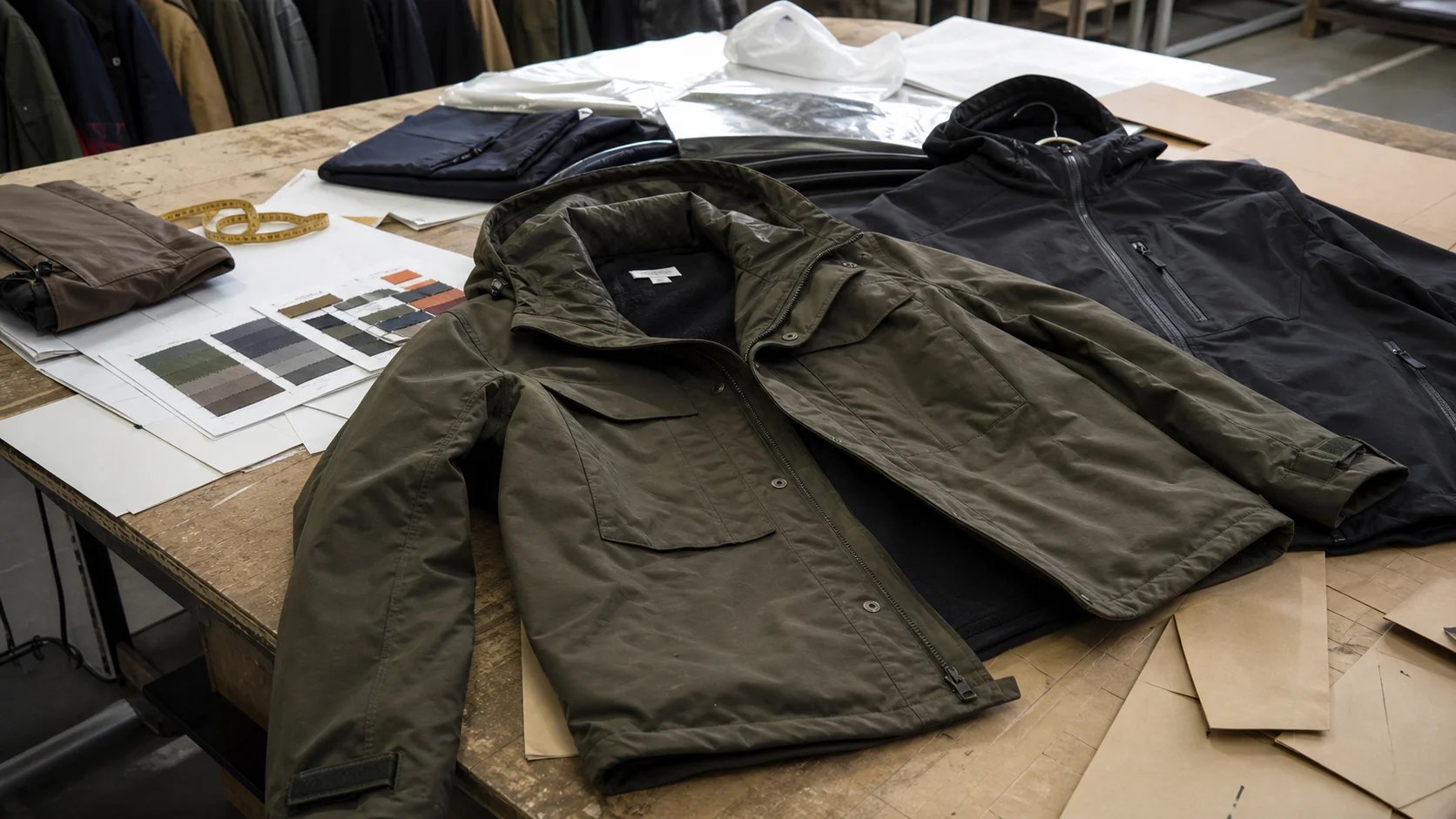
A product-specific outline for buyers comparing custom bomber jacket manufacturers in China, focused on fabrics, trims, decoration, sampling, and production details that affect sourcing decisions.
Custom Bomber Jacket China Manufacturer Options - Fabrikn production reference
When buyers search for a custom bomber jacket manufacturer in China, they are usually balancing four things at once: price, product complexity, consistency, and speed. China remains a strong option because it can still handle all four better than many sourcing markets when the jacket program requires multiple materials, branded trims, technical decoration, or repeatable bulk production.
Bomber jackets are not simple cut-and-sew basics. Even a standard fashion bomber often includes rib collar, cuff and hem components, front zipper installation, lined body construction, sleeve pocket details, welt or flap pockets, topstitching control, and decoration placements that need accurate alignment. Once the design moves into varsity-bomber hybrids, padded winter bombers, satin streetwear styles, or PU and nylon versions, the manufacturing demands increase quickly.
That is where China still has a practical edge. Buyers can often source shell fabrics, rib, zippers, metal snaps, woven labels, hangtags, polyfill, quilting services, embroidery, patches, printing, and packing materials within the same broader supply chain. That reduces handoff risk between vendors. It also shortens development time when compared with fragmented sourcing setups.
This does not mean every supplier is equally capable. The phrase “custom bomber jacket manufacturer China” covers a very wide range of businesses, from small trading-led operations to fully integrated apparel factories. Some are suitable for low-complexity fashion jackets. Others are better for structured outerwear programs with technical testing, repeat orders, and stricter quality expectations. The purchasing decision should start with the jacket spec, not with the lowest quote.
A capable bomber jacket supplier should be able to support more than sewing. Buyers should expect a clear development process, practical comments on construction, and enough sourcing depth to match the intended price level.
At minimum, a manufacturer should be able to review:
For custom bomber jackets, buyers should also look for suppliers that can comment on production risks before sampling starts. That includes zipper waviness on lightweight satin, shade variation on recycled polyester, rib color mismatch, puckering around sleeve pockets, fill migration in quilted styles, and print cracking on coated fabric surfaces. A supplier that only says “no problem” to every request is often harder to manage later.
Many buyers also benefit from working with a broader apparel development partner rather than a sewing-only source. If you are evaluating production support for design, sourcing, and quality coordination, it is useful to review service scope in one place, such as https://fabrikn.com/services/. That helps clarify whether the supplier relationship is built for simple order taking or for actual product execution.
Bomber jackets sit in a wide product range, and construction choices affect cost, MOQ, and factory selection. Buyers who define the product clearly at the start usually get faster and more accurate quotations.
These are often made with nylon twill, polyester satin, taslon, or lightweight cotton blends. Common features include a full zip front, rib trims, two side pockets, and a basic lining. This is usually the easiest category for general apparel factories to handle, provided the zipper installation and rib attachment are controlled well.
These add insulation, thicker lining, and sometimes water-resistant shell fabrics. The complexity rises because bulk handling changes seam behavior, sleeve setting, and final pressing. If the jacket includes quilting or heavy fill, buyers should confirm whether quilting is done in-house or outsourced.
These often mix wool-feel melton, fleece, PU sleeves, chenille patches, snap fronts, striped rib, and contrast details. The main risk here is not sewing alone. It is material coordination. Mixed-material jackets can show obvious problems if color, hand feel, or panel shrinkage are inconsistent.
These styles may use oversized fits, multiple patches, specialty embroidery, custom-dyed rib, branded hardware, or washed finishes. They can look simple in drawings but become sampling-heavy because decoration balance matters. A factory that is good at basic uniforms may not be the right match for this segment.
Purchasing judgment: if the bomber jacket relies on trims and decoration to create perceived value, the best supplier is rarely the one with the cheapest FOB quote. Execution quality on rib, zipper, and decoration usually determines whether the final product looks commercial or looks discounted.
The shell fabric drives both performance and price. Buyers should specify the exact material direction early because suppliers often quote based on assumptions if the tech pack is vague.
Basic polyester taffeta lining is common for entry-level bombers. Higher-grade options may include breathable mesh, anti-static lining, or custom printed lining. For colder styles, polyfill weight often ranges roughly from 80gsm to 200gsm depending on target season and silhouette. Heavier fills need fit adjustments, especially at armholes and cuffs.
Rib is one of the most visible bomber components, and poor rib quality can downgrade the whole jacket. Buyers should clarify whether the rib is stock or custom knitted, and confirm composition, weight, stripe design, recovery, and colorfastness. Stock rib lowers MOQ and speeds development, but exact color matching is harder. Custom rib improves brand alignment, yet usually increases minimums and development time.
Front zipper quality matters more than many buyers expect. Coil zippers can reduce cost, while metal zippers often increase perceived value. The tradeoff is weight, stiffness, and possible scratching during packing. Snaps on varsity bombers should be tested for attachment strength, especially when used on heavy body fabrics.
Decoration choices affect production routing. Large back embroidery can slow output and raise defect risk if the base fabric distorts. Heat transfers may fail on coated or textured surfaces without testing. Buyers should approve strike-offs or decoration swatches before bulk production, not just the garment body.
MOQ for bomber jackets in China varies by fabric source, trim customization, and factory type. For simple stock-fabric bombers, small manufacturers or trading-supported suppliers may accept around 100 to 300 pieces per style. For more established factories, a more typical MOQ may fall between 300 and 800 pieces per style, sometimes split across colors. If the program includes custom-dyed shell fabric, custom rib, branded hardware, or multiple patch types, effective minimums can rise further because material suppliers also set their own order thresholds.
Buyers should separate garment MOQ from material MOQ. A factory may accept a 300-piece order, but the shell mill may require a larger dye lot, or the rib supplier may need higher volume for custom stripe development. That mismatch is one of the most common reasons why quotations change after initial discussions.
For custom bomber jackets, skipping the pre-production sample is risky unless the style is a repeat with no material changes. Rib quality, zipper color, lining match, patch placement, and internal finishing often look different in bulk-ready materials than in early samples.
Sample lead times often range from 7 to 21 days depending on material readiness and decoration complexity. Bulk production may take roughly 30 to 75 days after sample approval and deposit, but the actual timing depends on fabric booking, lab dips, custom trim development, line capacity, inspection scheduling, and shipping season.
Buyers should pay close attention to dependencies that slow bomber programs:
Direct purchasing judgment matters here. If a supplier promises a very short lead time on a heavily customized bomber, the buyer should ask which materials are stock, which trims are custom, and whether decoration capacity is reserved. Fast promises without routing detail are not reliable planning data.
Bomber jackets combine multiple processes, so quality failures often come from the interaction between components rather than from one obvious mistake. A practical QC plan should target the known weak points.
Fabric inspection should check width, shade, defects, and hand feel consistency before cutting. Trim approvals should include zipper shade, rib elasticity, snap finish, and label content accuracy. During sewing, in-line inspection should focus on zipper setting, pocket symmetry, stitch density, and measurements after pressing. Final inspection should review workmanship, decoration placement, packing ratio, and carton marking.
AQL final inspection is still common, but outerwear buyers should not rely on final inspection alone. By the time a lined jacket reaches packed status, repairs are slower and more visible. In-line control is more useful for bombers than end-stage sorting.
Tradeoff to keep in mind: low-cost suppliers can be workable for basic bomber styles, but once the jacket includes mixed materials, custom rib, or several decoration techniques, weak process control becomes expensive very quickly. Repair labor, delayed shipment, and inconsistent appearance can erase the initial price advantage.
Most buyers receive quotes that are hard to compare because each supplier assumes different inputs. The right comparison method is not simply FOB price per piece. It is total execution fit.
That comparison matters because “best” depends on the order profile. A startup with a clean nylon bomber and limited budget may not need a specialized outerwear source. A growing brand selling premium decorated bombers usually does.
Startups often prioritize low MOQ and flexibility. That can work, but there is a cost. Small runs usually limit custom fabric and trim choices, which means the jacket may depend on available stock materials. Buyers in this stage should simplify the design, reduce the number of custom components, and spend more attention on fit and branding details that are actually visible.
Mid-sized brands generally need a better balance. They may be ready for custom rib, branded lining, or more advanced patches, but still need reasonable minimums and communication speed. This is usually where supplier development support becomes more important than a minimal unit price difference.
Larger buyers and established labels often have the leverage to push for custom material programs, testing protocols, and booking capacity ahead of the season. Their focus should be repeatability, documentation, and risk reduction across multiple production cycles.
If you are building a longer-term sourcing structure, supplier background and operating approach matter as much as the product itself. A general overview of company positioning can be helpful during shortlist review, including pages such as https://fabrikn.com/about-us/.
Bomber jacket development runs more smoothly when buyers provide complete information early. The most effective purchase orders are usually supported by a proper tech pack, clear material expectations, and realistic commercial targets.
Buyers who only send reference photos tend to get broad estimates, not reliable costing. A bomber jacket can change price significantly based on shell gsm, lining quality, patch count, zipper grade, and rib customization. A clearer brief usually produces better supplier behavior and fewer quotation revisions.
Communication discipline also helps. Approval comments should be consolidated and written clearly. Material substitutions should be documented. Measurement changes should be version-controlled. A large share of preventable production errors comes from fragmented approval chains rather than from sewing skill alone.
For buyers ready to move from inquiry to active development, a direct discussion is usually more productive than extended back-and-forth on broad estimates. A contact page such as https://fabrikn.com/contact-us/ is the logical next step when you need to discuss a jacket spec, MOQ target, or development timeline.
China remains one of the most practical sourcing bases for custom bomber jackets because the supply chain can support a wide range of fabric, trim, and decoration requirements in one ecosystem. That strength is especially useful for bombers, where product value depends on coordinated execution across many components.
The main buying mistake is treating all suppliers as interchangeable. They are not. Some are built for low-cost simple jackets. Some are better for branded custom development. Others are more suitable for outerwear programs that need tighter process control and repeat consistency.
The best sourcing outcome usually comes from matching the supplier to the actual jacket profile: material complexity, order volume, target market, and tolerance for risk. Buyers who define their BOM clearly, approve samples carefully, and manage inspection points early will usually get stronger results than buyers who focus only on the first quote.
For any business searching for a custom bomber jacket manufacturer in China, the right path is not just finding production capacity. It is finding a supplier setup that can execute the jacket you want at the quality, quantity, and timeline your brand can actually sustain.
Get a free quote from Fabrikn — your trusted B2B clothing manufacturer with 10+ years of experience. MOQ as low as 200 pieces.
Get a Free Quote →Typical MOQ often starts around 100 to 300 pieces for simple stock-based styles, while more common custom programs fall around 300 to 800 pieces per style. Fully customized fabrics, rib, or hardware can push practical minimums higher.
Sampling may take 1 to 3 weeks depending on materials and decoration. Bulk production often takes about 30 to 75 days after approval, though custom fabric development, rib knitting, and peak season congestion can extend timelines.
Nylon twill, polyester satin, taslon, cotton twill, PU, and wool-look fabrics are common choices. The best option depends on target price, appearance, season, and intended end use.
Common issues include rib color mismatch, zipper waviness, puckering at pockets, padding inconsistency, patch misalignment, and surface damage on coated materials. In-line inspection is especially important because repairs are harder after lining and packing.
Yes, especially for buyers who need coordinated sourcing of shell fabric, rib, trims, decoration, and packing. China remains a strong option when the program requires customization, repeatability, and broader supply chain support.
A proper tech pack should include sketches, measurements, fabric and lining specs, rib details, trim list, decoration artwork, quantity breakdown, and target delivery window. Photo references alone usually lead to rough estimates rather than reliable pricing.