
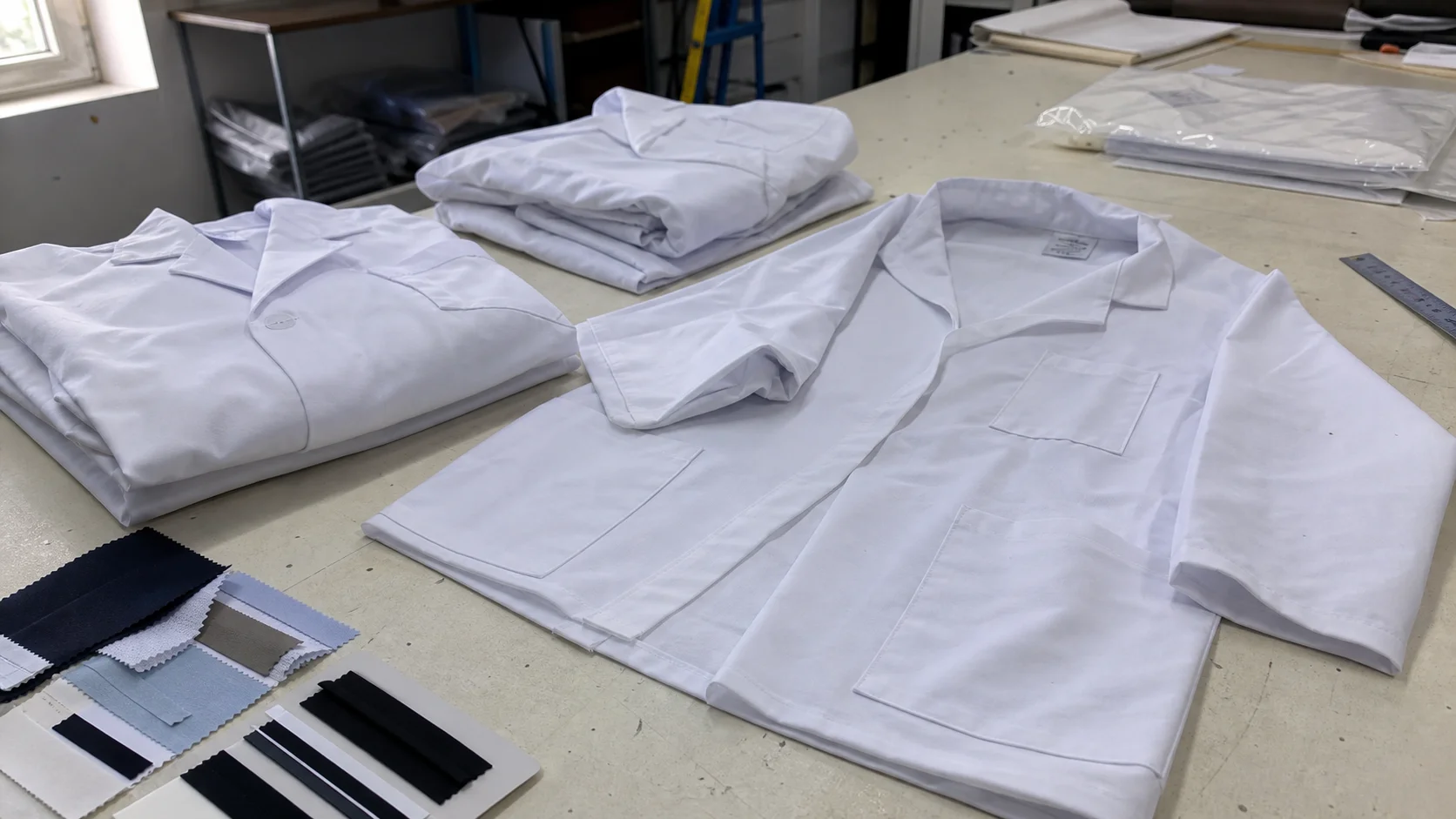
A product-specific outline for restaurant chains sourcing bulk chef coats with documented colorfastness testing, covering fabric specs, wash performance,...
Bulk Chef Coats With Colorfastness Testing Quotes - Fabrikn production reference
Restaurant chains do not buy chef coats the same way a single independent kitchen does. A chain rollout usually involves multiple store locations, repeated wash cycles, stricter brand consistency, and a much higher cost of replacement if the garments fail early. That is why the phrase “bulk chef coats with colorfastness testing quotes” matters in purchasing conversations. Buyers are not only comparing unit prices. They are comparing risk.
In practical sourcing terms, a quote for bulk chef coats with colorfastness testing should show more than garment cost. It should clarify fabric composition, dye or whiteness stability expectations, test methods requested, size ratio assumptions, trim specifications, packaging, labeling, and the timing of sample approvals. If those details are vague, the low quote often becomes the expensive quote later.
For restaurant chains, chef coats need to hold appearance through industrial laundering, frequent hot washing, stain treatment, and daily abrasion from kitchen use. White coats can yellow, black coats can fade, contrast piping can bleed, and embroidered logos can distort the visual standard between locations. A sourcing manager who asks for testing upfront is usually trying to prevent exactly those failures.
There is also a brand control issue. If one batch of chef coats looks bright white and the next batch looks cream-toned, the inconsistency becomes visible across franchise or corporate units. If a dark trim bleeds onto a light body fabric, replacements and dispute costs rise quickly. That is where careful supplier scoping, pre-production testing, and realistic lead-time planning matter more than a headline FOB number.
Buyers comparing suppliers for private label uniforms often review production support beyond the coat itself, including labeling, packaging, size grading, and quality checkpoints. A useful starting point is a supplier’s broader manufacturing scope, such as the capabilities outlined on https://fabrikn.com/services/. That context helps purchasing teams see whether the vendor is set up for structured apparel programs rather than one-off garment runs.
The term can sound straightforward, but it often means different things to different buyers. Some only want a garment quote plus a lab test fee. Others expect a complete development-to-bulk package with testing embedded into approval milestones. The second approach is safer for chain accounts.
A solid quote package for bulk chef coats with colorfastness testing generally covers the following:
Not every restaurant chain needs the same test package. A black poly-cotton chef coat for back-of-house use may need a different emphasis than a white premium cotton-rich executive chef coat for front-facing hospitality kitchens. The buyer’s job is to match testing scope to real operating conditions rather than adding every possible test line item without a reason.
The cheapest quote is often the one with the least defined fabric and testing scope. In uniforms, undefined scope usually shifts cost from pre-production into replacements, claims, and rushed reorders.
Colorfastness is not a decorative issue. For restaurant chains, it affects replacement cycles, visual consistency, and wearer confidence. Kitchen teams work in heat, moisture, and repeated wash environments. If the coat loses color too fast or transfers dye, the result is more than cosmetic.
Common commercial concerns include:
Restaurant chains usually care about colorfastness because they buy at scale and reorder in stages. A coat that looks acceptable after ten washes may still be a bad choice if the chain expects a longer wear life or uses aggressive laundry chemistry. That is why testing should reflect probable end use. Light-duty hospitality laundering and industrial laundry processing are not equivalent conditions.
There is a tradeoff here. Higher colorfastness performance can increase cost, narrow fabric options, or add development time. That does not mean buyers should always choose the highest test threshold available. It means they should choose a threshold that matches operational reality and brand sensitivity. For some chains, a standard poly-cotton twill with stable dye performance is the sensible middle ground. For others, a premium finish and stricter controls are justified because uniform presentation is central to guest experience.
Colorfastness results start with material choices. Buyers sometimes focus on the shell fabric and overlook the fact that trims can create the most visible failures. A chef coat is only as reliable as the weakest component in the garment package.
Many bulk chef coats fall in the range of roughly 180 to 245 GSM, depending on style and market positioning. Lighter weights can improve comfort in hot kitchens but may reduce opacity and long-term structure. Heavier weights can support a more premium hand and better coverage, though they may increase heat retention and freight costs.
From a purchasing standpoint, contrast design details are where many quote comparisons go wrong. A supplier may price an attractive chef coat with dark trim, but if trim colorfastness is not tested against the shell fabric, the aesthetic feature becomes a liability. Simpler styling is not always better, but it is often easier to control across large volume programs.
When developing a private label range, buyers should also review the supplier’s background and production positioning. Basic company information can help teams assess fit before deeper sampling begins, and a reference point such as https://fabrikn.com/about-us/ can support that early qualification process.
Bulk chef coat quotes are usually built from a set of cost drivers rather than a single simple garment formula. Understanding those drivers helps buyers compare offers on equal terms.
Quote Component What It Usually Includes Buyer Caution Fabric Cost Shell fabric by composition, weight, and finish Check if quoted fabric matches required wash performance Trim Cost Buttons, snaps, labels, thread, piping, embroidery Trim substitutions can affect colorfastness and appearance Cut and Sew Labor for pattern, sewing operations, finishing Complex panels and premium details raise cost and defect risk Testing Lab fees for requested colorfastness scope Confirm which tests are included and at what stage Packaging Folding, polybags, size stickers, carton packing Chain rollouts often need store-ready packing details Development Samples, pattern setup, label development Some quotes exclude repeated revisionsBuyers should ask one direct question when comparing quotes: what has been assumed but not written? Missing assumptions drive disputes later. If one supplier includes pre-production testing and another only includes a base fabric quote, the numbers are not comparable.
Another useful purchasing check is whether the supplier distinguishes between in-line testing risk and final garment testing risk. Some issues show up at fabric stage, while others only appear once all trims are assembled and washed together. A strong quote process accounts for both.
Restaurant chain uniform programs usually move more smoothly when approvals follow a disciplined sequence. Rushing directly from tech pack to bulk order is where many preventable failures begin.
For white chef coats, a lab dip stage may be less central than fabric whiteness consistency and wash response. For black, navy, or contrast-trim coats, shade approval becomes more important. Buyers should not skip pre-production samples if trims are likely to interact under washing conditions.
In many cases, one sample round is not enough. Practical sourcing teams often plan for two to three development rounds before bulk approval, especially when private label branding, embroidery placement, or pattern balance needs refinement. That adds time, but it usually reduces bulk risk.
A careful buyer also asks whether testing is performed on fabric only, garment only, or both. Fabric-stage results can look acceptable while the finished coat fails because thread, tape, piping, or fused parts react differently in wash conditions.
MOQ for bulk chef coats varies by supplier setup, fabric sourcing route, and the amount of customization involved. For stock-supported fabrics with limited branding changes, MOQs can start around 300 to 500 pieces per style. For custom-dyed fabrics, wider size ranges, or multiple colorways, it is common to see 800 to 1,500 pieces per style or color as a more workable threshold. Some larger programs go well beyond that if they are spreading inventory across many restaurant units.
Buyers should be cautious when chasing very low MOQ promises on highly customized chef coats. Small runs with custom trims, embroidery, and testing can carry disproportionately high development cost. The unit price then climbs, or the supplier quietly simplifies specs to protect margin.
There is a clear sourcing tradeoff:
For restaurant chains, the best planning model is often not the lowest MOQ. It is a quantity structure that preserves dye lot consistency and testing integrity while still fitting the rollout schedule. If a chain expects a phased launch, it may be smarter to reserve fabric or place one consolidated production booking rather than buy disconnected small lots that risk shade variation.
Lead time for bulk chef coats with colorfastness testing is rarely just a sewing schedule. It depends on development approvals, material readiness, test turnaround, and the amount of customization in the order.
Typical timelines often fall within these broad ranges:
These are planning ranges, not guarantees. Lead time stretches when buyers change artwork late, add trims after sample approval, request custom packaging, or shift size ratios after fabric booking. Test failures also create delays because the supplier may need to resubmit fabric, replace trim components, or repeat pre-production approvals.
This is one area where disciplined communication matters. A supplier cannot protect a delivery date if the technical package is still moving. Buyers who need chain-wide launch certainty should treat approval cutoffs as commercial deadlines, not flexible preferences.
Even when the colorfastness report is acceptable, bulk inspection still matters. Testing verifies defined criteria. It does not guarantee that every production carton matches the approved standard.
Common inspection risks for chef coats include:
Restaurant chains should also think about end-use presentation. A technically passable coat can still be commercially weak if collars roll inconsistently, cuffs twist after washing, or white fabrics show transparency under kitchen lighting. Inspection should not be reduced to counting stitches and checking measurements alone.
From a sourcing perspective, the most expensive defects are not always the most dramatic. Carton assortment errors, mislabeled sizes, or mixed branding can disrupt store-level allocation and create replacement freight costs that exceed the original garment margin.
In the private label apparel category, chef coats are often part of a larger uniform strategy rather than a standalone item. That changes how buyers should evaluate quotes. The coat has to work within the chain’s broader image system, replacement policy, and operational demands.
Private label requirements often include:
The key tradeoff is between customization and repeatability. Extensive custom details can strengthen brand identity, but each extra variable creates another point of failure. A practical sourcing editor’s view is simple: if a design detail will not materially improve recognition, comfort, or function, it may not deserve a place in a high-volume uniform program.
That does not mean private label chef coats should be generic. It means the branding system should be selective and buildable. Good programs usually rely on stable core fabrics, controlled logo execution, and a trim package that can be repeated without constant redevelopment.
When buyers are ready to move from initial inquiry to specification review, a direct communication path helps reduce misunderstanding and quote drift. For project discussions, sample requests, or technical clarifications, teams can route requirements through https://fabrikn.com/contact-us/.
If the goal is to source bulk chef coats with colorfastness testing for restaurant chains, the best buying decisions usually come from controlled simplification. Not every problem is solved by adding more tests, more trims, or more sample rounds. The objective is to define the right garment, test it against real use conditions, and protect repeatability.
Several buying practices tend to produce better outcomes:
There is no universal best fabric for every chain. Poly-cotton blends often win on durability and easier care. Cotton-rich options can improve hand feel and comfort. Premium finishes may support a more polished image. The right choice depends on wash regime, kitchen environment, price ceiling, and brand standard.
The important point is that colorfastness testing should be used as a commercial filter, not just a technical checkbox. It helps buyers see whether a chef coat program is likely to remain stable after launch. For restaurant chains operating across multiple units, that stability is worth far more than a small saving on the initial quote.
A disciplined quote process, realistic MOQ strategy, and careful sample approval flow usually separate dependable private label uniform sourcing from reactive buying. In this category, consistency is the product as much as the garment itself.
Get a free quote from Fabrikn — your trusted B2B clothing manufacturer with 10+ years of experience. MOQ as low as 200 pieces.
Get a Free Quote →It commonly includes colorfastness to washing, rubbing, and perspiration. Some programs also request light fastness or bleach-related performance depending on garment color and laundry conditions. Buyers should confirm whether testing is done on fabric, trims, or finished garments.
For simpler programs using standard fabrics, MOQ often starts around 300 to 500 pieces per style. For custom fabric, multiple colors, or more complex private label requirements, 800 to 1,500 pieces per style or color is a common commercial range.
After final approvals, many standard orders run around 4 to 8 weeks for production, but total lead time depends on fabric readiness, sample revisions, testing turnaround, and packaging requirements. Custom materials or failed pre-production tests can extend that schedule.
Trims are a common failure point. Contrast piping, embroidery thread, labels, and interlinings can react differently from the shell fabric during washing. A coat can pass basic fabric review and still fail commercially once all components are assembled.
Not always. White coats avoid some dye-fade issues, but they bring other risks such as yellowing, transparency, stain visibility, and inconsistent whiteness across batches. Dark coats can face fade and crocking concerns. The easier option depends on use conditions and the fabric package.
They should ask for full fabric and trim specifications, testing scope, sample stages, MOQ, lead-time assumptions, packaging details, labeling requirements, and inspection expectations. A short quote with missing assumptions is rarely enough for a chain program.