
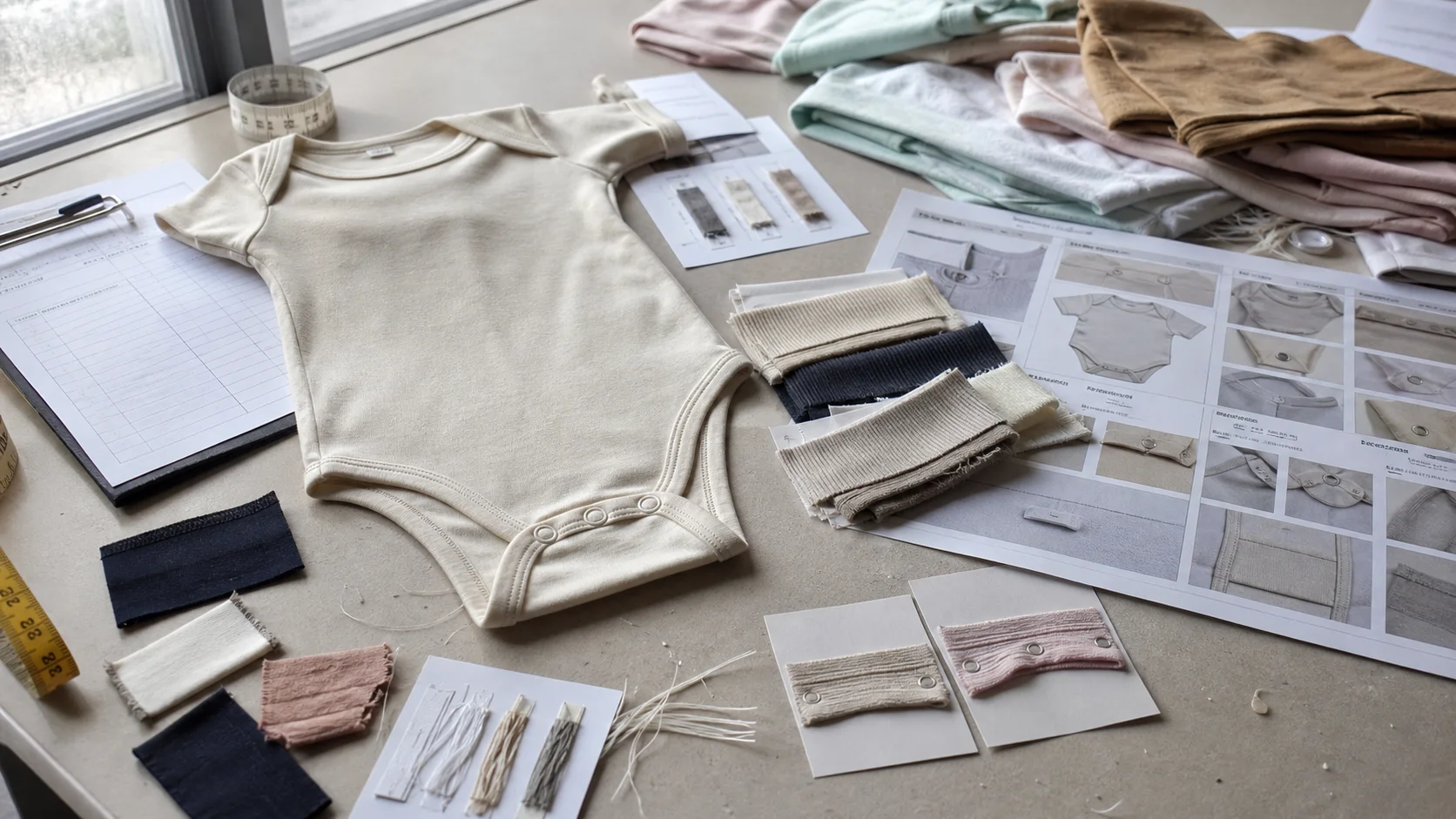
A practical testing roadmap for baby bodysuits, sleepers, and sets, covering fiber safety, shrinkage, colorfastness, seam integrity, and lab handoff...
Babywear Fabric Testing Plan for Private Label Buyers - Fabrikn production reference
Private label babywear has a narrow tolerance for error. Soft hand feel matters, but so does shrinkage control, seam stability, colorfastness, trim safety, and chemical compliance. A fabric that looks acceptable on a swatch can still fail after washing, distort during sewing, or create risk once it reaches infant use. For construction teams, the right testing plan is not a paperwork exercise. It is the practical filter that protects fit, finish, and compliance before production volume starts.
This guide breaks down a babywear fabric testing plan for private label buyers, with the same priorities sourcing teams use when they are deciding whether to move from sampling into bulk. It covers fabric selection, sample approval, typical MOQ ranges, lead-time dependencies, inspection risks, and the tradeoffs that usually appear between comfort, durability, and cost.
If you are building a private label program and need support on development, material sourcing, or production coordination, see Fabrikn services, or use the contact page to start a project discussion. If you want to learn more about the company before sending tech packs, visit About Fabrikn.
Babywear is different from adult apparel in both use and scrutiny. Garments touch skin more directly, are washed more often, and need to stay comfortable after repeated laundering. A slight miss in shrinkage or seam recovery can turn a good fit into a tight neck opening, a twisted sleeve, or a body that no longer hangs correctly. Construction teams cannot solve those issues only at the pattern stage. The fabric itself has to support the design.
Private label buyers also carry more responsibility than a simple brand-on-a-tag arrangement might suggest. The retailer or brand owner is usually expected to decide the standard, approve the pre-production sample, and sign off on the bulk material. If the testing plan is weak, the first sign of trouble often appears in returns, complaint handling, or failed inspection at the end of the cycle. In babywear, late-stage fixes cost more because trims, stitches, and fabric performance are tightly linked.
A good testing plan does not try to make fabric perfect. It tries to expose predictable failure points before production, when changes are still manageable.
A useful testing plan should begin with end use. A bodysuit, sleepwear set, romper, bib, and layette blanket do not share the same risk profile. A stretch rib for a bodysuit needs excellent recovery. A woven sleep sack needs dimensional stability and seam integrity. A brushed knit for a winter layer needs pilling control and low irritation risk. Construction teams should define the garment type before choosing the test list.
The plan should cover five broad areas:
For construction teams, the last category is easy to overlook. A fabric can pass a lab test and still behave poorly on the line. It may curl at the edge, fray too quickly, slip under the presser foot, or show needle damage. That is why garment sampling should be treated as part of testing, not a separate activity.
The best babywear fabric testing plan is staged. Each stage answers a different question, and skipping one usually shifts risk downstream.
The first screen is not a formal test, but it is still critical. Review fiber content, yarn type, construction, GSM, width, finish, stretch percentage, and hand feel against the target garment. Ask for current mill data, not a generic spec sheet from an older run. Construction teams should check whether the fabric is compacted, pre-shrunk, enzymatically treated, brushed, or singed, because those details affect both cost and outcome.
Once yardage is available, send samples to a lab or use supplier-certified data where acceptable. Common tests include wash shrinkage, spirality or skew, color fastness to washing, perspiration, rubbing, saliva resistance where relevant, pilling, tensile strength, bursting strength for knits, and flammability if the product category requires it. For infant wear, buyers often ask for restricted-substance compliance as well, especially if the product touches skin or includes prints, coatings, or specialty finishes.
Lab data alone is not enough. Cut and sew a sample garment using the proposed fabric, trims, and construction method. Wash it under the intended care instructions, then evaluate fit, comfort, recovery, seam appearance, and dimensional change. If the garment is a stretch style, make sure the neckline, leg opening, and closure points remain stable after wash cycles.
The pre-production sample should use the final fabric lot, final trims, final label content, and final construction methods wherever possible. This is the point where many private label programs discover issues such as snap pull-through, elastic edge distortion, print cracking, or collar wave. Approve only after the sample reflects the full production setup. If changes are needed, document them clearly so the factory does not treat them as optional.
Bulk production introduces another layer of risk because fabric lots can vary. Shade variation, width drift, and finish changes are common enough to deserve routine checks. Ask for lot-by-lot control, pre-cut inspection, and clear hold points if the bulk behaves differently from the approved sample. A strong plan includes the right to reject or segregate fabric that falls outside agreed tolerances.
Construction teams should define technical specs early, before the sample chase turns into trial and error. These are the details that tend to cause trouble later if they are left vague.
Trims deserve special attention in babywear. A soft fabric can be undermined by a hard label, a stiff zipper guard, a weak snap, or an elastic that loses recovery after washing. Buyers sometimes focus on the fabric roll and treat trims as secondary. In practice, trim failure is one of the fastest ways to turn a good garment into a complaint.
Babywear private label programs often start with conservative order quantities. Typical fabric and garment MOQs vary by mill, factory, and construction complexity, but it is common to see sample development at low volume, then production MOQs ranging from a few hundred pieces per color to several thousand pieces per style when custom fabric, print, or trim development is involved. The more custom the textile, the less flexible the MOQ usually becomes.
Lead time is equally dependent on what is being tested. If the fabric is stock-supported, the schedule may be driven by sampling and approval. If the buyer needs custom knit development, dyeing, print strike-offs, or specialized trims, the critical path can expand quickly. A practical timeline often includes:
These ranges are only directional. Tight calendars often slip because one dependency was not planned early enough. Color approval can delay bulk yarn or fabric booking. Trim approval can hold sewing. Wash test failures can trigger pattern changes. A good sourcing team protects the schedule by closing approvals in sequence, not in parallel, when the risk is high.
Construction teams usually see the garment before the buyer sees the problem, which makes them the first line of defense. The main inspection risks in babywear are rarely dramatic. They are small defects that become serious at scale.
One useful habit is to test the garment as the consumer will use it. Wash it more than once, inspect it wet and dry, stretch closures, check seam recovery, and review the inside finish. Construction teams should look for skipped stitches, needle holes, seam grin, leg opening distortion, and neck opening stretch-out. Babywear tends to reveal weakness through repeated laundering rather than first-use appearance.
Most babywear buyers want the same three things: softness, safety, and margin. The challenge is that all three can pull against one another. A premium organic cotton may improve brand positioning but increase cost and lengthen sourcing time. A cotton-spandex blend may improve recovery and fit but need tighter wash testing and stronger color control. A cheaper fabric may hit target cost but create quality issues that cost more later.
The best purchasing judgment is usually conservative. When the design is close to the body, when the garment will be washed frequently, or when the buyer is launching a new supplier relationship, it is safer to over-test than to cut corners. The extra time spent on lab dips, trim approval, and wash validation is usually cheaper than an avoided return cycle.
There is also a difference between acceptable and scalable. A sample may pass because the factory hand-finished it carefully. Bulk may behave differently because operators, machine settings, and fabric lots are not identical. Private label buyers should assume that any uncontrolled variable will move against the schedule if it can. That assumption leads to better approval discipline and fewer surprises.
In babywear, the right question is not whether a fabric feels good in the hand. It is whether it still feels good, fits well, and holds compliance after the first buyer wash and the third consumer wash.
Approval should be written and sequential. First confirm the fabric spec. Then approve lab dips or strike-offs. Next review the sewn sample. After that, sign off on the pre-production sample and retain a reference sample on both buyer and factory sides. If any material change occurs, such as a mill substitution, new dye batch, trim swap, or construction adjustment, treat it as a new approval point.
The most practical approval records usually include fabric composition, GSM, width, finish, approved shade standard, trim codes, wash instructions, test reports, and dated sample comments. A clean approval trail helps when production teams, quality teams, and buyers need to compare what was promised with what was delivered.
For private label programs that are still building supplier systems, a sourcing partner can help keep the plan realistic. That is especially useful when the garment line spans multiple age groups, uses several fabric types, or combines print, embroidery, and closures in one style. For production support and category guidance, review Fabrikn services or reach out through the contact page.
Get a free quote from Fabrikn — your trusted B2B clothing manufacturer with 10+ years of experience. MOQ as low as 200 pieces.
Get a Free Quote →The most important tests are shrinkage, colorfastness, pilling, seam strength, and any compliance checks tied to the fabric or trim. For knit babywear, recovery after wash deserves close attention because it affects fit and appearance.
At minimum, buyers usually want one or more pre-production wash tests on the sample garment and a review of bulk wash performance where risk is high. Styles with stretch, prints, or close-to-skin trims often need extra rounds if the first result is borderline.
MOQs vary widely by supplier, but low-volume sampling can start small while production often rises into the few-hundred to few-thousand-piece range per style or color. Custom fabric, special trims, or printed designs usually push the MOQ higher.
Lab testing measures controlled samples. Production adds sewing tension, machine variation, different fabric lots, and finishing differences. A material can pass in the lab and still distort, curl, or sew poorly when it reaches the line.
Both. Fabric should be screened first, then the sewn sample should be tested, because garment construction changes how the fabric behaves. Pre-production approval should reflect the final fabric, trims, and sewing method before bulk starts.
Buyers can review the services page for development support, use the contact page to start a project, or read more about the company on the About page.
For private label babywear, the safest fabric testing plan is the one that is specific, documented, and tied to construction reality. The earlier a buyer defines the fabric standard, the easier it is to protect quality, control cost, and keep the production calendar from slipping.