
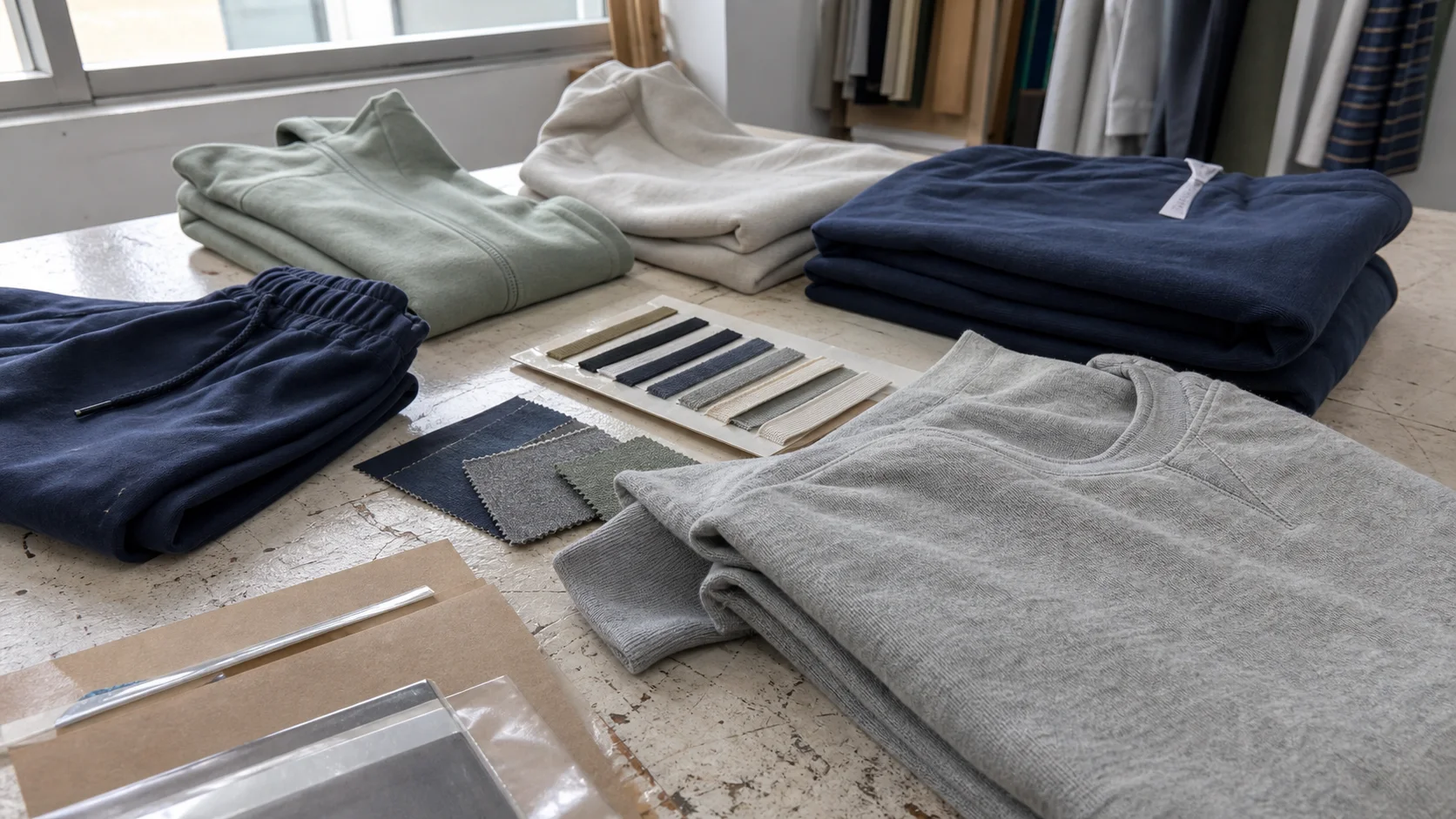
A practical SEO outline for school merchandise buyers planning tracksuit orders with the right MOQ, size range, decoration, and replenishment strategy.
Best MOQ Strategy for School Tracksuit Buyers - Fabrikn production reference
Buying school tracksuits is not just a color-and-size exercise. MOQ, or minimum order quantity, shapes the whole commercial outcome: price, material choice, lead time, sample cost, and how much risk the buyer carries if the program underperforms. For schools, clubs, and merchandise buyers, the best MOQ strategy is usually not the lowest possible quantity. It is the quantity that protects margin, keeps production realistic, and leaves enough room for reorders without overcommitting to stock. In practice, a stock-fabric program can sometimes move in 18-22 business days after approved samples, while a custom-dyed or heavily decorated run often needs 30-45 business days.
In activewear and teamwear sourcing, the right MOQ depends on fabric availability, construction complexity, decoration method, and whether the order is being produced from stock materials or custom-dyed components. A school tracksuit can look simple on paper, yet it often includes more variables than expected: brushed fleece or polyester tricot, rib trims, YKK or equivalent nylon coil zippers, elastic waistbands, embroidery, woven labels, care labels, size stickers, and branded packaging. Each added detail can push a factory toward a higher MOQ or a longer lead time.
The buyer’s job is to match the order structure to actual demand. A school with stable enrollment and a uniform policy can usually support a more efficient run. A buyer handling merchandise for multiple schools, a district-wide program, or a seasonal event line may need a more flexible plan. The right MOQ strategy reduces dead inventory without forcing the supplier into uneconomical small batches that raise unit cost and quality risk. For company background or service scope, see about us, services, and contact us.
For suppliers and sourcing teams that handle schoolwear and teamwear programs, a practical benchmark is to treat MOQ as a tool for controlling risk rather than a fixed hurdle. That mindset usually leads to better negotiation and cleaner production outcomes, especially when the order is tied to a single intake window or term start date.
MOQ affects more than just the order entry form. It influences how fabric is booked, how trims are purchased, how cutting is planned, and how much line time the factory can justify. School tracksuits often sit in a price-sensitive segment, so small inefficiencies show up quickly. If the MOQ is too low, the factory may compensate with higher unit pricing, restricted fabric choices, or less favorable delivery terms. If the MOQ is too high, the buyer carries too much stock and may be stuck with old colors, incorrect size curves, or leftover logoed goods at the end of the season. A common example is the difference between a 150-set run on stock fabric and a 500-set run on the same style: the lower order may look easier to approve, but the higher one usually buys better fabric consistency and less setup loss per unit.
Schools also face a special risk profile. Sizes are spread across children and teens, repeat orders may be uncertain, and demand can change with policy updates, enrollment, or weather. Merchandise buyers have a different problem: they may need a mix of sizes and a branded presentation, but still want the flexibility to test demand before scaling. MOQ strategy has to reflect that uncertainty. It is common to split the range into size ratios such as 2:2:3:2:1 across youth sizes or to hold back 5-10 percent of volume for late size top-ups.
There is also a quality angle. Very low MOQs can trigger mixed production methods, more manual handling, and more opportunities for inconsistency in shade, stitching, or decoration placement. That does not mean low MOQ is always poor. It means the buyer should know the tradeoff. A small order can be the right decision for a pilot collection, but it needs tighter control on fit approval, color tolerance, and inspection checkpoints such as measurement verification, logo placement, and zipper operation.
Actual MOQ varies by factory, material, and customization level, but the following ranges are common in school tracksuit sourcing. They are not universal rules; they are practical reference points buyers use to structure requests. Buyers often see price bands such as $2.50-4.00 per unit at 500 MOQ for a simple stock-fabric program, before embellishment and freight.
Tracksuit Type Typical MOQ Range What Drives It Stock fabric, basic logo print 100 to 300 sets per color Available fabric, limited customization, faster sampling, usually 18-22 business days after approval Custom color, standard knit or tricot 300 to 500 sets per color Mill dyeing, trim sourcing, shade matching, and booking enough fabric for consistent lot shade Brushed fleece or technical polyester blend 300 to 800 sets per style Fabric weight, finishing, shrinkage control, and higher cutting waste management on 260-320 gsm materials Fully custom design with embroidery and special trims 500 to 1,000 sets per style Pattern development, embroidery setup, labeling, packaging, and repeatable trim supply such as zippers, drawcords, and ribSome suppliers quote lower MOQs to win the order, then recover cost through higher sampling charges, higher unit price, or strict payment terms. A buyer should compare the full landed cost, not only the headline MOQ. A 150-set order can make sense if it is a deliberate test. It is a weaker choice if the school already knows it will need 600 sets over the season and can consolidate demand in one production run. Ask for the quote to separate garment cost, decoration cost, packing cost, and freight so the comparison is real.
Size range also matters. An order of 300 sets with six size options is usually more manageable than 300 sets with twelve size combinations and frequent short-run reorders. The more fragmented the size curve, the less efficient the cutting and packing. That tends to push factories toward higher MOQs or less attractive pricing. A standard youth curve with 5-6 sizes usually cuts more efficiently than a mixed youth-plus-adult program with many one-off sizes.
The best MOQ strategy for school tracksuit buyers is usually a tiered one. Instead of asking for one perfect minimum across every style, separate the order into core items and variable items. Keep the base garment simple and repeatable, then use decoration, labeling, or packaging to create the school-specific identity. This lets the buyer hold the garment MOQ down while still delivering a branded product. In practice, that means standardizing the shell fabric, the zipper type, and the core fit before customizing the chest logo or back print.
A standard tracksuit jacket and pant set with a familiar fit, one fabric weight, and one main color is easier to source than a fully customized silhouette. The more pattern variations you introduce, the more likely the factory will treat the order as a development project rather than a production run. That usually pushes MOQ up. A simple set built on a 240-260 gsm polyester tricot or a 280-300 gsm brushed fleece base is easier to repeat than a mixed-fabric panel construction.
Every additional colorway can mean another fabric booking, another dye lot, and another risk of shade variation. For school merchandise buyers, it is often smarter to choose one core color combination and use small branding differences for differentiation. If the school insists on multiple house colors, try to concentrate volume into the dominant color and keep secondary colors to a smaller test order. Even a 10-15 percent secondary-color split can create enough fabric fragmentation to slow cutting and raise cost.
If the supplier can produce a blank tracksuit in a workable MOQ, the logo application may be handled later through embroidery, heat transfer, or print. That can help when demand is uncertain. The drawback is that decoration adds another step and another inspection point. Buyers should confirm whether the base MOQ and decoration MOQ are separate or combined. For example, a blank base might be available at 200 sets, while embroidered branding may require 300 pieces to justify machine setup on a multi-head embroidery line.
A pilot order is often the best answer when the buyer is unsure of sell-through or when the school is changing suppliers. A first run of 100 to 200 sets can validate fit, shrinkage, and decoration quality. If the pilot performs, the buyer can scale with a repeat order using the same fabric and trims. The tradeoff is that pilot runs usually cost more per unit, so they should be treated as risk reduction, not as the final economic model. A pilot should still include a full measurement sheet, a wash test, and a logo placement approval.
School programs often fail when the first order is produced well but the reorder cannot match the original fabric shade or trim. Buyers should ask whether the supplier can hold greige fabric, bulk yarn, or repeatable trims. This matters especially for orders that may be replenished midyear. If continuity is uncertain, it is better to increase the opening MOQ slightly than to save a small amount on the first order and lose continuity later. Ask whether the supplier keeps the same rib quality, zipper model, and thread specification across repeat orders.
District buyers and merchandise distributors can sometimes aggregate demand across multiple schools, clubs, or intake periods. This is one of the most effective ways to improve MOQ efficiency. Larger consolidated orders usually unlock better fabric pricing and cleaner production scheduling. The downside is more internal coordination. Buyers must confirm size curves, artwork approvals, and delivery windows before combining demand. A combined PO of 500-1,000 sets often moves more efficiently than several 100-set purchase orders placed separately.
MOQ strategy only works when the spec is clear. A vague brief invites revisions, and revisions almost always raise cost. School tracksuits should be specified with enough detail that the supplier can quote accurately and the buyer can compare offers on a like-for-like basis. The most useful brief usually includes fabric composition, weight, knit structure, zipper type, thread type, label construction, decoration method, and packaging method.
Core fabric choices are usually 100% polyester tricot for lighter programs, or brushed fleece for colder weather and heavier handfeel. Common knit weights are 220-260 gsm for tricot and 280-320 gsm for brushed fleece. Buyers should also specify whether the inside is brushed, unbrushed, or mesh-backed, because that changes both the price and the comfort profile. If stretch is needed, ask for a polyester-spandex blend and confirm the recovery requirement rather than assuming the handfeel will be consistent.
Trim details matter just as much. Zippers are often #5 nylon coil with auto-lock pullers on the jacket, while pants may use a covered elastic waistband with an internal drawcord. Cuffs and waistband ribs are commonly 2x2 rib or self-fabric, depending on the target price and fit. Thread is usually polyester core-spun or 100% polyester thread matched to the shell color. Buyers should specify whether labels are woven, heat-transfer, or printed satin, and whether care labels need country-of-origin text, fiber content, and wash symbols.
Decoration should be defined early because it changes both price and minimums. A small left-chest embroidery may use 6,000-10,000 stitches, while a heat transfer logo requires an artwork file, a placement spec, and an approval on opacity and wash resistance. If the buyer needs printed numbers, names, or school crests, the supplier should confirm whether the process is screen print, sublimation, digital transfer, or embroidery. Each method has different setup cost, wash performance, and MOQ behavior.
Useful sourcing detail: ask for a bill of materials, a measurement chart with tolerances such as +/-1 cm at body width and inseam, and third-party test reports for colorfastness to washing, rubbing, and perspiration if the program requires them. If your procurement rules call for certifications, request current supporting documents such as OEKO-TEX, ISO 9001, BSCI, or WRAP reports as buyer requirements rather than assuming they apply.
Sampling is where many MOQ decisions become real. A buyer should expect at least one fit sample, one color or lab-dip approval if the fabric is custom dyed, and one pre-production sample or gold seal sample before bulk cutting begins. For school tracksuits, the sample stage is not just about appearance. It should confirm fit, shrinkage, zipper operation, logo placement, and trim compatibility.
A solid sample package usually includes a tech pack, artwork files in vector format, a size spec, and a sample comment sheet. Buyers should compare the sample against the measurement chart with a soft tape and record actual values, not just subjective fit comments. Common checkpoints include chest width, sleeve length, body length, waistband stretch, inseam, and cuff opening. If the tracksuit uses embroidery, the buyer should also approve stitch density, thread color, and patch backing before bulk production.
Pre-production checks should be documented before cutting starts. Typical checkpoints include fabric roll inspection, shade banding confirmation, trim matching, zipper cycling, measurement verification, and a panel-to-panel seam review. If the supplier uses automatic cutting, ask whether the sample approval was built into the same marker ratio planned for bulk. If the supplier cuts manually for the sample and automatically for bulk, confirm that the garment balance will not shift.
Buyers should also request a wash and wear check on the sample. A common practice is one wash cycle at the care-label temperature, followed by a re-measurement for shrinkage and twist. For schoolwear, a shrinkage target below 3 percent is typical for the body fabric, but the buyer should set the actual tolerance in the spec sheet. If the order includes rib cuffs or printed graphics, check for distortion, cracking, or curling after washing.
Lead time is usually driven by the slowest step in the chain, not the sewing floor alone. For school tracksuits, the biggest dependencies are fabric booking, dyeing or knit confirmation, label and trim sourcing, sample signoff, and production slot availability. A stock-fabric order with approved artwork may ship in 18-22 business days. A custom color or custom-trim order commonly extends into 30-45 business days, especially when lab dips, strike-offs, or embroidery approvals are still pending.
Fabric choice is the first lead-time lever. Stock polyester tricot or fleece moves faster because the supplier can allocate existing rolls. Custom-dyed fabric adds time for color development, lab dip approval, bulk dyeing, and shade confirmation. A lab dip cycle often adds 5-7 business days, and a trim delay on zippers or woven labels can add another 3-10 days depending on whether the item is standard or sourced to order.
Approval timing matters as much as production time. If the buyer takes a week to approve the fit sample, the whole order shifts a week. If artwork revisions are still open, the embroidery or print schedule cannot start. Buyers should assume the lead-time clock begins after the supplier has written approval for the sample, size breakdown, artwork, and packing instructions. That point is often more important than the PO date.
Seasonality also changes the answer. Back-to-school programs, winter uniform launches, and year-end merchandise drops can all tighten capacity. Factories may have enough machine time to sew the order but not enough room in cutting, washing, packing, or freight booking. Buyers should leave buffer for peak-season congestion and, where possible, book repeat styles early so they can hold the same fabric shade and trim specification.
Inspection risk changes with order size. Low MOQs often involve more manual handling and less process repetition, which can raise the chance of variation in stitching, measurement, or logo placement. Mid MOQs can be more efficient, but they introduce risk if multiple cutting bundles or color lots are mixed and not tracked carefully. The right inspection plan depends on how the factory is building the order, not just how many sets are on the PO.
For school tracksuits, common inspection checkpoints include incoming fabric roll inspection, cut panel measurement checks, seam quality checks, zipper function, embroidery or print placement, thread cleanup, final size ratio verification, and packing count. A buyer may use AQL 2.5 for major defects and 4.0 for minor defects as a common reference point, but the final acceptance standard should be written into the purchase documents. If the tracksuit has a chest logo, insist on a measured placement point rather than a visual estimate.
Low MOQ orders sometimes suffer from inconsistency in shade or trim matching because fewer pieces are available to absorb waste or replace rejects. Mid MOQ orders can suffer from line drift if the factory switches operators or runs the garment in two different production windows. The buyer should ask for in-line QC rather than only final inspection. In-line checks catch problems like skipped stitches, uneven collar shape, or zipper skew before the full run is complete.
For decorated garments, ask for a sample of the first production dozen and verify logo position, thread tension, and print cure. If the tracksuit includes heat transfer, check adhesion at the edges. If it includes embroidery, check backing trim and puckering. If it includes print, verify wash resistance and that the print does not sit too close to seams or zipper tape. These are the issues that usually become expensive after shipment.
Negotiating MOQ works best when the buyer is specific about what is being reduced. Asking for a lower MOQ on everything usually produces weak results. Asking for a lower MOQ on the base garment, while keeping the trim, decoration, and packaging simple, is more practical. The supplier can then keep setup costs under control without sacrificing the production logic of the order.
One effective method is to request tiered pricing at 100, 300, and 500 sets, then compare the marginal drop at each level. If the price at 500 sets is significantly better than the price at 300, the buyer can weigh the value of adding volume against the inventory risk. This is a clearer negotiation than asking for the supplier’s absolute floor. Buyers should also ask whether the quote assumes one artwork location, one colorway, and one shipping carton spec, because each variation can alter the price.
Another practical lever is to reduce decoration complexity. Replacing multi-color embroidery with a single-color logo, or moving from embroidered initials to heat transfer, can reduce setup cost and allow a lower MOQ. Standardizing the zipper puller, drawcord, and label set has the same effect. These are small changes, but they matter because they cut the number of special purchases the supplier must place.
Do not negotiate away the controls that protect quality. If the supplier agrees to a lower MOQ, keep the measurement tolerances, inspection checkpoints, and sample approvals intact. A cheaper order that arrives with poor fit or unstable shade is not a better order. If the supplier wants a lower MOQ to test the account, the buyer can offer a repeat-order discussion or a forecasted second batch instead of relaxing the spec.
Different buying models work for different demand patterns. A single-school uniform program is usually the easiest case because the fit, artwork, and size ratios are stable. In that model, a 300-500 set opening run with a clear reorder plan is often more efficient than trying to chase the lowest possible first-order MOQ. The buyer can hold one approved fabric, one trim set, and one packing format across the year.
District programs usually work best with a consolidated size matrix and limited color variation. A single base garment in two or three approved colors, packed by school or by size ratio, can reduce the number of style lines while still giving each school an identity. The useful sourcing detail here is to keep artwork changes shallow: if the shell is the same, only the crest, name label, or packaging may need to change from school to school.
Merchandise programs are more volatile, so the best model is often a controlled test run followed by a replenishment plan. A 100-200 set pilot can validate demand. If it sells through, the buyer can reorder on the same block, fabric, and trim spec. This model works better when the supplier can promise fabric continuity or reserve greige goods for repeat orders. Otherwise, the second batch can drift in shade or handfeel.
For all three models, the buyer should decide early whether fulfillment will be by bulk carton, pre-packed individual sets, or school-separated bundles. Packing method affects labor, carton count, and final QC time. A pre-packed program usually adds a small cost but can save downstream handling if the school is distributing directly to students.
Before committing, ask the supplier for the exact spec basis of the quote. That includes fabric composition, GSM, knit type, trim list, zipper brand or equivalent, decoration method, packaging spec, measurement tolerances, and the assumed size curve. If the quote does not state those items, it is not yet comparable. A good source package should also identify whether the price is for ex-factory, FOB, or another delivery term.
Ask what machinery will be used for the critical operations. For school tracksuits, that usually means automatic fabric cutting, 4-thread or 5-thread overlock, coverstitch, bartack, and multi-head embroidery if logos are stitched. The relevant sourcing detail is not the machine name by itself, but whether the supplier uses the same process for samples and bulk. A sample made on one setup and bulk made on another can create fit or finish differences.
Request the supplier’s quality checkpoints in writing. A useful answer includes incoming fabric inspection, inline seam control, measurement audit, zipper function check, decoration check, and final packing verification. Ask whether the supplier records defect photos and whether they can hold a golden sample for repeat reference. For programs with compliance requirements, request current third-party reports or audit documents as buyer requirements only; do not assume any certification is current unless the latest paperwork confirms it.
Also ask about reorder continuity, fabric reservation, and spare trim stock. If the program is likely to repeat, the supplier should be able to explain how they will keep the same shade, same rib, and same zipper model on the next batch. That is often more useful than a low introductory price. A supplier that can give a clear lead time, a consistent BOM, and a documented approval flow is usually the better long-term choice.
Get a free quote from Fabrikn — your trusted B2B clothing manufacturer with 10+ years of experience. MOQ as low as 200 pieces.
Get a Free Quote →What is a practical MOQ for school tracksuits?A common starting point is 100-300 sets per color for stock fabric with simple print, and 300-500 sets per color for custom color or standard tricot. Fully custom embroidered styles often need 500-1,000 sets per style to hold the cost structure together.
What should be locked before bulk production starts?Buyers should lock the fabric composition and GSM, zipper type, rib specification, logo method, size chart, and packing method. Typical pre-production approval also includes a fit sample, artwork signoff, and, when relevant, a lab dip or strike-off.
How long does a school tracksuit order usually take?Stock-fabric orders can often move in 18-22 business days after sample approval. Custom-dyed or more complex orders commonly take 30-45 business days, depending on fabric booking, trim sourcing, and approval timing.
What inspection checks matter most?Measurement tolerance, seam quality, zipper function, logo placement, and color consistency matter most. A buyer should also confirm fabric roll inspection, final packing count, and any wash-test results required by the program.
Can certification documents be requested?Yes. If your procurement policy requires them, ask the supplier for current supporting documents such as OEKO-TEX, ISO 9001, BSCI, or WRAP reports. Those should be treated as buyer-requested documents unless the source content already states otherwise.