
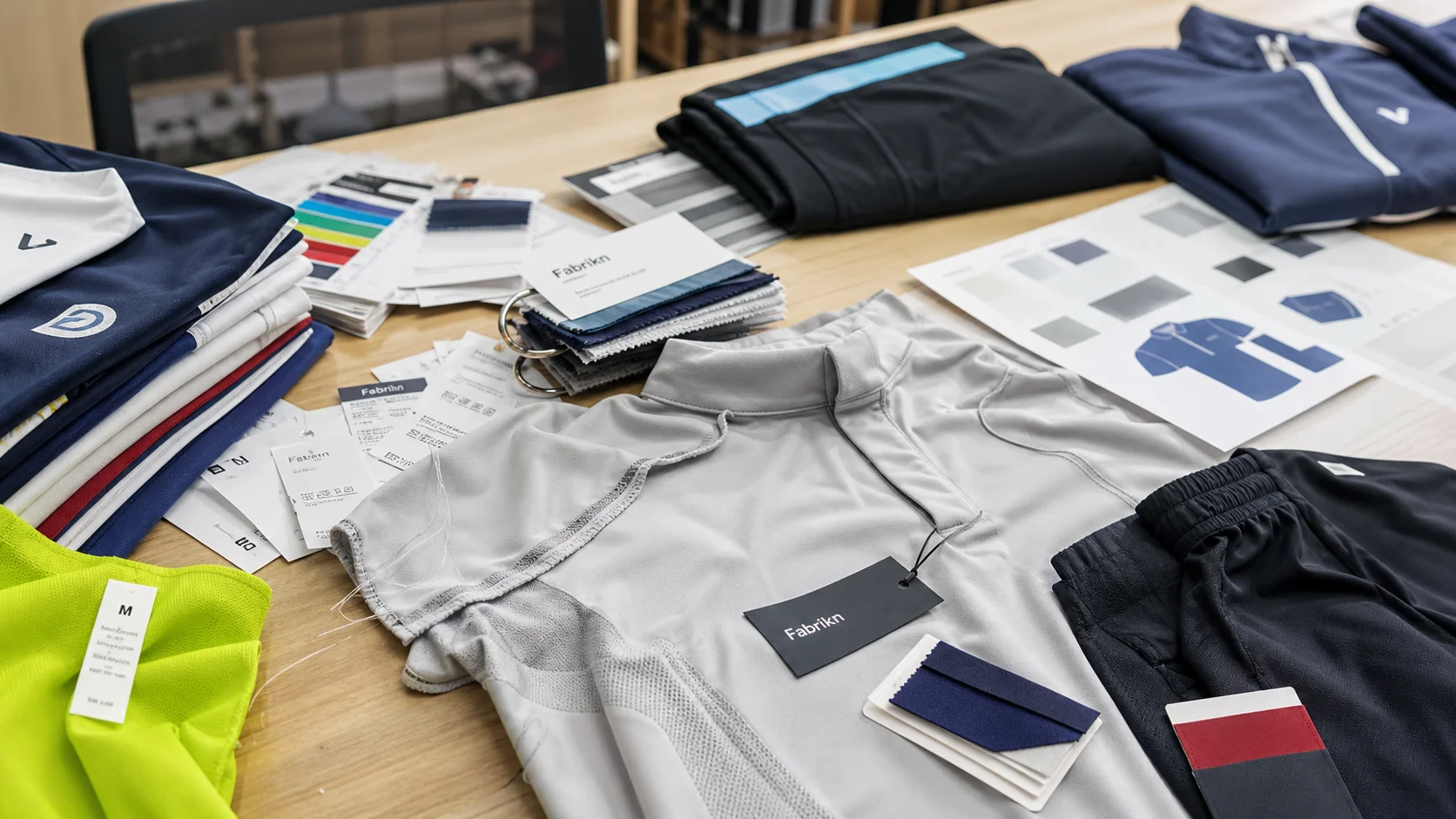
A focused outline for building school sportswear catalog content around OEM tracksuit trims, covering rib, piping, zips, labels, color matching, compliance, and approval workflows.
OEM Tracksuit Trim Sourcing for School Catalogs - Fabrikn production reference
OEM tracksuit trim sourcing for school sportswear catalogs is a specification problem before it is a buying problem. The jacket and pant silhouette may look simple, but trims decide whether the program feels durable, consistent, and easy to reorder. School catalog business punishes inconsistency. A zipper that runs stiff in one batch, a rib that loses recovery, or a label set that changes shade can create complaints across a whole seasonal program.
For private label apparel, the goal is not just to buy trims that look acceptable on a sample. The goal is to lock down repeatable components that can survive wash cycles, student wear, and multi-size grading. That means tightening the spec on zipper type, elastic quality, drawcord construction, labels, tape, thread, and packaging. It also means understanding where the supplier is sourcing sub-components, because a clean garment sample can still turn into uneven production if the trim supply chain is loose.
For brands building school catalogs, the trim package should support three things: durability, fast repeat ordering, and manageable cost. A lower price that depends on weak elastic or unstable color matching usually becomes expensive after the first complaint cycle. Procurement teams need to treat trim as part of performance, not decoration.
School tracksuits face a narrower and more demanding use case than many casual sportswear programs. They are expected to look neat, feel comfortable, hold up to repeated laundering, and stay consistent across sizes and reorder windows. Trims carry a lot of that burden. A tracksuit body fabric might be serviceable, yet the garment still fails if the cuffs bag out, the zipper breaks, or the waistband twists.
Trim sourcing also affects brand presentation in a school catalog. Private label schoolwear is usually evaluated visually first, then practically. Buyers and merchandisers want easy-to-read product options, clear color continuity, and a consistent handfeel across coordinated pieces. That consistency is easier to achieve when trims are controlled by documented specs rather than left to the factory’s default stock options.
The purchasing judgment is straightforward: on school catalog programs, trim savings only matter if they do not create hidden defect risk. This is not the place to chase the cheapest zipper or the lightest elastic unless the program is very low intensity and the seller accepts higher replacement risk. A modest upgrade in trim quality is often cheaper than handling returns, replacements, and lost trust.
Catalog programs are different from one-off custom orders. Buyers typically want a stable product window, predictable colorways, a controlled size range, and enough stock continuity to cover school-term demand. That means trim decisions should be made with repeatability in mind. A nice-looking sample is not enough if the trim is hard to replenish later.
Common needs in school catalog sourcing include:
Many buyers also prefer trims that are broadly available, not proprietary to a single mill or subcontractor. That makes reorders less fragile. If a tracksuit uses an unusual zipper pull, custom narrow tape, or special reflective detail, the program may look sharper, but the replenishment risk rises. Catalog teams should only accept that tradeoff when the design value is obvious and the volume justifies it.
Trackwear trims are usually simple on paper and problematic in execution. The spec needs to cover each component clearly enough that the factory cannot substitute by assumption.
For school tracksuits, the front zipper is one of the highest-risk components. Common options are nylon coil zippers, plastic molded zippers, and occasionally metal zippers for heavier styles. Nylon coil is often the practical choice for comfort and flexibility. It tends to run smoother on lighter sportswear and reduces the chance of sharp edges. Molded zippers can feel sturdier, though they may be heavier and less flexible. Metal zippers usually make less sense unless the design is intentionally more fashion-led than athletic.
Buyers should specify zipper length, tape color, puller style, slider finish, and whether the zipper is auto-lock or non-lock. If the tracksuit has a stand collar, the zipper top stop and garage details should be confirmed early. A poor zipper garage can create neck irritation, which becomes a real complaint point in schoolwear.
Rib trims on cuffs, hems, and collars deserve more attention than they often get. Rib content, weight, and recovery determine how the garment sits after wash and wear. Common constructions include polyester/cotton rib, polyester/spandex rib, or all-synthetic rib with stable recovery. For school use, the key question is whether the rib keeps its shape after repeated laundering.
Rib color should be tested against the shell fabric under daylight and store lighting. Small shade differences are visible on catalog photography and in real-world classroom wear. If the body fabric is dark, the rib should be checked for pilling, twist, and shrinkage behavior before bulk approval.
Elastic is not a generic commodity once the garment has to perform under student wear. Waistbands and cuffs need the right balance of stretch and recovery. Too soft, and the garment loses shape. Too firm, and comfort drops. School buyers usually benefit from a medium-compression elastic with stable recovery and clear wash performance data.
Ask for elastic width, elongation range, snap-back expectation, and whether the elastic is woven, knitted, or braided. Woven elastic often offers better stability in waist applications, while knitted elastic may feel softer. The right choice depends on garment weight and target price. For school catalogs, stability should usually outrank novelty.
Drawcords are common in pants and occasionally in hoodie-style tops. They seem minor until they fail inspection. Cord diameter, material, tip finish, and knot retention should all be specified. If aglets are used, they should be secure and smooth. Loose or sharp tips create avoidable safety and presentation issues.
Some school buyers prefer internal drawcords or omit them in younger size ranges for safety and compliance reasons. That decision should be made early because it affects patterning and seam construction. Late changes to cord placement often create fit and production delays.
Private label schoolwear depends on label execution. Main labels, size labels, care labels, and swing tags must be planned together. Woven labels usually offer a more professional look, while printed neck labels can reduce irritation and simplify compliance text. Heat transfer branding may work for select styles, but it needs proper wash testing.
Brand marks on trims should remain controlled. Too many logo placements can raise cost and reduce flexibility in reorders. A clean, restrained label package often works best for school catalogs, where trust and legibility matter more than heavy branding.
Side tape and contrast piping can help a tracksuit stand out in a catalog, but they also create color-matching and seam-alignment risk. If the design relies on tape, the supplier should confirm width tolerance, color standard, and attachment method. Heat-sealed tape, sewn tape, and applied piping each carry different cost and durability profiles.
Catalog teams should be careful with highly detailed trim layouts. The more decorative the trim package, the more likely it is that production will drift from sample to bulk. School sportswear usually benefits from controlled, repeatable trim placement rather than fashionable complexity.
The right trim material is usually the one that creates the fewest surprises in bulk. That sounds basic, but it is the part many programs miss.
Polyester-based trims are common in school sportswear because they support color stability, cost control, and durable wear. Cotton-rich trims may feel softer, but they can absorb more moisture and show more wash variation if not engineered carefully. Spandex content helps recovery, though too much stretch can make the trim unstable or sensitive to heat during production.
For zippers, smoother running matters more than visual novelty. A standard tested coil zipper from a reliable source is often a better buy than an unusual decorative option. For labels, woven construction usually lasts longer than printed alternatives, but the best choice depends on where the label sits and how the garment is washed.
Buying judgment should remain practical: use upgraded trims where failure would damage the program, and keep the rest straightforward. A stronger zipper and better elastic are often worth paying for. Highly customized sliders, flashy cords, or decorative metallic trim can be harder to reorder and easier to reject.
MOQ for trims depends on whether the supplier is using stock components or making custom items. For school catalog programs, typical ranges can be low for standard labels and high for custom zippers or dyed trims.
Trim Item Typical MOQ Range Lead Time Risk Buying Note Stock woven labels 1,000 to 5,000 pcs Low Best for repeat catalog styles Custom printed care labels 1,000 to 3,000 pcs Low to medium Confirm wash durability Standard coil zippers 500 to 3,000 pcs Medium Color and slider consistency matter Custom-dyed rib 300 to 1,000 kg equivalent Medium to high Shade matching needs approval Custom drawcords or aglets 3,000 to 10,000 pcs Medium Ask for compliance details earlySampling should be treated as a sequence, not a single step. First comes the trim swatch or component approval. Then comes the garment sample with production-intent trims. After that, a pre-production sample should confirm the final combination of body fabric, trim, fit, and branding. Skipping any of these steps increases the chance of bulk deviation.
Lead time depends heavily on trim availability. Stock trims can be quick. Custom dyeing, special weave construction, and branded hardware take longer and may hold the entire order. Lead-time planning should also account for testing, correction cycles, and shipping buffer. In school catalog business, missing a selling window is often more damaging than paying a slightly higher unit cost.
Trim problems are often simple failures that become costly at scale. They are not always dramatic. They are usually small inconsistencies repeated across a lot.
Common risks include:
Inspection should check not only appearance but attachment strength and functional behavior. A zipper may look fine and still snag. A label may be centered and still itch. A waistband may appear straight and still twist after laundering. For school tracksuits, the post-wash result is part of the product, not an afterthought.
It is wise to request trim testing against at least basic use conditions: pull tests on zippers and seams, wash and dry cycles, colorfastness checks, and elastic recovery checks. The scope does not need to be overengineered, but it should match the intended use. Students are rougher on garments than catalog photography suggests.
Procurement teams should build one document that leaves little room for interpretation. A clear trim sheet saves time in sampling and protects the reorder cycle.
A decent trim spec does not need to be long-winded. It needs to be precise. If a supplier can read the sheet and still ask basic questions, the sheet is not finished. The goal is to reduce assumption-making before the factory starts cutting and sewing.
The best OEM supplier for school tracksuit trims is not always the one with the widest catalog. It is usually the one that can explain sourcing risk clearly and provide consistent documentation. Buyers should look for suppliers that can show trim sample options, confirm replenishment paths, and state what changes when volumes scale.
Practical questions to ask include whether the supplier can hold color consistency across production lots, whether they can support repeat ordering of the same trim, and whether they can provide test records or material declarations when needed. A good answer is specific. A weak answer sounds optimistic but vague.
Factories and sourcing partners should also be clear about where they can control trim procurement and where they cannot. If they outsource multiple components, the buyer needs to know which parts are standard and which are custom. That distinction matters when a school catalog style becomes a core reorder item.
For related sourcing support, see the services page, learn more on the about us page, or reach out through the contact page.
A private label school sportswear catalog should balance visual appeal with production simplicity. Too much trim complexity hurts stock continuity. Too little detail can make the line look generic. The right middle ground is a set of controlled design cues that can be reproduced consistently across seasons.
That usually means using one or two brand-defining trim elements, not five. A distinctive zipper pull, a clean contrast piping line, or a consistent woven label package can be enough to build recognition. Once the trim identity is set, the buying team can maintain the assortment with less friction.
Catalog management also benefits from trim standardization. If several tracksuit styles share the same zipper family, label construction, or rib quality, procurement can reduce complexity and improve reorder speed. The tradeoff is reduced design variety. For schoolwear, that tradeoff is usually acceptable because stability tends to matter more than novelty.
Catalog-ready tracksuits are built on repeatable trims, not decorative shortcuts. The strongest programs are usually the ones where the brand mark is clear, the hardware is boring in the best way, and the trim package can be reordered without a reset.
One more practical point: keep trim choices aligned with the age group. Younger school sizes often need simpler, safer, more durable components. Older youth and adult ranges can support slightly more styling, but the core requirements remain the same: clean finishing, dependable function, and stable color.
Get a free quote from Fabrikn — your trusted B2B clothing manufacturer with 10+ years of experience. MOQ as low as 200 pieces.
Get a Free Quote →Zippers, rib cuffs, waist elastic, labels, and drawcords matter most. Those components affect durability, comfort, and how consistent the garment looks after use.
It depends on the component. Stock labels can start around 1,000 pieces, while custom zippers, dyed rib, or branded cord products can require several thousand units or material-based minimums.
Usually two to three. A trim approval stage, a garment sample stage, and a pre-production sample are the most practical checkpoints for school catalog programs.
Custom trim development, color matching, and replenishment uncertainty are the main risks. A standard body fabric can be easier to manage than a custom zipper or dyed rib that has to match season after season.
Simple is usually the safer buy. Decorative trim can help a product stand out, but it also adds approval time, inspection risk, and reorder complexity. For most school sportswear catalogs, controlled simplicity is the better commercial choice.
Check zipper function, trim color match, rib recovery, label placement, seam security, and post-wash appearance. A bulk lot can pass visual inspection and still fail in use if the trims are weak or inconsistent.