
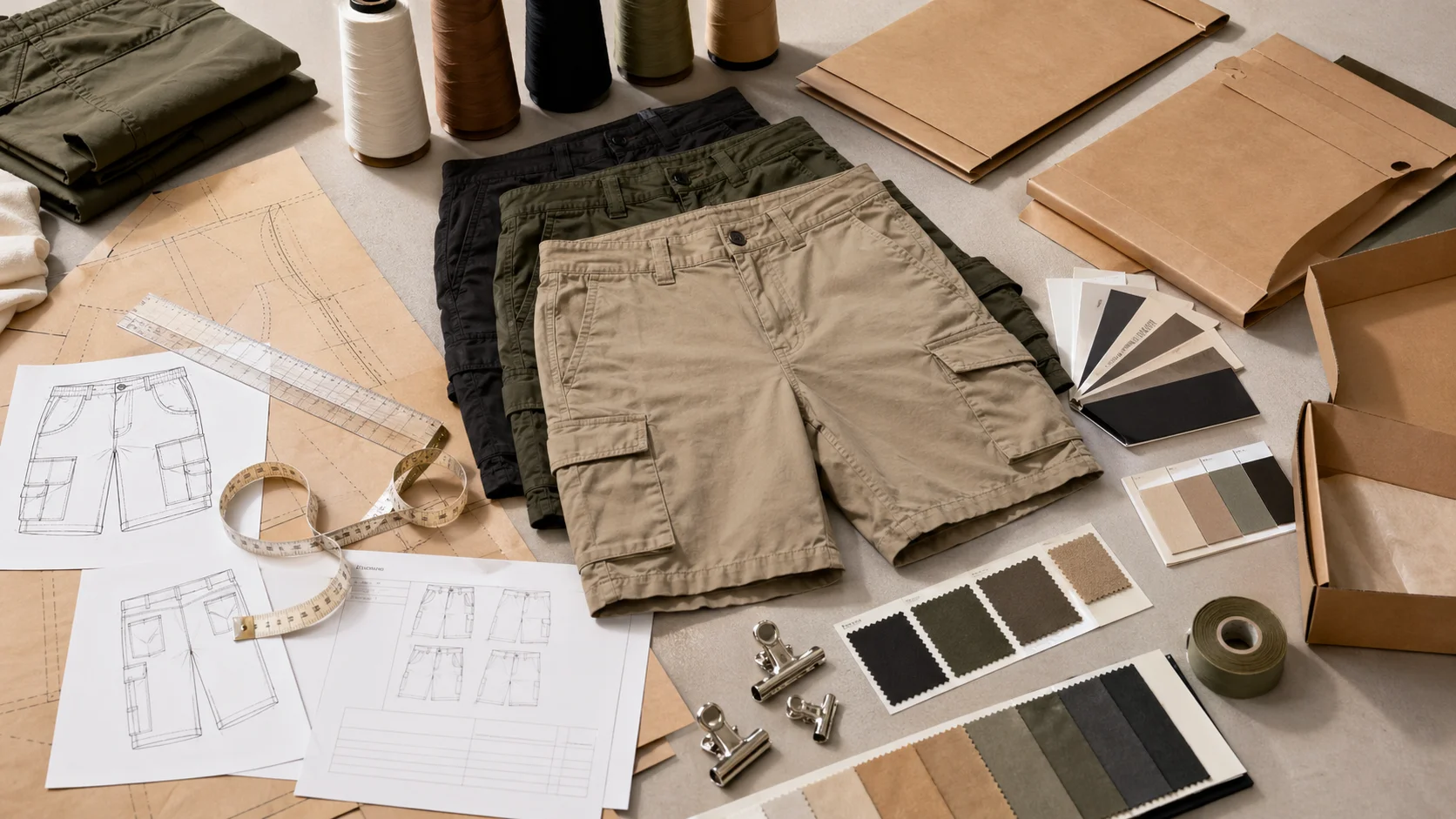
Branded Tissue Paper for Clothing Packaging with checks for samples, fit, MOQ, QC evidence, pricing terms, and delivery risk.
Fast answer: Branded Tissue Paper for Clothing Packaging: Material, Print, Packing Flow, and Cost should be judged by production evidence, not by a generic sourcing promise. The buyer needs sample proof, cost breakdowns, QC checkpoints, and delivery buffers in writing.
Ask for recent sample photos, measurement tolerances, fabric or print test assumptions, decoration test notes, packing examples, and a named inspection checkpoint. These details show whether the team can repeat an approved sample at bulk volume.
Separate garment cost, decoration, labels, packaging, sampling, testing, freight, and rush charges. When every cost line is visible, it becomes easier to reduce colorways, adjust size depth, or reserve more time for sampling.
Before a shopper touches the fabric, the tissue has already made its pitch. I have watched it on packing floors and in retail audits: tissue comes first, and the brain makes a quick call on care, restraint, and price integrity in about 3 seconds. That is why the best branded tissue paper for clothing packaging does more than hide a garment. It frames it.
In Guangzhou, Ho Chi Minh City, and Istanbul, I saw the same lesson repeat across brands and order sizes. Brands that spent $0.08-0.14 per order on custom tissue often looked more premium than brands that added a $0.40 rigid insert. Weight is not the point. Signal is. Tissue says the garment was handled, folded, and packed with attention. It also keeps a box program visually consistent, whether the outer carton is plain kraft, coated white, or a $1.20 rigid mailer.
What buyers notice first is plain: clean folds, crisp logo placement, no smear, no translucency that makes the shirt look cheap. A tissue sheet that matches the brand palette within a tight tolerance does more work than many heavier add-ons, because it sits in the visual center of the unboxing. Shoppers do not count grams. They count cues.
Production physics backs that up. Many mills print tissue more consistently than small-batch folding cartons because the substrate is thinner and easier to control in high-volume runs. I have seen 50,000-sheet tissue jobs hold registration within 1.5-2.0 mm while a carton program from the same supplier drifted wider than 3 mm across a run of 8,000 units. Not a romance story. Just production. Mills such as the converter in Dhaka that runs 60-inch Heidelberg XL flexo presses and automatic Kalander folders keep moisture at 47 percent and still hold registration, because they understand fabric-sensitive materials.
Value brands use tissue to compensate for simpler boxes. Luxury brands use it to extend a full packaging system across swing tags, inserts, dust bags, and outer cartons. The tissue becomes the first chapter of the brand story, especially for clothing packaging solutions that need to look elevated without pushing freight weight through the roof. The central point is blunt: the best branded tissue paper for clothing packaging is a measurable brand cue, not decoration.
Most apparel tissue sits between 17 GSM and 30 GSM. At 17-20 GSM, you get soft drape and lower cost, but less opacity. At 22-24 GSM, logos stay cleaner and folding is still fast. At 28-30 GSM, the sheet feels sturdier and resists tearing, though it can lose some of the airy hand that makes unboxing feel refined. For the best branded tissue paper for clothing packaging, that range matters more than a trendy finish.
Virgin pulp sheets usually print sharper and wrinkle less. Recycled tissue carries a stronger sustainability story, but the fibers can be more uneven, which shows up in slight fuzzing on fine lines and small typography. Glassine is smoother and more moisture resistant, yet it feels less like traditional tissue and can read more industrial. Acid-free tissue helps with delicate fabrics and archival use, especially for silk, embroidery, or babywear that may sit in storage for months. I have used it for brands that ship $68 bodysuits and $180 knit sets, where presentation and fiber care both matter.
Print method changes the result. Flexographic printing on a 52-inch Bobst carrier press is common for 10,000 pieces and above because it runs quickly and keeps unit costs down. Digital works for short runs of 500-3,000 sheets, especially when the design changes by collection; the Epson SurePress PX608 on glassine delivers 2-3 mm tolerances on each sheet. Offset can deliver excellent solids and gradients, though setup fees climb and the minimum order volume often starts around 8,000-12,000 sheets. Flexo suits one-color logos. Digital gives more design freedom. Offset rewards brands that can live with a longer prep cycle of 10-14 days.
Finishes should be chosen with care. Matte feels clean and contemporary. Satin reads smoother but can tip toward slick if the ink coverage is heavy. Light glazing with a calender roller improves fold memory and helps the sheet slide into cartons without catching, though too much sheen can weaken recyclability claims. Here’s what most people miss: I have seen 18 GSM tissue outperform 24 GSM tissue in folding speed because it drapes better into a carton and creates less spring-back. Fewer packing errors. Faster line speeds. Sometimes by 12-15 percent.
For premium apparel, I lean toward lightly glazed virgin or high-quality recycled tissue with a restrained print area. For lower-priced basics, a cleaner recycled sheet with one-color branding often gives better value. Brands like custom bra manufacturing partners often use softer tissue to protect lace and molded cups, while tighter knits and tees can tolerate a more economical sheet. The right spec is the one that fits the product, not the mood board. If you are sourcing the best branded tissue paper for clothing packaging from a manufacturer, ask what production controls they use to maintain quality across every run.
Supplier geography changes more than people admit. In Asia, I regularly see 18-22 business days for a 20,000-sheet job from the Guangzhou mill that runs both Komori digital inkjet rigs and 70-inch flexo lines, lower print costs, and stronger access to high-volume tissue mills. In Europe, lead times often run 3-6 weeks, but documentation is usually tighter and smaller premium runs are easier to manage. North America can be faster for replenishment—even 7-15 days once a spec is locked—though raw material costs and freight exposure are often higher. For the best branded tissue paper for clothing packaging, region is a risk decision as much as a price decision.
My checklist is practical. I inspect pulp source (virgin sulfate from GOTS-certified mills, post-consumer waste validated by GRS reports), print registration, moisture control, die-cut accuracy, and packing cleanliness. I also ask how sheets are counted, because a supplier that packs 500 sheets per ream with 1 percent variance beats a cheaper quote that ships loose bundles and creates line-side rework. The cleanest plants keep dust out of the stack, humidity near 45-55 percent, and use SAP-driven automatic stackers linked to inline optical counting. Sounds boring. Saves orders. If you are comparing a factory to a trading company, ask who actually owns the printing line and the counting system.
Brokers often look cheaper on paper by 8-15 percent. Then the delays begin. They may not control the mill, so traceability disappears, samples arrive in fragments, and claims become hard to verify. Direct mills or tightly managed converters usually cost more upfront but reduce back-and-forth by 2-3 weeks. I have seen a brokered order collapse because the color target shifted after approval, which forced a reprint of 20,000 sheets. That is not a small miss for a brand with a 6-week delivery promise.
Compliance should never be vague. Ask for FSC documentation if that claim appears on the artwork. Ask whether recycled content is verified by invoice or chain-of-custody paperwork. Confirm azo-free inks, especially if the tissue may touch skin, sleepwear, or babywear. For brands selling through strict retailers, skin-contact concerns matter even when the tissue is only a secondary package component. If you are building custom baby clothing assortments, insist on OEKO-TEX Standard 100 and GRS traceability in addition to WRAP or BSCI audits, because retailers in North America and Europe will audit those files before onboardings.
Costs bend dramatically once you look beyond the scary headline. At 500 MOQ with two-color flexo printing on 25 GSM recycled tissue, direct Chinese mills tied to a Guangzhou converter quote $2.50-4.00 per unit, inclusive of die-cutting, overprinting, and standard packing. Moving to Dhaka or Istanbul can shave another $0.15 per sheet, but you trade a longer quotation cycle and sometimes a 6 percent tariff edge depending on where the clothing ships. When you climb to 20,000 sheets with three-color prints and a satin glaze, the per-unit price drops to $0.65-0.90 because the press run amortizes the die costs.
Short runs of 500-1,000 sheets printed digitally on machines like the Epson ColorWorks or HP Indigo often cost $3.20-5.60 per sheet, but they include inline proofing, variable data, and quick sample approval. Mid-volume flexo runs of 5,000-10,000 sheets on a Komori or Bobst line tend to fall around $1.10-1.75 per sheet once you factor in both printing and finishing, including cross-cutting, center-folding, and roll slitting. The most expensive line items are usually plates, dies, and hand-placed foil or spot UV; expect foil to add $0.18 per sheet and soft-touch coating to add $0.25.
Freight, of course, matters. A 20,000-sheet order from Guangzhou in a 20-foot container bound for Los Angeles adds about $0.05 per sheet in FCL shipping but only $0.25 per sheet in DDP delivery if the supplier handles customs and drayage. For the same order shipped airfreight from Ho Chi Minh City, expect $0.65-0.95 per sheet and a tighter 18-22 business day lead time, including production, sample review, and delivery to the port. That window lets brands plan seasonal drops, but only if they lock art early and avoid last-minute reruns.
Certificates matter because they prove someone touched the fiber before it became a folded sheet. Ask for GOTS documentation whenever retail partners promote organic cotton garments; it confirms the entire chain, including fibers used in the tissue pulp, meets strict environmental and social criteria. OEKO-TEX Standard 100 ensures there are no harmful substances in the inks or coatings, while GRS validates your recycled claims across the entire converter network. WRAP and BSCI audits demonstrate safe working conditions and responsible sourcing—non-negotiable for large North American and European retail partners. When you combine these certifications, you get a sourcing story that supports both sustainability and compliance.
When a factory in Istanbul markets itself as eco-friendly, request the latest WRAP audit, the annual GRS certificate from the auditor (usually SGS, Bureau Veritas, or Intertek), and a third-party verification of any carbon-neutral language. Similarly, a Dhaka converter that claims 60 percent post-consumer recycled content must show the invoice trail and the GRS certificate scope. If a Guangzhou printer advertises OEKO-TEX Standard 100 and FSC C014766, verify the serial number with the issuing body before approving the first pre-production sample.
Artwork approval begins with a dieline exported as a layered PDF that specifies bleed, fold lines, and die-cut tolerances. At least two Pantone references should accompany the file, ideally matched via M0 measurement conditions and verified on both a GretagMacbeth Spectro Eye and an inline spectrophotometer on the press. Request a pre-press proof that includes a physical swatch, and compare it in daylight against a target garment swatch to ensure the color story truly complements what sits beneath the tissue.
Sample approvals should include at least one production-equivalent sheet from the actual press line you intend to use (e.g., the Komori 52-inch digital press or the Bobst 70-inch flexo). These samples should pass through the same calendering, folding, and stacking equipment you plan to deploy in your fulfillment center. If you plan to add hot foil stamping, request that the sample uses the same brass shim and die, because foil adhesion varies with substrate density. After approvals, confirm the supplier logs a digital approval in a shared quality report. The best converters in Ho Chi Minh City and Guangzhou link their approval logs to ERP systems, which automatically gate each work order until the art signoff is complete.
Once you finalize the spec, ask for a pilot order of 2,000-5,000 sheets to test across your fulfillment network. Track fold quality, ink rub resistance (measured per ASTM D3512-21), and how the tissue fares against your automated folder-gluers. If you plan to include tissue within a subscription program, test whether your automatic tissue inserters can handle the sheet size and weight without jamming; some converters in Istanbul use Komori proprietary feeders paired with custom folding heads for this reason.
Rollout is as much about logistics as about look and feel. Plan a minimum of 18-22 business days when you source from a Guangzhou mill that serves the U.S. market via Long Beach, or allow 3-4 weeks if you swing a container from Dhaka via Chittagong, which includes inland trucking and port dwell time. Keep a buffer for artwork changes, and double-check that your supplier has backup machines such as a secondary flexo press or a digital backup line, so you can keep weekly replenishment orders on track.
Finally, align your brand story around what the tissue represents: a measured, certified way to protect garments, communicate care, and extend tactile cues that make each unpacking moment feel intentional. When you source the best branded tissue paper for clothing packaging, detail the experience—not just the sheet.
Q: What’s a realistic lead time for a bespoke tissue job with foil and a custom logo?
A: Expect 18-22 business days from a Guangzhou or Istanbul converter once art is locked, assuming the order is above 5,000 sheets. For Dhaka runs, budget 20-26 business days because of tighter shipping windows and longer inland transit.
Q: Which certifications should I insist on if I’m launching a babywear line in Europe?
A: Start with OEKO-TEX Standard 100 for chemical safety, GOTS if the tissue complements organic cotton garments, and GRS if you are marketing recycled content. Add WRAP or BSCI audits to satisfy large EU retailers and any North American partners who require social compliance documentation.
Q: How do I keep unit costs under control?
A: Combine flexographic printing for larger runs with simple two-color artwork, lock down the sleeve size early, and order at least 8,000-10,000 sheets per shipment to amortize die costs. When necessary, layer in a short digital run for seasonal launches, but keep that under 1,500 units to avoid sticker shock.