
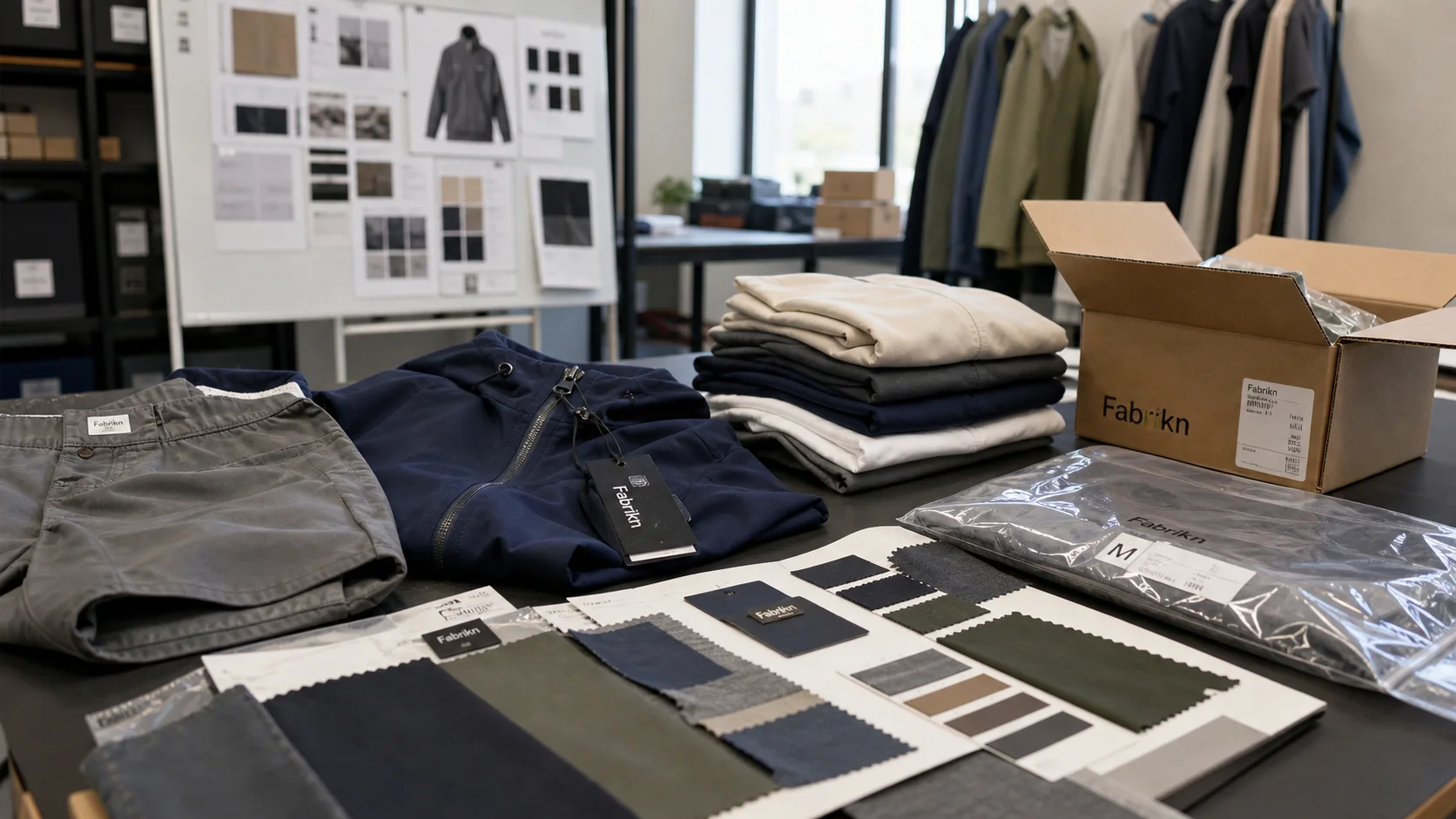
Choosing a Bulk Apparel Manufacturer for B2B Merchandising with checks for samples, fit, MOQ, QC evidence, pricing terms, and delivery risk.
Fast answer: Choosing a Bulk Apparel Manufacturer for B2B Merchandising should be judged by production evidence, not by a generic sourcing promise. The buyer needs sample proof, cost breakdowns, QC checkpoints, and delivery buffers in writing.
Ask for recent sample photos, measurement tolerances, fabric or print test assumptions, decoration test notes, packing examples, and a named inspection checkpoint. These details show whether the team can repeat an approved sample at bulk volume.
Separate garment cost, decoration, labels, packaging, sampling, testing, freight, and rush charges. When every cost line is visible, it becomes easier to reduce colorways, adjust size depth, or reserve more time for sampling.
Choosing a Bulk Apparel Manufacturer for B2B MerchandisingSelecting a bulk apparel manufacturer for B2B merchandising is not only a sourcing decision. It shapes margin, delivery reliability, product consistency, and how confidently a brand can scale seasonal programs or recurring replenishment. In practice, the difference between a clean program and a messy one is often a few concrete details: whether the factory works from a complete tech pack, whether it can hold shade consistency across lots, and whether it documents approvals before cutting bulk. The right partner makes it easier to move from concept to shelf-ready goods without constant firefighting. The wrong one can turn a simple order into a chain of missed deadlines, fit problems, and avoidable rework.
For merchandising teams, the goal is usually practical: secure apparel that matches commercial targets, hits quality expectations, and arrives in a predictable window. That means looking beyond quoted unit price and asking whether the factory can actually support the full program, from development and sample approval through production, inspection, and packing. Typical sourcing reviews start with the bill of materials, size chart, trim list, and test requirements, then confirm whether the supplier can support the requested construction, such as side-seam tees, double-needle hems, coverstitch finishing, or bartacked stress points. If you are still shaping your sourcing process, it can help to review a manufacturer’s broader capability set on pages like Services and About Us before requesting quotes.
Choosing a Bulk Apparel Manufacturer for B2B Merchandising - Clothing Manufacturer manufacturing guide
B2B merchandising is different from buying a small run for a direct-to-consumer drop. The order often needs to support uniformity across stores, sales channels, events, dealer programs, or corporate campaigns. The apparel has to look consistent in photos, on racks, and after distribution. It also has to be commercially sensible, because margins in merchandising can tighten fast when freight, sampling, duties, testing, and defects are added into the cost picture. In many programs, the buyer is managing a landed cost target rather than a factory price target.
A bulk apparel manufacturer for B2B merchandising should be able to do more than simply sew garments. The manufacturer needs repeatable processes, stable sourcing for fabric and trims, and a willingness to document approvals clearly. That often means controlled cutting with automated cutters such as Gerber or Lectra systems, production on standard machines like single-needle lockstitch, 4-thread overlock, and coverstitch units, and clear traceability for fabric lots and trim lots. That matters most when orders are tied to a launch date, a trade show, a seasonal campaign, or a restock commitment.
The best sourcing decision is often the one that reduces surprises, even if it is not the lowest quoted price on day one.
That tradeoff is important. A cheap quote can look attractive until the buyer has to absorb delayed approvals, shade variation, inconsistent grading, or late deliveries. In many B2B programs, a slightly higher factory price is justified if the supplier offers stronger development support, better quality control, or a more reliable production calendar. A practical sourcing check is whether the supplier can explain its inspection points, test standards, and packing method without hand-waving.
Clear input makes for usable quotes. A manufacturer can only price accurately when the brief covers the garment type, fabric, fit, decoration method, sizing range, labeling, packaging, and target quantity. Weak briefs lead to assumption-based pricing, and assumption-based pricing usually creates problems later. A complete brief typically includes a tech pack, a measurement chart, artwork files, label placements, and a trim map so the factory can quote with fewer assumptions.
A practical product brief should include the following:
Buyers often underestimate how much quote clarity depends on construction details. A basic cotton tee and a heavyweight garment-dyed tee can share the same silhouette and still have different costs, labor demands, wash behavior, and minimum order requirements. For example, a 180-200 gsm combed ring-spun cotton tee with a rib neck and twin-needle hem will price very differently from a 280 gsm brushed fleece hoodie with flatlock seams, metal tips, and embroidery. The more precise the brief, the less likely the factory is to pad the price for unknowns.
MOQ, or minimum order quantity, is one of the first filters in manufacturer selection. In bulk apparel, MOQ ranges can vary widely based on product complexity, fabric availability, decoration method, and whether the factory uses stock materials or custom-developed inputs. A simple cut-and-sew T-shirt may be available at a lower MOQ than a fully customized jacket or technical uniform piece.
Typical MOQ ranges are often more flexible when the factory uses existing fabrics and standard trims. In many programs, a buyer may see MOQs in the low hundreds for simple styles, while custom-developed products can require several hundred pieces per color or style. As a working benchmark, a basic tee at 500 MOQ may price around $2.50-4.00 per unit, while a heavier 240-280 gsm tee with garment wash, woven label, and folded polybag may land closer to $3.75-6.50 per unit. Hoodies, polos, and styles with embroidery, custom zippers, or special wash processes often run higher because of added labor and trim costs.
Pricing should be reviewed on a landed-cost basis, not a garment-only basis. The practical comparison includes sample fees, decoration charges, packaging, freight, customs, duties, and inspection costs. A source that looks cheaper per unit can become more expensive once all the moving parts are counted. For many buyers, the right question is not “What is the lowest unit price?” but “What is the finished cost at 500, 1,000, and 3,000 units after all adders?”
Cost Factor Why It Matters Common Risk Fabric cost Drives base garment price, shrinkage behavior, and hand feel Substitution to a lower-grade fabric or a lighter GSM than quoted Trim cost Affects branding, durability, and finish Label, zipper, drawcord, or thread mismatch Decoration cost Influences unit economics and visual impact Print cracking, embroidery distortion, or misregistration Labor complexity Impacts production time and consistency Delayed output on complicated construction or extra stitch lines Logistics Can materially change final landed cost Unexpected freight, duty, or carton overage costsThere is a useful rule in apparel sourcing: if the factory quote is unusually low, it is worth asking what is missing. Sometimes the answer is a manageable scope difference. Other times the quote excludes testing, packaging, lab dips, embroidery digitizing, or a proper approval round. A serious manufacturer should be able to explain exactly what is included and what becomes a change order.
Sampling is where many merchandising programs either gain control or start losing time. A strong factory will not rush samples blindly. It will confirm technical details, review the spec, and produce prototype or development samples before bulk production begins. Depending on the product, the process can include a prototype sample, a fit sample, a size-set sample, a salesman sample, and a pre-production sample. For more technical styles, the supplier may also prepare a wash sample, shade band, and gold seal sample for final reference.
The approval sequence matters because each stage serves a different purpose. A fit sample helps validate shape and size. A material sample confirms fabric hand feel, weight, and color. A pre-production sample shows how the actual bulk materials and trims will behave. Skipping steps can save a few days early on and cost far more later in rework. Typical sample turnaround is 5-10 business days for simple knitwear when fabric and trims are in stock, and 10-15 business days or more when the style needs custom labeling, embroidery digitizing, or lab dips.
Most B2B buyers should expect at least one, and often multiple, feedback cycles before sign-off. The faster a supplier can move through revision rounds without losing accuracy, the stronger the operational fit. That said, speed alone should not override clarity. A sample that arrives quickly but misses the construction details is not a useful sample. It is also common to request a pre-production sample after final bulk fabric and trims are confirmed, because the bulk version is the best predictor of the shipment you will actually receive.
Before approving bulk, confirm these points in writing:
If the supplier provides a clear sample approval record, that is a good sign. If approvals happen only by informal chat messages, the buyer takes on more risk when disagreements arise during production. For quote requests or production discussions, a direct channel through Contact Us is usually a better starting point than relying on vague back-and-forth. Common sourcing practice is to store every approved revision in one file set so the factory, merchandiser, and quality team are all referencing the same version.
Fabric choice is more than a style issue. It affects drape, shrinkage, printability, hand feel, color retention, and how forgiving the garment is in production. A merchandising program may need the same silhouette to work across multiple channels, but the fabric can still change the outcome dramatically. Common options include 100% combed cotton, ring-spun cotton, cotton-poly blends such as 60/40 or 65/35, and performance knits with polyester and elastane. For fleece programs, brushed back fleece around 280-320 gsm is common; for tees, 160-220 gsm is often the working range depending on the market.
Construction details matter just as much. A tee built with side seams, shoulder-to-shoulder tape, a 1x1 rib collar, and double-needle hem stitching will usually hold shape better than a looser cut-and-sew build. Hoodies often benefit from bartacks at pocket corners, coverstitch on seams, and reinforced drawcord exits. Woven shirts may need felled seams, fused collars, and button spacing checked at the sample stage. These choices affect both durability and the time required on the sewing line.
Trim selection should be specific, not generic. A quote should identify the zipper brand or grade, thread type, label format, and packaging components. For example, YKK or SBS zippers are common reference points, as are Coats or Amann sewing threads, satin or woven main labels, care labels, and silicone or woven patches. If a program requires sustainability claims, certifications such as GOTS for organic cotton and OEKO-TEX Standard 100 for restricted substance testing are useful reference points. Operational certifications like WRAP and BSCI are also widely requested in supplier qualification because they indicate social compliance systems are in place.
Process choice affects the final hand and compliance profile. Garment dyeing can create a washed, broken-in look but may also increase shade variation across lots. Reactive dyeing generally gives stronger color on cotton, while pigment dyeing can create softer vintage effects. For print programs, screen printing is common for larger quantities and offers a predictable ink deposit, while DTG is more flexible for small runs but can behave differently on dark fabrics. For embroidery, the machine path, stitch density, and backing choice all affect puckering and appearance.
Useful sourcing checkpoints typically include fabric GSM verification, shrinkage testing after wash, colorfastness review, and trim compatibility testing before bulk starts. If the factory cannot name these checkpoints, the buyer should assume they are not part of the standard workflow and ask to add them.
Lead times in apparel sourcing depend on whether the factory is using stock fabric, whether the trim set is ready, and how many approval rounds are needed. A typical bulk order for a simple tee can move in 18-22 business days after final approval if the fabric is on hand and the decoration is straightforward. More complex styles often take 25-40 business days, and garments that require custom knitting, special dyeing, heavy embroidery, or multiple wash stages can push into a 45-60 day window.
Several dependencies commonly extend the schedule:
Lead time should always be split into development time, production time, and transit time. A factory may quote “30 days,” but that may only cover production after all approvals are complete. A realistic sourcing plan needs a buffer for sample comments, holiday shutdowns, raw material delays, and freight booking. For recurring replenishment programs, many buyers keep a rolling forecast so the factory can reserve fabric and trims ahead of the next call-off.
It is also wise to ask whether lead time is tied to ex-factory date or delivery date. Those are not the same thing. A shipment can leave the factory on time and still miss the commercial need if freight, customs, or inland transport are not planned early.
Quality control in bulk apparel should be visible at multiple stages, not only at the end. Common checkpoints include incoming fabric inspection, cutting-room measurement checks, inline sewing audits, finishing inspection, and final packing review. Many buyers use AQL sampling for final inspection, often around AQL 2.5 for major defects and AQL 4.0 for minor defects, though the exact standard should be agreed in advance.
Fabric inspection usually checks GSM, width, shade variation, defects, and shrinkage risk. In cutting, the team should verify marker efficiency, panel alignment, and cut accuracy. During sewing, the factory should monitor seam allowance, stitch density, tension, puckering, skipped stitches, and needle damage. At finishing, the team should confirm measurements against the tolerance table, label placement, print registration, thread trim, and any wash effects. At packing, carton count, size ratio, polybag content, hangtag inclusion, and carton marks are common checkpoints.
Specific risks vary by garment. T-shirts often fail on collar shape, twist after wash, and print cracking. Hoodies often fail on hood symmetry, pocket alignment, or rib recovery. Wovens can fail on button spacing, placket alignment, and seam slippage. If the garment is for children or regulated use, needle detection, restricted substance testing, and relevant labeling checks become even more important.
Buyers should ask for the factory’s defect handling process. A useful answer includes who isolates rejected goods, how repairs are documented, and whether the factory provides a revised carton list after rework. A supplier that can explain its in-line and final inspection method in concrete terms is usually more reliable than one that says “we check quality carefully” without naming the checkpoints.
Choosing the right partner is partly about product fit and partly about process fit. A factory that excels at basic knits may not be the right one for tailored woven pieces, and a supplier with strong decoration capability may not be the best option for strict fit grading. The shortest path to a useful shortlist is to compare actual evidence: sample quality, communication speed, quality documentation, and the ability to quote clearly from a complete brief.
Useful qualification questions include whether the factory can support GOTS-certified organic programs, OEKO-TEX Standard 100 fabric requirements, WRAP or BSCI social compliance audits, and consistent documentation for each order. It also helps to ask what equipment the line uses, such as Juki single-needle machines, Pegasus overlock units, Kansai coverstitch machines, or Tajima embroidery machines, because equipment often signals the kind of work the factory handles regularly. For sourced programs, ask for recent inspection records, fabric test summaries, and proof of any relevant certification rather than relying on verbal claims alone.
A good manufacturer should also be able to describe its commercial support. That includes whether it can hold greige fabric for repeat orders, whether it can re-run a best-selling color, and whether it can support split shipments when merchandising calendars change. The most useful partners are usually the ones that can explain constraints early, not the ones that promise everything and sort it out later.
A simple scorecard makes it easier to compare suppliers on more than price. Many merchandising teams use a short list of criteria and request the same information from every vendor so the responses are directly comparable. That helps expose hidden assumptions, such as whether testing is included or whether packing is export-ready.
Criterion What to Ask For Useful Sourcing Detail Product fit Similar styles, sample photos, and construction notes Look for experience with the same GSM, stitch type, and trim set Pricing clarity Unit price, setup charges, sampling fees, and packaging costs Ask for pricing at 300, 500, and 1,000 units to see scale breaks Lead time Development time, production time, and transit assumptions Confirm whether the quote includes lab dips, embroidery digitizing, or wash approval Quality system Inspection checkpoints, AQL standard, and defect handling process Request incoming fabric, inline, and final inspection records Compliance Certifications and test reports Look for GOTS, OEKO-TEX Standard 100, WRAP, or BSCI where relevant Communication Named contact, response time, and approval process A same-day reply on spec questions is a strong sign for active programsFor most teams, the best vendor is not the one with the flashiest presentation. It is the one that can provide a complete and consistent answer set, with enough detail to support a repeat order six months later. Common sourcing practice is to score suppliers on product fit, quality, compliance, and communication separately so price does not hide operational risk.
Once a supplier is chosen, the relationship should be managed like an operating system, not a one-time purchase. That means keeping approved specs current, tracking deviations, and creating a repeat-order process that does not require reinventing the program each season. The more stable the data, the less time each order spends in clarification.
Long-term partners often support forecast-based ordering, reserved fabric lots, consistent size blocks, and repeatable decoration setup. In practice, that can mean holding 10-20 percent overage for top sizes, pre-booking fabric for recurring programs, or agreeing on a 2 percent spoilage allowance in advance. Those details help merchandising teams avoid stockouts when a style performs better than expected.
It also helps to keep a simple order history that records the approved fabric, trim package, color code, carton configuration, and final inspection result. That documentation is especially valuable if the program reorders after several months and the original team is no longer driving the account. The best suppliers appreciate this discipline because it lowers friction on both sides.
For ongoing collaboration, ask whether the factory can support quarterly review calls, revised size curves, and return-to-bulk approvals after any spec change. A reliable partner will treat those requests as part of the sourcing system, not as exceptions.
Get a free quote from Fabrikn — your trusted B2B clothing manufacturer with 10+ years of experience. MOQ as low as 200 pieces.
Get a Free Quote →What is a normal MOQ for a bulk apparel program? For simple knit styles, a common starting point is 300-500 pieces per color or style, with 500 units often used as a practical quote benchmark. Custom fabrics, complex decoration, or special wash effects can raise the MOQ into the 800-1,500 range or more.
How much should I expect to pay for a basic tee? A typical 180-200 gsm cotton tee at 500 MOQ often prices around $2.50-4.00 per unit before freight and duties. Add-ons such as embroidery, garment dye, heavier GSM, woven labels, or premium packing can move it higher.
How long does bulk production usually take? For stock-fabric basics, 18-22 business days is a common production window after final approval. Custom knit, dye, embroidery-heavy, or washed programs often need 25-40 business days, and more complex styles can stretch further if materials are not ready.
What certifications matter most? GOTS is relevant for organic cotton programs, OEKO-TEX Standard 100 is common for restricted substance testing, and WRAP or BSCI are frequently requested for social compliance verification. The useful sourcing step is to request the current certificate and check the scope matches the product type.
How do I reduce quality risk? Use a complete tech pack, approve a pre-production sample, agree on AQL targets, and require checkpoints for fabric, cutting, sewing, finishing, and packing. It is also common to ask for bulk shade approval and final carton counts before shipment release.
What should I ask before placing an order? Ask what is included in the quote, which fabric and trim sources are approved, which machines or processes will be used, what the lead-time dependencies are, and which inspection steps are standard. A good supplier can answer those questions in specific terms, not general promises.