
A focused outline for buyers planning bulk jackets with heat transfer decoration for warehouse staff programs, covering garment selection, transfer methods, placement, durability, sizing, compliance, and rollout logistics.
Bulk Jackets With Heat Transfer for Staff Programs - Fabrikn production reference
Bulk jackets with heat transfer decoration are a practical choice for warehouse staff programs when the goal is clear branding, controlled cost, and consistent rollout across teams. For many buyers, the real question is not whether heat transfer can work. It is whether the method matches the working environment, garment type, wash expectations, and reorder pattern.
In warehouse operations, outerwear often needs to do several jobs at once. It has to provide warmth, maintain mobility, identify staff by company or department, and survive repeated wear in active environments. Heat transfer branding is often selected because it can deliver sharp logos, reflective details, employee identifiers, and left-chest or back placements without the setup burden that comes with some other printing methods.
That does not make it the right answer for every jacket program. Buyers still need to weigh fabric composition, jacket surface texture, transfer film type, adhesion risk, and the number of logos or names involved. A low-cost transfer on the wrong shell fabric can create peeling issues. A premium transfer on a low-value jacket can push the project out of budget without creating enough real benefit.
For staff programs, the strongest purchasing decisions usually come from balancing three factors: garment durability, decoration clarity, and replenishment flexibility. Heat transfer performs well when that balance is defined early and documented properly.
If your team is comparing decoration routes for uniform outerwear, it helps to review supplier capabilities in one place before requesting quotations. A general overview of production and decoration support is available at /services/.
Heat transfer is commonly used for branded jackets because it handles operational requirements that warehouse programs face every season. Unlike some decoration methods that depend on flat, highly stable fabric surfaces, transfer applications can adapt to a wider range of outerwear styles when the correct material and press settings are used.
For warehouse use, buyers often prioritize four things:
Heat transfer helps on all four points. Logos stay crisp, especially for small text and fine-line branding that can be harder to maintain on textured jackets with other methods. Variable data, such as employee names, is easier to add in short runs. This matters in warehouse programs where turnover, shift expansion, or seasonal staffing can make exact unit forecasting difficult.
There is also a useful budgeting advantage. If the base jacket is already selected and stocked, decoration can be applied in batches tied to actual hiring needs. That can be more efficient than overcommitting to finished inventory with pre-applied branding.
Still, buyers should not assume every transfer behaves the same way. Standard PU transfers, reflective transfers, printable transfers, and specialty stretch films each have different performance profiles. The right choice depends on shell fabric, coating, seam placement, and wash care instructions.
The decoration method should not be chosen before the jacket itself is understood. In bulk uniform programs, the base garment creates most of the performance outcome. Heat transfer can only work as well as the shell fabric and construction allow.
Warehouse staff jackets are usually sourced in a few common categories:
Each category affects decoration choice.
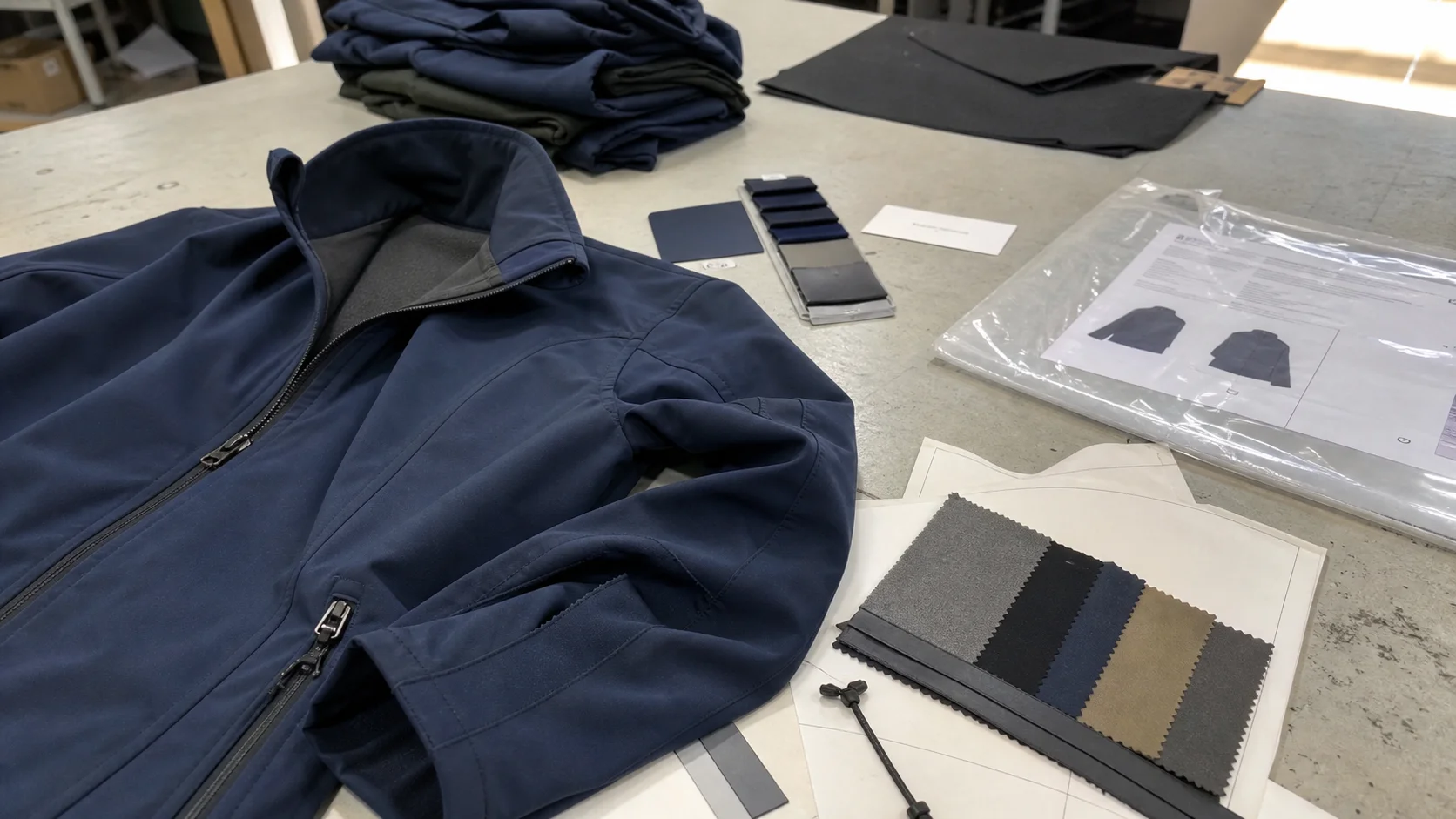
Softshell jackets are popular because they offer a smoother surface, moderate stretch, and an updated staff-uniform look. They usually accept premium transfer films well, but temperature sensitivity needs checking. Some laminated softshells can show press marks if heat and dwell time are not controlled.
Insulated jackets can be more complicated. Uneven fill distribution, stitched channels, and bulky panels limit clean logo placement. Large back logos often work, but chest placements near seams or quilt lines can become inconsistent in production.
Fleece is functional but not always ideal for transfer decoration. The pile texture can affect adhesion and edge definition. Buyers using fleece should request strike-offs on the actual fabric, not just approval on a smooth substitute panel.
Coated or water-resistant shells deserve extra caution. Certain coatings may react poorly to press heat, and some surfaces can reduce long-term bond strength. In those cases, the lowest quote is rarely the safest quote.
Many sourcing problems start when decoration is treated as a simple logo add-on instead of a technical process. For bulk jackets, the specification sheet should define more than artwork size and placement. It should state the transfer type, intended press conditions, acceptable appearance standard, and durability expectation.
Common heat transfer options for staff jackets include:
For warehouse staff programs, simple one-color or two-color transfers are often the most stable purchasing choice. They are easier to reproduce consistently in reorders and usually easier to inspect. Full-color logo transfers can look strong for corporate branding, but the cost, approval complexity, and adhesion variables may increase.
Dye migration is one of the most overlooked risks on dark polyester jackets. If the wrong transfer is used, color can bleed into lighter logo areas over time, especially under heat exposure. That problem may not appear during first sample review. It can show up later in wear or storage. Dark navy, red, and black polyester garments deserve specific blocker testing.
Buyers should also confirm whether the logo requires a matte, semi-gloss, or reflective finish. Visual expectations need to be aligned before production starts. A technically acceptable transfer that looks too shiny or too heavy can still fail an internal brand review.
For bulk jackets heat transfer for warehouse staff programs, sample approval is where most preventable errors should be caught. A disciplined approval sequence protects both buyer and supplier. Skipping it usually leads to problems that are expensive to correct once full production starts.
A sound approval process often includes these stages:
The key point is this: a digital mockup is not a production approval. It only confirms visual layout. It does not confirm how the transfer behaves on the actual garment.
For warehouse jackets, a pre-production sample should be reviewed for:
Some buyers also request a basic wash or wear simulation before bulk approval. That is not always standard, and it can extend timing, but it is worth considering for programs expected to run across multiple seasons.
Purchasing judgment matters here: if the jacket fabric is unfamiliar, coated, heavily textured, or dark-dyed polyester, requesting a real pre-production sample is usually worth the extra days.
If you are organizing artwork approvals or comparing production readiness across suppliers, direct inquiry tends to work better than assumptions. Contact options are available at /contact-us/.
MOQ for bulk decorated jackets depends on whether the buyer is sourcing finished garments, decoration only, or a full cut-and-sew program. There is no single standard, but some practical ranges are common in the market.
For stocked blank jackets with transfer branding, MOQ can start around 50 to 100 pieces per style-color combination, especially when decoration is straightforward and artwork is consistent. For custom-manufactured jackets with branded transfer application, MOQ often begins closer to 300 to 500 pieces per style, color, and sometimes per size ratio package. Some factories may require higher volumes if custom fabric, special trims, or complex packaging are involved.
Buyers should be careful with low MOQ offers that look attractive on paper. A very low starting quantity may carry hidden tradeoffs:
Lead times also need realistic treatment. A buyer may hear one number for “production time,” but actual delivery timing usually depends on several linked stages:
For decorated stocked jackets, lead time may fall in the 2 to 5 week range after final approval if blanks and transfer materials are available. For custom jacket production with heat transfer branding, a more typical planning window is often 6 to 10 weeks, sometimes longer if fabric development or peak-season capacity is involved.
Short deadlines are possible, but rushing creates avoidable quality risk. Alignment issues, press marks, and packing errors often increase when branding is added under compressed timelines.
Inspection standards for bulk jackets should cover both garment construction and decoration performance. Too many buyers inspect only logo appearance and miss functional jacket issues, or they inspect only sewing quality and miss transfer durability risks.
The most common heat transfer quality issues in staff jacket programs include:
Those risks increase when the program includes multiple jacket sizes, bulky insulated panels, or individualized names. The more variation involved, the more important clear SOPs become on the production floor.
For larger orders, an inline check plus final random inspection is usually safer than relying only on final inspection. If a placement issue is discovered late, rework on pressed jackets can be slow and expensive, and some garments cannot be corrected cleanly.
Direct buying tradeoff: if your program includes names, multiple departments, and more than one logo position, spending more time on pre-production control is usually cheaper than fixing labeling or decoration errors after dispatch.
The best bulk jacket programs are built for repeatability, not just for the first purchase order. Warehouse staffing changes, weather shifts, and site expansion often turn a one-time outerwear order into an ongoing uniform program. Buyers that document standards early tend to reduce cost and confusion later.
A repeatable staff jacket program should define:
There is also a strategic decision between holding blank jacket inventory and holding finished decorated inventory. Blank inventory offers more flexibility for onboarding and name changes. Finished inventory may reduce handling steps, but it creates risk if branding or staffing needs shift.
For many warehouse programs, a hybrid model works best:
This approach helps control dead stock while keeping branding consistent.
Buyers vetting long-term supply partners should also look at communication discipline, not just jacket price. Program success depends on accurate spec handling, reorder consistency, and realistic lead-time guidance. Background information on supplier positioning can be reviewed at /about-us/.
Before confirming a supplier or placing a PO, it is worth running a basic commercial and technical checklist. The goal is simple: reduce surprises after approval.
Checkpoint What to Confirm Why It Matters Garment fabric Exact composition, coating, and weight Determines transfer compatibility Transfer type PU, printable, reflective, stretch, blocker Affects adhesion, look, and durability Sample stage Mockup, strike-off, PP sample sequence Prevents approval gaps MOQ Per style, color, and logo version Clarifies true buying commitment Lead time From final approval, not initial inquiry Avoids unrealistic delivery planning Inspection points Placement, adhesion, names, packing Reduces costly rework Reorder rules Top-up minimums and artwork retention Supports staff program continuityFrom a purchasing standpoint, the strongest approach is usually not the cheapest jacket and not the most complex decoration. It is the combination that can be reordered reliably, inspected efficiently, and worn hard without early branding failure.
That is why bulk jackets with heat transfer remain a practical option for warehouse staff programs. When fabric choice, transfer specification, and approval discipline are aligned, the method offers useful branding control without unnecessary production complexity.
Get a free quote from Fabrikn — your trusted B2B clothing manufacturer with 10+ years of experience. MOQ as low as 200 pieces.
Get a Free Quote →Softshell jackets are often the most decoration-friendly option because they usually provide a relatively smooth surface and balanced performance for active work. Final suitability still depends on coating, stretch level, and heat sensitivity, so pre-production testing remains important.
For stocked jackets with decoration, MOQ often starts around 50 to 100 pieces per style-color combination. For custom-manufactured jackets, MOQ is often closer to 300 to 500 pieces or more, depending on fabric, trims, and packaging requirements.
Decorated stocked jackets may move in roughly 2 to 5 weeks after approvals if inventory is available. Custom programs commonly require 6 to 10 weeks or longer, especially when sampling, fabric sourcing, or peak-season capacity affects scheduling.
It can be, if the transfer film is matched correctly to the jacket fabric and the press process is controlled. Durability problems usually come from the wrong material choice, inadequate adhesion, or poor handling of coated and dark polyester shells.
Yes. Heat transfer is often a practical route for names, department labels, or role identifiers. The tradeoff is that personalization increases data-control risk, so spelling, placement, and packing checks need tighter oversight.
The most common issues are logo misplacement, edge lifting, press marks, dye migration, and errors in personalized names or titles. These are best controlled through strike-offs, pre-production samples, and clear inspection standards.
That depends on staffing volatility and branding stability. Blank stock offers more flexibility for fast onboarding and name changes, while finished stock can simplify distribution. Many programs work best with a hybrid approach that mixes both.