
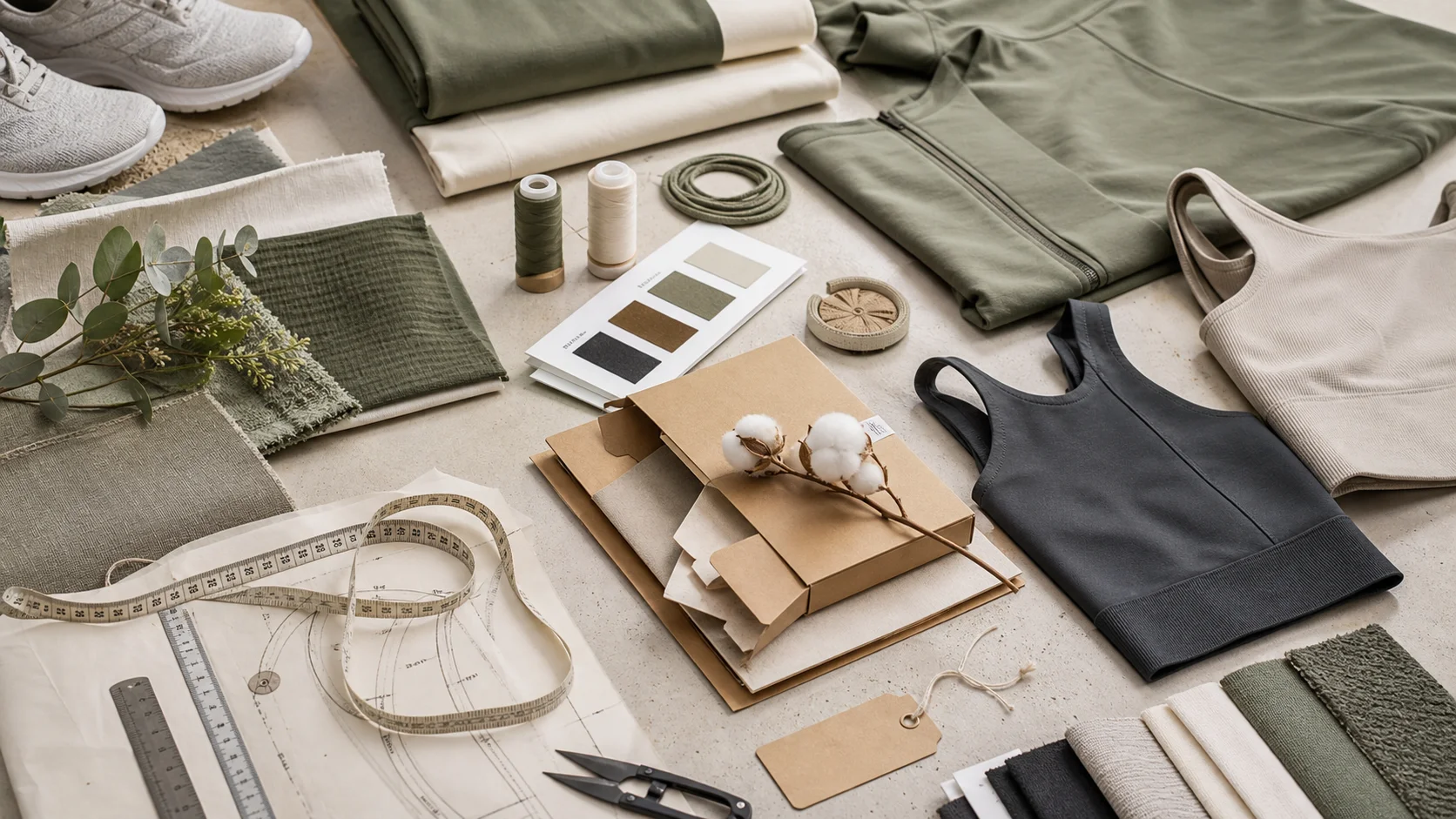
A focused outline for distributors planning sustainable activewear assortments around wholesale matching sets, trim sourcing choices, and production-level...
Wholesale Activewear Sets With Trim Sourcing - Fabrikn production reference
Wholesale activewear sets remain one of the most commercially useful categories for distributors because they combine repeat demand, strong size-run velocity, and flexible merchandising across gym, studio, lounge, and travel use. Yet many buying teams still plan these products mainly around silhouette and fabric weight, while underestimating the effect of trim sourcing on margin, delivery, performance, and returns.
That is a costly oversight. In activewear, trims are not decorative extras. Waistband elastics, drawcords, zipper tapes, heat-transfer labels, cup components, thread types, reflective details, and silicone grippers all affect wear performance and bulk production consistency. A strong-looking sample can still fail in scale if trims are unstable, delayed, shade mismatched, or incompatible with stretch fabrics.
For distributor assortment planning, trim sourcing should be treated as a commercial control point. It influences how many SKUs can be launched, whether color stories remain aligned across top-and-bottom sets, and how safely a seasonal program can be repeated or replenished. This becomes even more important in Sustainable Fashion, where recycled or lower-impact trims may have longer development cycles, higher MOQs, or narrower color availability than conventional options.
Buyers planning wholesale activewear sets should look at the product as a system, not a standalone garment. A coordinated set often includes a sports bra, crop top, leggings, shorts, jacket, or overlay layer sharing matching trims and performance expectations. If one trim component changes hand feel, recovery, colorfastness, or wash durability, the whole set can feel inconsistent at retail.
That is why trim sourcing belongs early in line planning. Teams that define trim standards up front usually manage costing and delivery with fewer surprises. Teams that leave trim decisions until after proto approval often end up accepting substitutions, absorbing airfreight, or simplifying the assortment late in the cycle.
If the objective is a reliable, scalable, sustainability-aware activewear program, trim sourcing has to be built into the sourcing brief from the start. Buyers comparing development routes can review broader manufacturing support options through /services/ and use that as a reference point when structuring technical packages and vendor communication.
Distributor assortment planning is not only about trend coverage. It is about balancing open-price entry sets, mid-tier performance sets, and premium fashion-performance capsules without overcomplicating the supply chain. Trim strategy is one of the clearest ways to manage that balance.
At entry level, many wholesale activewear sets rely on trim simplification. That often means fewer exposed zippers, standard elastic widths, stock care labels, and limited branded hardware. The advantage is shorter development, lower MOQ exposure, and easier factory consolidation. The tradeoff is reduced product distinction. If every style uses the same visible components, the assortment can feel repetitive even when silhouettes change.
Mid-tier programs usually gain the most from selective trim investment. A brushed logo elastic waistband, cleaner flatlock thread selection, shaped drawcord ends, bonded hem tape, or better removable cup packaging can improve perceived value without pushing the style into premium pricing. This tier often gives distributors the best margin-to-differentiation ratio.
Premium set programs tend to involve custom trims across multiple styles. That may include branded jacquard elastic, recycled zipper systems, soft-touch heat seals, reflective transfers, or compression-support interior constructions. These features elevate the set, but they introduce more development risk. Custom trims can raise MOQ requirements and make replenishment difficult if one component is discontinued.
For assortment planning, the practical move is to group trims into three buckets:
This approach helps distributors avoid building every SKU from scratch. It also improves buying leverage. When several set styles share the same elastic, zipper family, label quality, or drawcord spec, order volumes consolidate and trim pricing becomes easier to negotiate.
Another planning advantage is color discipline. Activewear sets often fail visually when core trims do not match the fabric palette closely enough. Black is straightforward. Seasonal earth tones, desaturated brights, and heathered solids are less forgiving. If a distributor intends to offer sets across several coordinated styles, trim approval should be linked to the full assortment palette, not to one sample in isolation.
Teams that need early sourcing alignment often benefit from involving production contacts before final assortment signoff. For direct factory communication or development planning, /contact-us/ is the logical next reference point when preparing an inquiry list and technical expectations.
Not every activewear trim carries the same sourcing risk. Some are basic and widely available. Others create disproportionate delays because they require custom tooling, performance testing, or exact dye matching. Distributor buyers should know where the pressure points usually sit.
Elastic is often the most important trim in an activewear set. It affects fit retention, comfort, and visual structure. Common options include knitted elastic, woven elastic, brushed-back elastic, fold-over elastic, and jacquard logo waistband elastic.
Typical MOQ for stock elastic colors may start around 500 to 1,000 meters, while custom jacquard or branded elastics often move into 3,000 to 10,000 meters depending on width, construction, and supplier setup. Those thresholds matter. A distributor planning only a few hundred sets per color can quickly end up overcommitted on branded elastic.
The safest purchasing question is not whether the elastic looks good on a salesman sample. It is whether it keeps recovery after wash, sweat exposure, and repeated stretch in production fabric conditions. Elastic that is too stiff can cause waistband rolling. Elastic that is too soft can weaken support positioning in leggings or bras.
Quarter-zip tops, jackets, and pockets add value, but zipper selection should stay practical. Coil zippers are common for lightweight activewear because they are flexible and easier to sew into stretch constructions. Vislon or molded styles can work for outer layers, though they often feel bulkier.
Custom zipper tape shades, branded pullers, and recycled zipper components can all extend lead time. Buyers should expect longer approval cycles if exact color matching is required. A standard black, white, navy, or tonal grey zipper is usually lower risk than trying to match every seasonal color exactly.
Drawcords appear simple but can create surprising inconsistency. Diameter, material blend, stretch level, colorfastness, and end finishing all need control. Silicone-dipped ends, metal tips, heat-cut ends, and plastic aglets each have different cost and durability profiles.
Metal trims can upgrade appearance, but they are not always the right choice for activewear. They may add weight, complicate wash performance, or conflict with sustainability positioning if the rest of the garment is built around lightweight recycled materials.
Many activewear programs now prefer heat-transfer neck labels or printed branding to reduce irritation. That can improve comfort, though transfer adhesion has to be tested on the actual fabric base. High-stretch synthetic fabrics do not all behave the same under heat application.
Woven labels, size tabs, and care labels remain necessary in many markets, but buyers can often simplify by standardizing multilingual care content and fiber declarations across style families. That reduces label variation and lowers the chance of pack-out errors.
Sports bras and support tops involve more than shell fabric and elastic. Removable cups, cup pocket mesh, underband elastic, stabilizing tape, and lining mesh all operate like trims from a sourcing standpoint. These components need to be specified early because they affect fit approval and garment classification.
A set can look commercially strong on the hanger and still disappoint in wear if the bra insert shape shifts, the cup foam collapses after laundering, or the mesh pocket opening distorts. Support trims deserve the same approval discipline as external trims.
In Sustainable Fashion, the trim conversation gets more complicated. Buyers often focus on recycled nylon or recycled polyester shell fabrics first, which makes sense. Yet trims may still remain conventional, mixed-material, or difficult to trace. That weakens the sustainability story and can create problems if retail partners ask for a clearer material breakdown.
Some lower-impact trim routes include recycled polyester zipper tape, recycled elastic content, recycled sewing thread, FSC-certified packaging elements, water-based print applications, and reduced-plastic branding components. These options are increasingly available, but not always at the same price, color range, or lead time as standard trims.
The purchasing decision here should be commercial, not symbolic. It is usually better to lock in a few verified sustainable trim upgrades that can be repeated consistently than to specify a fully optimized bill of materials that cannot be delivered on time or at target cost.
Three tradeoffs come up often:
Take jacquard elastic as an example. A recycled-content version may support the sustainability brief, but if the MOQ is too high for the program, deadstock risk rises. In that case, a stock solid elastic with lower-impact content and minimal branding may be the stronger sourcing decision.
The same principle applies to packaging trims. Custom recycled zip bags, belly bands, or hanger attachments may look aligned with a sustainable category launch, but they can add unnecessary SKU fragmentation. Distributors usually gain more by simplifying packaging and investing the budget into trims that directly improve garment life and repeat wear.
Another issue is end-of-life complexity. Mixed-material trim assemblies can make recycling harder, especially in garments with bonded films, silicone applications, foam inserts, and multiple hardware types. Full circularity is still difficult in performance apparel, so the realistic goal for many buyers is durability, lower-impact material selection where commercially viable, and transparent specification control.
Background information on manufacturing positioning and sourcing structure can also be reviewed via /about-us/ when teams are comparing supplier communication models and development support expectations.
MOQ planning in wholesale activewear sets should be done at both garment and trim level. Buyers often confirm that a factory can cut 300 to 500 sets per color, then discover that the custom waistband elastic, branded zipper pull, or reflective transfer requires much higher volume. That mismatch creates either cost inflation or forced substitution.
Typical garment MOQs for wholesale activewear sets can range from about 200 to 600 sets per style-color for smaller programs, while larger factories may prefer 800 units or more depending on fabric type, machine allocation, and finishing requirements. Trim MOQs can sit below or above those numbers. Stock labels and standard elastics are usually manageable. Custom trims are where the exposure starts.
Sampling should move through clear stages:
Trim approvals should never be treated as a visual signoff only. Buyers need hand feel checks, stretch compatibility checks, wash checks, and, where relevant, adhesion or pull tests. For sports bras and compression bottoms, trim performance under extension matters more than tabletop appearance.
Lead times vary widely, but the dependencies are predictable. If the program uses stock trims and common synthetic fabrications, development can move relatively fast. If the program depends on custom dyed elastics, recycled zipper systems, branded transfers, or special packaging, calendar risk grows.
A practical planning sequence is to freeze critical trims before too many colors or silhouettes are added. Once a distributor expands the assortment around an unresolved trim package, every later change multiplies sample revisions and approval work.
Buyers should also ask one direct question early: which trims are sourced internally by the factory and which are nominated or outsourced? That answer affects accountability. If a factory cuts and sews efficiently but depends on external trim arrivals with limited buffer time, the production schedule is only as reliable as the slowest component.
Trim-related quality failures in activewear rarely come from one dramatic issue. More often, they appear as repeated small defects that damage sell-through and reorder confidence. Distributors should build inspection checkpoints around the most common trim risks.
Tonal mismatches between zipper tape, elastic, thread, and base fabric are one of the fastest ways to make a set look off-spec. This is especially visible in beige, olive, mauve, and muted seasonal colors. Lab dips or trim color cards should be approved against the actual production fabric, not against a digital reference alone.
Trims that do not move with the base fabric can cause seam grinning, tunneling, distortion, or discomfort. This is common with poorly selected elastics, rigid tapes, and transfers applied on high-stretch zones. If the trim restricts extension more than the surrounding fabric, the garment may pass basic visual inspection but fail in wear.
Reflective transfers, heat-seal logos, and bonded applications should be checked after wash and stretch, not just after application. Peeling edges, cracking, and surface abrasion are recurring issues when application settings are not tuned to the exact fabric blend and finish.
Zipper pullers, aglets, stoppers, hooks, sliders, and detachable components need simple but direct durability review. Loose attachment points, rough edges, and cracking finishes are not premium details. They are return triggers.
Size labels, care labels, and removable cup insert pairing errors are common in set production, particularly when multiple coordinated styles are packed together. A distributor should not assume that a good garment inspection automatically covers packaging and labeling accuracy. Those checks need their own line items.
Commercially, the goal is not to inspect everything equally. The goal is to inspect where failures are most expensive. For activewear sets, that usually means waistband performance, bra support components, zipper reliability, transfer durability, and shade consistency across matched pieces.
A usable sourcing brief for wholesale activewear sets should go beyond design sketches. It needs enough trim clarity to let the manufacturer quote realistically and flag risks before sampling drifts.
The brief should include:
This level of detail helps the factory distinguish between trims that can be sourced from stock and trims that require custom development. It also makes costing more honest. Buyers who only ask for a “premium sustainable activewear set” without trim definition often receive quotes that look attractive at first and become unstable later.
One smart tradeoff is to customize only what the customer sees and feels most clearly. If the commercial goal is distributor assortment efficiency, visible waistband identity and reliable support performance usually matter more than overengineering every small internal trim. That keeps the line differentiated without making production unnecessarily fragile.
The best activewear sourcing results usually come from disciplined simplification, not from maximum component complexity. Trim sourcing should support repeatability, comfort, and commercial clarity. If it does not, it is probably adding noise rather than value.
Wholesale activewear sets with trim sourcing discipline give distributors a much stronger base for assortment planning. The category depends on coordinated performance, repeatable quality, and manageable replenishment. Those outcomes are not driven by fabric choice alone. They depend on how elastics, labels, zippers, support parts, and branding trims are specified, approved, and controlled from the beginning.
In Sustainable Fashion, the buying decision becomes even more strategic. Lower-impact trims can improve product positioning, but only if they fit the program’s MOQ, lead-time, and quality realities. The most effective assortments usually come from selective trim standardization, careful custom development where it truly adds value, and clear inspection priorities around the components most likely to fail.
For distributors planning a scalable activewear program, the practical takeaway is simple: treat trim sourcing as a planning tool, not a late-stage accessory decision. It is one of the clearest levers for protecting margin, reducing risk, and building a set assortment that can actually perform in volume.
Get a free quote from Fabrikn — your trusted B2B clothing manufacturer with 10+ years of experience. MOQ as low as 200 pieces.
Get a Free Quote →Trim sourcing includes all non-fabric components used in the set, such as elastics, zippers, drawcords, labels, heat transfers, cups, mesh supports, threads, and packaging details. In activewear, these parts affect fit, function, and delivery timing more than many buyers expect.
It depends on the trim type. Stock trims may work at relatively low volumes, while custom elastics, jacquard waistbands, or branded hardware can require several thousand units or meters. Buyers should confirm trim MOQ separately from garment MOQ before finalizing the assortment.
Trims influence product differentiation, color consistency, development complexity, and replenishment feasibility. Shared trim platforms across multiple SKUs can improve buying efficiency and reduce sourcing risk.
Not automatically. Sustainable trims can strengthen category positioning, but they must still meet cost, performance, and lead-time targets. A smaller number of commercially workable sustainable trim choices is usually better than an ambitious trim package that cannot scale.
Common risks include poor elastic recovery, transfer peeling, zipper failure, trim-to-fabric shade mismatch, uncomfortable support components, and labeling or pack-out errors. These issues can affect both wear performance and return rates.
Approval should include visual review, hand feel, wash testing, stretch compatibility, and functional checks on the actual garment fabric. For support styles like bras and compression bottoms, trim performance in motion and extension matters more than appearance alone.