
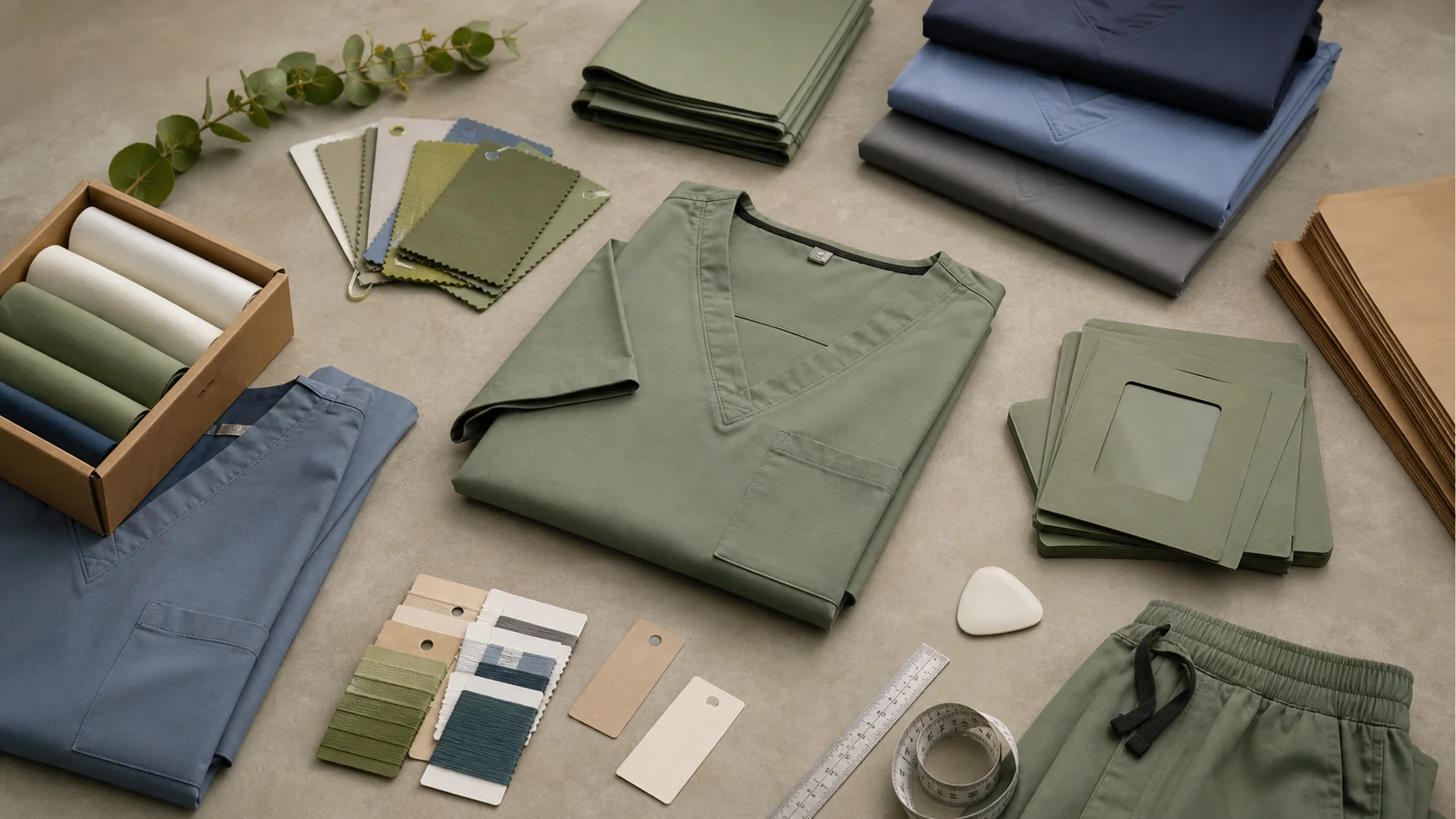
A focused outline for hospital purchasing teams evaluating bulk scrubs with heat transfer decoration, covering transfer types, garment compatibility,...
Bulk Scrubs Heat Transfer for Hospital Buyers - Fabrikn production reference
Bulk scrubs heat transfer for hospital purchasing teams is a practical decoration option when buyers need clean logo application, department identification, and controlled branding across large uniform programs. In plain terms, heat transfer decoration applies a pre-printed or cut design onto scrub garments using heat, pressure, and dwell time. For hospital buyers, that matters because the method can deliver consistent placement, readable small text, and a smoother hand feel than many alternatives.
Hospitals rarely buy decorated scrubs for appearance alone. The real drivers are identification, compliance, inventory control, and brand consistency across departments, outpatient clinics, labs, and support staff. A well-run heat transfer program can help differentiate roles without changing the core garment body. That gives purchasing teams more flexibility when they want one scrub platform with multiple logo or title variations.
Heat transfer is especially useful when artwork changes by site, cost center, specialty, or employee function. Embroidery remains common in healthcare, but it is not always the best fit for lightweight scrub fabrics or for artwork with fine lines. Screen printing can work at high volume, though it is less flexible when purchase orders are split across many logo versions or smaller departmental quantities.
Buyers comparing decoration methods should treat heat transfer as a controlled process rather than a generic print add-on. The quality outcome depends on fabric content, transfer material, curing method, wash expectations, and operator discipline. The method can work very well in healthcare procurement, but only when specifications are locked before production.
For hospital purchasing teams, bulk scrubs heat transfer usually means ordering scrub tops, pants, jackets, or lab-adjacent garments in volume, then adding logos, department names, or role identifiers through a transfer process that scales across size runs and color assortments. The bulk side of the equation changes how buyers should think about risk. At low volume, decoration issues are annoying. At hospital scale, they become an inventory and replacement problem.
Most healthcare buyers are balancing several variables at once:
Heat transfer can support these goals when the project is structured correctly. It is often a strong choice for left-chest logos, sleeve marks, back identifiers, and role-specific text. It is less ideal when the artwork is oversized, when the fabric has an unstable surface finish, or when the buyer has not confirmed wash-performance expectations in advance.
Purchasing teams that source decorated uniforms through a full-package vendor often want one point of coordination for garment manufacturing, decoration, packing, and shipment. That reduces handoff errors. If your organization is evaluating sourcing support, the service scope matters as much as unit price. A supplier handling garment development and finishing under one workflow is usually easier to manage than splitting apparel and decoration across separate vendors. Buyers reviewing vendor capabilities can start with https://fabrikn.com/services/ to compare production support categories and identify whether the supplier can manage decoration as part of a broader apparel program.
Not every scrub program needs heat transfer, but several scenarios make it a logical purchasing decision.
Large hospitals often want one scrub body with different identifiers for nursing, radiology, pharmacy, outpatient care, environmental services, and administrative clinical support. Heat transfer handles these variations efficiently, especially when the base garments stay the same and only the graphics change.
Hospital systems frequently use logos with thin strokes, detailed seals, or text that must remain sharp at smaller sizes. Heat transfer usually reproduces this better than embroidery, which can fill in detail or distort small lettering on lightweight fabric.
Many modern scrub fabrics are polyester-cotton blends, polyester-spandex blends, or recycled performance constructions. Embroidery can pucker lighter fabrics if stabilization is not managed well. Heat transfer often creates a flatter finish on these garments, provided the temperature settings are compatible with the fabric.
If the program includes job-title applications such as RN, LPN, Lab Tech, or Imaging, transfer decoration can simplify customization. The practical advantage is that role text can be standardized by template without changing the garment pattern or ordering separate embroidered runs for each title.
Screen printing becomes more cost-efficient at larger quantities with simpler artwork. Heat transfer tends to hold up better as an option when orders are split into multiple smaller lots by department, campus, or facility type.
Hospital buyers should not approve decorated scrub orders from a visual mockup alone. The right approach is to confirm garment, artwork, application, and testing details together. The most common quality failures happen when decoration specs are approved separately from fabric specs.
Start with the scrub fabric. Typical scrub compositions include:
Each fabric responds differently to heat and pressure. Stretch fabrics need special attention because transfer films can restrict stretch recovery or crack if the wrong material is used. Dark shades also increase the risk of dye migration, particularly on polyester-rich garments.
Ask the supplier exactly which transfer category is being quoted. Common options include:
For hospital scrub programs, soft-hand transfers with stable wash performance are usually preferable to thick films unless the application specifically requires high visibility or heavy opacity.
Lock down the exact decoration position before sampling moves into final approval. Left chest is common, but buyers should specify the distance from the shoulder seam or center front, not just the general area. Back prints, sleeve logos, and hem identifiers should be measured from repeatable construction points.
If the hospital system has brand standards, request color references in Pantone or an equivalent visual standard. White logos on dark scrubs are usually straightforward. Branded blues, greens, and reds need closer review because transfer output can shift under different finishes and fabric backgrounds.
Hospital laundry conditions vary. Some programs rely on industrial laundering, while others use home laundering by staff. That difference is critical. Buyers should define expected wash conditions, drying temperature, and target cycle performance before approval. A transfer that performs well in home wash may fail faster in harsh institutional processing.
The right decoration method depends on artwork, volume, fabric, and use conditions. No single method wins every time.
Method Best For Strengths Tradeoffs Heat Transfer Detailed logos, variable runs, smooth finish Sharp detail, flexible low-to-mid volume variation, flat application Can crack, peel, or migrate if poorly matched to fabric or wash conditions Embroidery Premium logo appearance, classic branding Durable look, strong institutional feel May pucker light scrubs, adds weight, loses fine detail Screen Printing Large runs with simple artwork Good unit economics at scale, broad color coverage Less efficient for many artwork versions, setup-heavy for fragmented ordersFrom a purchasing standpoint, heat transfer often sits in the middle. It is usually more flexible than embroidery for detail and more adaptable than screen printing for mixed departmental orders. The main caution is durability verification. If the supplier cannot present a clear approval path tied to actual fabric and care conditions, buyers should slow the program down before placing a large PO.
MOQ planning is one of the biggest sourcing issues in bulk scrubs heat transfer for hospital purchasing teams. Buyers should expect MOQs to vary based on whether the supplier is producing custom scrubs, decorating stock scrubs, or applying multiple logo versions across the same order.
These are working market ranges, not fixed rules. Programs with many logo changes usually face higher effective MOQs because each artwork version creates setup, approval, and production handling costs.
Buyers who skip the decorated pre-production sample usually expose themselves to avoidable problems. Artwork that looks clean in a PDF can behave differently once pressed onto stretch fabric or textured scrub surfaces.
A practical purchasing rule is simple: do not bulk-approve from a strike-off alone when the order value is meaningful. A strike-off helps with artwork review, but it does not confirm how the transfer performs on the final garment. The closer the hospital program gets to multi-site rollout, the more important the pre-production sample becomes.
Lead times for decorated scrubs depend on more than sewing time. Heat transfer adds artwork preparation, sample review, transfer production, application scheduling, and inspection checkpoints. Buyers should ask suppliers to separate garment lead time from decoration lead time rather than presenting one blended estimate.
Several dependencies can extend timelines:
Hospital buyers should also ask whether transfers are applied inline during production or after garments are completed. Inline coordination can reduce handling, but it also ties decoration output to sewing flow. Post-production application may offer more flexibility for split branding, though it can add another scheduling layer.
For teams building longer supplier relationships, company background and production scope are worth reviewing early. A vendor that understands apparel development, sourcing coordination, and production workflow tends to handle decorated uniform programs with fewer surprises. Basic supplier background information is available at https://fabrikn.com/about-us/.
Heat transfer on scrubs is not difficult to execute, but it is easy to get wrong at scale. Most failures trace back to a small group of predictable issues.
Inspection should cover both garment and decoration. At minimum, buyers or their QA partners should review:
If the program is sizeable, request a documented pre-production standard kept on file for comparison during inline and final inspection. That gives both buyer and supplier one measurable reference instead of relying on memory or email screenshots.
For hospital use, wash testing is not optional when the scrub fabric is new, the transfer type is new, or the care environment is demanding. Even a visually strong transfer can fail after repeated high-heat drying or aggressive laundering chemistry. Buyers do not need to over-engineer every order, but they should insist on evidence when the uniform will be used hard and reordered often.
A vague RFQ creates vague pricing and higher sourcing risk. Hospitals get better results when the request package is detailed enough to expose tradeoffs early.
A strong RFQ should include:
Buyers should also ask suppliers to quote separately for sampling, decoration setup, carton labeling, and replacement policy. When these costs are bundled into one unclear number, comparison becomes difficult. Transparent quoting usually reveals which supplier actually understands healthcare uniform execution.
If your team needs to discuss a project scope directly, the cleanest path is to send the garment specs, artwork count, target quantities, and timing in one inquiry. Initial sourcing contact can be made at https://fabrikn.com/contact-us/.
The cheapest quoted transfer is rarely the cheapest program outcome. Hospital buyers should evaluate total landed value, not just piece price.
A lower-cost transfer may be acceptable for short-life promotional medical apparel, but that is usually the wrong choice for daily-wear hospital scrubs. On the other hand, over-specifying premium transfer materials for a simple low-strain chest logo can push costs up without meaningful operational benefit.
Purchasing teams should aim for fit-for-purpose performance. That means matching the transfer system to the scrub fabric, expected wash conditions, and service life target. In many cases, the best commercial decision is a mid-priced transfer with proven adhesion and stable color, paired with a scrub fabric that holds shape and shade through repeat laundering.
There is also a practical tradeoff between standardization and flexibility. One scrub platform with multiple transfer versions simplifies garment inventory but can increase decoration management. Separate scrub colors by department may reduce logo complexity, though that can expand SKU count and complicate replenishment. The right answer depends on how the hospital manages uniform issuance and reorder control.
Hospital buyers should look past sales samples and ask operational questions. A capable supplier for bulk scrubs heat transfer should be able to explain its decoration workflow, sample controls, production checkpoints, and reorder discipline in plain terms.
Useful supplier questions include:
The strongest suppliers are not the ones promising that every method works on every scrub. The stronger answer is usually more specific: this fabric works, this transfer type is safer, this wash condition needs testing, and this MOQ is realistic for the artwork count. That kind of purchasing clarity is worth more than a polished pitch.
For hospital purchasing teams, bulk scrubs heat transfer can be a very effective solution when identification, logo detail, and program flexibility matter. The method is well suited to multi-department healthcare ordering, especially when one garment platform supports several branded applications. The deciding factor is process control. Buyers who specify fabric, transfer type, wash expectations, placement, and inspection standards early usually get better bulk outcomes and fewer reorder disputes.
Get a free quote from Fabrikn — your trusted B2B clothing manufacturer with 10+ years of experience. MOQ as low as 200 pieces.
Get a Free Quote →Yes, it can be durable enough if the transfer material matches the scrub fabric and the expected wash conditions. Buyers should confirm performance through pre-production sampling and wash testing, especially for polyester-rich or stretch fabrics.
For decorating stock scrubs, typical MOQs often start around 50 to 150 pieces per logo or placement. For custom scrub manufacturing with decoration, MOQs are often in the 300 to 800 piece range per style or color, depending on complexity.
It depends on the program. Heat transfer is often better for fine logo detail, lighter fabrics, and multiple artwork variations. Embroidery may suit buyers who want a more traditional textured look, but it can add weight and cause puckering on lightweight scrubs.
The main risks are poor adhesion, cracking on stretch fabric, dye migration on dark polyester garments, inconsistent logo placement, and sorting errors across departments. Most of these can be reduced with clear specifications and pre-production approval controls.
Lead times vary by sourcing model. Stock garments with decoration may take roughly 2 to 6 weeks after approvals. Custom-manufactured scrubs with heat transfer often take 6 to 12 weeks or longer if fabric sourcing, sampling revisions, or complex packaging are involved.
An RFQ should include garment type, fabric composition, color standards, size breakdown, artwork files, placement measurements, care expectations, quantity by logo version, packaging needs, and delivery timing. Better RFQs usually produce more accurate pricing and fewer production surprises.