
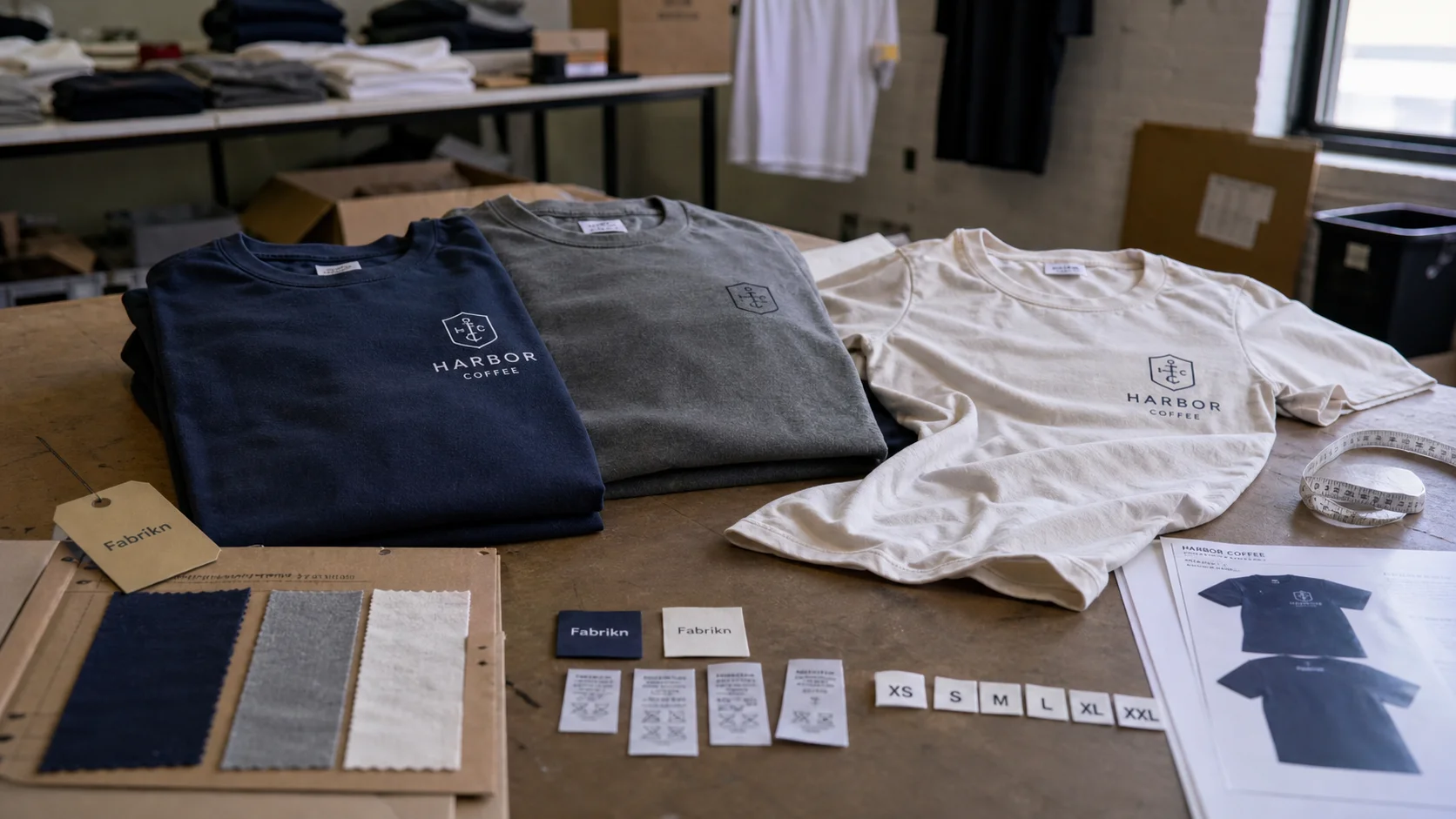
A product-focused outline for hospital uniform distributors evaluating OEM scrubs with embroidery, covering garment specs, logo execution, production workflows, compliance, and private label scale-up considerations.
OEM Embroidered Scrubs for Hospital Distributors - Fabrikn production reference
OEM scrubs with embroidery for hospital uniform distributors sit in a practical middle ground between commodity basics and fully custom medical apparel collections. Distributors want reliable replenishment, consistent fit, controlled branding, and pricing that still works across contract supply, reseller channels, and institutional tenders. Hospitals want garments that are presentable, durable, easy to identify by department, and suitable for repeated industrial or commercial laundering.
That combination makes embroidered scrub programs more technical than many buyers first assume. A scrub set may look simple on a hanger, but once a distributor adds logo embroidery, role identification, color coding, fabric performance requirements, and private label packaging, the sourcing process becomes much more demanding. Stitch density affects fabric puckering. Pocket placement affects logo visibility. Fabric composition affects drape, shrinkage, and colorfastness. Lead time depends not only on sewing capacity, but also on digitizing approval, trim readiness, labeling, and inspection standards.
For hospital uniform distributors, the most effective OEM program is rarely the one with the lowest headline FOB price. It is usually the one that balances embroidery quality, repeatability, manageable MOQ, and a realistic production calendar. Cheap unit pricing loses its appeal quickly if chest logos shift off placement, thread shades vary between lots, or scrub tops arrive with unacceptable shrinkage after wash testing.
In private label apparel, purchasing discipline matters more than marketing language. Distributors should treat embroidered scrubs as an operational product line with clear specifications, approval gates, and replenishment rules. A structured development process helps reduce rework and supports margin protection over multiple orders.
Companies comparing private label production models often start by reviewing a supplier’s core services, then move into sampling and specification alignment before discussing volume commitments.
Hospital uniform distribution is not only about garment supply. It is about standardization. Buyers on the distributor side often need a product that can be sold into hospital groups, clinics, diagnostic centers, care homes, and medical colleges without rebuilding the design each time. OEM embroidered scrubs support that requirement well because the base garment can remain stable while branding and role identification are adapted across accounts.
Embroidery is especially relevant where institutions want:
That does not mean embroidery is automatically the best option for every project. It gives a premium and durable look, but it also adds cost, setup time, and production complexity. On lightweight scrub fabrics, poor embroidery execution can cause puckering or distortion. On large-volume tender business, even a small embroidery surcharge can materially affect landed margin. Buyers should judge embroidery based on the use case rather than treating it as a default upgrade.
For distributors supplying institutional accounts, embroidered OEM scrubs often make the most sense when the customer values identity, professionalism, and repeat orders over purely lowest-cost procurement.
Most hospital distributors are not looking for fashion development. They are looking for controlled variation on a proven product. The usual needs are straightforward, but the details matter:
In practice, distributors often need two parallel product strategies. One is a stock-friendly core scrub line in commercial colors such as ceil blue, navy, teal, black, or wine. The other is an account-specific program with logo embroidery, custom labels, and occasionally exclusive colors. Trying to force both needs into one sourcing structure usually creates problems. Core programs reward standardization and higher volume concentration. Account-specific programs require flexibility and faster sample handling.
A capable OEM supplier should be able to explain where the program is standardized and where customizations begin to increase cost, lead time, or risk. That purchasing conversation is more valuable than a broad promise of “full customization.”
The development path for embroidered scrubs should be methodical. Buyers who skip steps often pay for it later in claims, delays, or rework.
The process usually begins with selecting or developing the base scrub top and pant. This includes silhouette, neckline, pocket count, side vent details, waistband construction, inseam options, and size grading. For distributors, adapting an existing proven block is often safer than building an entirely new fit from zero.
A usable tech pack should define fabric composition, weight, color, shrinkage tolerance, stitch construction, measurement chart, logo placement, label details, and packaging requirements. When the embroidery is small, buyers sometimes under-specify it. That is a mistake. Embroidery files should include dimensions, stitch count guidance where available, thread color references, backing requirements, and exact placement from HPS or pocket edge.
Before bulk production, the logo usually needs digitizing into a machine-readable embroidery file. This step influences stitch direction, density, underlay, and edge clarity. A good-looking logo on paper may not sew cleanly on scrub fabric without adjustment. Thin text, small icons, and dense fills are common trouble spots.
Distributors should request an embroidery strike-off or logo swatch before approving bulk. For higher-value programs, it is sensible to test the embroidery on the actual production fabric rather than a similar swatch.
The first prototype confirms styling and construction. Embroidery on the proto helps identify whether placement interferes with pockets, princess seams, or chest drape. A chest logo that looks balanced on a size medium may sit too close to the armhole on smaller sizes unless grading rules are considered.
Fit review should cover both garment comfort and embroidery appearance across sizes. Size sets are especially useful for institutional programs where extended sizing is important. Logo placement may need slight tolerance rules so it remains visually consistent across XS to 3XL or beyond.
The PPS should reflect final approved fabric, trims, labels, thread shades, packaging, and embroidery execution. This is the key approval stage before bulk cutting. If the buyer approves a PPS with unresolved issues, those issues often become accepted standards in production.
Distributors needing support with specification management and production coordination typically review supplier about us information alongside technical capability, because execution discipline matters at least as much as factory access.
Scrub sourcing tends to focus heavily on price per set, but the long-term performance of the program depends on specification accuracy.
Each fabric route has tradeoffs. Polyester-rich blends generally hold color better and dry faster, but can feel less natural. Cotton-rich options may feel more comfortable, yet they can shrink more and show wear sooner in aggressive laundering. Stretch blends improve mobility and wearer acceptance, though they usually increase material cost and may complicate embroidery stability if the fabric is too light or too elastic.
Many scrub fabrics land around 140 to 180 GSM, though premium or stretch constructions may vary outside that range. Lighter fabrics can improve comfort in warm environments. They also increase the risk of embroidery puckering if stabilizer choice and stitch density are not controlled well.
If the logo is small and text-heavy, the buyer should consider simplifying the artwork. A clean logo that embroiders well is often more professional than a detailed logo that becomes muddy in production.
MOQ and lead time vary by supplier setup, fabric source, and degree of customization, but some broad ranges are common enough to guide planning.
Program Type Typical MOQ Sampling Complexity Typical Lead-Time Considerations Stock fabric, standard scrub style, added embroidery 150 to 300 sets per color Low to moderate Faster if base fabric and trims are ready Private label scrub line with custom labels and packaging 300 to 800 sets per style/color Moderate Depends on label, trim, and packaging development Fully custom fabric color and branded embroidery program 800 to 1500+ sets per color or style High Longer due to dyeing, approvals, and capacity bookingThese are not fixed rules. Some suppliers accept lower MOQs for sampling or mixed-size institutional orders, while others require higher minimums to justify setup and embroidery handling.
A realistic bulk lead time for OEM embroidered scrubs is often around 45 to 75 days after final approval for standard programs, though urgent repeats using ready fabric can move faster. Buyers should be cautious of promises that compress every stage without explaining how fabric, embroidery, and finishing capacity are secured.
Embroidery adds a visible quality checkpoint to every garment. Small defects become easy to spot, which means QC standards need to be firm before bulk starts.
For hospital distributors, inspection should cover both garment construction and decoration quality. That means checking measurement tolerances, seam performance, shade continuity, embroidery placement, logo clarity, wash performance, and carton assortment.
One practical issue is that embroidery is often done in panels or semi-assembled form, while final QC happens on finished garments. If panel alignment was poor early in the process, the distortion may only become obvious at finishing. Buyers should confirm whether in-line inspection includes embroidery checks before full assembly.
Purchasing judgment: If a supplier is strong in garment sewing but vague about embroidery control, that is a real risk. Embroidered scrubs should not be treated as plain scrub production plus a simple add-on.
Where order value or account sensitivity is high, an inline inspection plus final random inspection is usually worth the extra control. It costs less than a rejected institutional shipment.
Private label scrub programs work best when distributors separate the visible brand elements from the operational core of the garment. In plain terms, keep the fit and construction stable where possible, then customize the brand presentation in a controlled way.
This approach supports replenishment. A distributor can reorder one body, one fabric, and one fit block while changing the embroidery file or packaging by customer account. That is a cleaner model than maintaining too many unique styles with low annual volume.
There is also a margin advantage. When the base product is standardized, forecasting improves and approval cycles shorten. The buyer spends less time re-developing features that are not central to the sale.
Distributors preparing a new program or RFQ generally benefit from early technical discussion through a direct contact us channel, especially when embroidery placement, private labeling, and packaging all need to be quoted together.
OEM scrub pricing is shaped by a handful of major drivers. Buyers should know which ones are worth paying for and which ones simply inflate complexity.
Lower MOQ vs. better pricing: Smaller runs reduce inventory exposure but usually increase unit cost. For distributors with uncertain demand, that may still be the right decision.
Stretch fabric vs. durability: Stretch improves wearer comfort and can support premium positioning. Heavier stretch reliance may increase sourcing cost and sometimes reduce long-term toughness in rough laundry environments if the fabric selection is weak.
Large chest embroidery vs. cleaner garment drape: Bigger logos create stronger visual branding, but they also increase stitch count, cost, and the risk of puckering.
Many colorways vs. replenishment efficiency: A wide palette helps win more accounts, yet it fragments MOQ and can complicate stockholding.
Cheap trim sourcing vs. repeat-order consistency: On institutional programs, elastic failure, drawcord variation, and labeling inconsistency create avoidable claims. Saving a few cents on trims is often a poor trade.
Purchasing judgment: Hospital distributors should optimize for repeatability first, then style differentiation. In medical uniforms, consistency usually protects margin more effectively than chasing too many custom features.
Before placing an OEM embroidered scrub order, distributors should pressure-test the supplier on process, not only presentation.
Strong answers to those questions usually indicate a disciplined OEM partner. Vague answers often point to hidden subcontracting, incomplete specification control, or inconsistent production planning.
OEM embroidered scrubs for hospital distributors can be an effective private label category when approached with sourcing discipline. The opportunity is clear: hospitals and medical institutions value durable uniforms, visible identity, and reliable replenishment. The challenge is equally clear: embroidery adds technical and operational complexity that must be managed carefully.
The best buying outcomes usually come from standardized base styles, tightly written specifications, controlled embroidery approvals, realistic MOQs, and lead times tied to actual material and capacity constraints. Distributors should focus less on broad customization claims and more on repeatability, wash performance, fit consistency, and inspection control.
In practical terms, a successful OEM scrub program is not defined by how many features can be added. It is defined by whether the same garment can be reordered six months later with the same fit, fabric behavior, logo appearance, and commercial margin. That is the benchmark hospital uniform distributors should use when sourcing embroidered scrubs under a private label model.
Get a free quote from Fabrikn — your trusted B2B clothing manufacturer with 10+ years of experience. MOQ as low as 200 pieces.
Get a Free Quote →OEM in this context refers to a manufacturer producing scrubs to a distributor’s required specifications. That can include custom fabric selection, private label branding, embroidery placement, labels, packaging, and size ranges.
For standard scrub bodies using available fabric, many programs start around 150 to 300 sets per color. More customized private label programs often move into the 300 to 800 set range, while custom-dyed or heavily specialized programs may require 800 pieces or more per color or style.
Many OEM embroidered scrub orders run about 45 to 75 days after final sample approval, depending on fabric readiness, trim sourcing, embroidery scheduling, and order volume. Repeat orders on established materials can be faster.
Embroidery is often more durable and gives a more professional look, especially for logos and name identifiers. Printing may be better for large graphics, tighter budgets, or very lightweight fabrics where embroidery could distort the material.
There is no single best fabric for every program. Poly-cotton blends remain common for value and durability. Stretch blends are popular for comfort and premium positioning. The right choice depends on laundering conditions, price targets, climate, and wearer preference.
At minimum, distributors should approve the tech pack, fabric quality, color standard, embroidery strike-off, fit sample, size set if needed, labels, packaging details, and final pre-production sample. Skipping approval stages increases the chance of avoidable bulk defects.
The main risks include logo misplacement, puckering, thread color inconsistency, poor backing selection, distortion on stretch fabrics, and damage around dense stitch areas. Those issues should be addressed during sampling and in-line inspection, not only at final packing.