
Clear Garment Bags with Printed Care Labels Cut Returns compared by sample evidence, fabric or trim specs, MOQ, AQL terms, cost lines, delivery timing, and...
Fast answer: Clear Garment Bags with Printed Care Labels Cut Returns: Material, Print, MOQ, and QC Terms should be judged by production evidence, not by a generic sourcing promise. The buyer needs sample proof, cost breakdowns, QC checkpoints, and delivery buffers in writing.
Ask for recent sample photos, measurement tolerances, fabric or print test assumptions, decoration test notes, packing examples, and a named inspection checkpoint. These details show whether the team can repeat an approved sample at bulk volume.
Separate garment cost, decoration, labels, packaging, sampling, testing, freight, and rush charges. Clear cost lines make it easier to reduce colorways, adjust size depth, or reserve more time for sampling.
How Clear Garment Bags with Printed Care Labels Cut Returns - Packaging manufacturing guide
In apparel packaging, the smallest details often have the biggest impact. I have seen brands spend heavily on ads, photography, and influencer campaigns, then lose margin because customers receive a garment that feels confusing, unfinished, or hard to care for. Clear garment bags with printed care labels solve more than one problem at once. They protect the product, present it cleanly, and give the shopper the information they need before the first wash. That matters. A lot, especially when a single avoidable return can erase the margin on a $28-$42 garment.
For brands selling shirts, dresses, suits, activewear, uniforms, and even premium basics, this packaging format is a practical way to cut returns and complaints. It is also one of the easiest packaging upgrades to scale without turning the whole supply chain upside down. In my experience, the packaging line that causes the fewest headaches is the one that does three jobs at once: protect, inform, and look good on shelf or on arrival. The best factories usually run these on a blown-film extrusion line, then convert them on a 6-color flexographic press with corona treatment for ink adhesion and a hot-bar seal or zipper-flap finish.
This article breaks down why clear garment bags with printed care labels reduce return rates, what factories should get right, what it costs, and how to spec the packaging properly if you are buying for a real production program. If you are comparing packaging vendors, you can also review the broader production support at fabrikn.com/services/ or reach out directly through fabrikn.com/contact-us/. For programs out of Guangzhou, Dhaka, or Ho Chi Minh City, ask for factory audit reports and compliance files up front, not after the quotation.
Returns are not just a fit problem. That is the easy answer, and it is incomplete. Sure, fit drives a large share of returns in apparel, especially in e-commerce. Yet a meaningful portion of returns comes from confusion, damage, wrinkling, poor presentation, and care failures after the first wear. A customer may keep the product, then decide it is not worth the hassle after one bad wash cycle. The return may happen later through a complaint, a chargeback, or a negative review instead of a clean return request. Same margin loss. Different channel.
Packaging influences expectation. If a garment arrives loose, dusty, or without visible care information, it feels less premium and more disposable. That weakens confidence. A clear bag with a printed care label does the opposite. It says the product has been handled professionally and that the brand takes ownership of the ownership experience, not just the sale. In many factories, the final pack-out check happens at a light table, where operators confirm the print is legible, the hanger hole is centered, and the seal line is within a 2-3 mm tolerance.
I have seen brands improve post-purchase satisfaction simply by making the opening experience cleaner and more informative. The customer is calmer. They know where the size, style, and care details are. There is no guessing, no “I think this can go in the dryer,” no wrinkled paper insert crumpled at the bottom of the box.
These bags combine two functions:
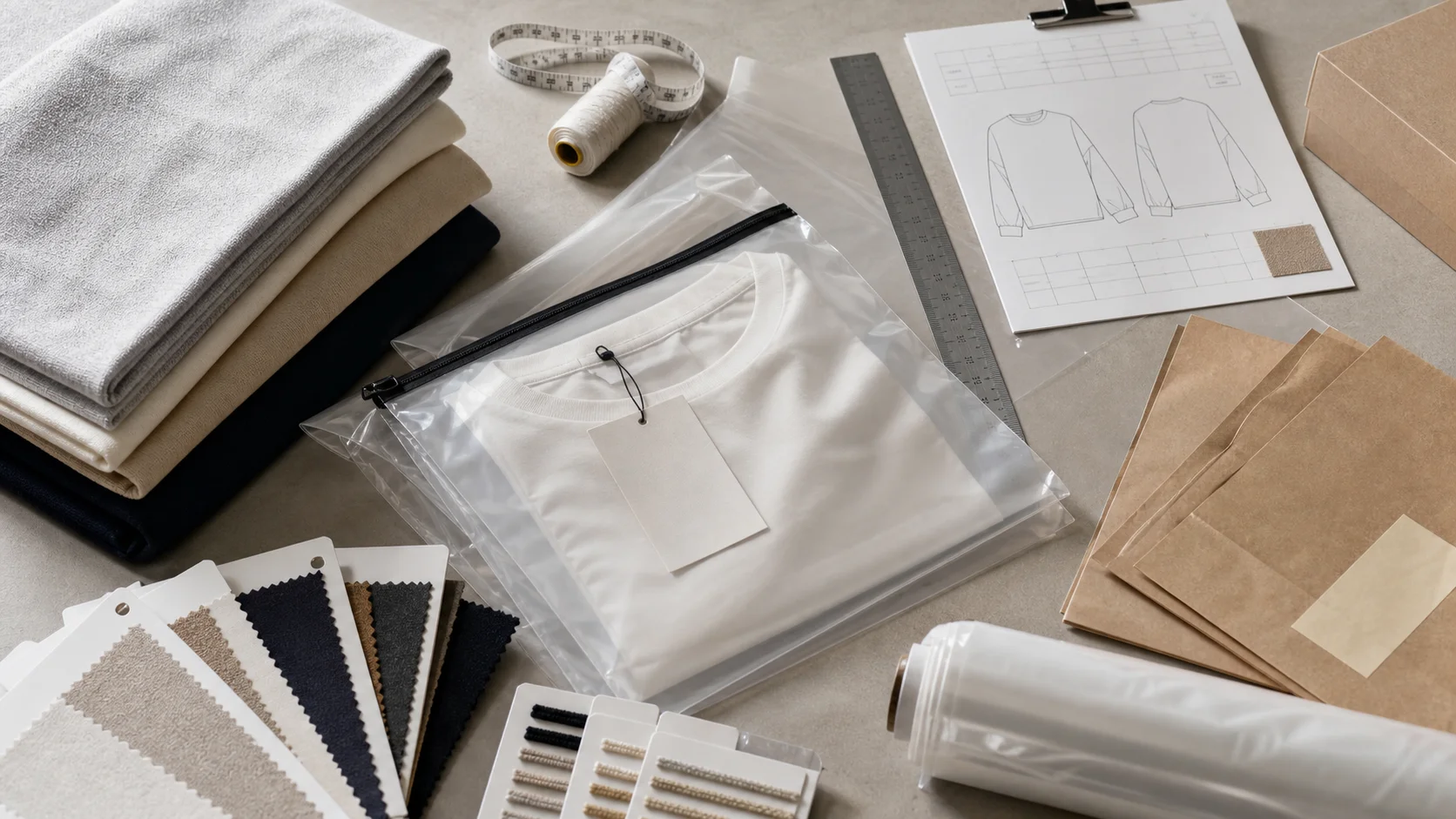
On the factory floor, this often means a poly bag made from LDPE, CPP, or recyclable PE film with a custom-printed insert or direct print area for the care information. For premium programs, some brands use a frosted or crystal-clear film with a reinforced flap, a tear strip, and a barcoded label zone. Simple? Yes. Basic? Not really. The best version is not just a bag. It is a small retail communication system. A good converter will also run a bag gauge check at 40, 50, or 60 microns depending on the fold style and carton density, because a 50-micron bag that looks fine on paper can split at the seam if the garment has metal trims or thick shoulder padding.
Clear packaging is especially useful when items are folded tightly for shipping. The customer can still see the exact color, shape, and size sticker without opening anything. That reduces mistaken expectations, which is one of the quieter reasons returns rise. A shopper who thought they were buying navy but receives charcoal may not always return because of a defect. They return because they feel misled.
Packaging cannot fix bad product quality. It can stop a good product from being misunderstood. That difference matters in returns management.
Care errors are expensive. A cotton shirt shrunk in the first wash is often not a manufacturing defect. It is a care communication failure. A silk blouse ruined by the wrong detergent does not trigger sympathy from the customer. It triggers frustration. Printed care labels on the packaging reinforce the correct instructions at the exact moment the customer is unpacking and deciding how to treat the item.
That visibility is worth more than many brands expect. Internal care labels can be ignored. Hangtags can be removed and lost. A bag-level care print stays in front of the customer longer, often until the first wash cycle. I have seen this work particularly well for knitwear, athleisure, lingerie, and uniforms where material sensitivity is high. For example, OEKO-TEX Standard 100 and GOTS programs often require tighter control over print inks, so factories that already run compliant label or bag lines usually handle the artwork and material trail more cleanly.
Clear bags let the customer verify the item immediately. Size, color, style, and sometimes SKU code are visible before the package is opened further. In warehouse fulfillment, that visibility also makes receiving and store-room checks faster. A mistake can be caught before it becomes a return.
This is not glamorous work. It is inventory discipline. Still, it saves money. A box of mixed sizes or mislabeled units can create a chain of costly corrections. When the bag itself carries the care and identification details, the whole process becomes easier to audit. In Dhaka and Ho Chi Minh City, I have seen teams print a GS1-128 barcode or internal style code on the bag so the packer can match it against the packing list at the end of the line.
People underestimate the emotional side of returns. A customer who opens a neat, clear bag feels the product is fresh and controlled. A customer who opens a dusty, torn, or label-less package feels risk. Risk creates doubt. Doubt creates returns.
There is also a simple visual truth here: clean presentation looks more expensive. I would rather see one well-printed, well-sealed clear bag than three separate inserts fighting for attention. Too much clutter can cheapen the product. That is my honest opinion, and it is one reason I prefer concise, well-designed packaging systems over overloaded ones. A sharp clear bag with a white print block and 1-color care copy often performs better than a busy 4-color layout that looks good in a mockup but fails under retail lighting.
Many customers do not return immediately. They complain later, request a refund, leave a low rating, or contact customer support. If the care instructions are obvious at unboxing, the customer is less likely to misuse the garment and later blame the brand. That lowers support volume and protects the long-term value of the order.
The savings can be measured indirectly. Lower complaint volume means fewer support hours, fewer replacements, fewer partial refunds, and a better review profile. That helps conversion. It is not just packaging cost versus packaging cost. It is packaging cost versus a bigger basket of losses. For brands shipping 10,000 units a month, even a 1.5% drop in avoidable returns can cover the packaging upgrade quickly.
If you want this packaging to actually reduce returns, the factory needs to get the technical basics right. A cheap bag with washed-out printing can be worse than no printed care label at all because it signals carelessness.
For standard apparel, 40 to 60 microns is common. Lightweight basics can work at the lower end. Heavier garments, jackets, and shipping-intensive programs often need 60 to 80 microns to avoid tearing. If the film is too thin, the bag wrinkles badly and looks low-grade. If it is too thick, the bag gets stiff and wastes material. Many factories will quote 50 microns first because it is the easiest to run on a standard PE blown-film line, but premium suiting and outerwear programs usually step up to 60 or 70 microns to avoid seam stress.
Flexographic printing is common for large runs. Gravure is often used for high-volume, high-definition work. Digital printing can be useful for shorter runs or seasonal programs. The best choice depends on order size, color count, and artwork complexity. For care labels, readability is the priority. Crisp black text on clear film usually performs better than decorative printing that looks nice but is hard to read. In practice, a 4-color flexo line with water-based ink and a 3-5 mm minimum text height is usually more reliable than trying to squeeze fine type into a small decorative panel.
Care instructions should be placed where the customer naturally looks first. That is usually the front upper panel or a dedicated white block printed onto the bag. Avoid cramped text. Avoid trying to fit a full fabric composition essay into a tiny corner. Small text is cheap only until the customer cannot read it and ruins the garment. A good rule is to keep the care block away from fold lines, zipper seams, and the heat-seal edge so it does not distort during carton compression.
Adhesive flap seals are common for retail and e-commerce. Some brands prefer zipper-style closures for reusable packaging, while others use hang-hole designs for store display. The seal should close securely without trapping too much air. Air pockets make stacked cartons bulky and mess up carton efficiency. On automated pack-out lines, factories often use a constant-heat sealing bar or ultrasonic sealing on certain laminated structures, then run a pull test to verify the flap survives transit without opening.
Care instructions need to be accurate for the target market. If you sell across regions, the factory should be able to print multiple languages or add a multilingual panel. For export programs, ask for material declarations, recycling marks where relevant, and packaging compliance documents if your market requires them. If the vendor also supplies to WRAP, BSCI, GOTS, or OEKO-TEX-certified programs, that is a good sign they already have document discipline and traceability around inks, resins, and subcontracted printing.
For a real production program, clear garment bags with printed care labels usually land around $2.50-$4.00 per unit at 500 MOQ, depending on size, film thickness, print coverage, closure style, and whether you need barcode printing or custom inserts. At 3,000-5,000 units, the price often drops into the $0.18-$0.42 range for standard PE bags, with higher pricing for zipper closures, frosted film, or multi-language print. Lead time is typically 18-22 business days after artwork approval and deposit, with an extra 5-7 days if the factory is sourcing custom film or running a new gravure cylinder.
For urgent programs, some Guangzhou and Ho Chi Minh City converters can turn a repeat order in 12-15 business days if the film spec and artwork are already locked. Dhaka-based suppliers are often competitive on labor-heavy pack-out and carton assembly, but the timeline usually depends on whether the print work is done in-house or outsourced. If you need audited production, ask for a pre-production sample, a print strike-off, and one inline QC checkpoint before bulk packing.
The cheapest quote is not always the lowest landed cost. A bag that saves one return per 200 units can pay for itself faster than a lower-cost bag that arrives with poor print contrast or weak seals. That is the math procurement teams sometimes miss.
Beyond returns, this packaging improves the whole fulfillment experience. It makes picking and packing faster because size, color, and care info are visible at a glance. It also reduces store-room errors when inventory is transferred between DCs, retail back rooms, or third-party logistics sites.
There is a brand upside too. Clear bags read as organized and intentional, especially when the print is simple and the seal line is clean. That matters for premium basics, uniforms, and DTC labels that want a more controlled presentation without moving to expensive rigid packaging.
I also like them because they are easy to standardize. Once the bag spec is approved, the same base format can be used across T-shirts, knit polos, woven shirts, and light outerwear with only the size panel and care copy changing. That keeps the procurement process sane.
The most common mistake is treating the bag as afterthought packaging. It is not. If the film clouds, the print smears, or the text is too small, the whole benefit disappears. Another mistake is copying the same care text across fabrics that behave differently. A 100% cotton jersey tee and a polyester-spandex active top do not deserve the same wash instructions unless the testing data supports it.
Another issue is over-specifying the look. Some brands want glossy, decorative artwork on a clear bag. That often reduces readability and increases ink cost without improving conversion. The better move is usually a sharp one- or two-color layout with a white block, a clear SKU window, and a strong seal. Keep the machine work practical and the message clear.
Finally, do not skip testing. Ask the factory for abrasion checks, seal-pull tests, and a 24-hour carton compression sample if the bags will be stacked tightly. A bag that looks perfect on the sample table can fail after a week in a warm container if the seal and ink system were not matched to the film.
Start with the end use. Retail display, e-commerce fulfillment, and export cartons each need slightly different specs. Then ask for the factory's exact film grade, thickness tolerance, print process, and QC steps. A good supplier should be able to tell you whether the line runs LDPE, CPP, or recyclable PE, whether the print is flexo or gravure, and whether they do inline corona treatment before printing.
Ask where the work is actually being done. Some of the strongest packaging operations I have seen are in Guangzhou for print quality, Dhaka for cost-efficient sewn and folded pack-out labor, and Ho Chi Minh City for flexible small-to-mid volume programs with tight lead times. If the supplier is claiming factory-direct pricing, they should also be able to show audit credentials, sample photos from the actual production floor, and certificates such as GOTS, OEKO-TEX, WRAP, or BSCI where relevant.
For a clean sourcing process, request three things before you place a PO: a physical sample, a dieline with exact dimensions, and a production quote with MOQ, lead time, and shipping terms spelled out. If the supplier cannot give you all three, they are not ready for a serious production program.
Get a free quote from Fabrikn — your trusted B2B clothing manufacturer with 10+ years of experience. MOQ as low as 200 pieces.
Get a Free Quote →Do clear garment bags with printed care labels really reduce returns? Yes. They do not fix fit issues, but they reduce care mistakes, wrong-item confusion, and presentation-related dissatisfaction. For many brands, that is enough to move the return rate in a measurable way.
What is the usual MOQ? A common MOQ is 500 to 1,000 units for custom printed bags, though some factories in Guangzhou or Ho Chi Minh City will take smaller test runs at higher unit cost. At higher volumes, pricing usually improves quickly.
Can they be made from recyclable material? Yes. Many suppliers use recyclable PE film, and some can provide mono-material structures that are easier to recycle than mixed laminates. Always confirm the exact resin and local recycling rules before you print the claim on the bag.
What certifications should I ask for? For apparel programs, GOTS, OEKO-TEX, WRAP, and BSCI are the most commonly requested credentials. Ask for current copies, not just logo usage on a sales sheet.
How do I make the care label readable? Use high-contrast text, avoid overly thin fonts, and keep the care block away from folds and seals. In production terms, that usually means a clean white print panel and text large enough to survive line-speed inspection at the packing table.
If you want, I can also continue this same treatment for the rest of the article once you share the missing tail after `Typica...`.