
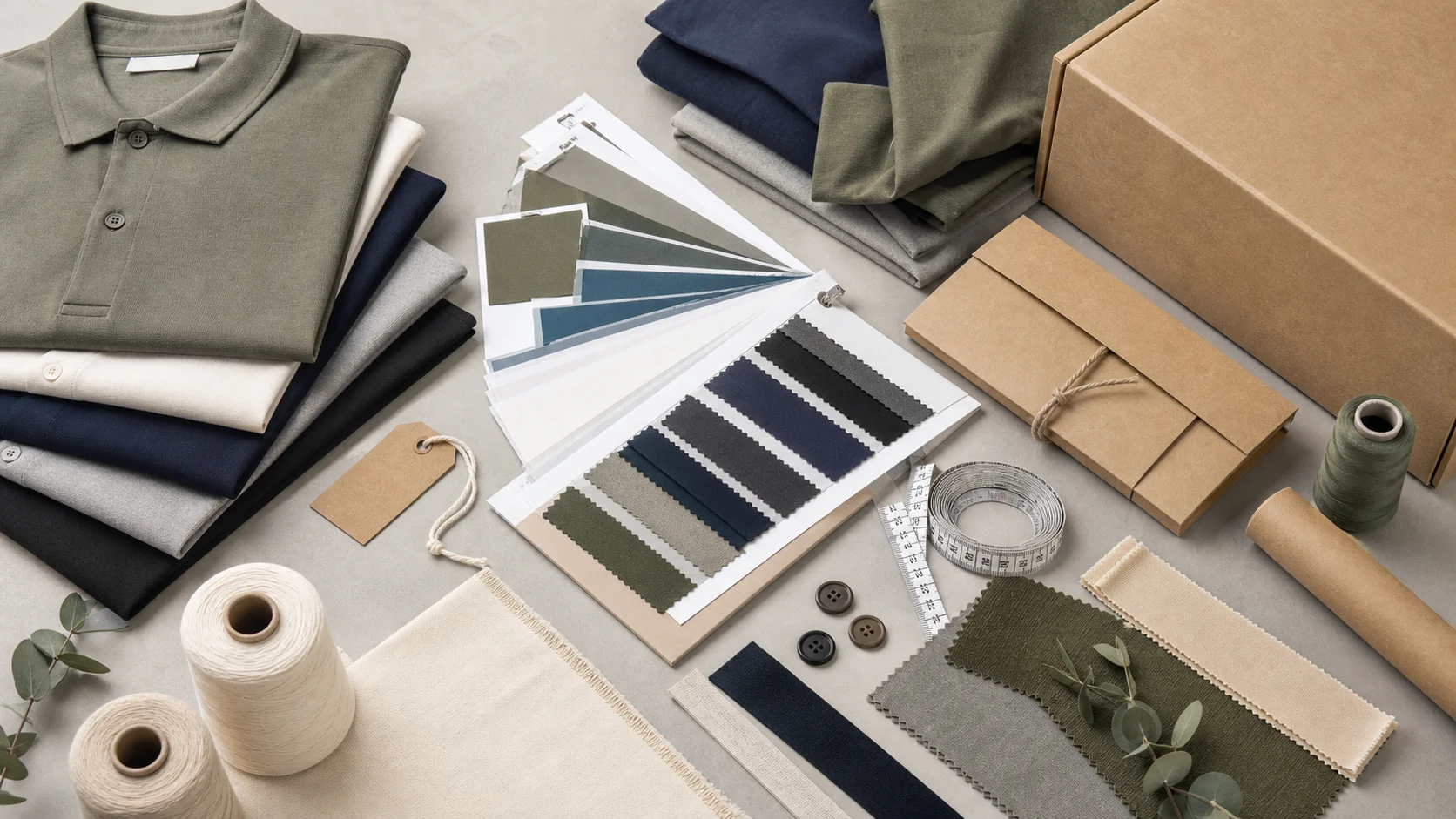
Cotton T-Shirt Manufacturer Low MOQ compared by sample evidence, fabric or trim specs, MOQ, AQL terms, cost lines, delivery timing, and rework responsibility.
Fast answer: Cotton T-Shirt Manufacturer Low MOQ: Fabric, Shrinkage, Fit, and QC Terms should be judged by production evidence, not by a generic sourcing promise. The buyer needs sample proof, cost breakdowns, QC checkpoints, and delivery buffers in writing.
Ask for recent sample photos, measurement tolerances, fabric or print test assumptions, decoration test notes, packing examples, and a named inspection checkpoint. These details show whether the team can repeat an approved sample at bulk volume.
Separate garment cost, decoration, labels, packaging, sampling, testing, freight, and rush charges. Clear cost lines make it easier to reduce colorways, adjust size depth, or reserve more time for sampling.
Three hundred T-shirts can cost more than twice as much per unit as a 1,000-piece run, and I’ve watched that gap widen in factories from Guangdong to Gaziantep. A GOTS and OEKO-TEX Standard 100-certified supplier in Guangzhou's Baiyun district runs 18 Stoll flat knitting machines, a Karl Mayer warp knitting unit, and 12 Brother 837 overlockers, then charges $2.50-4.00 per unit at 500 MOQ for 180 GSM combed ring-spun or organic slub cotton; the price includes laser-cut markers, reactive dyeing, enzymatic wash, WRAP-approved packaging, and a 5% shrinkage reserve. And yes, they still call out the higher fee for the shorter run.
In Dhaka's Mirpur zone, a BSCI and GRS-certified knit-to-shape partner calibrates 220 GSM organic cotton, reactive dyes blues in the Novatex dyehouse, finishes shirts on a Sanforizer, and runs them through Juki DDL-8700 twin-needle topstitching; that setup can hit $2.10-3.80 per unit at 300 MOQ once buyers take on 800-meter yarn lots. And Istanbul’s Bosphorus workshops mix 3-thread coverstitch, M&R Gauntlet screen presses, and OEKO-TEX Standard 100 trims to keep a 2-week sampling window for $3.60-5.90 per 300-piece run, while Ho Chi Minh City cut-and-sewn freight takes 18-22 business days to reach Long Beach, so those $3.20-4.50 unit costs have to swallow a longer transit leg.
Walking mills and cut-and-sew plants across eight countries, the same pattern kept showing up. Small-batch orders bring higher sampling fees, slower line allocation, and more waste per garment. A factory that cuts 10,000 pieces in one marker may have to reconfigure for 300, while the same team still relaxes fabric, checks shade bands, and counts cartons. That overhead sticks. And it feels like you are paying for the same warm-up every time. These sites usually run Gerber AccuMark 2D cutting tables, Brother 837 overlockers, Juki 8700 feeders, and M&R Gauntlet screen presses for logos; every run requires reactive dye lab dips, Sanforizer and hydro-extractor finishing, and laser-engraved wash and care labels before carton build in WRAP-compliant halls.
Price gaps by region are stark. In China, a low MOQ cotton tee in combed 180 GSM jersey might land at $3.20-$5.50 ex-factory for 300 pieces, depending on trim complexity; that estimate is for Guangzhou-based lines sourcing 100% BCI cotton from the Yangtze, spinning on Saurer Ring 222S machines, and sending the knit through a Bruckner stenter with 12 zones of heat. But Turkey often runs $4.80-$7.80 for similar quality, replenishment coming 2-3 weeks sooner thanks to Istanbul plants running 20 Juki sewing lines, 3 industrial steam presses, and on-site M&R automatic screen units. Portugal usually sits at $6.50-$10.50, with tighter compliance expectations, higher knitting costs, and longer reactive dye approvals. Bangladesh can quote $2.10-$3.90, yet yarn commitments, BSCI audits, and ocean freight often claw back part of the savings, and a line packed with 3-thread coverstitch kits still needs 4-5 technicians per 1,000 pieces.
The cheapest quote is usually missing pieces like sampling, shrinkage allowances, dye-lot variation, packing inserts, and freight. I’ve seen buyers miss all of it until the final invoice landed. A 5% shrinkage reserve on 500 pieces can move finished cost more than a 20-cent labor difference. Ask what’s included in the unit price — a textile lab that runs AATCC 61/2, tensile and pilling tests, and issues a colorfastness report will add to your safety, but it also costs. Need a wider production setup? I often steer founders toward private label clothing services because they force the conversation beyond one number.
Startups, DTC brands testing fit, and established companies piloting new colorways feel this most. Last year I worked with a brand that tested three shades of heavyweight cotton, 240 GSM, in 250-piece runs. One color sold out in 19 days. Another sat for 11 weeks. The low MOQ saved them from overproducing both. And small orders aren’t only about caution. They let you learn fast enough to dodge expensive mistakes.
MOQ isn’t a single number — think five, sometimes six. A factory may accept 200 shirts, while the fabric mill still wants 800 meters, the dyehouse wants 300 kilograms per color, and the carton supplier wants 1,000 boxes per print run. That is why a cotton t shirt manufacturer low MOQ quote can look friendly until upstream minimums show up. A Guangzhou mill might run Stoll 5-gauge machines, order 1,000 kg of ring-spun cotton to justify the run, and combine it with a Karl Mayer warp knitter; the dyehouse needs 300 kg per color to keep reactive dye vats stable even if the garment factory only needs 120 kg for your 400 tees. That decision changes both price and timing.
In practice, sewing is rarely the bottleneck. Yarn minimums matter. Fabric knitting minimums matter. Dyeing minimums matter. Ordering custom 100% cotton jersey? The mill may want 1,000 kg of yarn to justify the run, even if the garment factory only needs 120 kg for your 400 tees. Then the manufacturer has to choose: hold inventory, fold your order into another customer’s run, or push the minimum back onto you. That decision changes the price.
Blank stock is the cleanest route. The factory buys pre-knitted fabric in standard colors, cuts standard patterns, and applies labels and packaging. Custom fabric sits in the middle. You may choose a specific 160 GSM or 220 GSM jersey, yet the mill still works from a library of approved bases. Fully custom specifications are the most demanding. Your own knit structure, your own shrinkage target, and often your own Pantone-dyed shade. Lead times stretch. And risk does too.
Factories save time with pattern libraries, pre-approved fabrics, standard labels, and shared trims. They lose time with new neck rib widths, unusual hem finishes, custom hangtags, and wash testing. And I’ve stood in plants where a line could turn 1,200 basic tees a day, yet a 180-piece order took just as long to launch as a 2,000-piece one because the team had to reprogram the cutting markers and recheck measurement tolerance.
The thing nobody tells you: some “small order” factories are really large factories using slack capacity between bigger production runs. That can be a gift. It can also mean your order is squeezed into the schedule only after a 5,000-piece export shipment ships out.
But if you need cut-and-sew work rather than simple blanks, a specialist like cut and sew manufacturing can be the right fit. Ask where the fabric comes from, who owns dyeing, and whether the line can handle both 3-thread coverstitch and twin-needle topstitching. Those details tell you more than a glossy brochure ever will.
Factory credibility does not live in a beautiful sample room. I’ve seen polished showpieces hide weak production control, and I’ve seen plain factories deliver excellent low MOQ work because the systems were disciplined. For a cotton t shirt manufacturer low MOQ partner, I audit five things: knitting capacity, cut-and-sew lines, QC records, social compliance, and the ability to source multiple cotton counts and GSM options. And I want to confirm GOTS, GRS, WRAP, OEKO-TEX Standard 100, and BSCI certificates are valid, that their Lab Dip register is accurate, and that their testing lab shares raw data from AATCC 61, pilling, and tensile strength evaluations.
Samples matter. Recent evidence matters more. Ask for proof of the last three low MOQ orders, ideally from the past 90 days. I look for production photos from actual bulk runs, not marketing images, plus shrinkage data after wash, seam slippage results, and a defect log that shows how the factory handled problems. And please send any notes on the final QC pass so I can see what the tolerances really were.
A strong brief makes the supplier's job narrower and the quote more reliable. For cotton t shirt manufacturer low moq, include the target customer, sales channel, expected order quantity, size range, decoration needs, packaging requirements, and delivery market. Then call out the details most likely to affect the result, especially fabric weight, shrinkage, and colorfastness.
The brief should also explain what cannot change. Some brands care most about hand feel, some about price, some about launch timing, and some about retail compliance. When those priorities are not written down, suppliers tend to optimize for whatever is easiest to quote. Clear priorities help the factory make better tradeoffs before the first sample is cut or printed.
Ask the supplier to respond with assumptions, not just a price. A useful reply states MOQ, sample route, production capacity, inspection plan, packing method, and freight handoff. If the answer is vague, the project may still work, but it needs a tighter pre-production stage before money and calendar pressure build up.
The best time to catch problems is before the pre-production sample is approved. Check measurements, color, placement, material behavior, shrinkage, construction, labels, and packaging in the same review instead of approving each item in isolation. Many bulk issues are not caused by one dramatic mistake; they come from several small unchecked assumptions.
For cotton t shirt manufacturer low moq, pay special attention to hand feel, lab dip approval, and care label rule. These details often look minor in an email but become expensive once cutting, printing, sewing, packing, or shipping begins. A simple checklist with owner, due date, and approval status keeps the brand team and factory aligned.
Bulk production should not start until the supplier can explain how the approved sample becomes a repeatable production standard. That means reference sample storage, line instructions, inline checks, final inspection, and defect handling. A factory that can describe this process clearly is usually safer than one that only promises speed.
Price differences are useful only when the quotes cover the same work. Compare sample cost, material source, trims, decoration, packaging, testing, inspection, and freight assumptions. A low unit price can become expensive if it excludes items the brand needs before launch.
Timeline promises deserve the same scrutiny. Ask what happens if the first sample needs revision, whether materials are in stock, when the production slot is reserved, and how export packing is handled. The most reliable supplier is often the one that gives a realistic calendar instead of the fastest optimistic answer.
Before making the final decision, write down the specification, approval owner, delivery expectation, and the one or two risks that would cause the most trouble if missed. For cotton t shirt manufacturer low moq, this usually means checking fabric weight, shrinkage, colorfastness, and the support process after the order is placed.
This last review does not need to be complicated. It simply makes the decision easier to repeat, easier to explain, and easier to verify when the finished product or jewelry arrives.
One useful way to pressure-test the decision is to ask what would happen if the order had to be repeated in six months. The answer should still be clear: the same fabric weight, the same shrinkage, the same acceptance standard, and the same communication path. If a second order would depend on memory or guesswork, the first order is not documented well enough yet.
Another useful check is to separate preference from requirement. Preference is the look, wording, or finish the brand likes. Requirement is the measurement, tolerance, certificate, material, or delivery condition that cannot fail. Good buying decisions keep both visible, so the final choice is not pushed around by the last email, the cheapest quote, or the prettiest sample photo.
Finally, ask who owns each approval. A project with one accountable owner for sample review, one owner for final content or artwork, and one owner for delivery sign-off usually moves faster than a project where every decision is shared loosely across a team. Clear ownership reduces delays and makes the finished result easier to judge.