
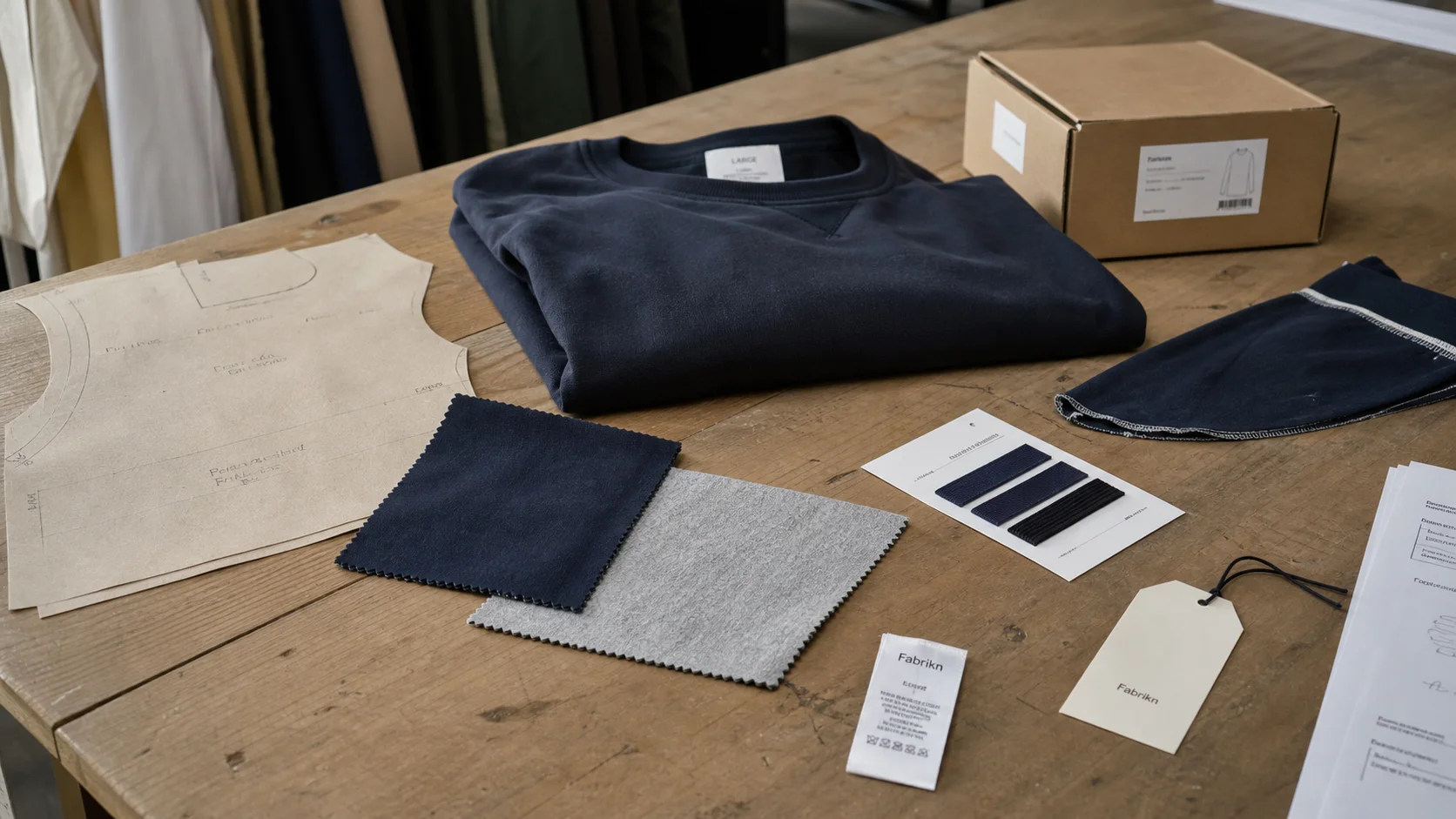
Country of Origin Labels for Apparel Packaging China with checks for samples, fit, MOQ, QC evidence, pricing terms, and delivery risk.
Fast answer: Country of Origin Labels for Apparel Packaging China should be judged by production evidence, not by a generic sourcing promise. The buyer needs sample proof, cost breakdowns, QC checkpoints, and delivery buffers in writing.
Ask for recent sample photos, measurement tolerances, fabric or print test assumptions, decoration test notes, packing examples, and a named inspection checkpoint. These details show whether the team can repeat an approved sample at bulk volume.
Separate garment cost, decoration, labels, packaging, sampling, testing, freight, and rush charges. When every cost line is visible, it becomes easier to reduce colorways, adjust size depth, or reserve more time for sampling.
One wrong line on a label can stall an entire shipment. On a $180,000 order, I’ve seen cartons arrive on time and still get bounced at retail intake because the hangtag, polybag, and shipper box each told a different story. And once a misprint makes it out the door, everyone else wonders why it wasn’t spotted sooner before the goods hit the retailer. That is how country of origin labels for apparel packaging china become a front-end problem, not a cleanup task. During a Guangzhou inspection near the Baiyun airport, the Komori Lithrone 440 label press printing on GOTS-certified recycled paper with OEKO-TEX Standard 100 adhesives paused because the operator failed to load the factory’s registered entity, and customs held the 60,000-piece carton until the corrected documentation arrived.
Why do they fail so early? QC spots it fast. Customs spots it too. In Guangzhou, Dhaka, Ho Chi Minh City, and Istanbul I’ve watched the same misprints slide through thermal transfer printers, HP Indigo 20000 sheets, and inline lamination lines before anyone in the supply chain could intervene. Retail compliance sees it last, after the damage is already visible. A bad label hints that the manufacturer or supplier is casual with the rest of the run. In factory visits across Guangdong, Zhejiang, and Jiangsu, I’ve watched one language mismatch snowball into claims that never matched the approved PO. Fabric blend changes from 95/5 cotton-spandex to 100% cotton. Packaging art stays frozen in a chat thread. One missed update, and thousands of units are exposed.
The failure pattern shifts by segment. Export basics, often at MOQ 5,000 to 20,000 pieces, usually break on simple transcription errors. Premium fashion, with 3 to 5 packaging components per SKU, gets trapped by version control. Private label programs tied to private label clothing carry the heaviest documentation load because buyers, agents, and retailers all touch the same file before approval. Those programs also stay on top of WRAP and BSCI audits, and their roll-fed BOPP and BOPET films usually sit on GRS traceability registers to satisfy ESG teams.
Here’s the scale problem: 1% sounds tiny until a 100,000-piece order leaves 1,000 units rejected, repacked, or delayed. On a 500,000-unit program, that same rate means 5,000 units and a very expensive fire drill. In factory terms, that is not a small defect. That is a production event.
Core data points look simple, yet they still have to be exact. Country of origin, manufacturer identity if required, packer details when local rules demand it, and any brand-specific formatting sit at the center. In many cases, the Guangzhou or Dhaka label house prints on fiber-certified stock compliant with GOTS and OEKO-TEX Standard 100, while adhesives are specified to meet the same standards for sensitive-skin claims. And I’ve seen buyers lose a week because the legal name on the label used the factory’s English trade name instead of the registered entity on the certificate of incorporation.
There is no universal format for apparel packaging origin labels in China. Customs rules differ from retailer rules, and channel rules differ again. A carton label for a wholesale shipment might need less visual information than a store-ready hangtag. A polybag may need a fiber-content line and warning text in two languages, while the outer shipper only needs origin plus SKU, carton count, and PO number. Because of that, the same supplier in Ho Chi Minh City or Dhaka quoting $2.50-4.00 per unit at 500 MOQ for HP Indigo digital labels also promises 18-22 business days from artwork approval to Guangzhou port, which keeps prototypes moving. If the retailer asks for a WRAP or BSCI audited facility, ensure the adhesives list the certification number and align with the GRS traceability register.
“Made in China” is the most common marking for finished apparel packaged for export. “Product of China” appears in some categories, but buyers shouldn’t use it casually because it can imply a different regulatory meaning in certain markets. Barcode placement matters too. A Code 128 or UPC label can sit neatly on the back panel, yet if it crowds the origin statement or pushes the font below 6 pt, the carton can still fail a retail check.
According to WTO trade data, global apparel trade still runs through multiple origin and assembly points. That is exactly why the packaging text has to match the documented production path, not the marketing story. When I audit country of origin labels for apparel packaging china, I check four things in 90 seconds: origin wording, entity name, barcode readability, and language pairing. Miss one, and the whole label can get rejected at receiving. Clean labels are not decoration; they are part of quality control.
Material choice decides whether the label survives the trip. In Guangzhou the Comexi FS-330 laminator runs at 90 m/min, bonding BOPET to kraft with 3M 468MP pressure-sensitive adhesive, while a Dhaka shop uses a Columbus rewind-wind line for GOTS-certified recycled stock. Coated paper is cheap, easy to print, and fine for dry cartons moving through 2 to 4 weeks of normal freight when it is fed through a Heidelberg Speedmaster CD 102 with UV-curable inks. BOPP film costs more, but it handles moisture, scuffing, and adhesive bleed in humid warehouses where temperatures swing from 18°C to 35°C. Recycled paper works well for brands chasing lower plastic use, though I’ve seen it curl faster under high humidity unless the adhesive and liner are tuned correctly. In one Ho Chi Minh City line, the label laminator needed a dial-in on the Nordson hot-melt applicator to keep the 3M 300LSE adhesive from darkening the print.
Removable adhesives help on retail handling, especially for reusable cartons and inspection stickers. Permanent adhesives cut peel-off risk, yet they can leave residue on premium packaging and raise labor cost if inspectors have to scrape labels during receiving. In one Ningbo factory, a batch of 30,000 labels used a low-tack adhesive to save $0.012 per piece. The labels saved pennies and cost dollars: 4,600 units peeled in transit, and the repacking bill went past the original label budget.
Print method matters just as much. Digital print on HP Indigo 20000 or EFI Nozomi is best for short runs, often 500 to 10,000 units, because setup is quick and variable data is simple. Flexo wins at scale, especially from 50,000 units upward, where plate-making cost gets diluted and color consistency improves; I often see a Heidelberg Speedmaster CD 102 or a Komori GL offset unit paired with a Bobst die-cutter for hanging tags and carton wraps. Thermal printing fits variable carton data, batch codes, and warehouse labels because it can change SKU by SKU without replate time. For apparel packaging, a buyer ordering mixed colors and sizes usually gets the best control from a hybrid setup: flexo for the master artwork, thermal for the variables, and die-cutting on a Zund G3 or Mitsubishi cutter to match the carton windows.
Sustainability claims should be judged by total waste, not a single material badge. A recycled label that fails in transit creates reprints, scrap liners, and extra freight. That feels like a real emissions penalty. Data from Textile Exchange shows buyers are paying more attention to material accountability, but in packaging I still see cheaper labels create more waste through rework than they save through unit price. That is why the recent push toward GRS-certified films and GOTS-certified fibers is gaining traction, even though the production process now includes another compliance gate.
A strong brief makes the supplier's job narrower and the quote more reliable. For country of origin labels for apparel packaging china, include the target customer, sales channel, expected order quantity, size range, decoration needs, packaging requirements, and delivery market. Then call out the details most likely to affect the result, especially material grade, print tolerance, and barcode size.
The brief should also explain what cannot change. Some brands care most about hand feel, some about price, some about launch timing, and some about retail compliance. When those priorities are not written down, suppliers tend to optimize for whatever is easiest to quote. Clear priorities help the factory make better tradeoffs before the first sample is cut or printed.
Ask the supplier to respond with assumptions, not just a price. A useful reply states MOQ, sample route, production capacity, inspection plan, packing method, and freight handoff. If the answer is vague, the project may still work, but it needs a tighter pre-production stage before money and calendar pressure build up.
The best time to catch problems is before the pre-production sample is approved. Check measurements, color, placement, material behavior, shrinkage, construction, labels, and packaging in the same review instead of approving each item in isolation. Many bulk issues are not caused by one dramatic mistake; they come from several small unchecked assumptions.
For country of origin labels for apparel packaging china, pay special attention to folding method, pack-out sequence, and retail compliance. These details often look minor in an email but become expensive once cutting, printing, sewing, packing, or shipping begins. A simple checklist with owner, due date, and approval status keeps the brand team and factory aligned.
Bulk production should not start until the supplier can explain how the approved sample becomes a repeatable production standard. That means reference sample storage, line instructions, inline checks, final inspection, and defect handling. A factory that can describe this process clearly is usually safer than one that only promises speed.
Price differences are useful only when the quotes cover the same work. Compare sample cost, material source, trims, decoration, packaging, testing, inspection, and freight assumptions. A low unit price can become expensive if it excludes items the brand needs before launch.
Timeline promises deserve the same scrutiny. Ask what happens if the first sample needs revision, whether materials are in stock, when the production slot is reserved, and how export packing is handled. The most reliable supplier is often the one that gives a realistic calendar instead of the fastest optimistic answer.
Before making the final decision, write down the specification, approval owner, delivery expectation, and the one or two risks that would cause the most trouble if missed. For country of origin labels for apparel packaging china, this usually means checking material grade, print tolerance, barcode size, and the support process after the order is placed.
This last review does not need to be complicated. It simply makes the decision easier to repeat, easier to explain, and easier to verify when the finished product or jewelry arrives.
One useful way to pressure-test the decision is to ask what would happen if the order had to be repeated in six months. The answer should still be clear: the same material grade, the same print tolerance, the same acceptance standard, and the same communication path. If a second order would depend on memory or guesswork, the first order is not documented well enough yet.
Another useful check is to separate preference from requirement. Preference is the look, wording, or finish the brand likes. Requirement is the measurement, tolerance, certificate, material, or delivery condition that cannot fail. Good buying decisions keep both visible, so the final choice is not pushed around by the last email, the cheapest quote, or the prettiest sample photo.
Finally, ask who owns each approval. A project with one accountable owner for sample review, one owner for final content or artwork, and one owner for delivery sign-off usually moves faster than a project where every decision is shared loosely across a team. Clear ownership reduces delays and makes the finished result easier to judge.