
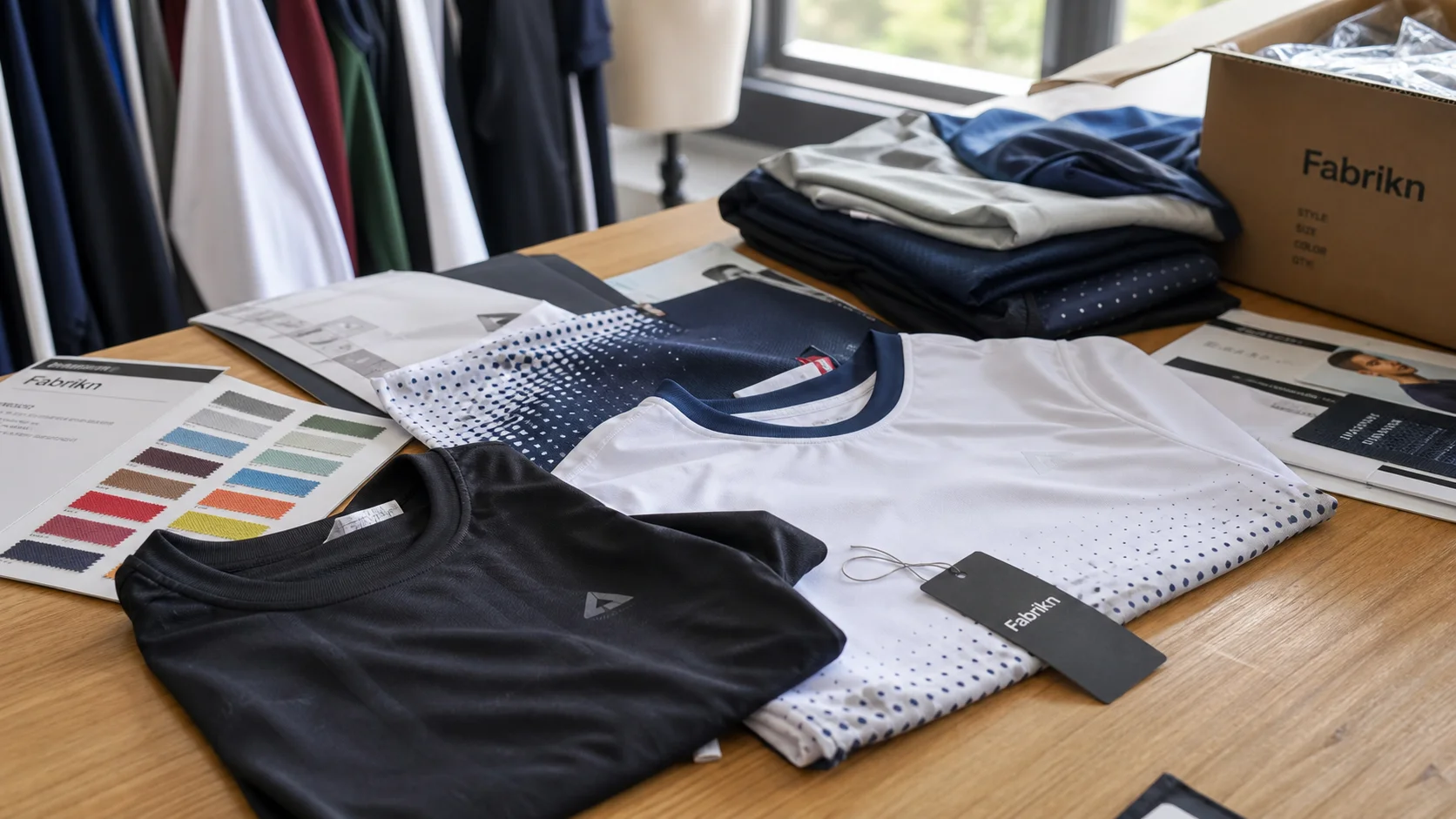
Country of Origin Tags for Apparel compared by sample evidence, fabric or trim specs, MOQ, AQL terms, cost lines, delivery timing, and rework responsibility.
Fast answer: Country of Origin Tags for Apparel: Tech Pack, Sample Gate, MOQ, and QC Terms should be judged by production evidence, not by a generic sourcing promise. The buyer needs sample proof, cost breakdowns, QC checkpoints, and delivery buffers in writing.
Ask for recent sample photos, measurement tolerances, fabric or print test assumptions, decoration test notes, packing examples, and a named inspection checkpoint. These details show whether the team can repeat an approved sample at bulk volume.
Separate garment cost, decoration, labels, packaging, sampling, testing, freight, and rush charges. Clear cost lines make it easier to reduce colorways, adjust size depth, or reserve more time for sampling.
I once watched a 14,800-piece shipment sit in a bonded warehouse because the origin marks on the garments said “Made in Vietnam,” while the entry paperwork listed “Country of origin: China” for a shell fabric that had been cut and sewn elsewhere. The tag cost $0.03. Then freight delays, relabeling labor, broker rework, and storage fees piled up, and the correction bill touched $30,000.
That is the part most buyers miss about country of origin tags for apparel. The label is tiny, but the liability is not. A trim that costs $0.02–$0.08 can end up beside customs holds, retailer chargebacks, return-to-sender freight, and a compliance review that eats two weeks. I have seen a $0.05 woven flag label protect a six-figure order and a $0.04 print trigger a retailer audit that turned up three more SKU-level errors.
Sampling rooms look polished, compliance shelves neat. Then production starts, one subcontracted sewing line swaps a label roll or a packaging team copies the wrong carton code, and the whole shipment becomes a puzzle nobody wants to solve. And risk climbs fastest on orders under 5,000 units because teams assume the label is “just paperwork” and leave it to the last minute.
Country of origin tags for apparel matter for three reasons: customs pries into them to decide admissibility and duties, retailers rely on them to police vendor agreements and markup rules, and consumers treat them as a trust signal even when they do not read every label carefully. If the origin mark is missing, vague, or inconsistent with the bill of materials, the problem is not cosmetic. It is legal, financial, and operational.
Last year I worked with a brand that sourced French terry 320 GSM from one mill, dyeing from another, and assembly from a third country. The label itself was technically easy, but the proof trail was not. That gap is where sourcing teams get hurt.
We rerouted several cartons to a certified facility in Guangzhou that runs Monforts pad-dry-cure lines and uses Stahls Hotronix presses to affix heat transfer labels. Relabeling labor in that plant cost $2.50-4.00 per unit at 500 MOQ because the rewoven flag had to pass QC and double-check its GOTS, OEKO-TEX Standard 100, and WRAP certifications before shipping. And the whole process—from submitting new artwork to receiving customs approval—took 18-22 business days, long enough that the retailer pushed the arrival date and the brand lost a promotional window.
Country of origin tags for apparel are not the same thing as care labels, fiber content labels, or brand labels. The origin tag answers one question only: where the garment is legally considered to have originated. Care labels explain washing and drying. Fiber labels list materials, such as 100% cotton, 60/40 cotton-poly, or 92% nylon and 8% elastane. Brand labels identify the seller or trademark owner. And those functions often live on one neck label, but they are not interchangeable.
In the US, origin marking is tied to customs rules and Federal Trade Commission guidance, so the mark must be clear, permanent enough for normal use, and legible. The EU and UK lean harder on language clarity, consumer transparency, and retailer documentation. Canada and Australia both expect readable origin statements, but the exact format can vary by product type and channel. And a garment sold on a marketplace may face stricter documentary scrutiny than the same item sold wholesale to one retailer.
“Designed in” is not “Made in.” “Assembled in” is not always enough. But partial assembly in one place does not automatically establish legal origin if the substantial transformation happened elsewhere. Mixed-country inputs make this messier, not less. A shell fabric woven in one country, dyed in another, and cut and sewn in a third still needs one defensible legal origin basis, not a creative slogan.
Placement and permanence matter. A hangtag alone may satisfy a presentation need, but many markets expect the origin statement to survive the ordinary life of the garment. Language matters too, because I have seen labels rejected for using abbreviations buyers understood but customs officers did not. A compliant label is not a marketing line. It is a legal statement that must withstand inspection at the carton, ticket, and garment level.
If you build private-label basics or premium tailoring, treat origin wording as part of the tech pack instead of a last-minute trim decision. And that is exactly where private label clothing services can help, because the label language sits alongside fit, fiber, and packaging rules instead of being corrected after the PO is issued.
In the United States and Canada, the pressure comes from border enforcement, broker documentation, and retailer scrutiny. The US is especially unforgiving when the origin statement conflicts with entry data or the supply chain story. Canada is similar in spirit, though some buyers forget that bilingual expectations can affect how label copy is presented. But a missing country line can trigger a document query even when the garment itself is fine.
Europe and the UK are different. Origin claims are still governed by customs logic, but retailers and platforms often add their own rules about visibility and language. I have seen EU buyers request origin text on the care label, the carton, and the hangtag for one style, then reject a second style because the claim was tucked under the seam allowance. In these markets, clarity is not optional. It is commercial hygiene.
Asia and export hubs reveal a split between factory habit and legal practice. Vietnam, Bangladesh, Turkey, and Portugal all work quickly when the brief is clear, but their label approval cycles differ. In Vietnam—especially Ho Chi Minh City and Hanoi garment zones—a clean label correction can move in 3-5 days if the PP sample is approved, thanks to rotary screen printing lines and Juki MO-6804S overlock machines ready on the line. Bangladesh’s Dhaka and Chattogram clusters, handling organic cotton blends that demand GOTS and OEKO-TEX Standard 100 oversight, often need 5-7 days because trim vendors, knit masters, and merchandisers may sit in different buildings. Turkey, especially Istanbul’s denim hubs, can turn a revision in 2-4 days on smaller runs, while Portugal usually moves fastest on technical knitwear and tailored programs, especially when the approval loop is already standardized at 48-72 hours.
Some lower-cost factories handle documentation better than premium suppliers because they export more often. I have seen a mid-tier factory in Bangladesh produce cleaner carton mapping, SKU tracking, and origin declarations than a luxury-adjacent supplier in Southern Europe that relied too heavily on one senior merchandiser. But experience with volume often beats status. According to U.S. trade and customs guidance, customs documentation quality is tied less to factory “tier” and more to process discipline and export frequency.
The practical point is simple. A garment can need one label for one market and a slightly different label for another, even when the fabric, sewing line, and pack method are identical. And if your cut and sew manufacturing partner understands destination-specific marking, you waste fewer days on relabeling and fewer dollars on air freight.
A strong brief makes the supplier's job narrower and the quote more reliable. For country of origin tags for apparel, include the target customer, sales channel, expected order quantity, size range, decoration needs, packaging requirements, and delivery market. Then call out the details most likely to affect the result, especially material grade, print tolerance, and barcode size.
The brief should also explain what cannot change. Some brands care most about hand feel, some about price, some about launch timing, and some about retail compliance. When those priorities are not written down, suppliers tend to optimize for whatever is easiest to quote. Clear priorities help the factory make better tradeoffs before the first sample is cut or printed.
Ask the supplier to respond with assumptions, not just a price. A useful reply states MOQ, sample route, production capacity, inspection plan, packing method, and freight handoff. If the answer is vague, the project may still work, but it needs a tighter pre-production stage before money and calendar pressure build up.
The best time to catch problems is before the pre-production sample is approved. Check measurements, color, placement, material behavior, shrinkage, construction, labels, and packaging in the same review instead of approving each item in isolation. Many bulk issues are not caused by one dramatic mistake; they come from several small unchecked assumptions.
For country of origin tags for apparel, pay special attention to folding method, pack-out sequence, and retail compliance. These details often look minor in an email but become expensive once cutting, printing, sewing, packing, or shipping begins. A simple checklist with owner, due date, and approval status keeps the brand team and factory aligned.
Bulk production should not start until the supplier can explain how the approved sample becomes a repeatable production standard. That means reference sample storage, line instructions, inline checks, final inspection, and defect handling. A factory that can describe this process clearly is usually safer than one that only promises speed.
Price differences are useful only when the quotes cover the same work. Compare sample cost, material source, trims, decoration, packaging, testing, inspection, and freight assumptions. A low unit price can become expensive if it excludes items the brand needs before launch.
Timeline promises deserve the same scrutiny. Ask what happens if the first sample needs revision, whether materials are in stock, when the production slot is reserved, and how export packing is handled. The most reliable supplier is often the one that gives a realistic calendar instead of the fastest optimistic answer.
Before making the final decision, write down the specification, approval owner, delivery expectation, and the one or two risks that would cause the most trouble if missed. For country of origin tags for apparel, this usually means checking material grade, print tolerance, barcode size, and the support process after the order is placed.
This last review does not need to be complicated. It simply makes the decision easier to repeat, easier to explain, and easier to verify when the finished product or jewelry arrives.
One useful way to pressure-test the decision is to ask what would happen if the order had to be repeated in six months. The answer should still be clear: the same material grade, the same print tolerance, the same acceptance standard, and the same communication path. If a second order would depend on memory or guesswork, the first order is not documented well enough yet.
Another useful check is to separate preference from requirement. Preference is the look, wording, or finish the brand likes. Requirement is the measurement, tolerance, certificate, material, or delivery condition that cannot fail. Good buying decisions keep both visible, so the final choice is not pushed around by the last email, the cheapest quote, or the prettiest sample photo.
Finally, ask who owns each approval. A project with one accountable owner for sample review, one owner for final content or artwork, and one owner for delivery sign-off usually moves faster than a project where every decision is shared loosely across a team. Clear ownership reduces delays and makes the finished result easier to judge.
The finished result should be judged against the approved standard, not against a vague idea of what looked good at the start. Compare the delivered item with the approved sample, written specification, photos, and any measurement or certification notes. If the result meets those points, the project is easier to reorder and easier to improve later.
If something is off, record it in practical terms: where the issue appears, how often it appears, whether it affects use, and what change would prevent it next time. That turns a complaint into a useful production note and helps the next order become more consistent.