
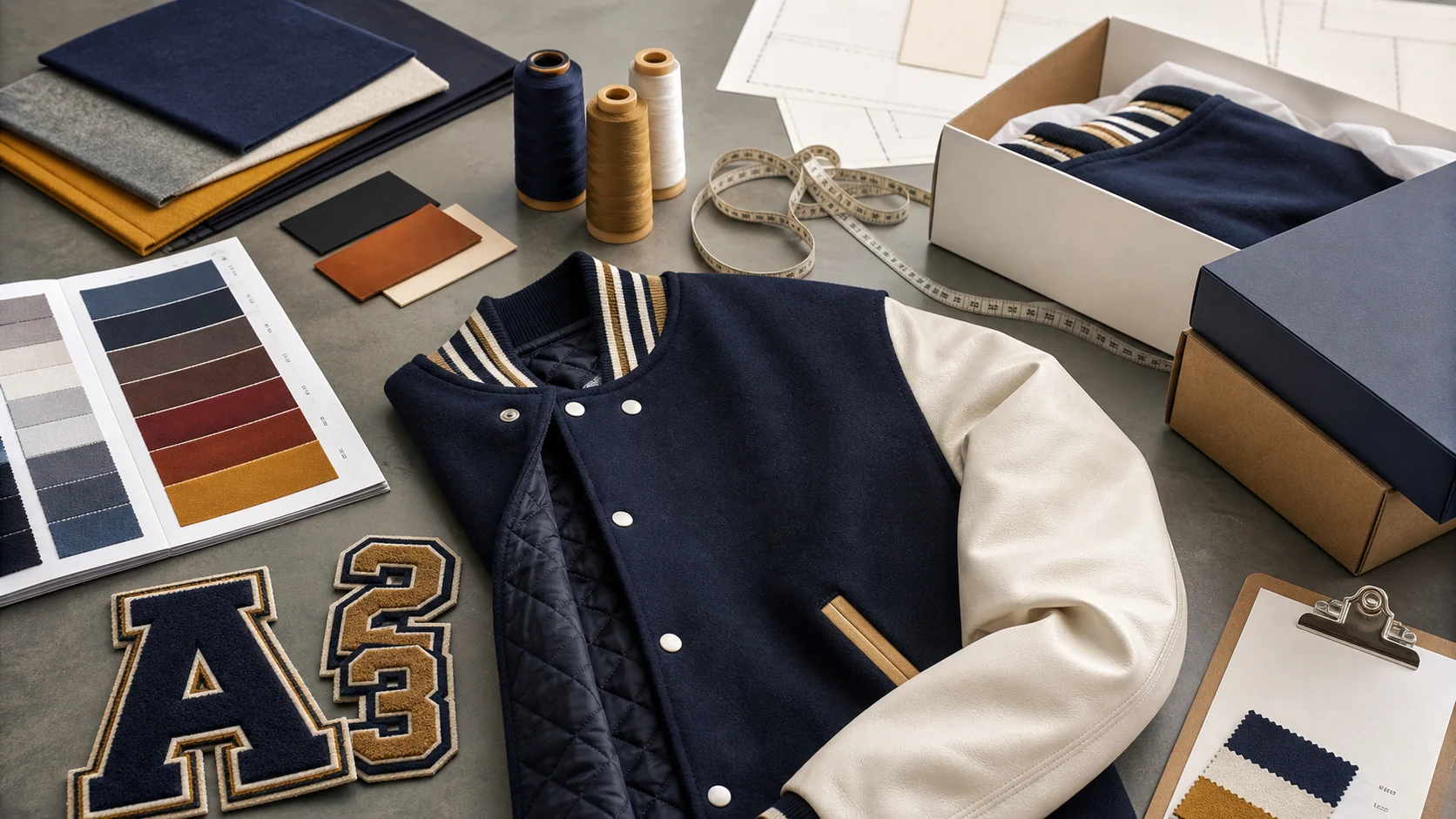
Alumni Clubs Design Custom Appliqué Varsity Jackets compared by sample evidence, fabric or trim specs, MOQ, AQL terms, cost lines, delivery timing, and...
Fast answer: Alumni Clubs Design Custom Appliqué Varsity Jackets: Sample Fit, Trim, AQL, and Delivery Risk should be judged by production evidence, not by a generic sourcing promise. The buyer needs sample proof, cost breakdowns, QC checkpoints, and delivery buffers in writing.
Ask for recent sample photos, measurement tolerances, fabric or print test assumptions, decoration test notes, packing examples, and a named inspection checkpoint. These details show whether the team can repeat an approved sample at bulk volume.
Separate garment cost, decoration, labels, packaging, sampling, testing, freight, and rush charges. Clear cost lines make it easier to reduce colorways, adjust size depth, or reserve more time for sampling.
How Alumni Clubs Design Custom Appliqué Varsity JacketsAlumni clubs love a varsity jacket for the same reason every good school memory sticks: it feels earned. It is not just another promotional hoodie tossed into a welcome bag. A custom appliqué varsity jacket carries the colors, the crest, the year, the chapter name, and that slightly proud energy people still feel when they say, “I went there.” When the body is built from 22 oz Melton wool and the sleeves use 1.4 mm PU or split cowhide, the jacket stops looking like merch and starts looking like a keepsake.
In my experience, alumni groups do best when they treat the jacket as a real membership piece, not a last-minute merch item. The strongest projects usually come from clubs that think about fabric weight, patch placement, embroidery density, and resale value for future fundraisers. A well-made appliqué jacket can look premium for years; a rushed one can start pilling at the cuffs after one season. That difference is usually decided on the factory floor, not in the sales deck.
If you are planning custom appliqué varsity jackets for alumni clubs, this guide walks through how the design process works, what a factory needs from you, what it costs, and where groups usually get tripped up. I will keep it practical, because that is what buying teams need. Most factory-direct orders move in 18-22 business days after sample approval, with a 3-5 business day proto sample if the artwork is clean.
How Alumni Clubs Design Custom Appliqué Varsity Jackets - Custom Clothing manufacturing guide
Appliqué gives a varsity jacket depth. That is the short version. The longer version is that it creates a layered, tactile look that embroidery alone cannot always match. Felt letters, twill patches, chenille numbers, and stitched crest elements all work together to make the jacket feel substantial. Alumni notice that immediately, especially when the chenille pile is 3-5 mm high and the satin stitching is dense enough to hold crisp edges.
Most alumni clubs want three things at once: pride, durability, and a piece people actually wear. Appliqué helps with all three. It reads well from a distance, it photographs well at reunions and chapter events, and it feels more “official” than a printed jacket because the design is physically built into the garment. Clubs that want a premium look usually pair a wool body with contrast striped rib knit at 2x2 or 3x3 gauge for the cuffs, collar, and waistband.
I have seen clubs choose appliqué when they want the jacket to do double duty as a commemorative item and a retail product. A clean design with school colors and a tasteful back letter can sell year after year. That is hard to do with trend-driven graphics, but easy when the art is built around a 10 to 12 inch back crest or a 7 inch chenille letter that does not age out.
“The jacket should look like something the club earned, not something the club rushed.” That is the simplest rule I share with alumni buyers.
The best designs start with one question: what should the jacket say about the club? That sounds simple, but it drives every decision. Are you trying to honor a specific graduating class? Are you building a general alumni jacket that can be sold for years? Are you celebrating a centennial, a homecoming, or a regional chapter? Those answers change the layout, the patch count, and even whether the sleeves need a second-color panel.
For custom appliqué varsity jackets for alumni clubs, I usually recommend starting with a core structure: left chest logo, back appliqué letter or crest, sleeve detail, and a clean inside label. From there, the factory can build a mockup and adjust sizes, colors, and stitch density. A good tech pack should include Pantone or TCX references, logo artwork in vector format, and the exact placement in millimeters, not just “centered.”
One thing I always push back on: trying to fit too much onto the jacket. Alumni groups often want every chapter, every date, every slogan, and every sub-logo on one garment. The result is clutter. A varsity jacket needs breathing room. If the back panel is already carrying a 9-inch chenille letter or a 10-inch crest, keep the rest disciplined and use embroidery sparingly for names or dates.
If your club is still exploring options, you can start with the broader service overview at fabrikn.com/services/ and narrow the jacket build from there.
Material choice changes everything. The same design can look premium or forgettable depending on the base fabric. For alumni jackets, the most common build is a wool-blend body with faux leather or genuine leather sleeves. That combination has the classic varsity feel people expect. It is warm, structured, and easy to recognize. In practice, I see factories in Guangzhou and Ho Chi Minh City quote the wool body at 22-24 oz per linear yard, while Dhaka factories often push a slightly lighter build for warmer climates.
Chenille appliqué works especially well on wool bodies because the texture sits naturally on the surface. Twill appliqué is another strong option when the club wants sharper edges and cleaner letter shapes. For embroidery-heavy clubs, I usually recommend using appliqué for the main letter and embroidery for the smaller details. That keeps the jacket readable. A Tajima or Barudan multi-head embroidery machine can handle the small text, while the main patch is usually laser-cut or die-cut before being tack-down stitched on a Juki LH-3578A or similar lockstitch machine.
The inside lining matters too. 190T satin is common because it slides on easily and feels polished. Quilted lining with 100-120 gsm polyester fill adds warmth, which is useful for clubs in colder regions. Rib knit cuffs and waistbands should be checked carefully; a 2x2 striped rib with 5-7% spandex will recover better than cheap acrylic trim. If those trim parts are weak, the jacket will age badly no matter how good the appliqué looks.
For clubs that need compliance documentation, ask for GOTS if the cotton components are organic, OEKO-TEX Standard 100 for fabric and lining safety, and WRAP or BSCI for factory social compliance. Those certifications are often carried by export factories in Guangzhou, Dhaka, and Ho Chi Minh City, but they should be verified on the actual audit certificate, not just mentioned on a sales sheet.
People often picture a factory as one big room with sewing machines. The reality is more layered. A good custom jacket factory usually divides the process into cutting, patch preparation, appliqué placement, stitching, sleeve assembly, body construction, quality checking, and final packing. Each step affects the final outcome. For jackets like these, I expect to see a laser cutter or hot knife table for patch shapes, a heat press for fusible backing, and a separate QC station with a measurement board and needle detector.
In a typical mid-size garment factory, one production line might handle 300 to 600 jackets per month depending on complexity. Appliqué jackets take more time than printed fleece or basic hoodies because the patch work is manual and detailed. A strong factory will also keep sample rooms, thread libraries, color cards, and trim tables so the club can approve details before bulk sewing begins. On the sewing floor, you will usually see Juki DDL-8700 lockstitch machines for construction, Juki bartack machines for stress points, and overlock machines for seam finishing.
I have seen the best results when the factory pre-tests the appliqué edges before full production. That reduces fraying, keeps corners neat, and avoids the lumpy look that cheaper shops sometimes produce. There is a reason buyers pay extra for careful stitching. It shows, especially at the shoulder seam, the pocket mouth, and the collar join where a poorly aligned patch can throw off the entire jacket.
If you want a closer look at the company background before ordering, visit fabrikn.com/about-us/. That is usually the page I suggest to clubs that want to understand the production standards before they move forward.
Let’s talk numbers, because that is usually where the conversation becomes real. Custom appliqué varsity jackets for alumni clubs are not bargain items. They are premium garments. Price depends on fabric, patch complexity, sleeve material, order volume, and whether you want custom labels or personalized names. A jacket with chenille front letters, satin lining, and standard rib trim will price very differently from a jacket with genuine leather sleeves, embroidered names, and inside neck tape.
For a general reference, I would expect the following range in a factory-direct setting:
Order Type Typical Unit Price Notes 50-99 jackets $58-$92 Basic wool-blend body, standard appliqué, fewer custom touches 100-299 jackets $44-$74 Better pricing once the pattern and trims are locked 300-499 jackets $36-$58 Common range for alumni associations and reunion campaigns 500+ jackets $31.50-$49.00 Best unit economics, especially with standard colors and shared artworkThat range moves quickly if you upgrade to genuine leather sleeves, add individual names, or require oversized chenille work. A 500-unit order with standard wool body, faux leather sleeves, one front emblem, and one back appliqué can land near the lower end. If you want premium leather, custom woven labels, and private packaging, expect the price to rise by $8-$18 per jacket.
One insider detail that matters: many factories in Guangzhou and Dhaka will quote a lower base price, then add separate charges for mold cutting, chenille digitizing, and label setup. Ask for those line items up front so your landed cost is real. Ho Chi Minh City factories often bundle more of those steps, but you should still confirm whether sampling, patch tooling, and hangtag setup are included.
For alumni clubs, timing usually matters because the jacket needs to arrive before reunion weekend, homecoming, or a fundraising launch. The normal timeline is 18-22 business days after sample approval for a straightforward order, and 25-35 business days if you are using custom chenille patches, individual names, or genuine leather sleeves. If the factory is busy during peak season, especially August through November, add another week.
A clean schedule usually looks like this: 3-5 business days for artwork and proto sample, 5-7 business days for material sourcing if the colors are not stock, 7-12 business days for bulk sewing, and 2-4 business days for QC and packing. If the club wants pre-shipment inspection by a third party, add one more day.
One thing alumni buyers often forget: shipping can be the slowest part. Air freight from East Asia is faster but expensive; sea freight can save money on larger orders but may add 18-30 days depending on the port. For small event launches, I usually recommend holding a 10-15 jacket buffer in case of size swaps or late sign-ups.
The most common mistake is overcomplication. Clubs cram too many names, symbols, and event dates onto one jacket, and the result looks busy. A varsity jacket is not a scrapbook. The second mistake is ignoring contrast; a navy-on-black appliqué or burgundy-on-dark green combination can disappear in photos and in person. The third mistake is not checking the rib trim and lining, which are the first places cheap jackets reveal themselves.
Another mistake is approving artwork without physical size references. A crest that looks balanced on a screen can become tiny on a 24-inch back panel. I usually tell buyers to print the layout at scale before final sign-off. If the letter or crest is meant to read from 10 feet away, you need more size than most people think. Also, never forget shrinkage and seam allowance: a 1/4 inch tolerance is normal in cut-and-sew work, but it needs to be planned into the placement.
Alumni clubs often underestimate how well a jacket can raise money. A premium jacket gives people a reason to spend more because it feels like a milestone item, not just merchandise. The strongest fundraising campaigns usually offer early-bird pricing, a numbered limited run, or a reunion pre-order window that lasts 10-14 days. That creates urgency without cheapening the product.
For example, a club might sell 120 jackets at $89 each, with a landed cost around $42-$55 depending on the build. That leaves room for a healthy fundraising margin, especially if the club keeps artwork simple and avoids too many one-off customizations. Some associations also bundle the jacket with a T-shirt or cap for a higher-value package, but the jacket should remain the hero item.
The best fundraising jackets also photograph well. If your club is sharing images on Instagram or in reunion mailers, make sure the back crest reads cleanly and the sleeve details do not disappear. A jacket that looks strong in a flat lay but awkward on a person will underperform in sales.
If you want the order to move smoothly, send the factory a complete package. That should include logo files, Pantone or TCX color references, desired quantity by size, preferred material, and your deadline. The better your information, the fewer back-and-forth rounds you will need. Most factories can work from AI, EPS, or layered PDF artwork; they struggle when buyers send low-resolution JPEGs pulled from social media.
I also recommend asking for three things before you pay a deposit: a size spec sheet, a trim card, and a photo or video of the sample under neutral lighting. If the factory offers customization from Guangzhou, Dhaka, or Ho Chi Minh City, ask where the main sewing line is actually located and which third-party audits are current. WRAP or BSCI documentation is useful, but only if it matches the facility that will sew your order.
A good order form should also clarify whether the jacket will have woven neck labels, printed care labels, or heat-transfer size labels. Those small details matter because they affect comfort and perceived quality. For alumni clubs, I usually recommend woven main labels and soft printed care labels so the neck feels cleaner.
Get a free quote from Fabrikn — your trusted B2B clothing manufacturer with 10+ years of experience. MOQ as low as 200 pieces.
Get a Free Quote →Most clubs start at 50-100 units, but the best pricing usually appears at 300 units or higher. If you expect several class years or chapters to buy in, 500 MOQ can improve your per-unit cost by $10-$15 compared with a small run.
Yes. Individual names are usually added through embroidery or a sewn-on twill name strip. Class years can be placed on the sleeve, chest, or inside label. Just remember that each extra variable increases labor time and may add $2-$6 per jacket.
You can ask for recycled polyester lining, OEKO-TEX certified fabrics, and organic cotton rib or pocketing if the supplier carries it. Some factories can also source GOTS-certified cotton trim, but availability depends on the mill and the order size.
Guangzhou is strong for speed, trim sourcing, and sample turnaround. Dhaka is often competitive on labor-heavy construction and larger bulk runs. Ho Chi Minh City is a good middle ground when you want organized production and clear quality control. The best choice depends on whether your priority is cost, speed, or consistency.
Ask for the confirmed measurement chart, final Pantone match, patch size in inches, stitch type, certification list, and ship date. If the jacket uses chenille, confirm whether the factory is using a chainstitch embroidery process or a cut-pile chenille application, because the feel and price are not the same.
For clubs that want a polished starting point, the safest move is to lock the concept early, keep the materials classic, and choose a factory that can show real sample work instead of just mockups. That is usually where the difference between “nice merch” and “club standard” becomes obvious.