
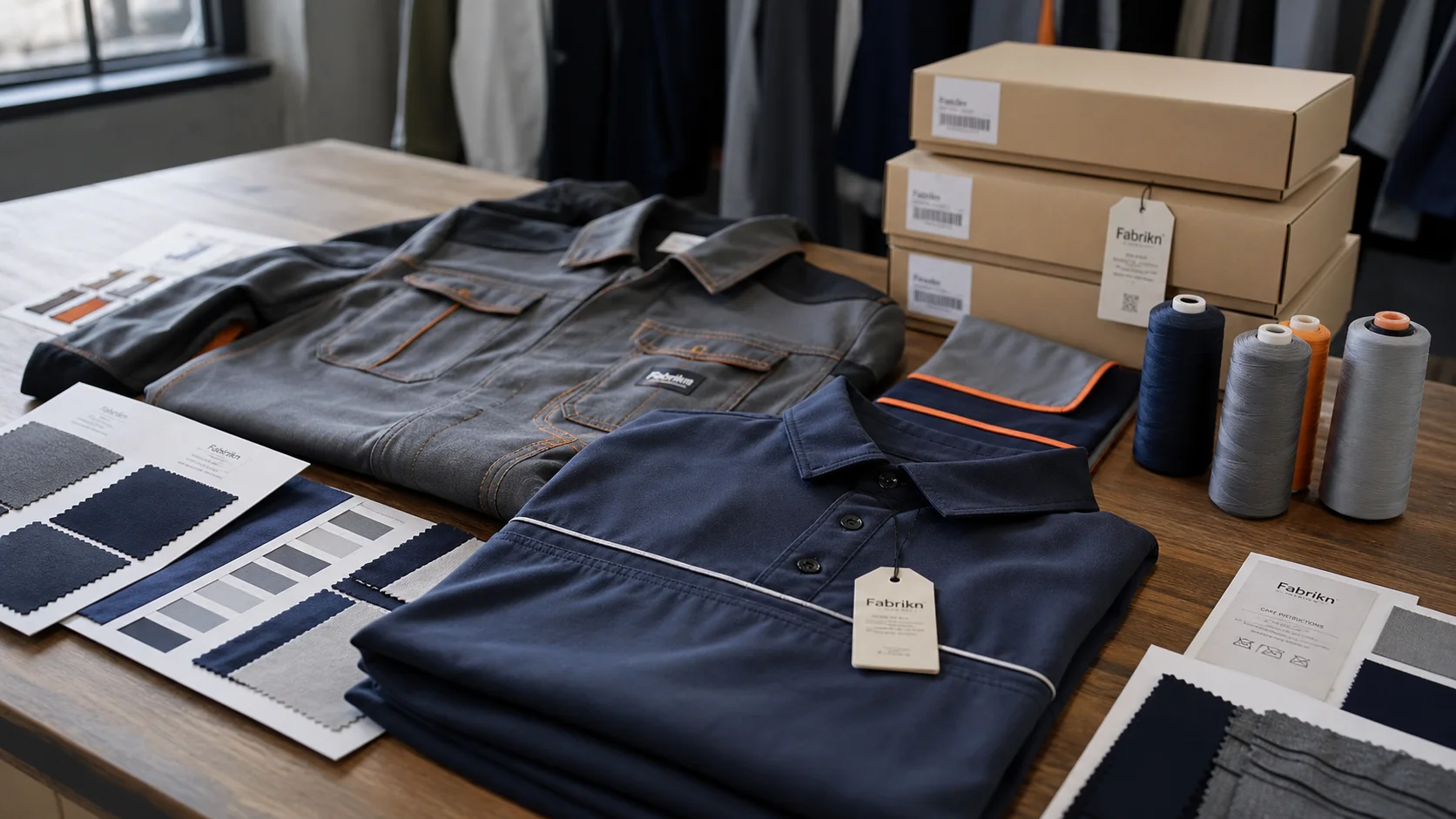
Custom Barcode and Price Labels for Apparel Packaging compared by sample evidence, fabric or trim specs, MOQ, AQL terms, cost lines, delivery timing, and...
Fast answer: Custom Barcode and Price Labels for Apparel Packaging: Material, Print, MOQ, and QC Terms should be judged by production evidence, not by a generic sourcing promise. The buyer needs sample proof, cost breakdowns, QC checkpoints, and delivery buffers in writing.
Ask for recent sample photos, measurement tolerances, fabric or print test assumptions, decoration test notes, packing examples, and a named inspection checkpoint. These details show whether the team can repeat an approved sample at bulk volume.
Separate garment cost, decoration, labels, packaging, sampling, testing, freight, and rush charges. Clear cost lines make it easier to reduce colorways, adjust size depth, or reserve more time for sampling.
One wrong label can stall a line faster than a broken needle. In custom barcode and price labels for apparel packaging, accuracy is not a finishing touch; it is the difference between clean dispatch and a very expensive apology. I once watched a warehouse crew stop packing for 18 minutes because a size 8 label had been printed over a size 10 code, and by the time anyone caught it, 240 units needed rework, two pallets were quarantined, and the retailer had already flagged the ASN. And yeah, the crew swore the next batch would be triple-checked before the knives even warmed up.
In Guangzhou’s Huangpu district, the compliance office insisted that every label supplier carry WRAP and BSCI certifications plus GRS documentation for recycled facestocks before the brand would sign a PO. That same program tracked OEKO-TEX Standard 100 and GOTS verification on the cotton hang tag yardage used on the label’s backing board, so any glue or ink had to stay within those thresholds. The purchasing team kept the certification printouts on their desks like talismans.
Retail labeling mistakes can add 2-5% in extra handling costs on certain programs, especially where a receiving center charges for relabeling, recertification, or manual key-entry. In one wholesale program I reviewed, the brand paid $0.14 per carton for intake labor, then another $0.09 for exception processing when barcodes failed on the first scan. That sounds tiny until you multiply it by 8,000 cartons a season. And then you get that sinking feeling in the cost review when someone says, "Oops, we missed a barcode batch."
Apparel packaging labels do more than identify a SKU. They keep size breaks intact, prevent color sorting errors, and speed up distribution center flow. A clean label on a polybag, hang tag, or shipper case helps the operator move in 3-4 seconds instead of stopping to decode style numbers by hand. At scale, those seconds turn into trailers. And when those labels start to smear, the operators feel it in the form of line backups and angry supervisors.
I’ve seen the same defect behave very differently by channel. A direct-to-consumer brand shipping 1,500 units a week can fix a bad carton label in about 12 minutes if the pack room catches it early. A wholesale program shipping 60,000 units to 14 doors may end up with a full pallet hold, a missed delivery window, and a chargeback tied to the retailer’s compliance manual. Same mistake, very different bill. But the wholesale team got the chargeback and then some.
According to ASTM and retail compliance documents from major chains, scan accuracy and label consistency are not optional in receiving. I’ve seen brands spend $0.02 more per label and save far more in labor because the pack line stopped rechecking every fifth carton. That is a revenue protection tool, not a cosmetic detail. It also ties directly to clothing packaging solutions that have to hold up from factory floor to store shelf. And the brand team kept reminding suppliers that the stamping had to stay tight for that reason.
Lead times across global hubs matter, too—when a carrier moves goods from Dhaka through the Suez and then into Istanbul, the label window can stretch to 18-22 business days, so late art approvals cost more than a few hours on a phone call. But spare the approvals and you end up paying for reshoots.
On the line, a label has five jobs. It must scan, communicate price, identify the SKU, carry country-of-origin or fiber content data where required, and support internal inventory tracking. Miss any one of those and the pack-out slows. I’ve seen a barcode print perfectly while the price field was off by $3.00, which caused a bigger headache at retail than a bad scan would have. And then everyone pretended the ticket was just a typo while the register screamed at them.
Placement matters as much as print quality. On polybags, labels need to sit flat without tunneling over a seam. On hang tags, they have to survive stapling, stringing, and folding. On folding cartons, they should stay readable after compression in a master shipper. On shipper cases, the carton code must be visible from 1-2 meters and protected from rub during transit. But the people folding the cartons are not artists, so make it easy for them.
Ask about barcode type, quiet zone, print contrast, adhesive strength, and temperature resistance before approving a spec. GS1-128 is common for cartons, while UPC-A or EAN-13 often appear on retail tickets. The quiet zone needs enough white space so scanners can separate the code from nearby text. If the label is going on chilled stock or humid routes, ask for performance data at 0-5°C and 70-85% relative humidity. And don’t let anyone tell you those ranges are optional.
The thing nobody tells you: a more expensive label can lower total cost if it cuts reprints and line stoppages by 5-8%. I saw this in a factory outside Ho Chi Minh City where a $0.041 synthetic label replaced a $0.019 paper label that kept smudging under a hot knife sealing station. The new label cost more on paper, but the line saved 2 rework cycles per shift and stopped losing 30-40 minutes of production each day. And that was enough to buy lunch for the team for a week.
Price labels also behave differently by channel. Full-price retail wants crisp MSRP and clean typography. Outlet programs often need old price plus new markdown fields, sometimes with a 2-3 line hierarchy. Promotional markdown workflows need variable data that can be updated within 24 hours, especially during clearance events. If your program includes private label clothing, the label spec needs to keep brand, size, and price clear without crowding the pack. But know which channel you're on before you lock the layout.
Direct thermal, thermal transfer paper, polypropylene, polyester, and removable films each solve a different problem. Direct thermal is cheap and fast, but heat and abrasion can darken the print. Thermal transfer paper gives better durability at a modest price. Polypropylene works well for moisture exposure. Polyester handles rough handling, UV, and long shelf life better than most paper stocks. Removable films are useful for premium packaging where the label must come off cleanly. But every material still needs a test run.
In practice, folded garments in dry, fast-turn environments can use paper labels with a permanent or medium-tack adhesive. Cold storage, coastal transit, and humid routes often need synthetic films with a stronger adhesive and a ribbon that resists smear. I’ve handled samples that sat for 6 weeks in a 35°C port warehouse, and the paper label looked tired by day 10 while the polyester sample was still readable after 1,200 rub cycles. And the buyers never blinked when the factory said “synthetic” a second time.
Adhesives matter more than buyers expect. Permanent adhesives are the default for carton and shipper applications. Removable adhesives suit premium hang tags or display packaging. Freezer-grade adhesives stay put at -18°C and lower, while low-tack options are better for delicate retail surfaces. A label that peels in the warehouse may be a defect; a label that leaves residue on a luxury box can trigger a separate complaint from the brand team. But the sourcing team still gets asked for “something cheaper.”
Print durability is not theory. Rub resistance, UV exposure, and smudge performance decide whether the carton arrives readable. Thermal transfer with resin ribbons performs better than wax when a label will face wet totes or rough distribution handling. I ask factories for abrasion testing and, if possible, a 24-hour sunlight check. Data from OEKO-TEX, Textile Exchange, and supplier test reports can also help brands align packaging choices with material safety and finish expectations. And if a test report looks too clean, it probably was run under perfect lab conditions.
Regional conditions change the spec. In southern China and Vietnam, humidity pushes many factories toward synthetic stocks earlier than buyers expect. In northern Europe, longer transit times and colder storage can favor stronger adhesives and more stable print films. In Mexico and parts of Latin America, dust, temperature swings, and longer inland routes often matter more than just humidity or cold does, so the label needs to keep sticking no matter how rough the truck ride gets.
A strong brief makes the supplier's job narrower and the quote more reliable. For custom barcode and price labels for apparel packaging, include the target customer, sales channel, expected order quantity, size range, decoration needs, packaging requirements, and delivery market. Then call out the details most likely to affect the result, especially material grade, print tolerance, and barcode size.
The brief should also explain what cannot change. Some brands care most about hand feel, some about price, some about launch timing, and some about retail compliance. When those priorities are not written down, suppliers tend to optimize for whatever is easiest to quote. Clear priorities help the factory make better tradeoffs before the first sample is cut or printed.
Ask the supplier to respond with assumptions, not just a price. A useful reply states MOQ, sample route, production capacity, inspection plan, packing method, and freight handoff. If the answer is vague, the project may still work, but it needs a tighter pre-production stage before money and calendar pressure build up.
The best time to catch problems is before the pre-production sample is approved. Check measurements, color, placement, material behavior, shrinkage, construction, labels, and packaging in the same review instead of approving each item in isolation. Many bulk issues are not caused by one dramatic mistake; they come from several small unchecked assumptions.
For custom barcode and price labels for apparel packaging, pay special attention to folding method, pack-out sequence, and retail compliance. These details often look minor in an email but become expensive once cutting, printing, sewing, packing, or shipping begins. A simple checklist with owner, due date, and approval status keeps the brand team and factory aligned.
Bulk production should not start until the supplier can explain how the approved sample becomes a repeatable production standard. That means reference sample storage, line instructions, inline checks, final inspection, and defect handling. A factory that can describe this process clearly is usually safer than one that only promises speed.
Price differences are useful only when the quotes cover the same work. Compare sample cost, material source, trims, decoration, packaging, testing, inspection, and freight assumptions. A low unit price can become expensive if it excludes items the brand needs before launch.
Timeline promises deserve the same scrutiny. Ask what happens if the first sample needs revision, whether materials are in stock, when the production slot is reserved, and how export packing is handled. The most reliable supplier is often the one that gives a realistic calendar instead of the fastest optimistic answer.
Before making the final decision, write down the specification, approval owner, delivery expectation, and the one or two risks that would cause the most trouble if missed. For custom barcode and price labels for apparel packaging, this usually means checking material grade, print tolerance, barcode size, and the support process after the order is placed.
This last review does not need to be complicated. It simply makes the decision easier to repeat, easier to explain, and easier to verify when the finished product or jewelry arrives.