
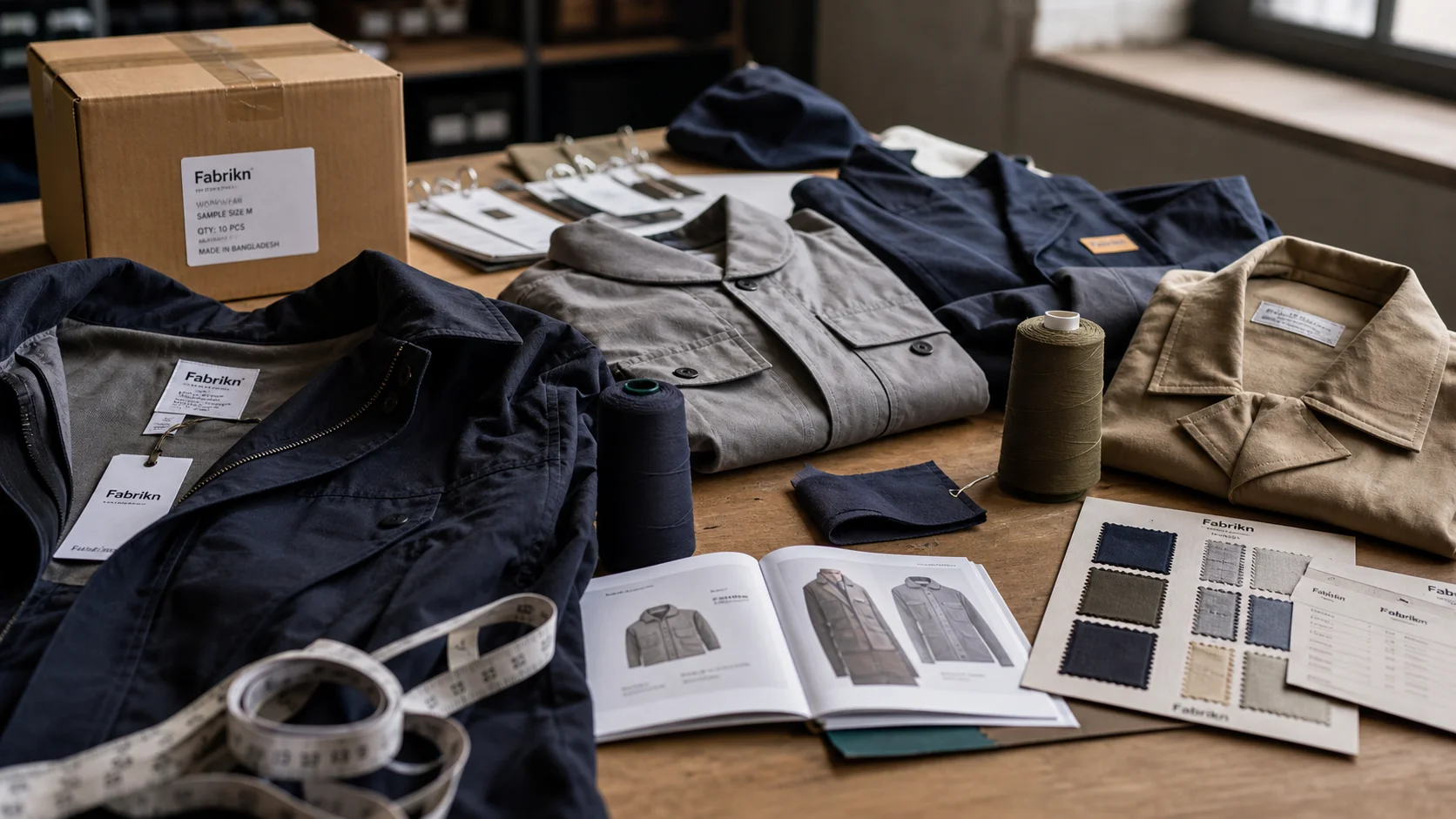
Barcode and Price Stickers with checks for samples, fit, MOQ, QC evidence, pricing terms, and delivery risk.
Fast answer: Barcode and Price Stickers: Data Fields, Adhesive, Print, and Packing should be judged by production evidence, not by a generic sourcing promise. The buyer needs sample proof, cost breakdowns, QC checkpoints, and delivery buffers in writing.
Ask for recent sample photos, measurement tolerances, fabric or print test assumptions, decoration test notes, packing examples, and a named inspection checkpoint. These details show whether the team can repeat an approved sample at bulk volume.
Separate garment cost, decoration, labels, packaging, sampling, testing, freight, and rush charges. When every cost line is visible, it becomes easier to reduce colorways, adjust size depth, or reserve more time for sampling.
One bad sticker can turn a clean shipment into a very expensive mess. I watched a 10,000-box run from a Guangzhou consolidation center to Istanbul derail in under three minutes: a misread price, a duplicated SKU, and then the rechecks, repacks, and furious emails began. That is why custom barcode and price stickers for clothing boxes are not decoration. They are control.
Clothing boxes do not behave like loose polybags. They stack, scrape, and sit in humid containers for three or four weeks, then get scanned under warehouse lights that are far less forgiving than a desk lamp. In Dhaka I watched acrylic permanent adhesives fail after a 21-day hold because the stickers had never been run through a humidity chamber, while the Ho Chi Minh City export dock crews relied on synthetic PET films for the same reason. Sometimes another carton has already scuffed the surface in transit. A label that looks perfect on a table can fail on a pallet at 85% humidity or after 200 meters of conveyor handling. The sticker has to survive the box, not the sample table.
The math is brutal. A 1% labeling error rate on 10,000 boxes creates 100 exceptions. If each one takes eight minutes of labor at $12-18 an hour, plus a possible chargeback, the bill can climb past $150-300 before freight delay even enters the picture. Premium brands I’ve seen will spend $0.04-0.08 per sticker to avoid a $2.50 rework problem. In Istanbul-based premium packaging, the combined sticker plus hangtag kit still runs $2.50-4.00 per unit at 500 MOQ when we include protective lamination and tamper-evident slits, but it avoids $40,000 in rework. Not indulgence. Discipline.
Factory visits across regions showed a pattern I did not expect at first. Higher labor-cost plants in Portugal and parts of Eastern Europe often ran tighter label control, with two-point checks and scanner verification on 100% of carton masters. In lower-cost plants I visited in South and Southeast Asia—Guangzhou, Dhaka, and Ho Chi Minh City—the sticker itself might be cheaper by a cent or two, yet the hidden expense arrived later as relabeling, inventory correction, and returns. A 3,000-square-meter finishing line in Istanbul can still win on service if it couples digital HP Indigo 20000 proofs with local inventory buffering. Cheap upfront. Expensive downstream.
The best buyers treat labels as part of SKU integrity, not decoration. That matters whether the cartons hold $8 basics or $80 outerwear. It matters even more for brands moving between retail, wholesale, and DTC channels, where one barcode mismatch can distort inventory and price trust across multiple systems. If you also work in custom baby clothing manufacturing, the stakes rise again because size, safety, and retailer compliance tend to be stricter. Labels must keep up.
Start with the data, not the design. I ask suppliers for SKU, style, size, color, currency, price, barcode type, and any retailer routing marks in a single spreadsheet. If the buyer wants custom barcode and price stickers for clothing boxes to work across warehouse and retail systems, the label has to carry the same truth as the ERP.
Barcode choice matters. Code 128 works well for internal logistics because it carries dense alphanumeric data. EAN and UPC still matter for retail scanning, especially in stores where old POS systems are still running. QR codes can add traceability, but I do not recommend relying on them alone for carton handling because many warehouse teams still scan linear codes first. For apparel exports, I have seen brands use all three: one for retail, one for cartons, one for traceability. I also require the supplier to log the print method—digital HP Indigo 20000 for short runs, Domino N610i thermal transfer for durable batch codes, or Mark Andy Performance Series P7 flexo when repeating the same SKU—and to flag the adhesive base so purchasing can sync it with the carton finish.
Adhesive and face stock should match the box. Recycled board needs stronger tack than virgin kraft. Coated cartons can reject weak adhesives if the surface is too slick. Cold storage is another trap. A label that performs at 20°C may lift at 4°C after condensation forms. For that reason, I ask for a specific note on carton finish, storage temperature, and whether the box will be handled with gloves or bare hands. I also include process notes such as whether the label will be die-cut on a Grafotronic inline finishing line or slit on a Miyawaki rewinder to prevent unexpected edge lift.
Design details decide scan success. Quiet zones around the barcode must stay clean. Contrast should be high. Matte finishes usually scan better than gloss under overhead warehouse lighting because glare can confuse handheld scanners. Minimum bar width matters too; too narrow, and the scan rate falls fast once dust or abrasion enters the picture.
The thing nobody tells you: most label failures I have seen came from bad data input, not bad printing. A 12-digit internal code entered as 11 digits, a wrong currency symbol, or a size mix-up in the merged file can ruin an entire batch. I have seen that happen on runs of 5,000 and 50,000 alike. One extra proofing step would have saved the lot.
Material choice is where buyers either save money or quietly create waste. Coated paper labels work well for short runs and dry warehousing. Thermal labels suit fast variable data, especially where prices or lot codes change weekly. Synthetic polypropylene or PET films cost more, but they hold up in moisture, rough handling, and longer storage cycles. That matters if boxes sit for 30-60 days before retail receipt. I am seeing more shops offer GRS-certified recycled PET and 85-micron matte polypropylene for longer shelf life, and even GOTS or OEKO-TEX Standard 100 approved cotton hangtags for secondary branding.
Printing method changes both cost and durability. Digital printing is ideal for small batches, frequent SKU changes, and pilot programs of 500-2,000 labels. Flexographic printing makes sense for repeat volumes of 25,000 pieces and above, where plate costs can be spread out. Thermal transfer printing remains the workhorse for durable variable codes because the ribbon bonds well and resists smudge better than direct thermal on long transit routes. Machines matter. An HP Indigo 20000 with inline color management gives consistent Pantone hits, while a Xeikon CX3 with Corona treatment ensures inks wet out on polypropylene. A Domino N610i thermal transfer system or a Mark Andy Performance Series P7 will handle the high-tack ribbons you need for cold chain. Finishers such as a Grafotronic DC330 die cutter with servo knife and a Miyawaki slitter rewinder keep the edges from peeling in the warehouse.
Finish is not cosmetic here. Matte labels often perform better than gloss under warehouse LEDs because there is less reflection at scan time. Gloss can still work, but it usually needs stricter placement and scanner angle discipline. I have watched a warehouse team lose 6-8 seconds per carton because glare forced repeated scans. Across 4,000 cartons, that becomes a real labor bill.
I compare options with a simple lens: cost per 1,000 labels, plus failure risk. Entry-level coated paper might run $7-12 per 1,000 for simple black print. A mid-tier paper-plus-lamination label can land at $14-22 per 1,000. Premium synthetic stock with thermal transfer printing can move to $28-45 per 1,000, depending on size, colors, and variable data. Those ranges shift by region, but the pattern is stable.
Cheap paper can be the expensive choice if it peels during a 4,000-unit carton run. I saw this in a factory supplying private label basics: the label cost saved roughly $18 on the order, then the team spent two shifts relabeling cartons after the adhesive failed on recycled board. If your business also runs private label clothing services, consistency matters as much as material price. Buyers remember the rework, not the sticker savings.
Volume changes the economics fast. A 500-label custom order may cost $0.12-0.30 per label before freight, while a 50,000-label order can drop to $0.03-0.08 depending on material and print method. The gap is not only raw quantity. Setup fees, proofing, and machine time matter, especially if the design carries multiple colors or retailer-specific data. After artwork approval, a flexo run from Dhaka or Ho Chi Minh City usually takes 18-22 business days to deliver once the plates are mounted and the ink recipe is confirmed.
For small batches, expect extra charges. Artwork setup might add $20-75. Barcode verification can add $25-100 if the supplier runs proper scan checks. Shipping for a low-volume order can hurt too, because a lightweight parcel still pays minimum freight. By contrast, bulk runs spread fixed costs across thousands of stickers, so the unit price falls quickly. Five hundred versus fifty thousand never compares cleanly.
Special specs raise the price. Variable data, lamination, tamper-evident slits, or die-cut shapes all add labor and material cost. A standard rectangular sticker is cheaper than a custom shape, but a custom die-cut around a zipper silhouette can prevent misplacement and signal premium quality. When you add in the extra time for inline UV coating, automatic slitting passes, and digital inspection cameras (we use ABB Vision systems in our Istanbul finishing line), the per-thousand price increases—but so does confidence on the floor.
Testing begins on the press. In Guangzhou and Ho Chi Minh City, I have seen operators scan each barcode with a Cognex DataMan inline verifier right after a flexographic pass, recording the decode rate and storing the CSV in the ERP. Digital samples run on an HP Indigo 20000 or a Xeikon both go through a static test that checks quiet zones and prints the expected checksum, and the results are tied back to the carton SKU.
Beyond scanners, adhesion and abrasion trials are vital. Teams put labels on the actual box stock, run them through a Grafotronic finishing line, and then send 10 pieces through a Taber abrasion tester and a shear test for the adhesive. If the box will be stowed in a cold warehouse, they also move it through a condensation chamber to watch for lift. Machines like the BYK Gardner adhesion peel tester measure the grams of force so we can compare adhesives before full-order cutting.
Every factory I audit keeps a log of these checks. We sample eight cartons per shift, capture a photo of the barcode, the placement, and the tactile finish, and we store them in a shared folder. If the supplier has ISO 9001 in addition to certifications like WRAP or BSCI, the data trail is more credible. Otherwise, I ask for a third-party lab report from SGS or Intertek before I release payment.
Suppliers should demonstrate compliance with brands’ social and environmental commitments. Look for real certifications: GOTS when cotton hangtags accompany the sticker, OEKO-TEX Standard 100 for skin-safe inks, WRAP and BSCI for ethical labor, and GRS for verified recycled content in films. Packaging houses that can share their certification numbers and audit reports usually have better traceability.
Location matters. Guangzhou and Ho Chi Minh City hubs tend to be strong on fast tooling and offer quick reprints, while Dhaka plants excel in pricing for high-volume private label basics. Istanbul-based converters bring proximity to European retailers and often pair their flexo presses with inline inspection (for example, the Mark Andy Digital Series combined with a Domino N610i) for faster approvals. I balance the speed of Guangzhou with the compliance clarity of Istanbul and the cost efficiency of Dhaka when specifying partners for multi-channel rolls.
For very high-touch projects, I negotiate fixed kits that include label, hangtag, and price sticker production. Even though the sticker component runs $0.04-0.08 each, bundling it with lamination, die-cut, and protective pouch often lands the whole kit at $2.50-4.00 per unit at 500 MOQ. That buys me dedicated press time, color matching, and traceable adhesives, which matters when I need to stay aligned with the ERP and warehouse software.
The right supplier also equips their technicians with calibrated machines, from HP Indigo 20000 digital presses and Domino thermal transfer systems to Grafotronic die cutters and Miyawaki slitters. They should offer both digital proofs via PDF/FLAT and physical press proofs, and they should log any process change—like switching from a PSA (pressure-sensitive adhesive) to a removed solvent acrylic—so you are never surprised on the loading dock.
Start by sending a full spec sheet: SKU file, preferred material, adhesive type, barcode symbology, placement template, and any retailer references. Add a cohesion memo that references the primary box surface (virgin kraft, coated, recycled) and whether the carton will sit outside in transit. Follow this with artwork in vector format tied to your ERP codes, and request print proofs from both the digital press and the flexo line that will run the job.
Schedule a supplier call to go through each SKU; use an HQ-approved checklist and include the QA team from your logistics hub—warehouse managers can flag any placement issues before the roll hits the carton. If you need extra finishing like lamination, tamper-evident slits, or numbered variable data, ask for pricing and lead times up front. Expect a standard job to take 18-22 business days from approval to delivery unless you can pull a rush spot on a nightlife-run line.
When the order ships, verify the certificate numbers for WRAP, BSCI, and GRS, and check the lot against your scanner sheet. Keep your own record of the adhesive lot number in case you need to reproduce the same tack and peel in the next season.
Retail teams rely on clean, consistent data. A sticker with the wrong price or UPC can stop a POS terminal in its tracks or trigger inaccurate markdowns. Consistent barcodes allow inventory counts to sync across Shopify, Oracle Netsuite, and the retailer’s own system. When each sticker carries the same SKU, color, size, and price data, the receiving dock crew in Istanbul or the store floor team in Milan can trust a single scan.
Custom stickers also support omnichannel flows. The same carton might move from a Guangzhou packing line to an Istanbul retail market and then to a direct-to-consumer fulfillment center that uses line-side scanners. Each step benefits from matte finishes that minimize glare, adhesive that survives conveyor belts and forklifts, and finishers who use inline verification to catch misprints before cartons hit the freight forwarder.
Finally, sustainability-minded retailers demand certifications. Stickers produced on GRS-certified films or OEKO-TEX Standard 100 inks can be part of the broader GOTS packaging story brands are telling. When the sticker ties back to the same compliance stack as the garment—WRAP, BSCI, GOTS—the entire carton feels like a single, verified unit.
Plan for 18-22 business days for flexo or thermal transfer jobs once proofs are signed, plates are made, and inks are mixed, especially when running through major hubs like Dhaka or Ho Chi Minh City. Digital jobs can often be faster—sometimes 5-8 business days—if the finish and adhesive are pre-approved.
Choose suppliers who can show GOTS for cotton hangtags, OEKO-TEX Standard 100 for inks and direct-contact adhesives, WRAP and BSCI for social compliance, and GRS for recycled PET or polypropylene films. These certifications ensure the entire sticker aligns with your apparel brand’s sustainability and ethical sourcing goals.
Entry-level coated paper stickers typically cost $0.12-0.30 per piece at 500 units, but bundling them with finishes like lamination, die-cutting, and tamper-evident slits can push the full label/packaging kit to $2.50-4.00 per unit at 500 MOQ. Higher volumes spread setup fees, improving the economics.
Always test. Use a press proof, run the same barcode through a Cognex DataMan verifier, and perform an adhesion test with a BYK Gardner peel tester. If the sticker will see cold storage, add a condensation cycle. These steps prevent issues before cartons leave Guangzhou or Istanbul.
Yes, as long as the data matches the SKU. Keep quiet zones clean, maintain consistent contrast, and ensure the barcode type (UPC for retail, Code 128 for internal use) is compatible with every scanning system. Your ERP, retail partners, and 3PLs should all reference the same master file.