
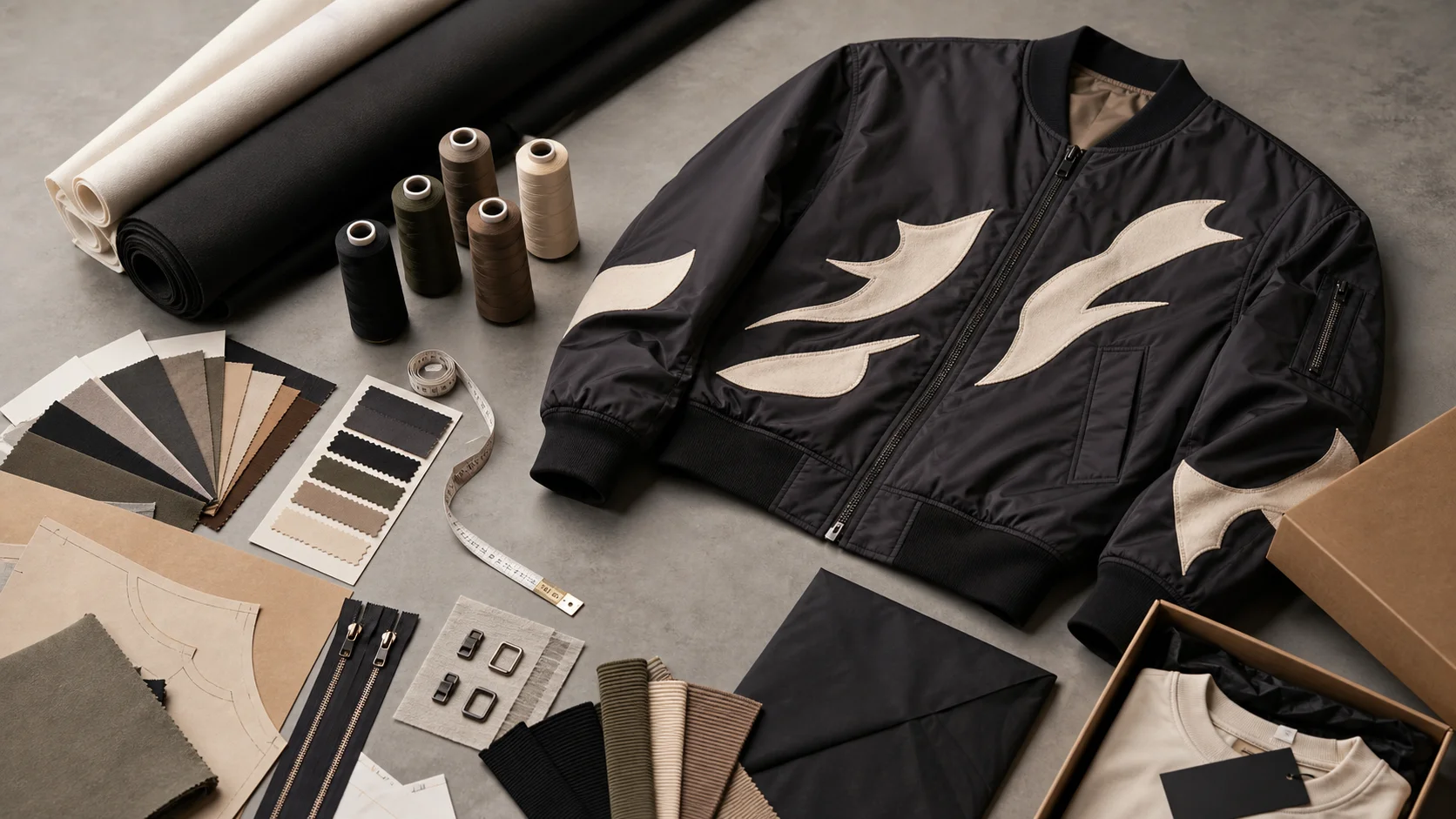
A cost-focused outline for streetwear buyers planning custom bomber jacket programs, covering MOQ thresholds, material choices, decoration methods, and the...
Custom bomber jacket MOQ cost is rarely just a factory’s minimum unit number. For a streetwear retailer, the real question is how much cash the first production run will absorb once fabric, trims, sampling, decoration, packing, and freight are all counted together. A low quoted MOQ can still be expensive if the jacket uses custom rib, special lining, metal trims, heavy embroidery, or multiple colorways. A higher MOQ can be the better commercial move when the spec is controlled and the style has repeat demand.
This article breaks down the way bomber jacket MOQ pricing usually works in sourcing, where the hidden costs sit, and how to compare quotes without getting trapped by a unit price that looks good only on paper. It is written for streetwear retailers that need a practical buying view, not a promotional one.
Custom Bomber Jacket MOQ Costs for Streetwear Retailers - Fabrikn production reference
MOQ means minimum order quantity, but in apparel sourcing that number is only part of the story. A factory may quote a style MOQ, a color MOQ, a fabric MOQ, and sometimes a trim MOQ. A bomber jacket can meet the style minimum and still fail the fabric minimum if the shell is custom dyed or if the rib knit requires a separate yarn commitment. Streetwear orders also tend to carry more decoration, which pushes the order structure up again because embroidery, patches, woven labels, and special zippers often have their own setup charges.
Retailers should treat MOQ as a combined threshold of production and commercial overhead. A factory is not just covering sewing time. It is spreading pattern work, marker creation, sample approvals, material sourcing, cutting loss, finishing, packing, and quality control across the batch. On a small order, those fixed costs are heavy. On a larger order, they are diluted. That is why a 50-piece run can carry a much higher effective unit cost than a 300-piece run even when the garment construction looks similar.
For bomber jackets, size ratios matter as well. A run that needs only one size curve may be easy to produce, while a full streetwear size set from XS to XXL can raise fabric waste and grading complexity. Colorways are another multiplier. A style in one base color is far simpler than the same jacket split across three shells and two lining options.
Bomber jacket MOQ ranges depend on the supplier’s production model, the material base, and how custom the style is. The ranges below are typical rather than universal, and they should be treated as starting points for negotiation rather than fixed market rules.
MOQ band What it usually means Commercial impact Best fit 50 to 100 pcs per style/color Small run with high setup pressure and limited material leverage Highest unit cost, more sample and approval dependence Testing a new design, limited drops, capsule collections 100 to 300 pcs per style/color Common middle range for many custom streetwear programs More balanced pricing, still sensitive to trim and decoration choices Seasonal retail programs, repeatable bestseller candidates 300 to 1000 pcs per style/color More efficient production scale with better material absorption Lower unit cost and better allocation of fixed charges Core range products and wider distribution programs 1000+ pcs per style/color Volume order with stronger cost control potential Lowest cost per unit, but higher inventory exposure Established styles, multi-channel retail, wholesale programsMany streetwear retailers start in the 100 to 300 piece range because it gives enough volume to compare fit, sell-through, and margin without overcommitting cash. A small boutique label may still need to begin at 50 to 100 pieces if the style is highly experimental, but the cost per jacket should be judged with care. A low entry MOQ can hide expensive setup charges, freight costs, or material premiums that narrow the margin quickly.
Some suppliers allow different MOQs by component. A shell fabric may be available at 100 pieces, while a custom rib knit or branded zipper pull may require a larger commitment. A buyer should separate what is truly flexible from what is rigid. That distinction often decides whether the order is workable at all.
Bomber jacket pricing changes because the garment is built from several cost layers. The shell is only one of them. Streetwear versions often rely on material contrast, heavy trims, and visible branding, which means the quote has to account for more than sewing labor.
Fabric is usually the biggest variable. A basic polyester satin shell will typically cost less than a heavy cotton twill, a premium nylon taslan, a wool blend, or a coated technical fabric. Weight, weave, coating, dye method, and finish all affect cost. If the fabric needs custom color matching, lab dips, or a mill minimum, the order can become much more expensive at low volume. A buyer should ask whether the quoted price is based on stock fabric, stocked color, or custom-developed fabric. Those three are not the same thing.
Rib cuffs, collar, and hem are often underestimated. A standard rib knit is not the same as a dense, striped, custom-dyed rib with strong recovery. Zippers can also swing the price. A no-name nylon coil zipper is cheaper than a branded metal zipper, and a custom zipper pull or engraved slider adds another layer of setup. Snaps, snap tapes, lining labels, hang tags, woven labels, and size pip labels may look small, but they accumulate quickly in the total cost.
Streetwear jackets often use embroidery, chenille patches, felt appliques, printed graphics, or woven badges. Decoration is not just a design choice. It is a cost and yield issue. Large chest embroidery can slow production, create puckering risk, and require more sampling rounds. Back graphics or sleeve work often increase labor, especially if the artwork spans multiple panels. A simple logo can be sensible at 100 pieces. A highly decorated jacket may need a larger MOQ to be priced responsibly.
A plain unquilted lining is cheaper than a quilted lining or insulated build. Padding weight, stitch pattern, and fill type all matter. Light transitional bombers can use a basic taffeta lining, while colder-season styles may use polyester fill or quilted wadding. Each added layer increases sewing time and inspection risk. If the lining is printed or contrast-colored, color consistency and shrink behavior need extra attention.
Streetwear retailers often want branded polybags, size stickers, carton marks, and fold presentation that matches store standards. Packaging is not decorative overhead only. It affects labor, carton count, and freight volume. A jacket packed in a rigid branded box can raise landed cost more than a plain polybag. That tradeoff may be justified for premium retail, but it should be priced deliberately.
MOQ cost cannot be read correctly without understanding the sample path. A jacket that moves through approval in one round is cheaper to launch than a jacket that cycles through fit corrections, artwork changes, and material swaps. Streetwear styles often require a few more checks because the silhouette is important and the finish is visible.
A practical approval flow usually includes a tech pack review, a first prototype, a fit sample, a revised sample, and then a pre-production sample or size set. Some programs also need strike-offs for embroidery or print, lab dips for fabric color, and trim submissions for zipper and rib approval. Each step can carry time and cost.
A good buyer does not approve a bomber jacket on appearance alone. Measurement points, stitch quality, seam balance, zipper alignment, rib recovery, and lining cleanliness all matter. A sample that looks strong on a hanger can still fail in wear if the sleeve pitch is wrong or the hem pulls. Once the pattern is locked, late changes become expensive because they may affect cutting markers, grading, and trims already purchased.
A bomber jacket should be approved as a system, not as a front-view image. Fabric hand, trim quality, fit, and finish have to work together or the style will look stronger in a sample room than on a sales floor.
Retailers often get better pricing control when the spec is written in practical terms. The more ambiguous the request, the more variation appears in the quote. A useful tech pack for a bomber jacket should identify shell composition, fabric weight, lining type, rib construction, zipper grade, trim width, embroidery dimensions, artwork placement, and finishing requirements.
Each of these choices pushes the MOQ conversation in a different direction. A stocked nylon shell with standard rib and one small embroidery can be viable at a lower run. A custom-dyed wool blend with striped rib, satin lining, sleeve embroidery, and branded metal hardware is a very different order. The second style may still be possible at a modest quantity, but the buyer should expect the unit price to reflect setup and complexity rather than sewing time alone.
Streetwear retailers should also ask about shrinkage and colorfastness early. Ribs and linings can behave differently under wash and steam. If the product is garment washed, measurement tolerances need to allow for movement after finishing. A factory that does not control shrinkage well can produce a jacket that samples correctly but shrinks out of tolerance in bulk production.
A useful quote separates the garment price from the hidden extras. If a supplier gives only one lump sum, ask for a line-by-line breakdown. That makes it easier to see whether the MOQ is driving cost through material setup, labor, decoration, or packing.
Cost item What it covers What to check Pattern and sample development Pattern work, grading, proto sample, corrections How many sample rounds are included Fabric Shell, lining, rib knit, interlining, padding Is it stock, custom dyed, or mill ordered Trims Zippers, snaps, labels, cords, hang tags, patches Separate MOQ or tooling charges Cut and sew labor Assembly, decoration attachment, finishing Whether decoration is included or treated as add-on Packing Folding, polybag, size sticker, carton packing Retail packing standards and carton marks Freight and duty International shipping, customs, import charges Whether the quote is FOB, EXW, or landedFOB quotes are common for apparel sourcing, but they do not represent total landed cost. Freight, duties, destination handling, and any inspection rework should still be added before margin is calculated. A jacket that looks profitable at factory gate can become weak once shipping and import charges are applied. That is especially true for heavier bomber styles, since carton weight and volume can climb fast.
Factory pricing should also be checked against sizing strategy. A run with a broad size spread can alter consumption enough to move the quote. If the retailer plans to sell mostly oversized fit, the marker needs to reflect that before the order is priced. Late fit changes are one of the easiest ways to destroy an otherwise sensible MOQ plan.
The ranges below are illustrative FOB examples for custom bomber jackets. They are meant to show how MOQ and complexity affect unit cost, not to serve as universal market pricing.
Style profile MOQ Typical unit cost direction Cost note Basic satin bomber with small chest embroidery 100 to 200 pcs Lower end of custom range Works best with stock shell fabric, standard rib, and simple packing Heavy cotton twill bomber with woven patch and custom lining 200 to 400 pcs Mid-range Price rises with lining print, patch placement, and tighter quality control Premium fashion bomber with wool blend, branded zipper, and multi-panel embroidery 300 to 600 pcs Upper mid-range to high Decoration and material commitment push cost faster than sewing complexity alone Technical bomber with coating, insulation, and specialty trims 500+ pcs High, then improves with volume Lead time and inspection risk are usually more important than raw labor costA 100-piece order may not be cheap in absolute terms, but it can still be rational if the retailer is testing a new silhouette or a seasonal drop. A 500-piece order should be judged differently. At that scale, the buyer should push harder on fabric sourcing, trim standardization, and carton optimization. The order should earn the volume, not just qualify for it.
Direct purchasing judgment matters here. A lower MOQ is not automatically a better deal. If the jacket needs two extra sample rounds, custom-dyed rib, and a branded zipper pull, the savings can disappear quickly. In many cases, the more disciplined approach is to simplify the spec, not to fight the factory for an unrealistically small quantity.
Streetwear retailers usually have more room to reduce complexity than they think. The most effective MOQ reduction comes from specification discipline, not pressure on the supplier.
When sourcing for a streetwear store, it is often wiser to invest in stronger fit and finish than to spend budget on uncommon trims. A jacket that fits well and feels substantial can sell better than a more elaborate piece that misses the market. That tradeoff is especially relevant when the retailer is still learning its customer’s size and color preferences.
Another useful move is to separate hero styles from test styles. A retailer can place a leaner MOQ on a new silhouette, then scale the winning shape into a larger run on the next order. That approach preserves cash flow and reduces dead stock risk. It also gives the factory a clearer demand signal, which can improve pricing on the follow-up production.
Bomber jackets carry specific risks that matter more at low MOQ because there is less room to absorb rejects. A tight production run can be damaged by a small number of defects if the factory is not strict on cutting and finishing.
A buyer should ask for in-process checks, not only final inspection. Cut panel verification, first-piece approval, and sewing line patrols matter because they catch errors before the full batch is complete. On a smaller MOQ order, one bad cutting lay can damage a meaningful share of the lot. On a larger order, the issue may be more distributed, but the absolute loss can be bigger.
Testing should match the fabric and the season. A lightweight fashion bomber needs seam, color, and fit control. A padded or coated bomber needs additional attention on pilling, coating transfer, filling distribution, and wash performance. Retailers sometimes under-spec these checks because the jacket is seen as a simple category. It is not simple once custom details and margin pressure enter the picture.
Timing is one of the hidden cost variables in MOQ sourcing. A factory can price the same jacket differently depending on whether materials are already in hand, whether the season is busy, and whether the order needs fast-turn production. A retailer that orders late in the season often pays more for speed, because the supplier has less room to consolidate materials or slot the job into a normal production queue.
Lead time is usually affected by fabric sourcing, trim approvals, artwork signoff, production capacity, and inspection scheduling. A simple bomber in stock material may move faster than a custom-dyed style with branded zippers and embroidered sleeves. Some programs can be produced in roughly 45 to 75 days after final approval, while more complex projects may need 75 to 120 days or more. Those are broad planning ranges, not commitments. Material availability and sample turnaround are the usual reasons schedules slip.
Streetwear retailers should place orders only after the core commercial variables are settled. That means color, fit, decoration placement, packing, and margin target should all be decided before production starts. A jacket order is not forgiving once cutting begins. Late changes almost always cost more than they save.
For a broader view of sourcing support, review the services page. For a direct quote request, use contact us. Background on the sourcing approach is available on about us.
Get a free quote from Fabrikn — your trusted B2B clothing manufacturer with 10+ years of experience. MOQ as low as 200 pieces.
Get a Free Quote →A realistic MOQ often starts around 100 to 300 pieces per style/color for a custom streetwear bomber, though some suppliers will go lower for simple builds and some will require more for custom fabrics or trims. The important point is not just the number of garments, but whether the shell, rib, zipper, and decoration can all be sourced at that level.
Low MOQ orders spread sampling, pattern work, fabric setup, trim sourcing, and inspection costs across fewer units. That raises the effective cost per jacket. A small run can still be useful, but it should be priced as a test order rather than treated like a scaled production run.
Custom fabric, heavy embroidery, branded zippers, quilted or insulated lining, and special rib knit usually raise cost the fastest. Complex artwork and multiple colorways also increase labor and material waste, which makes the MOQ more expensive to absorb.
A normal process often includes a prototype, a fit sample, one or more revisions, and then a pre-production sample or size set. Artwork strike-offs and lab dips may be added when the jacket uses custom color or decoration. Fewer rounds are better, but only if the first tech pack is complete.
Measure the garment against the spec, confirm fabric and trim references, check zipper alignment, inspect embroidery or patch placement, review shrinkage and recovery behavior, and verify packing requirements. Production approval should happen only after the jacket is acceptable in both appearance and measurable construction points.
No. FOB covers the factory-side price to the port or export point, but it does not include all freight, duty, destination charges, or import handling. Retail margin should be calculated on landed cost, not on factory price alone.
The better decision depends on sell-through confidence. A lower MOQ reduces inventory risk, but a lower unit price usually improves gross margin. The right choice is the one that protects cash and supports repeat orders without forcing the retailer to overbuy an unproven style.