
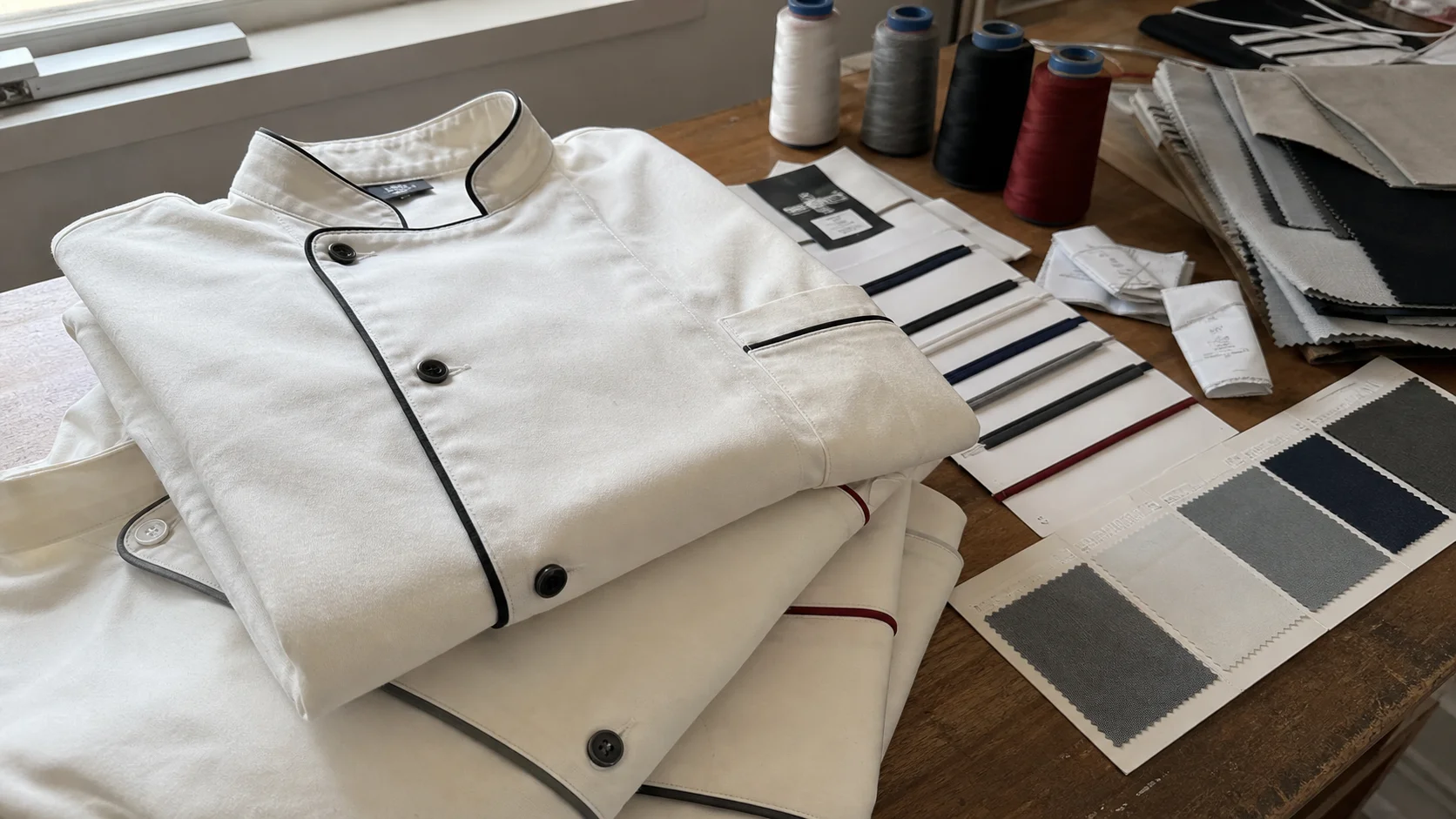
A focused outline for restaurant supply catalog teams sourcing OEM chef coat trims, covering trim specs, placement, durability, color matching, compliance,...
OEM Chef Coats Trim Sourcing for Buyers - Fabrikn production reference
Buying OEM chef coats for restaurant supply catalogs is less about garment styling and more about control. Trim choices affect price, lead time, wash durability, color consistency, and how well the finished line sits across different menu tiers. A collar tape, cuff binding, piping, or logo patch can look minor on a spec sheet and still create the biggest sourcing problem in production.
This article focuses on practical trim sourcing for private label chef coats. The goal is to help catalog buyers, import teams, and merchandising managers make decisions that protect margin without creating avoidable quality claims. For a broader view of manufacturing support, see the factory overview on services, and use contact us when you need a quote package reviewed. Background on the company and its positioning is available on about us.
Chef coats are often sold as a functional uniform, but catalog buyers know the trim is part of the product architecture. It defines the look, supports branding, and influences garment behavior after repeated industrial laundering. In a private label program, the trim package can be the difference between a clean, repeatable line and a fragmented assortment with quality drift across styles.
Trim is also where pricing gets unstable. Small specification changes can force new dye lots, different trim suppliers, revised minimums, or additional lab testing. Buyers who only compare garment base fabric cost usually miss this. A coat with standard poly-cotton body fabric can still become expensive if the piping, buttons, tape, and embroidery backing are not specified early.
For chef coats, trim should be treated as a controlled material set, not decorative afterthought. The best sourcing outcome comes from locking trim specs before sampling, not after buyers have already approved the silhouette.
Most restaurant supply catalogs carry chef coats with a predictable trim stack. The exact combination depends on the price point and intended end user, but the same elements appear repeatedly.
Buttons deserve special attention. Some catalogs prefer cloth-covered buttons for a premium appearance, but these can be more fragile in industrial laundry. Knot buttons, resin buttons, and high-temperature resistant buttons each solve a different problem. The right choice depends on wash cycle intensity, heat exposure, and the customer’s tolerance for replacement claims.
Piping and binding also need clear judgment. They make a coat read more finished, but they can distort during pressing or pucker after repeated washing if the base cloth and trim do not shrink at similar rates. For entry-level programs, a simpler trim package often sells better than a visually busy one that generates defects.
MOQ varies by factory, trim type, and whether the garment body fabric is stock-supported or mill-ordered. For OEM chef coats, practical buyer expectations usually fall into these bands:
Program Type Typical MOQ Range Buyer Note Basic stock-fabric chef coat 300 to 800 pcs per style/color Works best when trim is standard and repeatable Private label with contrast trim 500 to 1,200 pcs per style/color Trim color matching can raise risk and pricing Custom logo embroidery or patch set 300 to 1,000 pcs per placement Embroidery setup and approval usually add time Special trim or branded button package 1,000 pcs and up New trim sourcing often forces higher minimumsBuyers should not assume all trims are interchangeable across factories. A factory may quote a low MOQ on the garment but require a much higher MOQ for a custom button mold, woven neck label, or specialty binding tape. In catalog programs, the safest route is to separate the garment MOQ from the trim MOQ and confirm both in writing.
A clean approval flow matters more than speed. Many production mistakes originate in a rushed sample process where the buyer approves the silhouette but does not review trim behavior under pressing, wash, and stitching tension.
Skipping the pre-production sample is a common mistake. Proto samples often use substitute trim, while the final run may use a different tape, button, or embroidery thread. That gap can create color drift, bulk thickness issues, or stitch quality problems that only show up after bulk cutting begins.
Buyers should also ask for photo documentation of approved trim placements. This is not bureaucracy. It reduces argument later when a cuff binding is sewn narrower than expected or the collar edge runs a different width on repeat production.
Chef coat sourcing gets easier when the tech pack is specific. General descriptions such as “contrast trim” or “premium buttons” are too weak for production control. A useful spec should identify material composition, width, color reference, and performance requirement whenever possible.
At a minimum, the following should be defined:
For workwear sold through restaurant supply catalogs, consistency usually matters more than novelty. A trim package that is easier to repeat across seasons is often better than a more elaborate package with constant re-approval needs. That tradeoff should be made deliberately, not discovered after the line is already in production.
Lead time for OEM chef coats is rarely determined by sewing alone. The critical path often runs through trim sourcing, shade matching, and sample approval. Buyers who push a standard body fabric but custom trim set can still end up with a long schedule.
Typical lead times look like this, assuming the order is technically feasible and materials are available:
Three variables usually stretch the schedule. First, color approval on trim can take multiple rounds. Second, special buttons or woven labels may need outside tooling or a separate supplier. Third, industrial wash testing can reveal shrinkage or trim failure, and that finding should be fixed before bulk approval, not after delivery.
The practical sourcing answer is to keep at least one stable trim package in the line. Catalog programs that change every component every season tend to pay for it in lead-time volatility and lower fill rates.
Some defects are visible in hand inspection. Others only emerge after laundering, pressing, or repeated wear. Chef coat trim must survive a more demanding use case than fashion apparel, so the inspection plan should reflect that.
Inspection risk rises when multiple trims come from different sources. A factory may sew well and still ship inconsistent product if the button supplier changes resin composition or the binding tape arrives from a different lot. Buyers should ask for incoming material checks, trim lot tracking, and a pilot run before full cutting starts.
For higher-value programs, wash testing is worth the time. A small sample run through the expected laundering process can expose failures that visual inspection misses. That is especially relevant when the coat uses contrast trim, heat-sensitive buttons, or logo treatments with edge lift risk.
Catalog assortment planning usually breaks into three pricing tiers, and trim strategy should follow that structure.
Price Tier Recommended Trim Approach Why It Works Entry-level Self-fabric or minimal contrast trim, standard buttons, simple label pack Lower cost, easier sourcing, fewer failures Mid-tier Moderate contrast trim, branded labels, upgraded buttons or edge finish Balanced appearance and durability for broad catalog appeal Premium Distinctive piping, specialty buttons, embroidered branding, refined finishing Supports higher margin and stronger visual differentiationEntry-level programs should resist over-specifying trim. Buyers sometimes add multiple decorative features to make a basic coat look premium, then discover that the cost no longer supports catalog pricing. A clean, durable, repeatable coat usually sells better than a crowded one with weak margin.
Premium programs can justify more complex trim, but only when the sourcing team has control over material continuity and approval discipline. A premium coat that looks different from lot to lot damages the catalog more than a simpler coat ever would.
The best trim strategy is built around repeatability. That means choosing components that are easy to reorder, easy to inspect, and unlikely to trigger a production dispute. Buyers should prefer trims with stable suppliers, clear color references, and known wash performance.
A practical sourcing process usually includes the following:
Catalog teams often benefit from a limited trim library. A small set of approved buttons, tapes, labels, and embroidery placements can be reused across styles. That reduces quoting friction and helps maintain a recognizable product family. It also lowers the odds of being trapped by one-off sourcing issues on a reorder.
When evaluating a factory, ask how they manage trim substitutions. A supplier that changes trim without approval creates risk. A supplier that flags shortages early and proposes a documented alternative is easier to work with, even if the quote is not the absolute lowest.
Buyers should treat trim as part of the commercial spec, not just the design spec. The cheapest trim is not always the best choice, and the most decorative trim is rarely the best business choice. The right balance depends on reorder speed, wash durability, and how tightly the catalog program needs to control product consistency.
For most restaurant supply catalogs, the strongest approach is a restrained trim package with stable sourcing, clear approval steps, and enough visual distinction to support brand positioning. That gives the line a professional look without turning production into a custom development project every season.
If the product is meant for heavy commercial laundering, durability should outrank styling. If it is aimed at premium hospitality buyers, controlled visual detail can pay off, but only when the sourcing team has already solved material continuity. The wrong tradeoff is easy to spot after the first claim cycle. It is harder to fix once the line is in market.
Get a free quote from Fabrikn — your trusted B2B clothing manufacturer with 10+ years of experience. MOQ as low as 200 pieces.
Get a Free Quote →It is the process of selecting and controlling the non-body components of a chef coat, such as piping, buttons, binding, labels, and logo details, for private label or catalog production.
Many programs start around 300 to 800 pieces for simple styles and can move to 1,000 pieces or more when trim is custom, dyed-to-match, or tied to special tooling.
Trim often requires separate approval, matching, and supplier coordination. Buttons, labels, embroidery, and contrast tape can each become a scheduling bottleneck.
Both matter. The proto sample checks concept and fit, while the pre-production sample confirms actual production trim, labels, and final construction details.
Common failures include color mismatch, trim shrinkage, puckering, loose button attachment, and logo distortion after washing or pressing.
A limited, repeatable trim package with stable suppliers and clear specs is usually safer than a highly decorative setup with frequent material changes.