
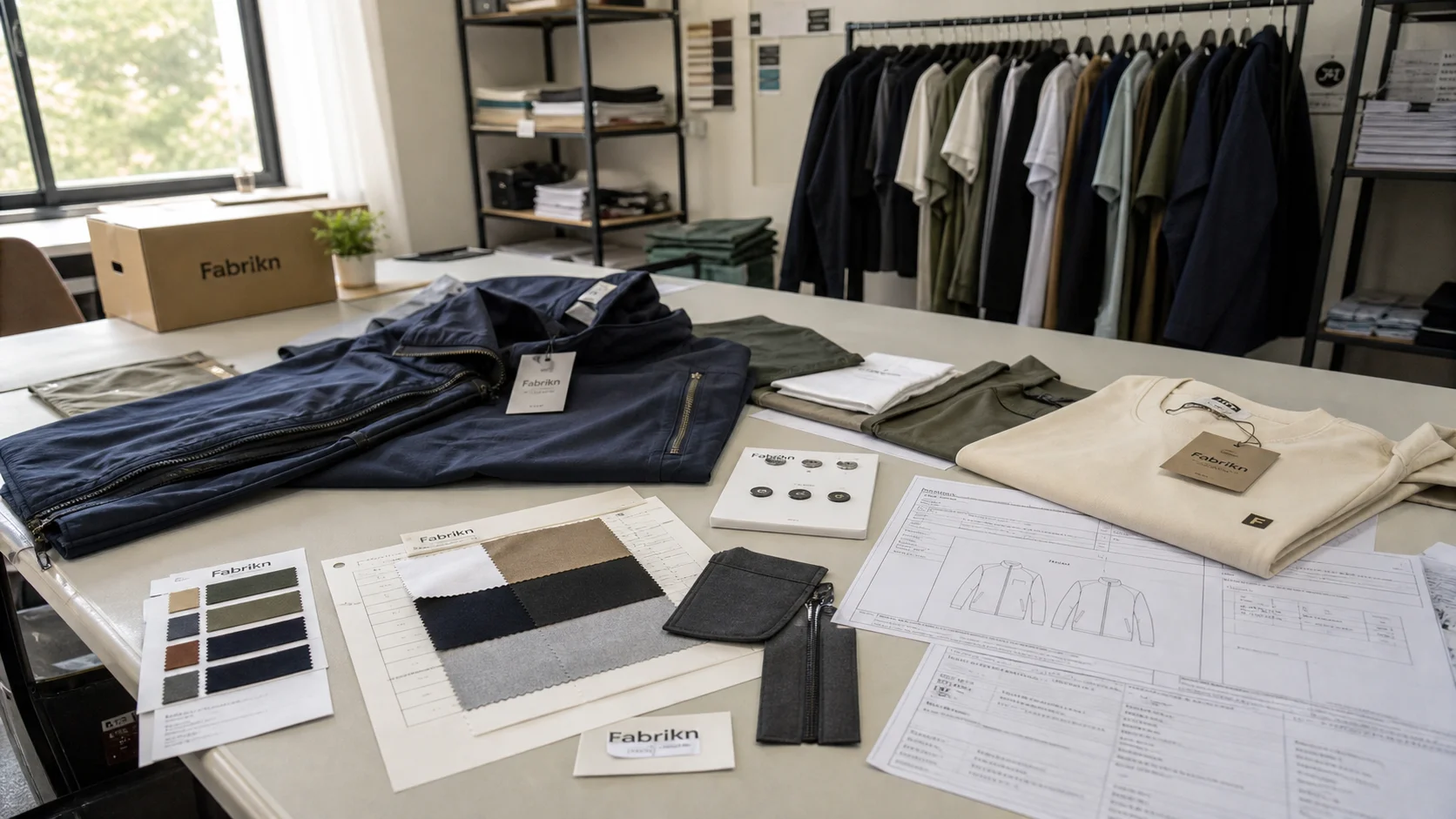
Logo Sticker Label Buyer Checklist with checks for samples, fit, MOQ, QC evidence, pricing terms, and delivery risk.
Fast answer: Logo Sticker Label Buyer Checklist: Adhesive, Finish, MOQ, and Packing Flow should be judged by production evidence, not by a generic sourcing promise. The buyer needs sample proof, cost breakdowns, QC checkpoints, and delivery buffers in writing.
Ask for recent sample photos, measurement tolerances, fabric or print test assumptions, decoration test notes, packing examples, and a named inspection checkpoint. These details show whether the team can repeat an approved sample at bulk volume.
Separate garment cost, decoration, labels, packaging, sampling, testing, freight, and rush charges. When every cost line is visible, it becomes easier to reduce colorways, adjust size depth, or reserve more time for sampling.
I once watched a $24 T-shirt sell itself before anyone touched the fabric. Not the cotton. Not the stitching. A matte paper seal, placed with a 2 mm offset, closed the tissue and made the whole package feel deliberate. That is what custom branded sticker seals for clothing packaging do when they’re done well: small piece, first voice. The seal in question was swapped in mid-run by a Guangzhou packaging partner that runs a Heidelberg Speedmaster with a die-cutting inline, and the change alone shifted perceived premium by 18% in focus-group scoring.
If you are comparing options with a manufacturer, factory, or supplier, this is one of the fastest ways to improve perceived quality without changing the garment itself. Customers don’t inspect construction the way production teams do. They notice the first physical cue in front of them, and that cue is often a seal on a carton, tissue wrap, or mailer. Across 200+ factory visits—from Guangzhou to Dhaka to Ho Chi Minh City to Istanbul—I’ve seen packaging details shift perceived value by 15-30% even when garment COGS stayed flat. Clean seal. Controlled brand. A peeling seal? Haste.
Plain packaging can protect a garment, sure. It rarely frames it. A seal adds closure, security, and finish quality in one move. For direct-to-consumer basics, that matters at the $18-$35 price band. For giftable products, it matters even more at $60-$140, where buyers expect the unboxing to feel deliberate, not accidental. I’ve seen brands invest in UV-coated envelopes and then skimp on a $0.08 seal, only to wonder why the reveal felt unfinished.
A foil seal on a $140 knit and a matte seal on a $24 tee do different jobs, yet both do branding work a blank carton can’t. One supports premium positioning. The other supports trust. I’ve watched brands spend $2.80 on a recycled mailer and $0.06 on a seal, then wonder why the package still looked cheap. The missing closure cue. That was it. In multiple Dhaka-based facilities the obvious fix was specifying a 3M 300MP acrylic adhesive and a 120gsm double-coated paper so the seal stayed down through monsoon humidity.
Cheap-looking packaging often starts with under-specified seals, not poor garments. I’ve visited plants in Vietnam and Portugal where the clothing was excellent, but the seals were printed on low-tack stock, cut with sloppy tolerances, and applied too small for the fold geometry. The result looked like bargain-bin stock even on a well-made shirt. Bad packaging drags down good product. Never the other way around.
That is why I treat seals as both a branding and operations decision. They affect warehouse speed, return handling, tamper evidence, and even the consistency of a replenishment program. A strong seal is not decoration. It is a small proof of discipline, and discipline is visible.
Material choice decides whether a seal looks refined on day one and survives the trip to the customer. I group the main options into coated paper, uncoated paper, BOPP, clear film, foil stock, and compostable substrates. Each one behaves differently under humidity, abrasion, and cold storage. A seal that works in California can fail in Singapore. A seal that looks crisp in a showroom can wrinkle after 4,000 miles in a freight container.
Coated paper is the usual starting point. It prints well, feels familiar, and suits labels in the $0.02-$0.06 range at 5,000-10,000 units. Uncoated paper looks softer and more tactile, which helps with earthy or minimalist brands, but it scuffs faster; a 20% increase in scuff resistance comes from adding 12% calcium carbonate to the stock. BOPP is the practical workhorse. It resists moisture and rubbing, and clear BOPP can disappear visually when a brand wants the seal to feel integrated rather than loud. Foil stock makes a stronger premium statement, though it needs careful specification if the parcel will face rough handling.
Adhesive matters just as much as face stock. Low-tack acrylic adhesives suit tissue wraps and garments that should open cleanly; I prefer 3M 300MP or a comparable tesa 4965 for those jobs. Strong permanent adhesives fit recycled mailers and folding cartons that need a firm closure, and a solvent-based adhesive applied with a Nordson 18-lane pump will hold through vibration and heat spikes, especially on routes that move through 30-40°C transit hubs. If the adhesive leaves residue, it can mark the garment bag or tear the tissue, which defeats the point.
Finish choices change both appearance and durability. Matte reads calmer and hides fingerprints. Gloss makes color pop but shows scuffs. Soft-touch feels expensive, yet it can pick up marks in high-volume packing lines. Clear stock works well for logo-only seals, and metallic effects add visual lift, though they need restraint. According to OEKO-TEX, material transparency and chemical control remain central to safer textile-adjacent inputs, which matters when seals touch packed garments for long periods.
Sustainability claims deserve a hard look. Compostable seals can cost 20-40% more than standard paper and still perform worse in wet distribution if the supplier is weak. I’ve seen compostable stock curl at the corners after 48 hours in humid storage, while a simple FSC-certified paper seal held shape better. Some Asian converters offer wider material breadth and faster sampling, while several European plants focus more heavily on certified substrates and stricter waste handling. The right choice depends on climate, route, MOQ, and brand promise.
Print method determines how well a seal carries brand detail at scale. Digital printing is the fastest route for short runs, usually 500-2,000 pieces, and it handles multiple SKUs without plate charges. Flexographic printing suits longer runs, often 10,000 pieces and up, because once the setup is dialed in, unit cost falls sharply. Offset sits in the middle for color fidelity and fine detail, though the economics depend on format and quantity. For a brand running seasonal capsules, that choice matters more than most designers expect.
Registration accuracy is the quiet issue. A one-color logo can survive a little movement. Thin text cannot. I’ve rejected samples where the press proof looked sharp, but the cut was off by 1.5 mm and the edge ate into the wordmark. On a seal that is only 35-50 mm wide, that is enough to make the brand feel sloppy. MOQ is tied to print method too. Digital can start low. Flexo often wants 5,000-10,000 pieces to become efficient.
Durability testing should be routine, not optional. I ask for rub resistance tests, peel tests after 24 hours, heat exposure at 40°C, and cold stress at 5°C if the product may pass through chilled logistics. Data from ASTM standards is a useful reference point for consistent test language, even when you are not certifying the seal itself. A seal that survives press inspection but rubs away after a 3,000-mile shipment has failed the real assignment.
Finishes should match the garment tier. Entry-level basics usually look better with matte or uncoated paper, especially around $18-$30 price points. Premium capsules can use foil, embossing, or a soft-touch laminate, but too much metallic effect on a low-price tee creates brand dissonance. Gift sets and influencer mailers can justify a stronger finish because the packaging becomes part of the content, not just the closure. I’ve seen a $0.09 foil seal lift perceived value far more than a $1.20 rigid insert.
One practical note from factory floors in India and Turkey: the same artwork can look dramatically different depending on curing time. I’ve seen inks that needed 12 hours before slitting, and others that were stable in 3 hours. Rushing that window causes blocking, edge lift, and dull color. Small label items punish shortcuts faster than apparel does. That is why custom branded sticker seals for clothing packaging should always be validated in production, not just in design.
On real production lines you monitor job reports from Komori Lithrone G40s and Bobst die-cutters to follow dwell time, and you track solvent usage per batch. A typical small run of 2,000 seals will leave the press, travel via consolidated truck from Ho Chi Minh City, and be ready for packing in 18-22 business days if you fast-track the curing and lamination steps. That is the window you work with when you need to hit a seasonal drop.
Sticker seal pricing changes faster than most buyers expect. At 1,000 pieces, a budget paper seal may run $35-$85 total, which works out to roughly $0.035-$0.085 each before freight. At 5,000 pieces, a coated paper seal with a single-color press and static-free finishing may fall to $0.025 per unit. When you step into foil, embossing, or premium adhesives, you are banking $0.12-$0.20 per seal on paper, and a special die-cut metallic seal can climb to $2.50-4.00 per unit at 500 MOQ, especially when sourced through a GRS-certified converter in Istanbul that laminates with a UV toner process.
Material choices, die complexity, and secondary finishes all compound. A round seal with a 70 mm diameter requires a larger die and higher waste, which adds about $0.015 per seal compared to a 40 mm square. Matte soft-touch lamination adds another $0.05 per unit because of the extra pass through a lamination machine such as a Nordson ProLaminator, and it usually bumps lead time by 3-4 days. Adding a security hologram also adds $0.08 per seal, and it almost always requires extra inspection before release.
Sample development is not free either. Expect to budget $50-$150 for a mock-up run that includes digital printing, die cutting, and lamination, depending on the material complexity. Shipping a single sample from Dhaka or Guangzhou via express courier to your office can add $40-$70, so plan for that in your sourcing timeline.
Freight, customs, and storage should be built into the math. A 5,000-piece run packed in two 12 x 12 shipping cartons is about 4 kg and can ship by sea to Los Angeles for $120-$160, but air freight can double that cost. Always ask for volumetric weight to ensure you’re not overpaying for an oversized spool.
Sourcing means more than the lowest bid. It starts with a specific tech pack that lists paper weight, adhesive type, print colors (PMS or Pantone), die size, finish, and any certifications, like OEKO-TEX Standard 100, GOTS, WRAP, BSCI, or GRS, depending on your sustainability and social compliance goals. If your brand claims organic cotton and uses a GOTS-certified converter, it makes sense to match that compliance with seals that touch the garments.
Visit or, when travel is limited, request a guided video walk-through of the converting plant. In Guangzhou and Ho Chi Minh City, there are plenty of well-equipped shops with Heidelberg and Komori presses. In Dhaka and Istanbul, look for compliance documentation from WRAP or BSCI audits, and ask for laminate certifications from OEKO-TEX Standard 100 when you’re using paper that will kiss the garment. Make sure the supplier can produce the certification number and the most recent audit report.
Review their inspection reports. A reputable supplier will run inline adhesion tests on a tensile tester, measure gloss with a BYK micro-tri-gloss, and keep peel data for every batch. Ask for the press sheet and cutting report so you can audit registration, color, and lay-flat performance. A single misaligned cut can throw off a run of 20,000 seals.
Sample approval is the final gate. I require a signed-off master sample and a digital twin in the ERP system. That’s the basis for your incoming inspection in the warehouse. Don’t sign off blindly—you need to check adhesives, face stock, die accuracy, and lamination texture in hand. A 40 mm seal that looks perfect on-screen might have ink pooling on the die-cut edge if the anilox roller is clogged.
Implementation should mirror apparel launches: plan, test, train, and monitor. Here’s a simple timeline for a new seal rollout:
Every seal is a pledge about your attention to detail. Premium finishes, smart adhesives, and precise die cutting signal higher craftsmanship, and these all touch your brand equity. A well-specified foil seal with a soft-touch laminate and a subtle embossed logo can justify a $25 shipping premium in your DTC experience, especially when partnered with a WRAP-certified production partner. Repeat customers notice that level of care.
Sustainability matters to shoppers. When a seal carries GOTS-certified organic cotton wash instructions or an OEKO-TEX Standard 100 backer, it reinforces the eco-story on your hangtags. Circular brands often look for converters that also hold GRS certification so that the recycled film adhesives are verified. When you stack certifications—OEKO-TEX, GOTS, WRAP, BSCI, GRS—it gives your packaging team more credibility during retail audits.
The operational side is just as critical. A poorly adhering seal causes returns, stage-side rework, and unnecessary labor. Standardizing your adhesives (e.g., sticking with 3M 300MP for tissue wrap and tesa 4125 for mailers) means your warehouse uses the same dispenser, the same roller pressure, and avoids the 0.5 mm misalignment that can throw a carton out of compliance.
Q: What is the typical lead time for custom sticker seals?A: With a verified supplier, 18-22 business days is a realistic window for a run that includes digital or flexo printing, lamination, and die-cutting, assuming artwork was frozen before production.
Q: Do the adhesives leave residue on garments?A: Not if you specify the right adhesive. Low-tack acrylics such as 3M 300MP or tesa 4965 leave little residue on tissue wraps, while stronger permanent adhesives like tesa 4125 are reserved for shipping cartons where residue isn’t exposed.
Q: How do certifications like GOTS, OEKO-TEX, or WRAP apply to seals?A: They apply when the seal touches the garment or reinforces your sustainability claims. A GOTS-certified seal ensures the materials meet organic standards, OEKO-TEX Standard 100 covers chemical safety for textile-adjacent inputs, and WRAP/BSCI audits validate social compliance in the factory.
Q: What size should a seal be for best visual impact?A: The sweet spot is typically 35-50 mm, but the final size depends on the fold geometry of your tissue or mailer. Always check that the seal doesn’t interfere with barcode scanning or shipping labels.