
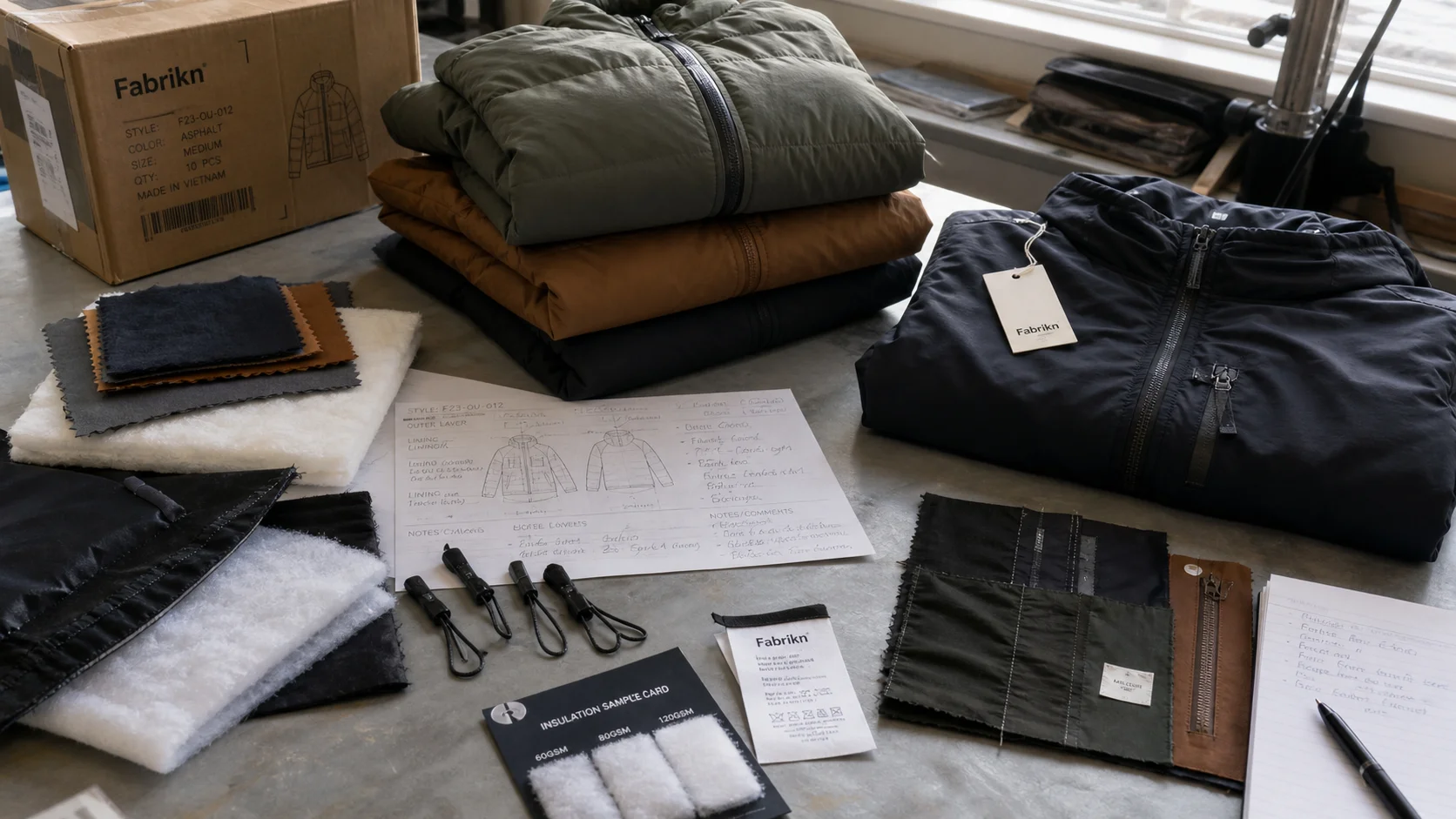
Custom Care Label Printing for Private Label Brands compared by sample evidence, fabric or trim specs, MOQ, AQL terms, cost lines, delivery timing, and...
Fast answer: Custom Care Label Printing for Private Label Brands: Material, Print, MOQ, and QC Terms should be judged by production evidence, not by a generic sourcing promise. The buyer needs sample proof, cost breakdowns, QC checkpoints, and delivery buffers in writing.
Ask for recent sample photos, measurement tolerances, fabric or print test assumptions, decoration test notes, packing examples, and a named inspection checkpoint. These details show whether the team can repeat an approved sample at bulk volume.
Separate garment cost, decoration, labels, packaging, sampling, testing, freight, and rush charges. Clear cost lines make it easier to reduce colorways, adjust size depth, or reserve more time for sampling.
In a London fitting room, I watched a buyer pinch a knit tee, check the drape, then flip the neckline only after the fabric had already won her over. That move repeats all day long, and it explains why custom care label printing for private label brands sits on the sales floor, not in the back office. Hanger tag first. Care label second. I’ve seen an $18 tee and a $68 tee fail for the same reason: a weak stitch line. Different price. Same mistake.
Eight countries, dozens of factory visits, and the pattern kept showing up: the cheapest brands often had the roughest label execution, even when the cartons looked polished and the hangtags looked expensive. A $0.03 label can still create a $3 relabel, a two-week delay, or a markdown when a retailer starts doubting the product. On a 500-piece order, that sting hits harder than on a 50,000-piece run. Small margin base. Fast damage.
In private label clothing, label quality works like insurance. Buyers may never say it directly, but they notice frayed edges, weak contrast, and a care block that looks overcrowded. Tiny flaws. Big suspicion. Returns climb too when consumers can’t read washing instructions after the third wash.
The hanger tag sells the first impression. The care label protects the second sale. I’ve stood on sales floors where the styling was sharp, the fabric outperformed expectations, and the label text was so faint customers squinted and walked. Lost conversion, plain and simple. A clean label on a $12 fast-fashion blouse and a $120 premium shirt gets judged differently, but both have to be readable, durable, and consistent. Retailers have rejected entire lots because the label looked “cheap,” even when the garment itself was solid.
Factory audits make the reason obvious. Older folding equipment can still produce usable garments, yet the labels drift 1–2 mm, which sounds harmless until a buyer checks 12 styles and finds four off-center. In one Turkish mill, sewing quality was excellent while the label printer was nine years old; crisp construction, inconsistent care blocks. In a Vietnam facility with newer machines, the print clarity improved but final-line inspection lagged. Either problem gets expensive fast on 1,000- to 5,000-piece orders.
India visits showed a sharp contrast: packaging teams in gloves and barcode scanners, while care labels came from unverified bins and got attached at speed. Pretty carton, wrong garment. Returns often start with ordinary confusion — wrong fiber percentages, missing country of origin, care symbols that don’t match the wash tolerance. For lower-priced brands, even a 0.5% bump in returns can wipe out the savings from the cheaper label program.
According to ISO, standardized processes drive repeatable quality, and labeling depends on that more than almost any other finishing step. On the factory floor, repeatability beats heroics. The strongest programs I’ve seen run on one master artwork file, one approved symbol library, and one final-line check before packing. The weakest ones lean on “we’ve done this before,” which is usually code for undocumented assumptions.
Label defects also create hidden cost. Relabeling a 2,000-piece batch can take two staff a full shift, plus re-pressing or re-stitching, then there’s the freight penalty if the shipment slips three or four days. A garment can survive a delayed launch. A seasonal buy often can’t.
Compliance isn’t paperwork for its own sake. It decides whether goods clear, stall, or trigger chargebacks. With custom care label printing for private label brands, the core items stay the same: fiber content, country of origin, care instructions, and market-appropriate language. Easy to list. Not easy to execute. I’ve watched a label pass in one market and get flagged in another because the symbols were fine but the written instruction wasn’t localized for retail rules.
At a wholesale price of $7 to $14 per piece, a label costing $0.04 to $0.12 protects a garment with a 10x to 20x markup over factory cost. Small spend. Huge leverage. Fast-fashion brands accept tighter label construction because the product life is short and the model depends on velocity. Mid-market brands need clearer language hierarchy. Premium brands overinvest in readability because customers inspect details more closely and keep garments longer. Nobody tolerates inconsistency. A label that changes by SKU creates friction fast.
For brands sourcing from a manufacturer, supplier, or factory in China, the brief has to be even tighter because production details can vary by line and by season. A good bulk program protects quality before cartons close. If you want a deeper look at material standards, see Textile Exchange guidance on preferred fibers and OEKO-TEX standards for tested textiles.
The buyer-facing rules are direct. Fiber content has to match the blend percentage. Origin marking must reflect where the product was substantially made, not where it was boxed. Care instructions should follow actual fabric behavior, not wishful thinking from the design team. A 95% cotton, 5% elastane jersey may survive a cooler wash cycle better than a printed viscose blouse, but both need clear directions. Language rules shift by destination too. In the EU, multilingual labeling may be required for certain markets. In North America, readability and origin marking are where brands usually slip.
Trade guidance from trade.gov keeps pointing back to market-specific documentation and origin accuracy. Sounds obvious. Then a shipment gets held because the label says one thing and the invoice says another. I’ve seen customs delays of five to seven days caused by a missing origin statement on a single carton mark. The fix almost always costs more than doing the label right the first time.
Premium brands understand that the label is part of the product theater, but it’s also a compliance document. Budget brands trim label spend because they’re chasing fractions of a cent per unit. False economy. Cleaner labels usually come from process control, not from the most expensive factory. I’ve seen a mid-sized Portuguese supplier beat a far pricier Shenzhen operation because it kept a tighter approval log, a locked symbol library, and a 100% final pack check on three key SKUs.
Here’s what most people miss: the best label programs are often built by suppliers with the least ambiguity. One approved file. One language matrix. One physical strike-off. Then the line gets held. Fewer revisions, less waste. On a 10,000-unit run, cutting just two review cycles can save three or four days and prevent a reprint of 500 to 1,000 labels. Not glamour. Discipline.
For brands making intimate apparel, the same clarity matters even more. I’ve seen label placement affect comfort on soft bras, which is why programs tied to custom bra manufacturing often use heat-transfer care details or very fine satin labels to avoid skin irritation.
Material choice decides how the label behaves after five washes, ten washes, and twenty washes. In custom care label printing for private label brands, I never start with price alone. Garment category comes first. Then customer expectations. Then friction risk. A denim jacket can tolerate a scratchier woven label better than a baby bodysuit. Activewear leggings need a label strategy that won’t rub during workouts. A silk blouse needs a different hand-feel altogether.
Factory-side, the usual mistake is simple: pick the cheapest substrate and hope the product category forgives it. It won’t. Soft printed satin works well for intimates. Cotton supports a natural, heritage position. Heat-transfer suits brands that want minimal irritation and a cleaner interior finish. Woven labels last longer, which is why outerwear and denim still rely on them. Prices vary, sure. But the use case leads.
When custom and wholesale buyers compare options in bulk, they should also consider the supplier’s production line and QC process. A reliable manufacturer in China can still miss the mark if the factory changes inks or stitch settings mid-run. Good quality comes from controlled production, not just a low unit price.
Woven labels use yarn-based construction and usually deliver the best durability. Printed satin labels feel softer and often cost less than woven options on smaller runs. Cotton fits natural or artisanal positioning, though poor stitch density can make it wear faster. Polyester is the workhorse: stable, widely available, and built for repeated laundering. Heat-transfer labels stay popular for irritation-sensitive products, especially babywear and performance apparel, because they remove bulk at the seam line.
For heavy-wash products, I look for labels tested through 20 to 30 wash cycles, especially in denim and activewear. A French terry 320 GSM hoodie can take a woven neck label if the inside seam is clean; a lightweight rib tank usually does better with printed or heat-transfer identification. Colorfastness matters too. A label that fades after ten washes is technically compliant only until the consumer owns it.
Denim wants abrasion resistance. Activewear wants stretch recovery and moisture resistance. Intimates want low-bulk finishes and soft edges. Babywear wants wash durability plus irritation control. I’ve seen enzyme-wash denim with rugged woven labels, and stone-wash styles where the garment aged beautifully while the label looked tired after eight washes because the thread selection was wrong. Preventable. With the right finish spec.
For brands using sublimation on graphic product lines, label compatibility still matters. Garment print tech doesn’t solve interior labeling, which is why many teams pair apparel graphics with sublimation printing services but keep care information in a separate durable format. In production, matching label type to wash chemistry beats chasing the lowest quote. A one-cent saving loses its shine if the label peels, curls, or scratches the wearer.
Pricing for custom care label printing for private label brands spans a wide range, but the structure is predictable. Basic printed satin labels can land around $0.02 to $0.06 each at higher volumes. Woven labels often run $0.05 to $0.15 depending on stitch density and finish. Heat-transfer labels can range from $0.08 to $0.25, especially when special stretch or wash performance is required. Metallic thread, soft-touch coating, and multi-language folding push the number higher. Multilingual care sets with two or three panels cost more because of material, print, and handling complexity.
MOQ depends on supplier type. Local printers may accept 250 to 500 pieces. Regional converters often start at 1,000 to 3,000. Overseas manufacturers can quote 5,000 to 10,000, sometimes lower when the label is bundled with garment production. Speed and flexibility improve as supply gets closer to home, and unit price usually rises with it. Smart buyers weigh reorder frequency against storage space. A brand replenishing every three weeks needs a different plan from one buying two seasonal drops per year.
For private label brands comparing wholesale and bulk options, the cheapest line item is not always the best value. A factory with a slightly higher MOQ may still win on quality and repeatability if its production system is tighter. Ask the supplier to quote both the label alone and the label integrated into garment production so you can compare true landed cost.
For a clean comparison, I use four buckets. Printed labels: $0.02 to $0.08. Woven labels: $0.05 to $0.15. Heat-transfer labels: $0.08 to $0.25. Specialty finishes: $0.15 to $0.40 or more, depending on complexity and wash testing. Quotes move with size, number of colors, fold type, and packaging method. A simple center-fold label can come in 20% cheaper than a loop fold. A two-color woven label may cost less than a full-color printed one, but only if the production line already has the right setup.
For brands using cut-and-sew development, label cost should be reviewed alongside overall garment assembly. A company sourcing from cut and sew manufacturing can sometimes bundle labeling into the sewing operation and cut handling cost by 10% to 15%. That savings disappears if the labels arrive late or need a rework pass.
Sample approval usually takes three to seven days if the artwork is clean and the supplier has the right stock substrate. Color matching can add two to four days, especially when Pantone references are incomplete. Compliance checks may take another one to three days when translation or symbol validation is needed. Bulk production often runs seven to 21 days, depending on MOQ and factory workload. Shipping is separate, of course, and a week lost in label approval can push a full garment launch back by ten days.
The tradeoff is blunt. A two-cent saving per label means very little if the factory misses the shipment window and you pay freight expediting on 800 garments. I’ve seen brands spend $600 to save $80. Backwards. Buy the faster replenishment path if in-season fill matters. Buy the lowest-cost path only when inventory cushion can absorb delays.
Supplier quotes get sharper when the brief is sharp. For custom care label printing for private label brands, I ask for garment category, label placement, dimensions, fold type, Pantone references, washing language, SKU count, and market destinations. Basic on paper. Not basic in practice. Half the quote errors I’ve seen came from missing details, not bad math. Fewer mysteries, fewer revisions.
A complete tech pack should include an image or sketch showing where the label sits on the garment, the maximum size tolerances, and whether the label has to stay soft against skin. A label matrix helps too: one line per SKU, one column for fiber composition, one for origin, one for language, one for care symbols. Without that matrix, the factory guesses. Guessing adds one or two revision rounds.
The best quote requests are specific enough to cut the back-and-forth down to a single email. Include order quantity, target price, required wash performance, and whether the label will be sewn into a side seam, neck seam, or waistband. If it has to survive 30 wash cycles, say so. If the product is for babywear, state the skin-contact requirement. If the brand sells into two regions with different language rules, spell that out. Ambiguity costs money. Clear specs save it.
Factories usually move fastest when they can price against a fixed file and a fixed timeline. That’s why the cleanest label programs I’ve seen were not the biggest-budget programs. They were the clearest. In one India-based factory, a four-SKU brief with exact label dimensions got quoted in under 24 hours. A much larger brand with vague artwork took six days and still needed a revision.
Use editable vector files when possible, not low-resolution images. A PDF proof is fine for review, but the factory needs a file that can be measured and translated without distortion. Keep the symbol library consistent across seasons. If the market team wants new icons, approve them once and lock them. I’ve seen brands change wash symbols mid-run, then wonder why the bulk lot no longer matches the sample. Avoidable.
Physical strike-offs matter. So do photo confirmations before bulk printing. Faster label programs usually have less ambiguity, not bigger budgets. A 48-hour sign-off chain beats a two-week chain with six people “checking one more thing.” Short approvals reduce risk. They also reduce the chance of a 2,000-label reprint.
The most expensive mistakes are often the ordinary ones. In custom care label printing for private label brands, I keep seeing wrong fiber percentages, missing origin text, unreadable font sizes, and care symbols that don’t match the garment’s actual wash tolerance. One error can trigger retailer rejection. Two can trigger a customs question. Three can turn a clean launch into a week of damage control.
Quality failures are less dramatic and just as costly. Weak stitch lines make labels curl. Poor adhesive makes heat-transfer labels lift after laundering. Low-grade ink fades before the garment does. I’ve seen labels pass visual approval and fail after ten washes, which hurts repeat purchase more than one-off complaints because the customer remembers the brand, not the supplier.
Retailers want label accuracy because they don’t want liability. If the fiber content says 100% cotton and the product contains 5% elastane, the issue is bigger than a typo. It’s a product integrity failure. Missing country of origin, cramped legal text, and inconsistent multilingual panels are all avoidable. Some factories in Vietnam and Turkey were strong on repeat production but slower to update translation templates. India-based suppliers often had solid sewing and weaker compliance paperwork. Portugal was usually the most disciplined on final presentation, though not always the cheapest.
Build a standardized template and use it every season. Pre-production checklists should confirm text, symbols, size, placement, and language before printing starts. Final-line inspections should catch obvious mistakes before cartons close. Sample approval alone is not enough. Bulk consistency is what saves money.
Wash testing should be non-negotiable. Check abrasion, ink bleed, seam durability, and hand-feel after repeated laundering. If a label scratches skin on day one, it will still scratch on day ten. If it curls after the first wash, the consumer sees a defect even when the garment is fine. I’ve seen brands spend $1.20 on a garment alteration and ignore the $0.06 label, then lose the customer anyway. That ratio is backwards.
Fixes are straightforward: standardize specs, lock approvals, test samples through five, ten, and twenty wash cycles, and inspect the final line. Dull details. Profit lives there.
Start with an audit, not a quote request. Review every existing label for readability, compliance, and durability. Map where the failures happen: font size, wash fading, crooked placement, or missing language. Then identify the top markets first, because a label that works in one country may need a different content structure in another. A pilot run of one to three SKUs is enough to expose weak points before a full collection goes out.
If you want custom care label printing for private label brands to pull its weight, begin with the clothes, not the spreadsheet. The right program protects compliance, improves the customer’s first touch, and keeps the garment from looking unfinished on the rack. One clean label can do all three.
Before asking for pricing, prepare the garment category, target retail price, label dimensions, fiber content, destination markets, and expected wash performance. Add Pantone references, artwork files, and approval contacts. If the label belongs to a seasonal range, note the launch window in weeks, not months. That helps the supplier build a realistic production slot. The best first step isn’t negotiation. It’s clarity.
Run a pilot with one to three SKUs, then inspect print accuracy, wash durability, placement, and packaging integration. If the label still reads cleanly after ten washes, you’re close. Score suppliers on turnaround, reprint rate, communication speed, and bulk consistency. Then move in this order: brief, quote, sample, test, approve, scale. That sequence saves money because it catches mistakes while they’re still measured in samples, not cartons.
Basic printed labels often run $0.02 to $0.08 each, woven labels $0.05 to $0.15, and heat-transfer labels $0.08 to $0.25. Specialty finishes can reach $0.40 or more depending on complexity and wash testing. MOQ and print method change the price quickly.
Sample approval usually takes 3 to 7 days if the artwork is complete. Bulk production often takes 7 to 21 days, with another 2 to 4 days if color matching or language checks are needed. Shipping time is separate.
You need garment type, label size, placement, fiber content, origin market, care language, Pantone references, SKU count, and expected quantity. A label matrix and tech pack reduce quoting errors and cut revision cycles by 1 to 2 rounds in many cases.
Yes. Accurate fiber content, clear care instructions, and correct origin marking reduce retailer rejections, customs holds, and consumer confusion. A label error can trigger relabeling costs, 5-7 day delays, or avoidable returns when the garment is otherwise well made.
It depends on the product. Woven labels are durable for denim and outerwear, printed satin is softer for fashion basics, cotton supports natural positioning, and heat-transfer works well for babywear and activewear. Match the label to the garment category, not the cheapest quote.