
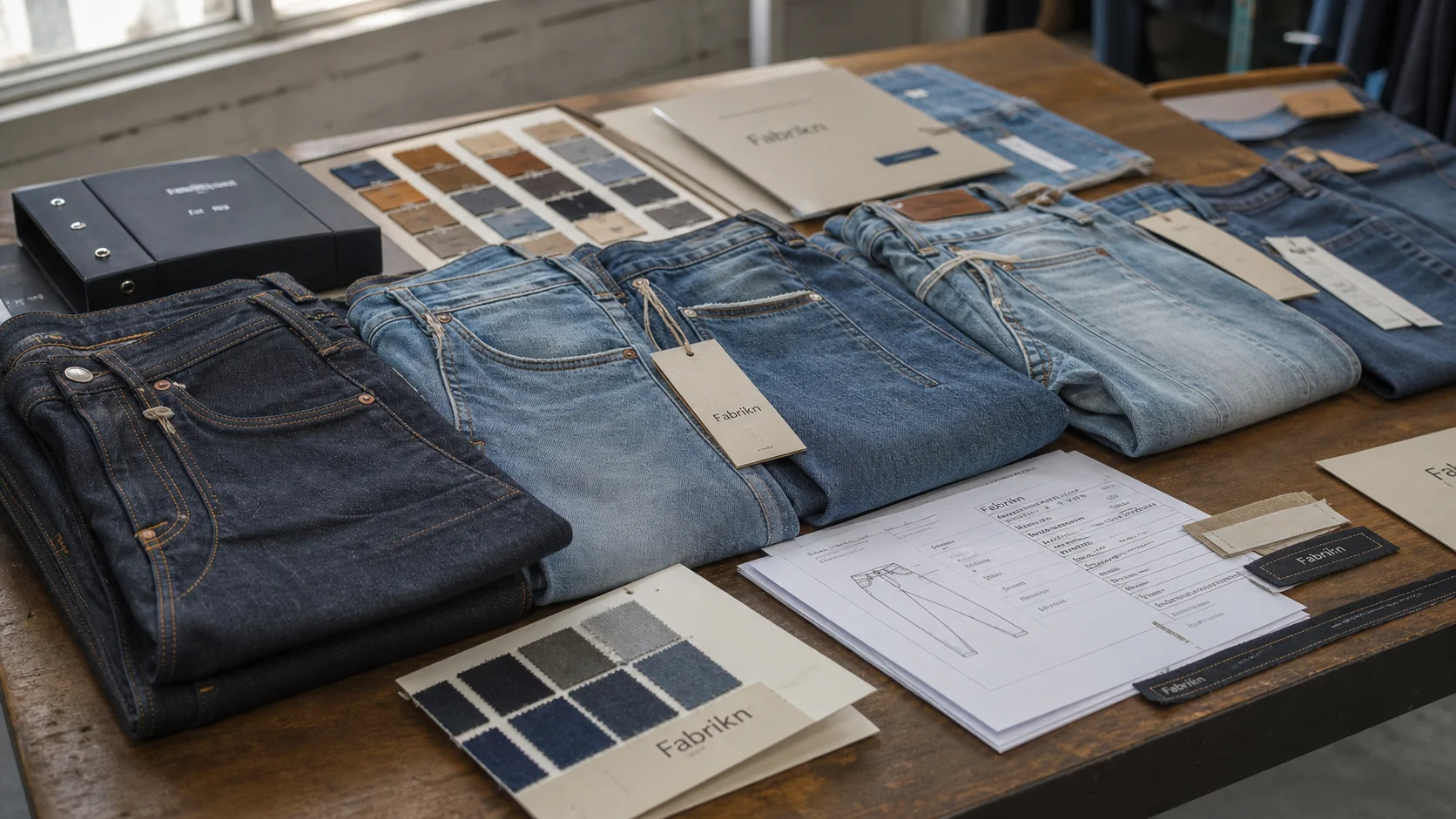
Fashion Startup Care Labels with checks for samples, fit, MOQ, QC evidence, pricing terms, and delivery risk.
Fast answer: Fashion Startup Care Labels: Rules, Material, Cost, and MOQ should be judged by production evidence, not by a generic sourcing promise. The buyer needs sample proof, cost breakdowns, QC checkpoints, and delivery buffers in writing.
Ask for recent sample photos, measurement tolerances, fabric or print test assumptions, decoration test notes, packing examples, and a named inspection checkpoint. These details show whether the team can repeat an approved sample at bulk volume.
Separate garment cost, decoration, labels, packaging, sampling, testing, freight, and rush charges. When every cost line is visible, it becomes easier to reduce colorways, adjust size depth, or reserve more time for sampling.
I have watched a 3-cent label turn into a $14 return. That is the ugly math behind fashion’s smallest component. Custom care labels for fashion startups deserve the same attention as fabric, fit, and freight because a label can decide whether a customer keeps a garment, leaves a bruising review, or triggers a compliance headache that forces a relabel.
Across 200+ factory visits in 8 countries, I have seen brands spend under 1% of garment cost on labels and then pay 8% to 12% of revenue later in returns, rework, and airfreight fixes. A knit tee with a $6.50 landed cost might carry a $0.08 label, yet a missing fiber line or faded wash symbol can stall an entire lot. In one Turkey-based site, 5,000 units were held because the care text appeared in English only, while the destination market required English plus French and Arabic on the same pack.
Luxury and value buyers judge labels differently, but both groups notice failure. A premium customer may forgive a silk-feel label with a soft hand and satin-stitch edge, even at $0.25 to $0.40 per piece. A value shopper buying a $12 basic still expects the label to survive 20+ washes without curling, bleeding, or peeling. On a denim factory floor in Vietnam, I once saw a $0.03 woven label look cleaner after 15 cycles than a cheaper printed transfer that failed by wash 6.
The cheapest quote often hides the slowest approval cycle. I have seen low-cost suppliers demand MOQ 10,000 pieces, then take 10 to 14 days for artwork corrections and another 7 days for strike-offs, which creates more reprints than the supplier charging 12% more but approving in 48 hours. That delay matters when your fabric is already booked, your sewing line is running, and you need a cut and sew manufacturing partner to keep the launch date intact.
Custom care labels for fashion startups are not packaging afterthoughts. They carry product data, legal proof, and brand memory in a space smaller than a postage stamp. Treat them that way, or they will collect their bill later.
The essentials are not glamorous, but they are non-negotiable. Start with fiber content, care instructions, country of origin, size, and brand name. Then add traceability logic: style code, color code, and batch or SKU number. For a 3-color jersey tee, that might mean “100% cotton,” “Made in Bangladesh,” size M, a 6-digit style code, and a production lot tied to 1,200 units. On multi-style drops, that coding is the difference between sorting 200 returns in 30 minutes and spending half a day guessing.
Compliance rules vary by market. The U.S. typically needs fiber content and country of origin; the EU and UK often require more detailed language handling and clearer fiber disclosure rules, especially for blended fabrics. In parts of Asia, multilingual expectations can be stricter than founders expect, especially for import labels and distributor packs. According to trade.gov textile market guidance and WTO data, apparel crosses multiple customs regimes every day, so one label format rarely fits every destination.
Brand-building extras belong after the legal basics are covered. QR codes can point to care videos, recycled-content statements, or a product page. Batch numbers help trace defects. But if those extras crowd out the care text, you have created a design problem, not a brand asset. I recommend an 8–10 pt minimum text size where local rules allow it, with enough white space to keep washing symbols readable after 2 or 3 seasons of wear.
The cleanest labels are not the densest. A startup launching 6 styles can often use one master label architecture with variable fields for size, color, and fiber ratio, then keep the legal copy identical across the range. That reduces artwork errors and cuts relabel risk. I have seen entire production lots of 2,500 pieces rerouted because one line read “cotton blend” instead of the precise 60/40 ratio. The relabel bill was higher than the original label run.
Woven labels, printed satin or cotton labels, heat-transfer labels, and tear-away options each solve a different problem. Woven labels feel premium and survive heavy washing. Printed satin labels stay soft against the skin. Heat-transfer labels remove physical bulk, which helps on activewear and babywear. Tear-away labels are common in athleisure and promotional basics, but they only work when the brand has another place to show compliance data, usually a hangtag or packaging insert.
Product category drives the choice. A 320 GSM French terry hoodie can take a sturdier woven label at the neck and still feel comfortable. A merino knit, by contrast, may need a soft printed satin label to avoid scratchiness. Outerwear can handle thicker constructions and folded woven labels because the shell fabric and lining create a buffer. Activewear is the strictest test: stretch, sweat, and frequent washing demand materials that hold up for 25 to 30 cycles without cracking or fraying.
Sustainability claims need restraint. Recycled polyester woven labels are not automatically better than organic cotton or FSC paper pairings. A paper hangtag may be lower-impact in fiber terms, but it disappears quickly and does nothing for care compliance. A recycled polyester label that lasts the life of the garment can be the lower-waste choice because it avoids replacement. Data from Textile Exchange keeps reminding the industry that recycled input is only one part of the equation; durability and use phase matter too.
I have seen labels sold as “eco” fail after 5 to 10 washes because the ink sat poorly on the substrate or the adhesive softened too early. That failure creates faster replacement and more waste than a slightly heavier conventional label. Match the format to wash frequency, price point, and positioning. A $42 knit top can justify a softer, more refined label system. A $9 basic cannot tolerate a label that peels by wash 4.
Label pricing drops as quantities rise, but small runs carry extra friction. A 500-unit order can cost more per piece than a 5,000-unit order because the setup fee gets spread over fewer garments. In practice, I have seen woven label quotes move from $0.22 at 500 pieces to $0.06 at 10,000 pieces, while setup and sampling stayed almost fixed. That is why startup founders feel ambushed by “cheap” label pricing.
The main cost drivers are predictable. More colors increase weave or print complexity. A folded woven damask label costs more than a flat printed one. Heat-transfer labels depend on adhesive chemistry and application method. The more compliance languages you need, the more text management and proofing time you buy. Add a satin finish, a tear-away seam allowance, or a special fold like end-fold plus center loop, and the unit price climbs again. A simple one-color cotton label for a mid-market tee may land near $0.04 to $0.08 at scale, while a multi-color premium label can hit $0.18 to $0.35.
For a startup, I break the budget into five lines: sample set fee, plate or digital setup, unit price, shipping, and reprint contingency. Sample fees often run $25 to $80. Setup can be $40 to $150 depending on method. Shipping from Asia can add $18 to $65 for small parcels, or more for urgent courier service. Set aside 5% to 10% of the label budget for a correction run, because that is how reality behaves. If you need a branded assortment right away, you can browse our product catalog to compare format options before sending artwork.
Speed costs money. Faster lead times can raise label costs by 10% to 30% because factories reserve smaller production windows and prioritize your order over larger runs. A supplier promising 72-hour turnaround on 2,000 labels may charge more than a plant quoting 12 days, but the real expense is often the one hidden in delay: missed delivery windows, split shipments, and airfreight on finished garments. For custom care labels for fashion startups, the lowest quote is rarely the lowest total cost.
I use a 10-item sampling checklist before any bulk release. First, confirm artwork version, fiber percentages, and country of origin. Second, check Pantone match or print density under natural light and shop light. Third, verify font legibility at actual size, not on a zoomed screen. Fourth, inspect edge finish and fold accuracy. Fifth, test label placement on the garment body, seam, or side panel. Sixth, read every symbol line by line. Seventh, confirm stitch allowance. Eighth, test hand feel against the base fabric. Ninth, confirm pack count. Tenth, sign off the exact production PDF.
Wash testing should match expected garment life. I recommend 5 cycles for trend-driven items, 10 cycles for standard basics, 20 cycles for mid-price knitwear, and 30 cycles for premium or workwear pieces. Rub testing matters too, especially for heat-transfer labels and dark inks on light fabric. A label that survives a dry rub can still fail under damp abrasion after one laundry cycle. The relevant benchmark is not vanity; it is wear behavior. Standards such as AATCC methods are useful references for testing consistency.
Compliance wording needs a second set of eyes. If you sell into the EU or UK, translated care instructions should be checked by someone who actually reads the market language, not by a spreadsheet. I have seen labels fail because “do not tumble dry” was translated with a softer meaning that confused the customer and the inspector. Small wording changes can trigger a full reprint on a lot of 1,800 or 4,000 units, which is why approval sign-off must be archived.
Many label defects do not show up at approval. They appear after the first wash, especially on low-cost inks and heat transfers that look fine on the roll. I have watched a factory approve a beautiful sample at 9 a.m. and reject it by 4 p.m. after the adhesive edge lifted on a steam test.
Sustainability claims need numbers, not adjectives. If a label lasts the full life of a garment, it can be greener than a shorter-lived “eco” label that must be replaced after 6 washes. I would rather see one durable woven label than two flimsy replacements. That logic holds whether the garment costs $18 or $180. Waste is waste when it is multiplied across 3,000 units.
Recycled polyester woven labels can outperform paper-based alternatives on wash durability, especially for activewear, denim, and outerwear. Organic cotton labels feel softer and may fit better with natural-fiber positioning, but they can fray sooner unless the weave and finish are carefully controlled. Low-toxicity inks and water-based printing help reduce chemical burden, and trim minimization can trim material use by a small but real margin. If a brand can remove one extra hangtag, one plastic pin, and one redundant care insert, the material count drops fast.
Regional sourcing varies widely. Some mills in Asia give more complete durability data, batch testing, and fiber documentation than boutique local converters, even when the local supplier feels more convenient. I have audited supplier factories in Sri Lanka, Vietnam, and Portugal that could show abrasion and wash reports within 24 hours, while smaller workshops elsewhere offered little more than a sample and a promise. Transparency matters. Audit trails matter. If your supplier cannot show what was used, where it came from, and how it was tested, the “sustainable” claim is decorative.
The rule I use is simple. Choose the smallest label footprint that still meets compliance and readability standards. A 28 mm woven neck label may be enough. A giant side-seam label with three tags, two loops, and a fold card is usually not. Keep it lean. Keep it legible. Keep it washable.
The fastest projects start with a one-page brief. I list garment type, fabric composition, target market, language requirements, preferred label material, fold style, size range, and any certifications or recycled-content claims that must appear. If the style is a 220 GSM French terry hoodie for the UK and EU, I write that plainly. If the same style will ship to the U.S. and Canada, I note the wording differences before anyone designs artwork. That single page saves days.
Timeline depends on complexity. Simple printed labels can move in 7 to 14 days. Woven labels or multi-language versions usually take 2 to 4 weeks. Complex custom finishes, specialty inks, or layered compliance language can take longer, especially if the supplier needs a revision cycle. If you are in development for a first drop, build the label schedule beside the garment sampling schedule. A missed label deadline can hold back cut tickets, packing, and launch photos.
I ask startups to consolidate label text across styles wherever possible. One master compliance template can serve 5 colors and 3 silhouettes if the country of origin and fiber content stay the same. That reduces version control errors. It also makes reordering easier when a 250-unit capsule sells through faster than planned. If you need a supplier response quickly, you can request a custom quote for care labels and compare the quote against your target landed cost before approving a format.
The order of operations should be boring. Prototype. Test. Approve. Place bulk order. Archive artwork and version numbers. Do not skip the archive step. Six months later, when a retailer asks for the approved care copy, you will want the exact PDF, the approval date, and the sample photo in one folder. Good labels are invisible when they work. Bad records are not.
For small runs, printed labels often cost $0.03 to $0.10 per piece, while woven labels can sit around $0.06 to $0.35 depending on colors, fold type, and finish. Add sample and setup fees of $25 to $150, plus shipping. At 500 units, the per-piece cost is usually much higher than at 5,000 units because setup gets spread across fewer labels.
Simple printed labels can take 7 to 14 days. Woven labels and multi-language labels usually need 2 to 4 weeks, especially if you need a strike-off and one revision cycle. Complex finishes, specialty adhesives, or urgent lead times can extend the schedule by several days and increase the unit cost by 10% to 30%.
Most labels need fiber content, care instructions, country of origin, size, and brand name. Many brands also add SKU or lot codes for traceability. If you sell in multiple regions, you may need translated text and different compliance wording, so one universal label often becomes two or three market-specific versions.
Sometimes, but only if the wording, language, and origin format satisfy all target markets. In practice, many startups use one master design with variable text fields or separate market versions. That reduces relabeling risk on lots of 1,000 to 10,000 units, which is usually cheaper than fixing customs or retail compliance problems later.
Source where the supplier can prove durability, consistency, and clear documentation. Some manufacturers in Asia offer better wash-test records and lower costs, while local converters may be faster for very small runs. I recommend comparing 3 quotes, checking sample quality after 5 to 10 washes, and confirming whether the supplier can handle your exact language and compliance needs.