
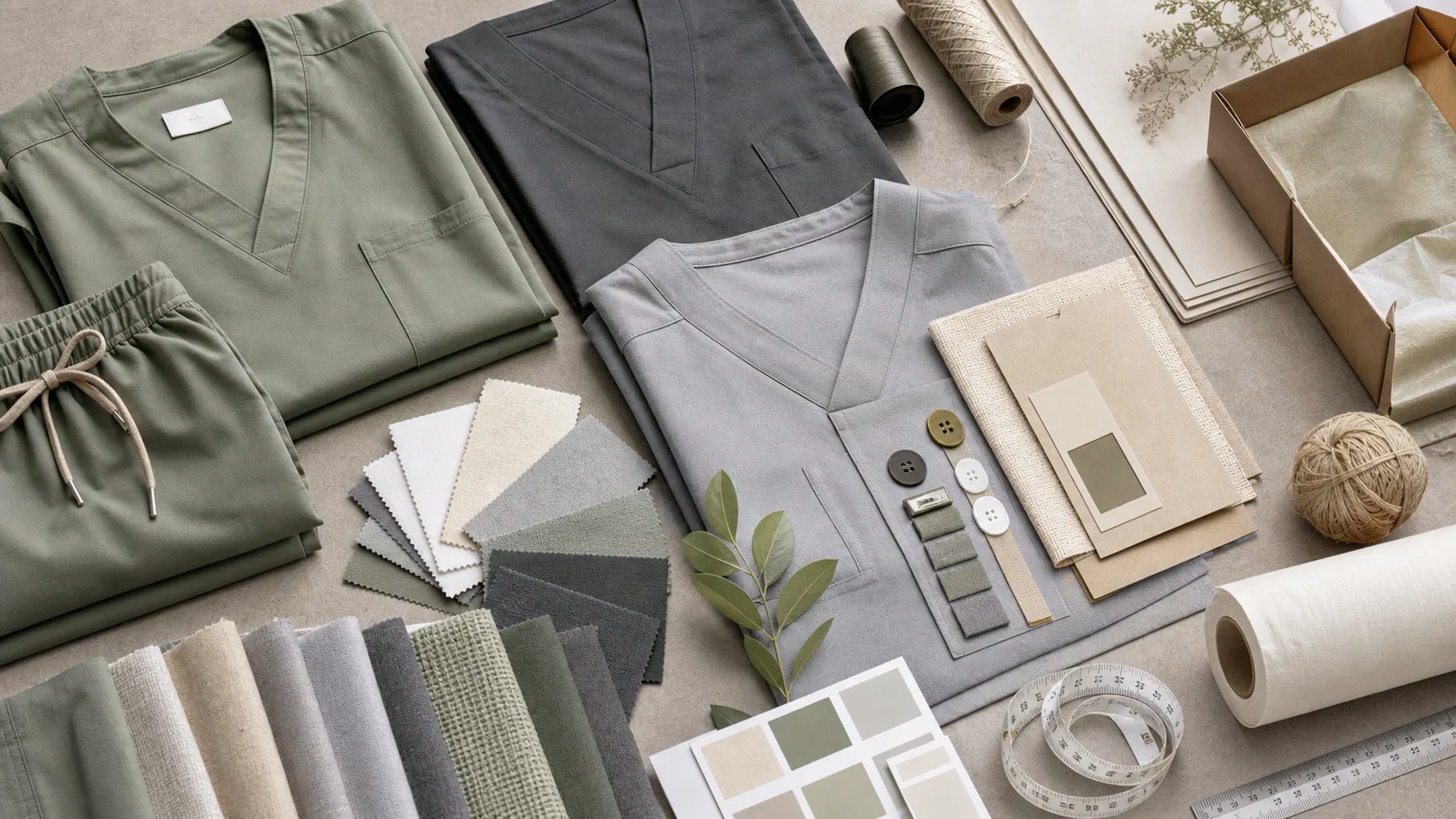
Custom Clothing Boxes Manufacturer China with checks for samples, fit, MOQ, QC evidence, pricing terms, and delivery risk.
Fast answer: Custom Clothing Boxes Manufacturer China: Board, Inserts, Finish, and Lead Time should be judged by production evidence, not by a generic sourcing promise. The buyer needs sample proof, cost breakdowns, QC checkpoints, and delivery buffers in writing.
Ask for recent sample photos, measurement tolerances, fabric or print test assumptions, decoration test notes, packing examples, and a named inspection checkpoint. These details show whether the team can repeat an approved sample at bulk volume.
Separate garment cost, decoration, labels, packaging, sampling, testing, freight, and rush charges. When every cost line is visible, it becomes easier to reduce colorways, adjust size depth, or reserve more time for sampling.
Packaging can quietly swallow 3% to 8% of apparel gross margin on a mid-priced DTC line. On gift sets with rigid boxes and inserts, I’ve seen that figure climb past 10%. That’s why a custom clothing boxes manufacturer china is rarely about chasing the lowest quote; it’s about protecting the margin already earned on the garment.
More than 200 factory visits across 8 countries keep pointing to the same thing. China wins on scale. Paper mills sit near converting plants, die-cutting runs are bigger, and print houses often handle offset, lamination, foiling, and gluing under one roof. Truckload board buys and 20,000-box runs lower the unit cost fast.
Guangdong, Zhejiang, and Fujian each bring different packaging strengths. Guangdong is strong on export coordination and dense supplier clusters. Zhejiang tends to be tighter on premium folding-carton process control. Fujian caught me off guard on e-commerce mailers, where some plants quoted 5 to 7 days for repeat jobs because common box styles stay in steady rotation. Useful differences, not magic tricks.
One spec change can move pricing more than the country of origin. A switch from 350 gsm art paper to 1.5 mm greyboard with wrap paper can raise the quote by $0.42 to $0.68 per piece, while changing the supplier from one province to another may only move it by $0.06 to $0.10. Matte lamination plus spot UV can add 12% to 18% on a small run, then drop to 4% to 6% on a 10,000-piece order.
Traps show up early. A quote that promises MOQ 300 often hides heavy setup fees. A low unit price can sit on top of $120 to $300 plate charges, $80 to $200 sampling fees, or board that crushes in freight. The prettiest sample on a desk means little if the actual caliper is 0.1 mm thinner than promised.
For brands pairing packaging with broader production, the same supplier logic applies to custom baby clothing manufacturing and private label launches, where the box has to match the product story and the freight math. When packaging sits beside a sewn garment line, the details matter more than logo placement.
I wrote this guide from factory audits, not brochures. Cost follows structure, not nationality. Once you see where the money goes, you can buy better boxes without paying for avoidable waste.
First split: direct manufacturer, trading company, or hybrid operation. A direct factory owns the machines, controls the workflow, and usually gives better price transparency. Trading companies move faster in English and can source multiple box styles, but they often add 8% to 15% on top of factory cost. Hybrid groups sit between the two, with sales offices in one city and production in another.
In a typical audit, I check whether the supplier has offset printing lines, digital proofing, specialty finishing, or only outsourced finishing. Offset works best for runs of 1,000 pieces and up because unit cost falls as volume rises. Digital printing suits 100 to 500 test pieces or artwork that changes a lot. Specialty finishing, such as foil stamping, embossing, or soft-touch lamination, usually stays in-house only in larger packaging clusters.
The production flow is straightforward. Design files get checked first. Sampling comes next. Then board selection, printing, lamination, die-cutting, gluing, and packing. In 17 factories I audited in southern China, most defects showed up in three places: file-to-plate transfer, folding accuracy, and final gluing. About 60% of visible sample defects came from registration drift or poor die alignment, not from printing itself.
Luxury retail boxes are usually stronger in Guangdong and Zhejiang, where rigid box lines and hand-finishing teams are common. Subscription and e-commerce packaging often performs better in factories that specialize in mailers, sleeves, and high-volume folding cartons. A plant built for 50,000 units a week will struggle with handcrafted magnetic closures if the line is set up for speed, not patience. That matters when brands source alongside private label clothing services; the box needs to match the product tier.
Machine lists matter. A factory with 6-color offset presses, automatic die-cutters, and inline gluing can hold tighter tolerances than a workshop leaning on manual folding. Smaller plants can still be better for niche details if they have trained operators and a disciplined QC desk. I’ve seen a 40-person shop outperform a 200-person supplier on corner squareness because the smaller team checked each batch against a 1.5 mm tolerance sheet.
Direct factories usually give better consistency on repeat orders of 5,000 to 20,000 boxes. Trading companies can help mixed-category buyers who need boxes, hangtags, and polybags in one shipment. Hybrid operations work best when the sales team understands export paperwork and the plant can actually honor the promised schedule.
For a standard folding carton, China often quotes $0.18 to $0.42 per piece at 2,000 units, depending on board and finish. Vietnam and India can land near the same zone on paper, but the quote often rises once plate charges, domestic transport, and slower replenishment get added. U.S. or European domestic suppliers may quote $0.55 to $1.20 for the same box at modest volumes, though they can move faster on rush jobs. The real comparison only works when ex-works price, freight, duty, and storage sit in the same calculation.
I’ve watched buyers lock onto a cheap unit price of $0.21 and miss the extra $450 to $900 in freight, $85 to $160 in customs fees, plus another $120 to $300 in warehouse handling for a small shipment. That’s how a “cheap” order turns expensive. Landed cost is the number that matters.
Cost drivers are easy to map. Board type comes first: 300 gsm art paper is cheaper than 2 mm rigid board. Print coverage comes next, because full-bleed artwork uses more ink and more press time. Finish choices like matte lamination, soft-touch, hot foil, embossing, and magnetic closures stack up fast. Inserts can add $0.06 to $0.35 per piece. MOQ changes the math too; 500 pieces may carry a 20% to 35% premium versus 5,000 pieces.
Here’s what most people miss: in large Chinese plants, a premium finish can cost less than a basic spec at a small regional supplier because the big plant runs the foil line every day and spreads setup over 10,000-plus units. I’ve seen soft-touch with gold foil cost $0.31 at a major Guangdong converter while a plain printed carton from a tiny subcontractor landed at $0.34. Scale beats simplicity more often than buyers expect.
A practical budget ladder looks like this. For 500 boxes, expect $220 to $480 all-in before freight. For 2,000 boxes, $520 to $1,100 is common for a mid-grade printed mailer or folding carton. For 10,000 boxes, the same spec can fall to $1,600 to $3,900, especially if the artwork is stable and the board is locally sourced. Add $80 to $250 for sampling and $100 to $600 for tooling, depending on die complexity.
For brands combining packaging with sewn goods, the economics mirror those in cut and sew manufacturing: low quantity, more labor, more variability; higher quantity, better absorption of setup costs. Read the box quote beside the garment P&L, not in isolation.
Certifications help, but they don’t print a straight line. Ask for FSC if the paper is marketed as responsibly sourced, ISO if the plant claims a formal quality system, and BSCI if social compliance matters to your retailer. Food-contact claims only matter when the box might touch edible inserts or fragrance oils. A certificate folder isn’t proof of good glue strength or accurate color.
The practical checks are physical. Measure board caliper with a micrometer. Ask for crush resistance if the box will ship stacked. Compare color tolerance against a signed reference sheet under daylight or D65 light. Check corner integrity after 10 open-close cycles. Smell the sample too; strong solvent odor can signal poor curing or rushed lamination. I’ve rejected samples that looked perfect and still failed on odor and edge lift.
First samples, pre-production samples, and mass-production samples should never be treated as the same object. The first sample is usually a proof of concept. The pre-production sample should match the final paper, ink, and finish. The mass-production sample, pulled from the line, tells you whether the operator actually held registration and glue standards across the run. In 29 audits, the most frequent failures were warping, poor creasing, color drift, and inserts that shifted by 2 to 4 mm.
For premium apparel or gift sets, I ask brands to run a simple transport test: pack 5 sample boxes, ship them 300 to 500 miles, then inspect for scuffing, corner crush, and seal failure. If the product includes delicate knits, silk, or babywear, the packaging check matters as much as garment finishing. That logic shows up in custom baby clothing manufacturing too, where clean presentation and safe handling have to work together.
For material and chemical compliance benchmarks, buyers can also review authority guidance from OEKO-TEX and Textile Exchange when evaluating paper, trims, or textile-adjacent packaging programs.
Sampling usually takes 3 to 7 days for a simple folding carton and 7 to 14 days for a rigid box with magnets, foil, or specialty paper. Mass production then adds 10 to 20 days for simple mailers and 18 to 35 days for luxury rigid packaging. If artwork revisions keep changing, add another 3 to 5 days per revision cycle. Imported paper can add a week if the mill lead time slips.
Simple mailer boxes move fastest because the machinery is standard and the finishing is light. Rigid luxury boxes are slower because they involve board mounting, hand wrapping, corner tucking, and more inspection points. In peak season, capacity tightens around Q4 and again before Lunar New Year, when plants prioritize committed orders and can push new buyers to the back of the line. I’ve seen lead times stretch by 30% in those periods.
A quick planning table helps. Fast-track orders usually mean 7 days for sampling and 7 to 10 days for production, with limited finishes and higher per-unit cost. Standard orders often run 10 to 14 days for sampling and 15 to 25 days for production. Complex orders with embossing, special coatings, and rigid construction can take 15 to 20 days for sampling and 25 to 40 days for production. If you need a seasonal launch, back-count from your apparel delivery date, not from your marketing calendar.
When a supplier also handles garment production, timing gets tighter. Packaging needs to arrive after final size approval but before bulk packing, which is why brands using a single vendor for boxes and contact the Fabrikn team for a packaging quote often find the schedule easier to align once they define the box early. Paper, print, and apparel should move on the same critical path.
I shortlist suppliers by RFQ response quality, not by the prettiness of the website. The right questions expose weak vendors fast. Ask who owns the factory, what machines they run, how many export orders they shipped last quarter, and whether the quoted price comes from in-house production or subcontracting. A real plant can answer in minutes. A broker usually needs time to call around.
Request live video of the workshop with date-stamped photos, recent packing slips, and shipment records from the last 60 to 90 days. Compare staff count against claimed output. If a supplier says 12 people can produce 80,000 rigid boxes a month, that math deserves scrutiny. Ask for three client references, one from your target market if possible.
Watch for sample-only vendors, fake certificates, and factories that suddenly “share capacity” with a partner site you never saw. I score three suppliers using the same spec sheet, same quantity, same delivery window, and the same QC standard. That keeps the comparison clean. If one quote is 25% lower, I want to know whether the board is thinner, the print is simpler, or the truth is missing.
For apparel brands, due diligence is similar to selecting a sewing partner. The same caution applies to private label clothing services: a polished sales deck does not prove process control. Ask for the factory, not just the front office.
If you’re sourcing from China for export, trade documentation and customs readiness matter too. The U.S. Commercial Service at trade.gov is a useful reference for market-entry and import planning basics.
Start with a spec sheet. Define box style, internal dimensions, paper grade, board thickness, print method, finish, insert, closure, and your target budget per piece. Then send the same document to three suppliers so the quotes are comparable. If one supplier starts “helping” by changing the spec, separate that quote from the rest and mark it as a different product.
I recommend a pilot order of 300 to 1,000 units before any larger run, especially if the box includes foil, magnets, or specialty wrap paper. Lock a written QC standard that covers color tolerance, corner squareness, glue strength, and acceptable defect rate. A payment term of 30/70 is common, though smaller factories may ask for 50/50 on first orders. Plan sampling, approval, and freight as separate milestones so each step is visible.
Use a 30-day sourcing checklist. Days 1 to 5: finalize specs and target landed cost. Days 6 to 10: request quotes and samples. Days 11 to 15: compare board grade, finish, and timing. Days 16 to 20: approve the pre-production sample. Days 21 to 30: place the order, book freight, and confirm the packing plan. If the launch window is tight, build in 7 extra days for customs, rework, or weather delays.
My decision rule is simple: choose the supplier who can show the factory, prove the numbers, and repeat the spec without improvising. Do that, and the right packaging partner becomes a cost-control tool, not a surprise line item.
For a standard folding carton, pricing often starts around $0.18 to $0.42 per piece at 2,000 units. Rigid gift boxes with foil, magnets, or inserts usually run higher, often $0.55 to $1.20 depending on board, finish, and quantity. Freight, duty, and sampling are separate.
Sampling often takes 3 to 14 days, depending on box complexity. Mass production usually runs 10 to 20 days for mailer or folding boxes and 18 to 35 days for rigid luxury boxes. Peak season can add 20% to 30% to those timelines.
Check factory ownership, machine list, export history, and recent shipment records. Ask for FSC, ISO, or BSCI only if relevant, and verify the actual workshop with live video or dated photos. A real supplier should show matching samples and production capacity numbers.
Yes, but not every factory is built for both. Plants with rigid box lines, hand-finishing teams, and foil or embossing equipment are better for premium packaging, while high-volume converters usually handle mailers and folding cartons more efficiently. Match the factory to the box style.
A pilot order of 300 to 1,000 units is a practical starting point for most apparel brands. That size is large enough to test print color, glue, fit, and freight behavior, but small enough to limit risk if the box needs revision. Use a signed QC standard before scaling up.