
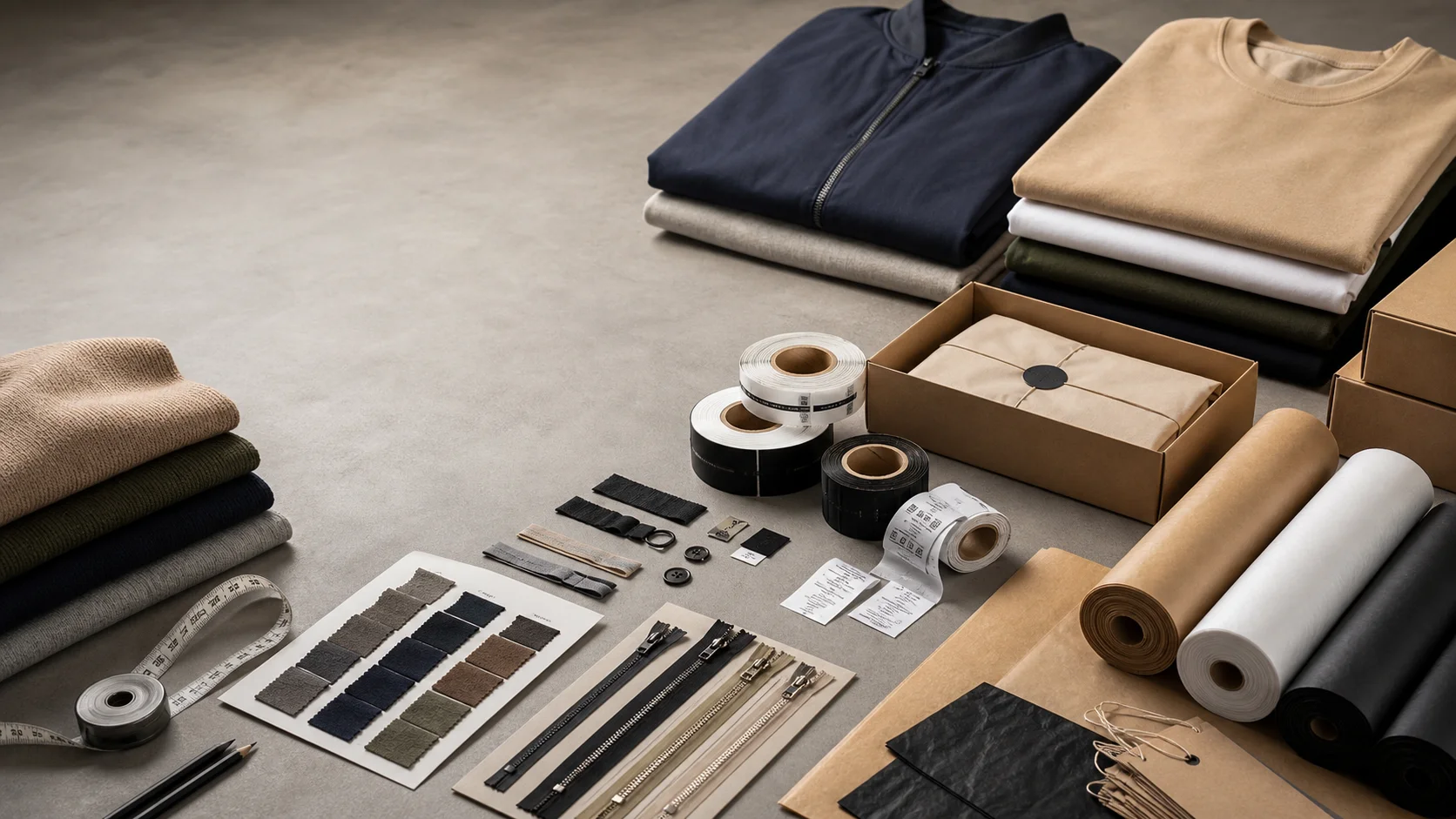
Custom Clothing MOQ Negotiation Strategies with checks for samples, fit, MOQ, QC evidence, pricing terms, and delivery risk.
Fast answer: Custom Clothing MOQ Negotiation Strategies: Samples, Cost Lines, QC, and Delivery Risk should be judged by production evidence, not by a generic sourcing promise. The buyer needs sample proof, cost breakdowns, QC checkpoints, and delivery buffers in writing.
Ask for recent sample photos, measurement tolerances, fabric or print test assumptions, decoration test notes, packing examples, and a named inspection checkpoint. These details show whether the team can repeat an approved sample at bulk volume.
Separate garment cost, decoration, labels, packaging, sampling, testing, freight, and rush charges. When every cost line is visible, it becomes easier to reduce colorways, adjust size depth, or reserve more time for sampling.
When sourcing custom clothing in bulk, minimum order quantities (MOQs) can feel like a gatekeeper. Fabrikn, a B2B clothing manufacturer, works with emerging brands and established retailers to demystify MOQ negotiation. By understanding how MOQs are structured and why they exist, bulk buyers can negotiate smarter, reducing upfront costs while still accessing premium custom apparel.
MOQs are not just arbitrary numbers; they are set to balance production efficiencies, material procurement, and factory scheduling. Each custom order incurs setup costs such as pattern making, sample development, cut and sew programming, and tooling. The more units a buyer agrees to produce, the easier it is for manufacturers to amortize those expenses, keeping unit costs competitive.
The goal of this guide is to equip bulk buyers with actionable negotiation strategies that improve flexibility, maintain quality, and protect margins. Whether you are launching a new label or expanding an established product line, mastering MOQ negotiation gives you a competitive edge.
Preparation is the foundation of any successful MOQ negotiation. This involves research, data gathering, and internal alignment.
Manufacturers like Fabrikn optimize operations around batch sizes, lead times, and machine utilization. Evaluate how your order fits within these constraints. Ask questions such as: What is the standard production run? Which processes drive cost? What are the factory’s most utilized facilities? Tailoring your order to complement the supplier’s schedule builds trust and opens room for flexibility.
Clearly articulating colorways, size ratios, and customization features reduces ambiguity. The more precise your technical package, the easier it is for the supplier to quote and set realistic MOQs. Prepare detailed spec sheets, fabric choices, trim options, and packaging instructions to streamline production planning.
Companies that can back their MOQ request with market insights are more persuasive. Provide historical sales data, forecasted demand, and previous reorder cadence. Demonstrating how you plan to rotate collections or forecast replenishment shows commitment to ongoing collaboration rather than a one-off experiment.
Define which variables you can flex. Are you willing to adjust delivery dates, accept higher lead times, or commit to longer-term partnerships in exchange for lower MOQs? Prioritize your must-haves versus negotiable items so you can navigate trade-offs during the negotiation.
Negotiating MOQs should not rely on price alone. Smart buyers show how their demand will scale, align forecasts with production, and cultivate strong supplier relationships.
If your initial order does not meet the standard MOQ, consider pooling multiple styles, colorways, or even collaborating with other brands. By bundling related items into a single order, you can meet the manufacturer’s minimum while offering variety. Fabrikn encourages clients to think of each order as a portfolio of SKUs, enabling more flexible negotiations.
Manufacturers appreciate visibility. Share monthly or quarterly projections so they can plan raw material purchases and labor shifts. Guaranteeing future volumes or providing rolling forecasts helps suppliers justify lowering MOQs for the current order because they can predict downstream demand. Be honest—overpromising erodes trust if projections fall short.
Repeat business holds tremendous leverage. Suppliers reward consistency with more accommodating terms because long-term partnerships reduce marketing and onboarding costs. Communicate regularly, pay on time, and involve your supplier early in the design process to turn them into a strategic partner. Fabrikn invests in collaborative relationships, helping buyers grow while improving production efficiency.
If your brand offers something unique—such as exposure into new markets, high-volume campaigns, or co-branding opportunities—share that value. Custom clothing manufacturers are more open to flexible MOQs when they see mutual growth potential. Offer to feature the supplier in your marketing materials or collaborate on a capsule collection that highlights their craftsmanship.
Crafting an agreement that balances your needs with the manufacturer’s operational realities is critical for sustainable MOQ negotiation.
Split your order into phases with defined milestones. This approach lets you place an initial smaller batch, followed by larger replenishments once the market response is validated. For example, negotiate a commitment for an initial MOQ of 300 units, with a clause to add 500 units once sales thresholds are met. Suppliers appreciate the structured nature of phased production because it reduces risk while keeping capacity engaged.
Lock in preferential terms for subsequent production runs. You might negotiate that once you meet certain volume thresholds, the MOQ for future styles decreases or the lead time shortens. Build in review points every 3-6 months to reassess demand and adjust MOQs accordingly.
Incorporate shared risk clauses that provide levers for both sides. For instance, offer to absorb some setup costs in exchange for a lower MOQ, or agree to share expedited shipping costs if demand surges unexpectedly. Show willingness to collaborate on inventory management to keep both parties aligned.
Ensure the contract outlines inspection points, acceptable tolerances, and compliance standards. When MOQs drop, quality oversight becomes even more critical because manufacturing efficiency is challenged. Agree on quality assurance procedures, testing protocols, and remedies for deviations to foster confidence in smaller runs.
Price and MOQ often move together, but a transparent cost structure opens new possibilities.
Ask your supplier to itemize the costs—fabric, trims, labor, overhead, and sampling. Understanding where the expense lies helps you identify negotiation pockets. If fabric drives cost, consider swapping to a similar but more accessible cloth or adjusting embellishments without compromising intent. Greater cost transparency builds trust and facilitates collaborative problem-solving.
Create pricing tiers linked to cumulative order volume. Even if your first order is below standard MOQ, commit to hitting thresholds that unlock lower unit costs in later batches. Tiered pricing motivates you to scale and gives the manufacturer confidence in future volume, making them more comfortable reducing initial MOQs.
In some cases, suppliers may agree to hold stock or invest in pre-production inventory to achieve MOQs. Discuss whether you can co-invest in raw materials that the supplier can lock in at better rates. This shared investment can reduce unit costs and enable smaller runs by covering some of the material overhead upfront.
Payment terms are integral to negotiation. Offering faster payment or upfront deposits can persuade suppliers to lower MOQs because it improves cash flow. Conversely, you might request extended payment terms for larger orders. Evaluate how payment flexibility aligns with your financial operations while ensuring the supplier remains incentivized to prioritize your production.
MOQ negotiation is not just about numbers—it extends into how production is planned and how the supply chain collaborates.
If your timelines allow, offer to align production with the supplier’s slow seasons or fill gaps in their schedule. Factories operate on capacity cycles, and being flexible with timing can reduce the urgency that drives higher MOQs. Outline multiple acceptable delivery windows to increase the likelihood they can fit you in without interrupting high-volume clients.
Ask about the supplier’s current capacity utilization. Are certain machines idle between big runs? Can your order be combined with another brand’s run if it shares similar construction? Sharing production resources can lower the effective MOQ for both customers while maximizing throughput.
Provide visibility into your upstream supply chain, especially if you supply your own materials. If you can drop-ship trims or manage logistics for certain components, you relieve the manufacturer of ordering burdens, making them more willing to negotiate on MOQs. Conversely, ask the supplier to share lead time updates, production schedules, and potential supply chain risks so you can plan reorders proactively.
Samples serve as negotiation leverage. When you approve patterns and materials early, it minimizes revisions and supports smoother production, increasing the likelihood of MOQ flexibility. Share the sampling process you prefer and how you plan to validate workmanship so the manufacturer can schedule accordingly.
If a traditional MOQ remains prohibitive, consider creative alternatives that meet your business goals while respecting the supplier’s constraints.
Some factories offer shared production lines where multiple brands share the same run. This approach distributes setup costs and lowers individual MOQs. Ask your supplier if they can accommodate shared lines for simple construction items where brand differentiation is primarily in the label or final finish.
Pre-orders provide demand validation and upfront cash flow. Work with your supplier to align production batches with confirmed orders. This reduces waste and helps justify smaller MOQs because each garment already has a committed buyer. Communicate the pre-order timelines clearly to avoid undue pressure on the manufacturer.
Manufacturers often keep rolls of popular fabrics. If you select materials from their stock, you reduce the need for freight and minimum batch cutting. This can lower MOQs since the supplier avoids ordering and storing extra material. Inquire about their fabric library during negotiation to find cost-effective alternatives.
Design garments with modular features that can share components across styles. For instance, pair a core shell with interchangeable sleeves or accents. This strategy increases order volume without requiring fully distinct garments, making it easier to hit MOQs while offering variety to your customers.
If your MOQ needs span multiple suppliers, consider working with a production partner who consolidates orders. Fabrikn acts as a partner for brands seeking consistent quality across product ranges. Partnering with a manufacturer that understands broader production networks allows you to align smaller runs with larger consolidated orders, leveraging economies of scale.
Get a free quote from Fabrikn — your trusted B2B clothing manufacturer with 10+ years of experience. MOQ as low as 200 pieces.
Get a Free Quote →MOQ stands for minimum order quantity. It is the smallest number of units a manufacturer requires you to order. MOQs are important because they ensure the factory can cover setup costs, achieve production efficiency, and allocate resources effectively. Negotiating MOQs helps you align budgets with demand without sacrificing production quality.
Prepare detailed specifications, collaborate on phased production, and share forecasts. Demonstrate reliability with upfront deposits or performance milestones. Open communication about quality expectations and regular inspection points keeps standards high while allowing for flexible quantities.
Yes. Consider bundling multiple designs, leveraging shared production runs, exploring pre-order models, using stock fabrics, and partnering with manufacturers who support product consolidation. Share demand forecasts and offer to adjust delivery timelines to align with factory schedules.
Fabrikn works closely with brands to map production strategies that align with their growth stage. By focusing on relationship-building, transparent forecasts, and shared commitments, Fabrikn supports negotiation of MOQs that work for both parties. Learn more about our collaboration approach on the services page.
Offering favorable payment terms, such as partial deposits or faster settlements, can give manufacturers confidence to lower MOQs. Conversely, structured payment plans tied to milestones can protect buyers. Discuss term options early and align them with your cash flow to complement MOQ discussions.
Include phased production clauses, review periods, shared risk initiatives, quality checkpoints, and reorder rights. Transparent communication, event triggers for adjusting quantities, and agreed-upon penalties or remedies build a contract that supports evolving MOQ needs.
Consistency, transparency, and respect for the supplier’s constraints create trust. Pay on time, include them early in planning, and communicate forecasts. A strong relationship encourages suppliers like Fabrikn to prioritize your needs, including discussing more flexible MOQs.
If you are ready to explore strategic MOQ solutions tailored to your brand, reach out through our contact page or learn more about our mission on the about us page.