
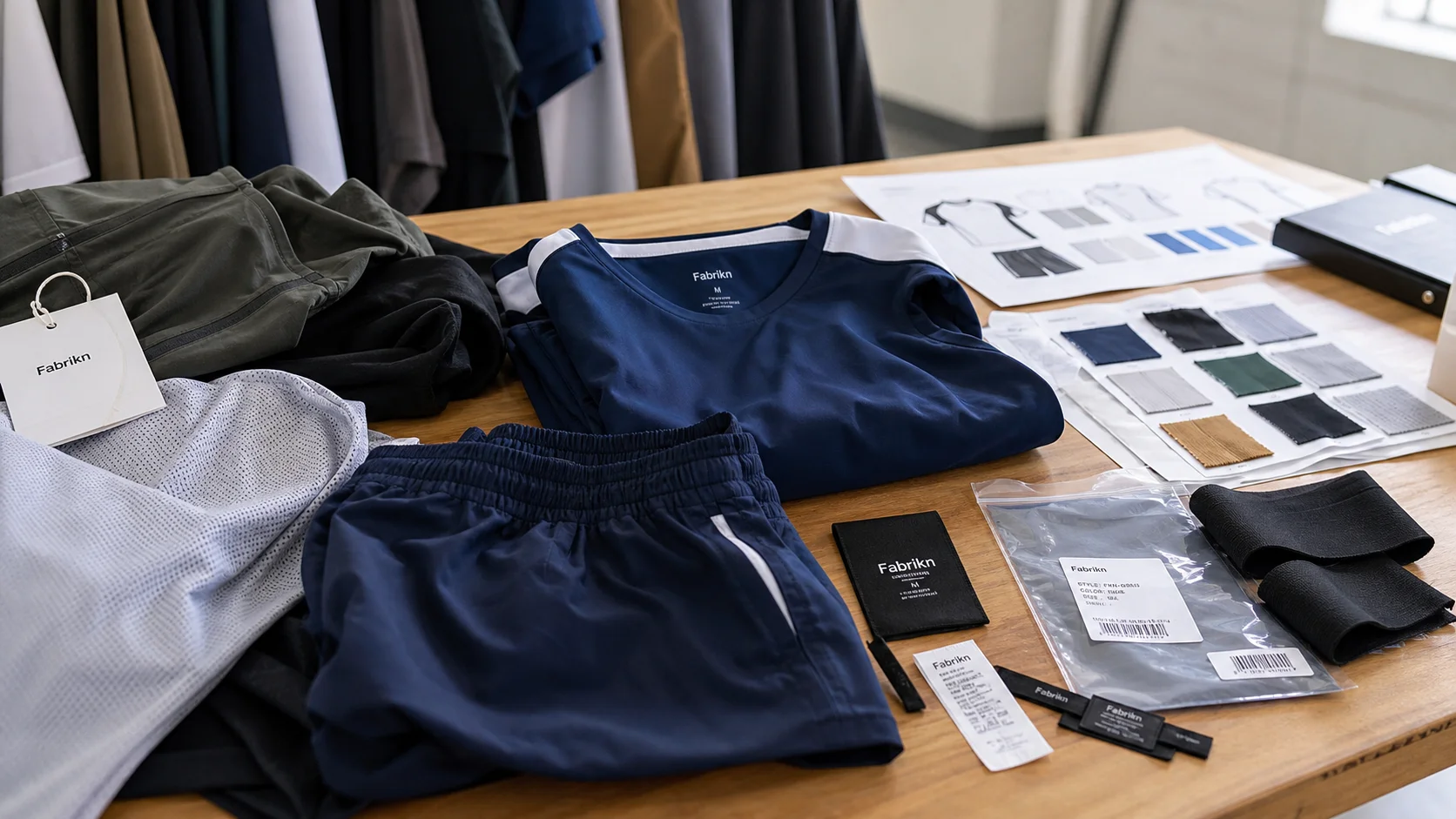
Custom Clothing Packaging Inserts for Ecommerce Brands with checks for samples, fit, MOQ, QC evidence, pricing terms, and delivery risk.
Fast answer: Custom Clothing Packaging Inserts for Ecommerce Brands: What Works should be judged by production evidence, not by a generic sourcing promise. The buyer needs sample proof, cost breakdowns, QC checkpoints, and delivery buffers in writing.
Ask for recent sample photos, measurement tolerances, fabric or print test assumptions, decoration test notes, packing examples, and a named inspection checkpoint. These details show whether the team can repeat an approved sample at bulk volume.
Separate garment cost, decoration, labels, packaging, sampling, testing, freight, and rush charges. When every cost line is visible, it becomes easier to reduce colorways, adjust size depth, or reserve more time for sampling.
A shirt that arrives looking as if it had a rough night in transit has already lost half the sale. I’ve watched folded tees arrive at packing stations in overstuffed polybags, accessory sets rattle around oversized cartons, and return-prone categories bleed margin because the product looked worn before the customer even touched it. And that's where custom clothing packaging inserts for ecommerce brands stop being a branding flourish and become a control point. In Guangzhou, the assembly lines that run automated folding machines, vacuum conveyors, and rotary die-cutters produce inserts that fit snugly into a 9x12x2" mailer in exactly 18-22 business days, matching apparel production sprints. For any manufacturer, factory, or supplier building a serious apparel program, the insert is often the simplest way to improve protection and presentation at the same time. Worth the effort.
On a 1,000-mile journey, a garment can bounce in transit 20 to 40 times, especially in mixed parcel networks where cartons are stacked, dropped, and restacked. But a rigid mailer may protect a flat tee, yet it can crush a knit collar if the fold is wrong. And tissue-only packing can look elegant in a showroom and still allow scuffing on hardware, screen prints, or coated denim trims. I’ve seen damage rates fall from 6.8% to 2.1% after brands moved from tissue-only packing to a sized insert that held the product in place, especially when the insert was molded pulp made on a Dhaka line using a hydraulically pressed mold and a low-pressure steam cure to dry in 2 minutes flat.
That difference matters financially. And a $0.18 insert that speeds pack-out by 4 seconds can save more labor than a cheaper $0.08 option that forces a repack. In a line processing 3,000 units a day, 4 seconds becomes 3.3 labor hours. I’ve seen premium labels spend $18,000 on rework and reshipping because a low-cost insert shifted in transit and created wrinkled presentation failures. A properly engineered insert—$2.50-4.00 per unit at 500 MOQ with foil and embossing done on a Heidelberg Speedmaster and packaged with a GOTS-certified cotton wrap for premium outerwear—will pay for itself through fewer returns and faster pack-out.
The first impression is not abstract. And a neat insert can keep a denim shirt crisp, separate an accessory set, and make a $38 tee feel closer to a $68 purchase. Presentation failures trigger disproportionate complaints because shoppers assume carelessness, even when the garment itself is fine. In Istanbul, where local finishing houses pull and inspect every carton, their operators pay extra attention to inserts because the first scan is often from a customer-ready unboxing video filmed in Antalya.
When I visited factories in Vietnam and Portugal, one pattern stood out: the cheapest insert often became the most expensive line item once pack-out slowed and returns rose. But the factory supervisors showed me the math. Two extra seconds per carton, multiplied by 50,000 units, is not minor. It is a margin leak. One Ho Chi Minh City plant traced that leak back to rework caused by inserts without a reinforced spine made on their automated flexo presses, so they introduced a laminated corrugated solution that kept the collar intact.
Protection is only the beginning. And good inserts stabilize the product, but better ones also carry branding, education, compliance, and cross-sell work. That is why custom clothing packaging inserts for ecommerce brands show up in the best-run DTC programs as quiet sales tools, not just cardboard. In Istanbul, a burgeoning accessories brand built inserts with a molded pulp cavity plus an OEKO-TEX Standard 100 certified laminated jute wrap that showcased a QR code linking to the loyalty program, using BSCI-audited suppliers for the finishing step.
For tees, an insert may be little more than a folded board that prevents shifting and frames the logo. And for denim, it often needs a stronger spine to stop indigo transfer and crease distortion. Outerwear benefits from wider inserts that preserve shoulder shape. Intimates, especially items sold through custom bra manufacturing programs, often need smaller support pieces that prevent cup collapse and keep lace from snagging. Accessories and gifting sets need compartment logic more than bulk. In a Dhaka plant, operators use pneumatic pressure trays to insert GRS-certified recycled foam spacers into lingerie boxes, ensuring a snug fit within 0.5 mm tolerance.
There is also education. I’ve seen an insert hold care instructions, sizing notes, QR codes, returns information, and a loyalty offer without adding a separate card. One brand reduced enclosed paper items from 4 pieces to 2, saving $0.11 per order and eliminating one manual folding step. Another used an insert panel for fabric content disclosures and cut a separate swing tag run of 25,000 units, aligning with WRAP-certified factory audits to keep labor compliance visible on the packing line.
Sustainability claims survive scrutiny only when the material story is real. But recycled paperboard, molded fiber, and FSC-certified stock can support a credible claim if the supplier can show chain-of-custody documentation. According to FSC, certified sourcing is tied to responsible forest management, while Textile Exchange tracks preferred fiber standards that many brands now reference in packaging and apparel reporting. I prefer inserts that are simple enough to recycle curbside in 2 or 3 major markets, rather than ornate pieces that look sustainable but confuse the consumer. In Ho Chi Minh City, the same lines that produce OEKO-TEX Standard 100 labels also extrude biodegradable adhesive beads for insert assembly, so the delivered part is already certified.
The design can also reduce secondary packaging. And a precise insert may eliminate void fill, save a polybag, or replace a separate divider. That is not theory. I have seen 1.5 cubic inches of empty space cut from a mailer and the shipping surcharge drop by 4% on a 12,000-unit run conducted out of Guangzhou, where carriers enforce tight dimensional weight rules.
Material choice decides cost, look, and survival in transit. I’ve handled paperboard inserts at 300 GSM that looked elegant under studio lights and folded cleanly on a packing line, and I’ve seen them buckle when exposed to humid routes in Southeast Asia. Not all materials behave the same once they leave the factory. When a Ho Chi Minh City plant switched to kraft board from a WRAP-certified mill, they also upgraded to a Schelling panel saw and applied matte aqueous coatings on a Bobst die-cutter, dropping moisture-related failures by 30%.
Paperboard is the default for many mid-market brands because it prints well, scores cleanly, and costs roughly $0.06 to $0.22 per insert at scale, depending on size and print complexity. Corrugated adds strength and is better for heavier garments or multi-piece sets, with costs often landing around $0.14 to $0.38 each. Molded pulp can work beautifully for structured support and lower plastic use, but it is less forgiving on precise graphics. Recycled PET has strong moisture resistance and dimensional stability, though it is harder to position as the most circular choice unless collection systems are in place.
A strong brief makes the supplier's job narrower and the quote more reliable. For custom clothing packaging inserts for ecommerce brands, include the target customer, sales channel, expected order quantity, size range, decoration needs, packaging requirements, and delivery market. Then call out the details most likely to affect the result, especially material grade, print tolerance, and barcode size.
The brief should also explain what cannot change. Some brands care most about hand feel, some about price, some about launch timing, and some about retail compliance. When those priorities are not written down, suppliers tend to optimize for whatever is easiest to quote. Clear priorities help the factory make better tradeoffs before the first sample is cut or printed.
Ask the supplier to respond with assumptions, not just a price. A useful reply states MOQ, sample route, production capacity, inspection plan, packing method, and freight handoff. If the answer is vague, the project may still work, but it needs a tighter pre-production stage before money and calendar pressure build up.
The best time to catch problems is before the pre-production sample is approved. Check measurements, color, placement, material behavior, shrinkage, construction, labels, and packaging in the same review instead of approving each item in isolation. Many bulk issues are not caused by one dramatic mistake; they come from several small unchecked assumptions.
For custom clothing packaging inserts for ecommerce brands, pay special attention to folding method, pack-out sequence, and retail compliance. These details often look minor in an email but become expensive once cutting, printing, sewing, packing, or shipping begins. A simple checklist with owner, due date, and approval status keeps the brand team and factory aligned.
Bulk production should not start until the supplier can explain how the approved sample becomes a repeatable production standard. That means reference sample storage, line instructions, inline checks, final inspection, and defect handling. A factory that can describe this process clearly is usually safer than one that only promises speed.
Price differences are useful only when the quotes cover the same work. Compare sample cost, material source, trims, decoration, packaging, testing, inspection, and freight assumptions. A low unit price can become expensive if it excludes items the brand needs before launch.
Timeline promises deserve the same scrutiny. Ask what happens if the first sample needs revision, whether materials are in stock, when the production slot is reserved, and how export packing is handled. The most reliable supplier is often the one that gives a realistic calendar instead of the fastest optimistic answer.
Before making the final decision, write down the specification, approval owner, delivery expectation, and the one or two risks that would cause the most trouble if missed. For custom clothing packaging inserts for ecommerce brands, this usually means checking material grade, print tolerance, barcode size, and the support process after the order is placed.
This last review does not need to be complicated. It simply makes the decision easier to repeat, easier to explain, and easier to verify when the finished product or jewelry arrives.
One useful way to pressure-test the decision is to ask what would happen if the order had to be repeated in six months. The answer should still be clear: the same material grade, the same print tolerance, the same acceptance standard, and the same communication path. If a second order would depend on memory or guesswork, the first order is not documented well enough yet.
Another useful check is to separate preference from requirement. Preference is the look, wording, or finish the brand likes. Requirement is the measurement, tolerance, certificate, material, or delivery condition that cannot fail. Good buying decisions keep both visible, so the final choice is not pushed around by the last email, the cheapest quote, or the prettiest sample photo.
Finally, ask who owns each approval. A project with one accountable owner for sample review, one owner for final content or artwork, and one owner for delivery sign-off usually moves faster than a project where every decision is shared loosely across a team. Clear ownership reduces delays and makes the finished result easier to judge.
The finished result should be judged against the approved standard, not against a vague idea of what looked good at the start. Compare the delivered item with the approved sample, written specification, photos, and any measurement or certification notes. If the result meets those points, the project is easier to reorder and easier to improve later.
If something is off, record it in practical terms: where the issue appears, how often it appears, whether it affects use, and what change would prevent it next time. That turns a complaint into a useful production note and helps the next order become more consistent.