
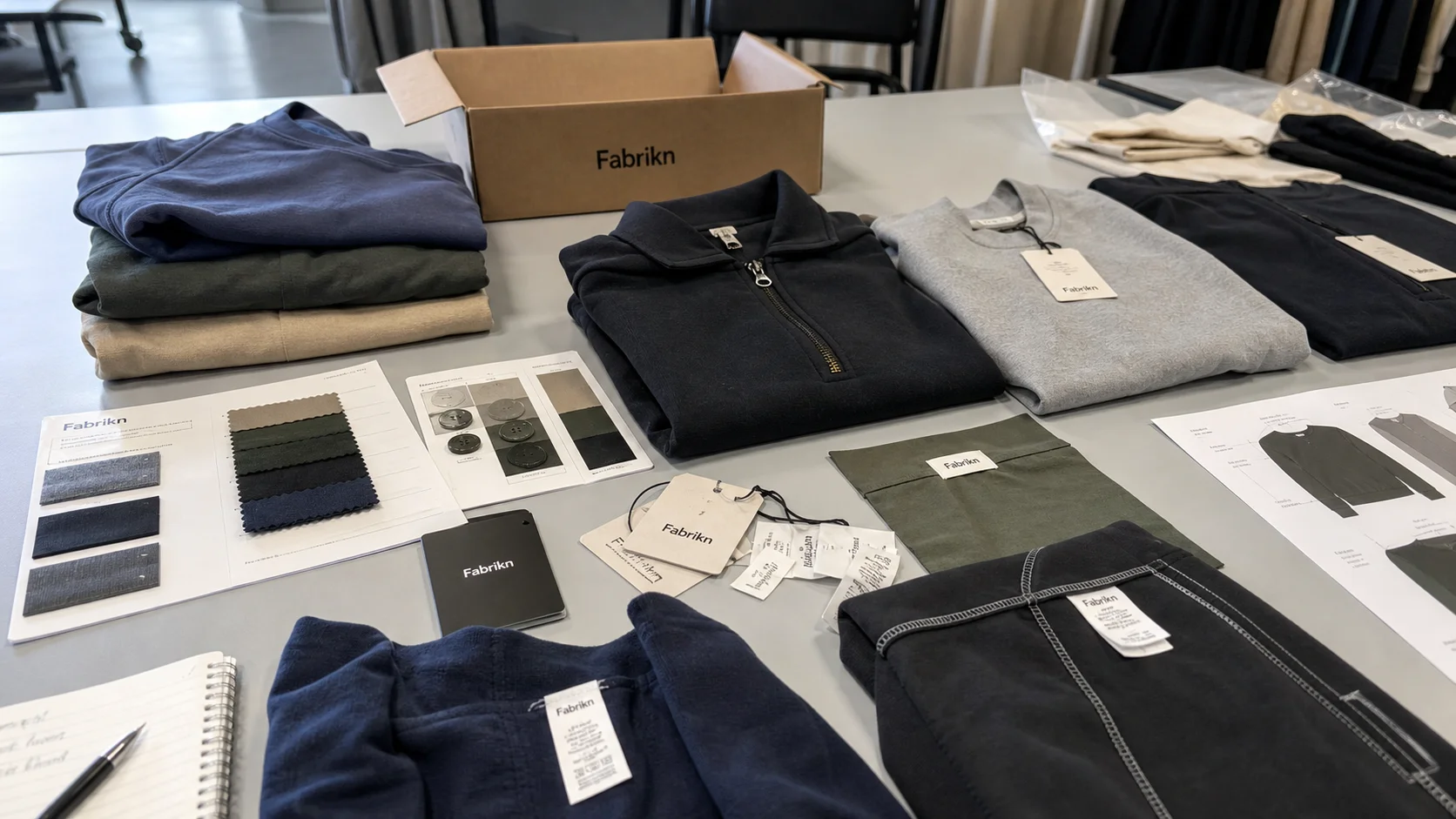
Apparel Composition Labels Supplier with checks for samples, fit, MOQ, QC evidence, pricing terms, and delivery risk.
Fast answer: Apparel Composition Labels Supplier: Fiber Text, Language, Print, and MOQ should be judged by production evidence, not by a generic sourcing promise. The buyer needs sample proof, cost breakdowns, QC checkpoints, and delivery buffers in writing.
Ask for recent sample photos, measurement tolerances, fabric or print test assumptions, decoration test notes, packing examples, and a named inspection checkpoint. These details show whether the team can repeat an approved sample at bulk volume.
Separate garment cost, decoration, labels, packaging, sampling, testing, freight, and rush charges. When every cost line is visible, it becomes easier to reduce colorways, adjust size depth, or reserve more time for sampling.
A perfect carton still fails if the inner label tells the wrong story. I once watched a 12,000-piece knit shipment sit for four days because the fiber split and country-of-origin line were missing. Freight lost to chargebacks. That is why the custom composition labels for apparel packaging supplier decision belongs in risk control, not decoration.
Retailers do not treat composition labels as branding extras. They treat them as evidence. During factory visits across eight countries, buyers and compliance teams kept saying the same blunt thing: if the label copy is wrong, the carton is wrong. For any custom composition labels for apparel packaging supplier program, accurate documentation matters as much as print quality. Industry audits and customs checks can stop a shipment at the warehouse gate, and marketplace rules can block listings before a single unit goes live. WTO data shows how much cross-border apparel movement depends on accurate documentation, and labels sit inside that paperwork chain.
Labeling mistakes are not rare, and they are not cheap. In several multi-brand programs I reviewed, they made up 3% to 7% of preventable returns. I have seen retailer QA teams inspect inner labels on one out of four units when a brand had a compliance history. Miss an RN number. Mix up a care symbol. Suddenly a carton release slips two to five days while the factory prints, sorts, and repacks.
Premium brands and value brands both need accuracy, but their standards split fast. A $180 cashmere sweater may call for softer satin, tighter Pantone matching within a 2-3 delta range, and a cleaner fold so the label does not telegraph through fine jersey. A $18 T-shirt usually tolerates a simpler printed composition tag. Not a sloppier one.
In the plant, placement matters almost as much as print. Labels sewn 8 mm off the center line irritate premium tees. Labels that curl after steaming fail floor checks. In factories I visited in Vietnam and Portugal, the strongest operators held placement tolerances within 2 mm and readability under 400 lux light. The rest hoped carton tape would hide the problem.
The core label data fields are not optional. Fiber content must add to 100 percent. Care instructions need to match the fabric and trim construction. Manufacturer identity, size, batch code, and origin country all need to be legible, correct, and consistent across the pack. A label for French terry 320 GSM is not the same as one for a 140 GSM modal blend, even when the garment silhouette is identical.
Exact wording changes by market. US labels lean on fiber content and country of origin. The EU and UK expect tighter traceability and clearer language on material composition. Japan often wants more precise formatting around fiber order and care symbols. According to ISO, quality systems depend on repeatable documentation, and that applies directly to label copy. A few words out of order can trigger a recheck from a retailer or customs broker.
Material choice shapes performance. Woven labels suit luxury goods because they feel refined and hold structure. Satin works for soft premium basics and childrenswear, though it can fray if cut badly. Heat-transfer labels are common in sportswear because they reduce bulk and survive high stretch, while printed fabric labels fit cost-sensitive programs with 5,000 to 50,000 units. I have seen woven labels priced at $0.08 to $0.22 per piece, satin at $0.05 to $0.14, and heat transfers ranging from $0.07 to $0.18 depending on quantity.
Durability testing should be brutal. Run 20 to 50 wash cycles, abrasion rubs, and steam exposure. Check legibility after tumble dry and line dry. If a label fades after three washes or the ink cracks after stretching, it is not production-ready. Packaging integration matters too. The composition label has to work with the hangtag, polybag, insert card, and carton label so the pack-out order stays clean. That is where clothing packaging solutions become part of compliance, not just presentation.
When labels, inserts, and carton coding line up, the line moves faster. When they do not, people on the floor waste 30 to 60 minutes per batch sorting mismatched components. I watched a 2,400-piece run stall because the barcode on the inner pack did not match the carton master code. Small error. Expensive pause.
A polished sales deck tells you almost nothing. The factory tells the truth. I ask for the ISO certificate, OEKO-TEX paperwork, REACH-related declarations, test reports, and traceability records before I even discuss pricing. If a plant cannot produce batch-level documents within 24 hours, I assume its recordkeeping is thin. OEKO-TEX is one of the few signals buyers can verify quickly, though it does not replace product-specific testing.
Reliable plants have a sample approval chain that is visible and boring. The bad ones rely on email memory. Red flags: vague lead times like “about 2 weeks,” no signed strike-off, unstable color matching between reprints, barcode scans that fail on 10% of cartons. I also watch what happens when I ask for a failed sample. If they show the defect, explain the root cause, and document the correction, I keep listening. If they hide it, I walk.
Regional differences are real. China can move quickly on larger label programs with MOQs around 3,000 to 10,000 pieces, and a decent factory may turn samples in three to five days. Vietnam often competes well on labor cost and mid-volume production, though lead time can stretch by a week during peak season. Bangladesh can be price-strong on bulk volume, yet sampling discipline varies widely. Turkey and Portugal usually cost more per piece, sometimes 15% to 35% above South Asia, but they can be faster for short runs and EU-bound orders. A capable custom composition labels for apparel packaging supplier should explain these trade-offs clearly.
On site, I check cutting accuracy with a ruler, then rub ink with a white cloth to test adhesion. I steam labels for 20 to 30 seconds to see whether shrinkage distorts the text. I also inspect how they are packed before shipment. A bundle tied too tightly can crease the printed face. A loose carton can invite dust and edge damage. The best factories treat a 1 mm shift as a problem, not a personality trait.
Last year I worked with a brand that sourced cut and sew manufacturing from one country and labels from another. The mismatch added six days to the release calendar because the QA team had to reconcile two different approval chains. That delay was avoidable.
Pricing depends on material, print method, order size, and how much compliance text you need. Simple printed composition labels can land around $0.03 to $0.08 per piece at 10,000 units. Woven labels usually sit closer to $0.08 to $0.22. Satin labels often fall between $0.05 and $0.14. Multi-language compliance labels with several care languages, QR codes, and batch coding can reach $0.12 to $0.35, especially at low volume. I have quoted 500-piece runs that cost nearly three times the unit price of a 20,000-piece order because setup got spread across fewer labels.
Low MOQ orders change the math fast. A supplier may charge a $35 to $120 plate or digital setup fee, then distribute that cost across the run. At 500 pieces, that fee hurts. At 15,000 pieces, it disappears into the unit rate. For a premium trial collection, that can be fine. For a basic tee program, it is painful. The buyer has to decide whether speed, flexibility, or price matters most.
Timing has five steps. Sampling takes 3 to 7 days. Strike-off approval can take 1 to 4 days if the brand responds quickly. Bulk production usually needs 7 to 18 days. Inspection and packing add another 1 to 3 days. Ocean transit can take 18 to 35 days, while air freight may compress delivery to 3 to 6 days but can add 25% to 60% to landed cost. This is why a domestic supplier sometimes looks expensive on paper and cheaper in practice.
Here is the comparison buyers usually need. A domestic supplier may quote $0.14 to $0.30 per label, deliver in 5 to 10 days, and offer more flexibility on rework. An offshore supplier may quote $0.04 to $0.16, need 15 to 30 days including shipping, and require firmer forecasting. I have seen brands choose the low-cost offshore option, then spend an extra $800 to $1,400 on air freight after a single artwork mistake. Faster is not always cheaper if the supplier’s QC reduces replacement risk.
For brands building private label programs, the label line item should be read beside packaging, trim, and compliance spend. If you are scaling private label clothing, the right custom composition labels for apparel packaging supplier can keep a 7,500-piece season on schedule without adding manual rework to the packing floor. That matters more than a penny saved on paper stock.
Luxury, sportswear, childrenswear, and basics demand different label logic. Luxury buyers care about hand feel, edge finish, and visual restraint. A composition label on a $220 blazer may need a softer weave, a lower-gloss satin, or even an external placement hidden inside a pocket bag. Sportswear wants abrasion resistance, stretch recovery, and wash durability. Children’s wear needs clarity, safety, and readable care icons. Basics need cost discipline and speed. A spec that works on one can fail on another, even when the garment itself is the same cotton jersey.
Price point changes expectation. On garments below $20, buyers often accept simpler printed labels and tighter supplier timing. On pieces above $150, they expect cleaner stitching, color consistency within a 1-2 shade range, and packaging that feels deliberate. In Europe, I have seen buyers ask for stronger sustainability documentation and cleaner traceability files. In the US mass market, speed and compliance accuracy tend to dominate the conversation. Both are rational. Both are unforgiving.
Packaging suppliers need to think in systems. Folding direction affects where the label sits. Tagging affects whether the label is visible in the shelf pack. Bagging affects moisture and curl. Carton coding affects warehouse scanning. A label spec that ignores the carton master code can slow a 10,000-unit receipt by half a day. That is not a small operational issue. It is payroll.
When I visited factories in Portugal and Bangladesh, I saw the same T-shirt treated two different ways. In Portugal, the label was sewn with softer thread and packaged flat in bundles of 50. In Bangladesh, it was folded tighter and packed in 100s to reduce carton count. Same garment. Different commercial logic. Same label code, different outcome.
Sustainability claims only work when the materials can prove them. Recycled polyester labels can be documented with supplier declarations. FSC paper inserts can support fiber-based packaging claims. Water-based inks can reduce solvent exposure and usually smell less harsh on the packing floor. According to Textile Exchange, recycled material claims need clear chain-of-custody evidence or they drift into marketing fiction. In many markets, that applies directly to a custom composition labels for apparel packaging supplier program.
Traceability is practical, not poetic. Lot numbers, QR codes, and audit references help brands trace a bad run in minutes instead of hours. I like to see one code linking the label batch, the garment lot, and the packing date. That makes recalls, reorders, and customs questions easier to answer. Vague phrases like eco-friendly or green are risky unless the claim can be backed by material proofs and purchase records.
Market scrutiny varies. EU buyers usually inspect evidence more tightly than some domestic wholesale channels, and they ask who verified the claim, not just who wrote it. For official guidance on importing and documentation standards, trade.gov is a useful reference. From factory work, I have learned a simple rule: sustainability matters commercially only when it also works at scale. A beautiful recycled label that jams the sewing line or costs 40% more without volume logic will not survive procurement review.
Start with a clean spec sheet. Define dimensions, fiber content, care text, language versions, color codes, placement, barcode needs, and packaging instructions. Then request samples and approve strike-offs before bulk. Test wash performance for at least 5 cycles if the garment is a basic item, and 10 to 20 cycles if it is premium or sportswear. Sign off only when the label, garment, and pack-out all match.
I recommend a single source of truth for artwork and regulatory copy. One spreadsheet. One approved PDF. One owner. That prevents version drift between design, sourcing, and QA. If the care text changes in one file and not another, you will pay for it later in reprints or relabeling. That mistake can add 2 to 6 days and turn a modest order into a fire drill.
A practical rollout looks like this: sample in week 1, strike-off approval in week 2, bulk in week 3, inspection before dispatch in week 4. Build a communication cadence of 48 hours for sample feedback and 24 hours for final approval. If your team needs help aligning labels, packaging, and garment build, start with a partner that can quote the whole program. You can get a free quote and compare MOQ, turnaround, and cost drivers in one conversation. The right custom composition labels for apparel packaging supplier should make that process simpler, not harder.
For brands with large order books, the buyer questions always return to the same three points: MOQ, lead time, and rework risk. Get those answered before artwork starts. That saves money, and it keeps production honest.
You need a tech pack, approved fiber content, care copy, size information, placement details, and packaging instructions. Most suppliers also ask for artwork in AI or PDF format and a target quantity, often 500, 1,000, or 10,000 pieces.
Basic printed labels can start around $0.03 to $0.08 per piece at higher volume, while woven labels often run $0.08 to $0.22. Low MOQ orders usually carry setup fees of $35 to $120, which raises unit cost sharply at 500 pieces.
Sampling usually takes 3 to 7 days, bulk production 7 to 18 days, and inspection 1 to 3 days. Ocean freight can add 18 to 35 days, while air freight can shorten arrival to 3 to 6 days.
Sometimes, but not usually. A label that works on a cotton basic tee may fail on a luxury knit or sportswear because durability, hand feel, and compliance expectations differ. Category and price point matter as much as the garment itself.
Start with a finalized spec sheet, then request samples and test them before bulk release. If you need help across garment, trim, and packaging, begin with a supplier that can coordinate private label clothing workflows and labeling specs in one approval chain.