
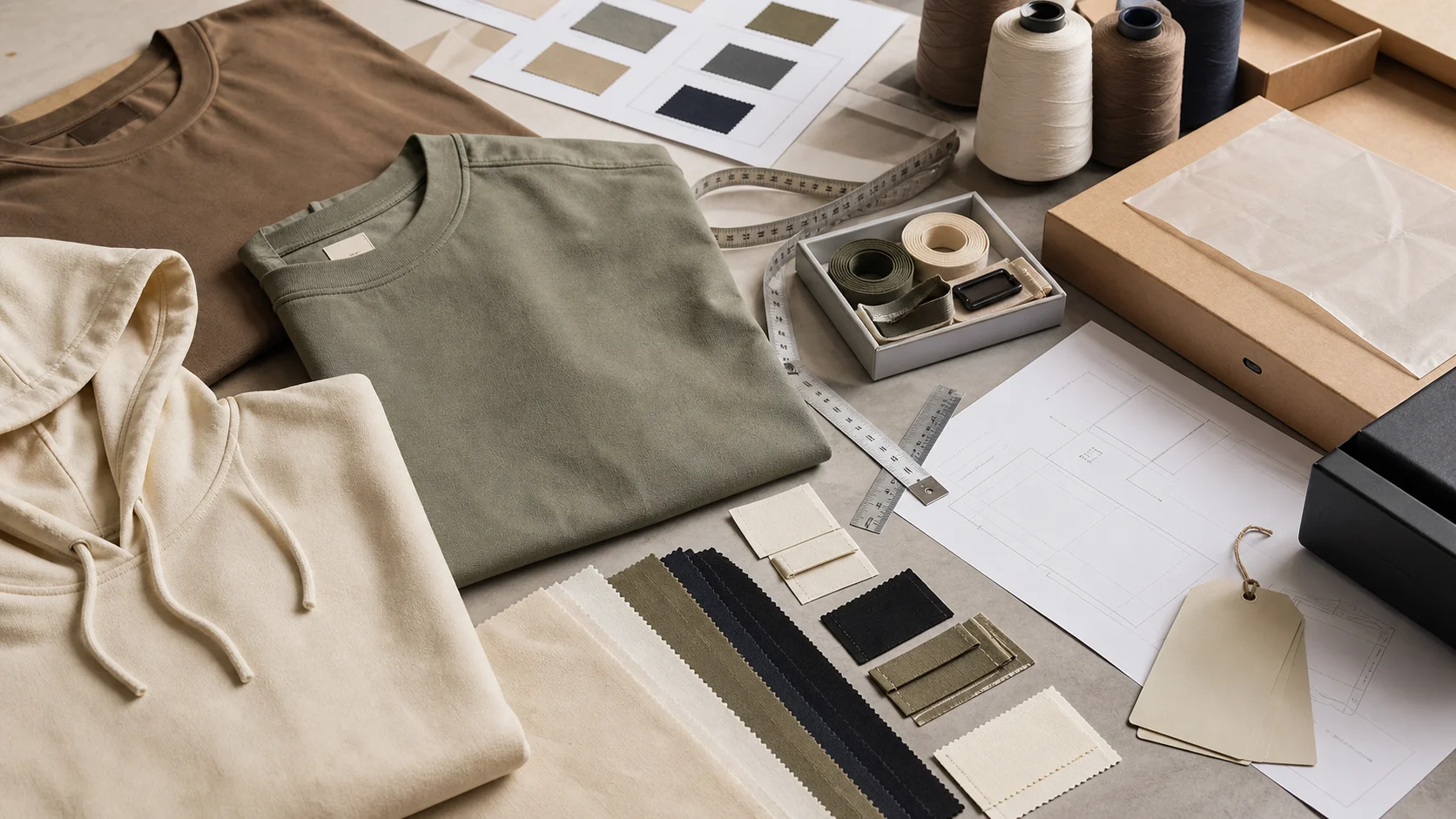
Custom Composition Labels for Fashion Brands China compared by sample evidence, fabric or trim specs, MOQ, AQL terms, cost lines, delivery timing, and...
Fast answer: Custom Composition Labels for Fashion Brands China: Material, Print, MOQ, and QC Terms should be judged by production evidence, not by a generic sourcing promise. The buyer needs sample proof, cost breakdowns, QC checkpoints, and delivery buffers in writing.
Ask for recent sample photos, measurement tolerances, fabric or print test assumptions, decoration test notes, packing examples, and a named inspection checkpoint. These details show whether the team can repeat an approved sample at bulk volume.
Separate garment cost, decoration, labels, packaging, sampling, testing, freight, and rush charges. Clear cost lines make it easier to reduce colorways, adjust size depth, or reserve more time for sampling.
I once stood in a label factory outside Ningbo while a manager quoted $0.03 per label for a 100,000-piece order, then calmly explained why 5,000 pieces would cost nearly five times more. That's the kind of arithmetic that keeps custom composition labels for fashion brands china at the center of sourcing conversations: low margins, tight tolerances, fast sampling, and no room for sloppy thinking. And yes, the math was precise enough to make a buyer sweat.
China still leads on woven, printed, satin, and heat-transfer labels because the supply chain is packed tight. A manufacturer or supplier can often source yarn, dyeing, printing, fold-and-cut, and packing within a short radius, which improves production speed and quality. But the real edge is how short that radius stays, so the same cluster can handle yarn, printing, cutting, and packing without a logistics headache. In Guangdong, Zhejiang, and Fujian, I’ve seen suppliers turn around artwork samples in 3-4 days. Inland operations can quote 8%-15% lower labor costs, yet sample loops often stretch to 7-10 days because materials move between more subcontractors.
That matters more than many buyers admit. A composition label may be only 2.5 cm by 5 cm, but it still carries fiber content, country of origin, care symbols, and sometimes batch codes. If the print is fuzzy, a wash symbol is wrong, or the fold orientation is reversed, the garment can fail a retailer audit or trigger a return. According to trade compliance guidance from Trade.gov, textile trade is still tightly governed by origin and documentation rules, which makes tiny labels part of a much bigger compliance chain. And yeah, that compliance chain doesn't forgive mistakes.
Speed versus price. Durability versus hand-feel. Regulatory accuracy versus visual polish. And each time you juggle those factors it feels like a bet.
Premium brands often pay $0.08-$0.18 per woven label for better edge finishing and color stability. Budget brands may stay near $0.02-$0.05 for printed polyester. I’ve seen the cheapest batch create the most expensive headache when a retailer rejected 12,000 units because the fiber percentages were off by 5 points. But even the budget folks pay attention when a retailer slams a batch that misses fiber counts.
The production path starts with a spec sheet, not a loom. I ask brands to define label size in millimeters, fold type, content language, care symbols, attachment method, and delivery format before a supplier even touches artwork. For custom composition labels for fashion brands china, the fastest orders usually move in this order: tech pack review, content approval, material selection, digital proof, sampling, wash check, bulk production, and final packing into rolls or cut pieces. And it stays that way until the final packing is locked in.
Artwork approval is where many failures begin. A supplier may receive English copy, then translate fiber terms into Chinese for printing, then back into English for proofing. That loop is where “polyester 100%” becomes “100% poly” or where “exclusive of trim” disappears. I’ve watched a premium activewear brand lose two weeks because the font at 5 pt looked crisp on screen but blurred on satin once heat sealed. And once your font doesn't hold, weeks disappear.
Material choice drives the method. Polyester is common for durability and low cost. Cotton feels softer but can fray faster. Satin gives a smoother hand for premium brands. Recycled yarns are increasingly available, though they often add $0.01-$0.03 per label. Care-content substrates vary too: woven damask for higher definition, printed taffeta for cost efficiency, heat-transfer for tagless comfort, and laser-cut options for clean edges on technical garments.
Errors show up at translation, shrinkage, or legibility. Wash symbols may be too small at 1.5 mm, fiber content can be misordered, and fonts can collapse after heat or steam. And the cheapest label often becomes the most expensive if cut accuracy or wash resistance fails. I’d rather approve a $0.06 label that survives 30 wash cycles than replace 50,000 units later. For brands already managing custom bra manufacturing, that discipline matters because soft-hand trims and compliance marks often have to work together in very small spaces.
Pricing changes fast with material, method, and order size. In China, printed polyester composition labels often start around $0.02-$0.05 per piece at 10,000 pieces, while woven damask labels usually sit near $0.05-$0.12. Recycled content, metallic threads, or tight logo detail can push that to $0.10-$0.20. For brands buying custom composition labels for fashion brands china, the cheapest quote is rarely the truest quote unless you compare the same fold, same colors, and same finishing method. And small finish tweaks change the math.
MOQ ranges are just as uneven. Trading companies may aggregate small orders and offer 500-1,000 pieces, but direct factories often set 3,000-10,000 pieces per design because machine setup and waste are fixed costs. A woven label line with 6 colors and a center fold may require 3%-5% extra allowance for trim losses. And when a supplier offers 800 pieces on a complex woven label, I usually ask where the hidden cost is buried.
Lead time depends on where the work happens. Artwork revision may take 1-2 days if the buyer responds quickly, sample development 4-7 days, and bulk production 7-14 days for standard runs. In inland areas, I’ve seen that stretch to 15-20 days when yarn dyeing or packaging is outsourced. Coastal clusters near Shanghai, Xiamen, and Shenzhen often move faster because label production sits closer to garment assembly, especially for private label clothing programs that need 10-20 SKUs synchronized in one calendar. And when inland areas stretch that to 15-20 days, expect yarn and packaging to bounce between subcontractors.
Regional price points tell their own story. Budget brands often prioritize printed care labels at $0.02-$0.04 and accept a 2-3 week total timeline. Mid-market labels pay $0.05-$0.09 for better hand-feel and tighter registration. Premium export programs with EU or US compliance usually pay more for accurate fiber naming, barcode clarity, and packed-by-color consistency. A sample order can run 1-2 cartons, but a bulk order may require 5,000-20,000 labels to make unit economics work. I’ve had suppliers quote 12% lower on paper, then add 8%-10% for split packaging, roll direction, and change fees after artwork sign-off. And budgets set the tone for who can afford that clarity.
Most label failures are boring, not dramatic. They fade after 10 washes, fray at the edge, or print the wrong fiber split. I’ve seen a 60% cotton, 40% polyester label arrive as 65/35 because a factory copied an old file and never rechecked the content line. That is exactly why custom composition labels for fashion brands china need a proper QC plan before bulk approval, not after the first carton lands. And they still cause a replay of paperwork.
The first test is visual. Check color accuracy against Pantone references, then inspect text at 100% magnification if possible. A satin label may look rich under warehouse lights yet fail under daylight. The second test is physical: 5-10 wash cycles, abrasion checks, seam pull tests, and fold recovery. I prefer to log every wash and abrasion result before I sign off on the run.
A strong brief makes the supplier's job narrower and the quote more reliable. For custom composition labels for fashion brands china, include the target customer, sales channel, expected order quantity, size range, decoration needs, packaging requirements, and delivery market. Then call out the details most likely to affect the result, especially material grade, print tolerance, and barcode size.
The brief should also explain what cannot change. Some brands care most about hand feel, some about price, some about launch timing, and some about retail compliance. When those priorities are not written down, suppliers tend to optimize for whatever is easiest to quote. Clear priorities help the factory make better tradeoffs before the first sample is cut or printed.
Ask the supplier to respond with assumptions, not just a price. A useful reply states MOQ, sample route, production capacity, inspection plan, packing method, and freight handoff. If the answer is vague, the project may still work, but it needs a tighter pre-production stage before money and calendar pressure build up.
The best time to catch problems is before the pre-production sample is approved. Check measurements, color, placement, material behavior, shrinkage, construction, labels, and packaging in the same review instead of approving each item in isolation. Many bulk issues are not caused by one dramatic mistake; they come from several small unchecked assumptions.
For custom composition labels for fashion brands china, pay special attention to folding method, pack-out sequence, and retail compliance. These details often look minor in an email but become expensive once cutting, printing, sewing, packing, or shipping begins. A simple checklist with owner, due date, and approval status keeps the brand team and factory aligned.
Bulk production should not start until the supplier can explain how the approved sample becomes a repeatable production standard. That means reference sample storage, line instructions, inline checks, final inspection, and defect handling. A factory that can describe this process clearly is usually safer than one that only promises speed.
Price differences are useful only when the quotes cover the same work. Compare sample cost, material source, trims, decoration, packaging, testing, inspection, and freight assumptions. A low unit price can become expensive if it excludes items the brand needs before launch.
Timeline promises deserve the same scrutiny. Ask what happens if the first sample needs revision, whether materials are in stock, when the production slot is reserved, and how export packing is handled. The most reliable supplier is often the one that gives a realistic calendar instead of the fastest optimistic answer.
Before making the final decision, write down the specification, approval owner, delivery expectation, and the one or two risks that would cause the most trouble if missed. For custom composition labels for fashion brands china, this usually means checking material grade, print tolerance, barcode size, and the support process after the order is placed.
This last review does not need to be complicated. It simply makes the decision easier to repeat, easier to explain, and easier to verify when the finished product or jewelry arrives.
One useful way to pressure-test the decision is to ask what would happen if the order had to be repeated in six months. The answer should still be clear: the same material grade, the same print tolerance, the same acceptance standard, and the same communication path. If a second order would depend on memory or guesswork, the first order is not documented well enough yet.
Another useful check is to separate preference from requirement. Preference is the look, wording, or finish the brand likes. Requirement is the measurement, tolerance, certificate, material, or delivery condition that cannot fail. Good buying decisions keep both visible, so the final choice is not pushed around by the last email, the cheapest quote, or the prettiest sample photo.
Finally, ask who owns each approval. A project with one accountable owner for sample review, one owner for final content or artwork, and one owner for delivery sign-off usually moves faster than a project where every decision is shared loosely across a team. Clear ownership reduces delays and makes the finished result easier to judge.