
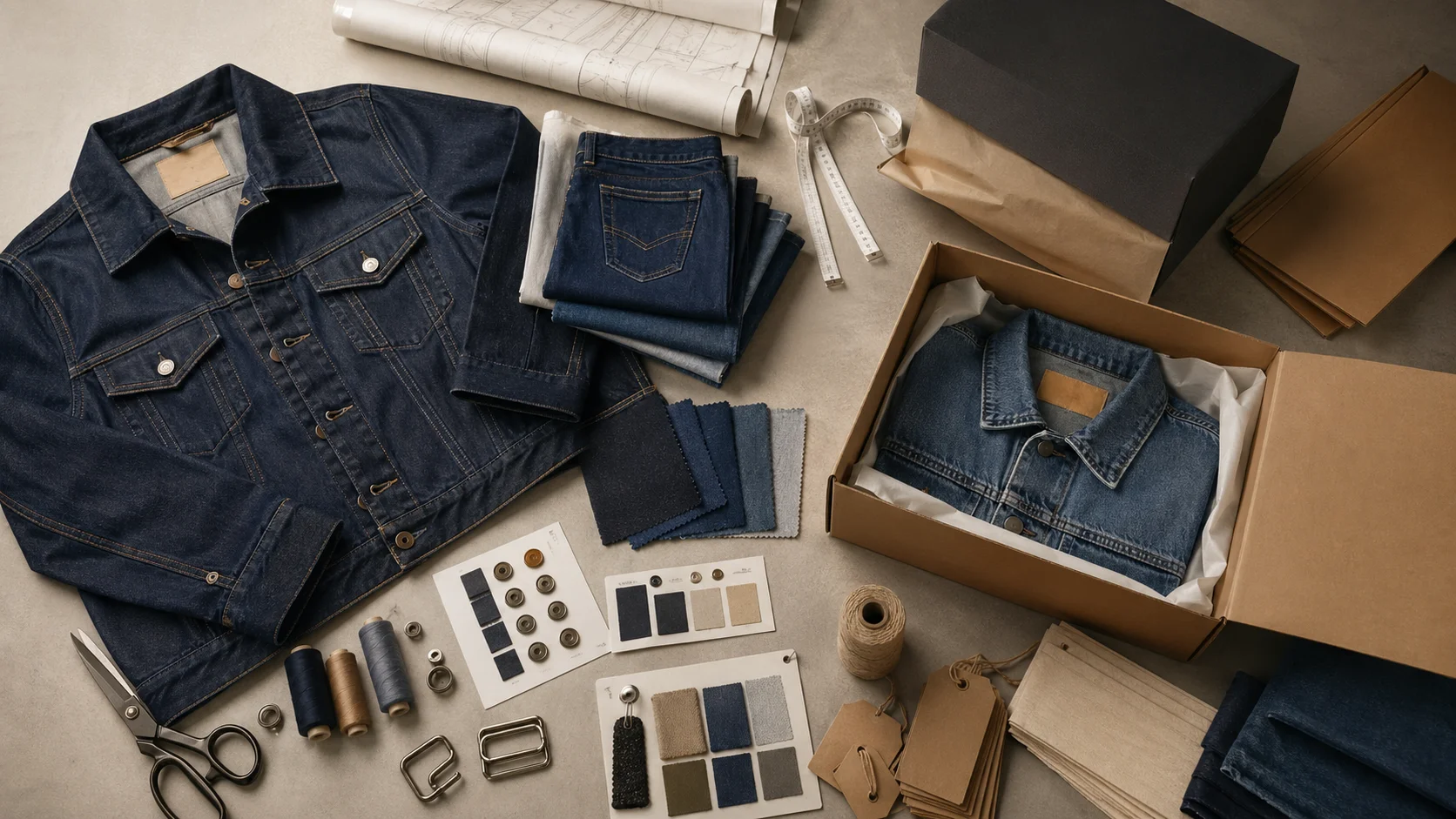
Country-of-Origin Apparel Labels with checks for samples, fit, MOQ, QC evidence, pricing terms, and delivery risk.
Fast answer: Country-of-Origin Apparel Labels: Compliance Text, Print, and Proof should be judged by production evidence, not by a generic sourcing promise. The buyer needs sample proof, cost breakdowns, QC checkpoints, and delivery buffers in writing.
Ask for recent sample photos, measurement tolerances, fabric or print test assumptions, decoration test notes, packing examples, and a named inspection checkpoint. These details show whether the team can repeat an approved sample at bulk volume.
Separate garment cost, decoration, labels, packaging, sampling, testing, freight, and rush charges. When every cost line is visible, it becomes easier to reduce colorways, adjust size depth, or reserve more time for sampling.
One wrong origin label can stall a shipment faster than a missed truck. I once watched a 2,400-piece order sit because 18 units carried the wrong country statement, and the retailer treated the lot like a suspect package until every carton was opened. That is the scale of custom country of origin labels for apparel: tiny part, outsized consequences. They govern compliance, SKU accuracy, and returns on every unit leaving the factory. For any manufacturer, factory, or supplier handling apparel production, the label is not a finishing detail; it is a control point.
Across visits in Vietnam, Portugal, and Morocco, the breakdowns almost never happened at the sewing machine. They showed up at handoff points. A cutter changed the fabric roll count and never touched the label file. Packing swapped carton art after a late color change. In North Africa, a QA clerk signed off on hangtags that didn’t match the sewn-in wording. Stitching was fine. Paperwork wasn’t.
Retail audits, marketplace rules, and customs inspections turn origin wording into a high-risk detail. According to U.S. Commercial Service import compliance guidance, traceability and documentation often matter more than presentation. In practice, custom country of origin labels for apparel with the right font but the wrong phrasing can trigger chargebacks, relabeling, or a second inspection. Premium brands feel it as trust erosion. Value brands feel it as rework. A $0.03 label error on 50,000 units becomes a much uglier number once labor, freight, and delay fees pile on.
I’ve seen the same mistake hit different price tiers in different ways. A luxury knit at $120 retail may use a satin woven label, laser-cut edge, and pantone-matched carton sticker. A $14 tee may use a basic heat-transfer mark and still face the same customs scrutiny. The margin structure changes. The risk doesn’t.
Compliance teams start with three questions: where the garment was cut and sewn, what exact origin statement is required, and where it needs to appear on the product or packaging. The answers shift by market, but the logic stays fixed: permanence, legibility, traceability.
In the US, the Federal Trade Commission expects clear, non-misleading origin information, and Customs and Border Protection can ask for substantiation at entry. The EU and UK lean on a mix of consumer law and buyer standards, with wording that may need to get more specific when assembly happens in one place and components come from another. Australia’s ACCC focuses on truthful claims and clear disclosure, especially when imported components and final assembly happen in different places. For buyers who want a deeper operational path, our cut and sew manufacturing page explains how the production stage shapes labeling decisions.
Proof usually comes before production: factory declarations, purchase order records, sewing logs, fiber-content backing, sample photos showing placement on the garment. I’ve reviewed shipments where the hangtag said one thing, the sewn-in label said another, and the carton label used a third abbreviation. Auditors catch that kind of inconsistency in minutes.
What matters isn’t decoration. Traceability is the point. A label that sits 2 cm off-center is usually fine. A label that fades after 5 washes, or uses an origin phrase with no paper trail, is not. Compliance teams will ignore beautiful presentation and focus on whether the wording survives handling, transit, and scanning.
According to OEKO-TEX documentation standards, textile product claims live or die on supporting records as much as testing. That matches what I see on factory floors. The best-run programs keep one master compliance file per SKU, with garment specs, label art, approved translation, and carton copy in the same folder. Messy files invite expensive arguments later.
Label material changes everything. Woven fabric labels feel permanent, which is why they still dominate premium knits and denim jackets. Printed satin labels are cheaper and faster, often landing at $0.02 to $0.06 per piece in large runs, but they can fray or fade after 20 to 30 wash cycles. Adhesive labels work for carton and polybag use, not for the garment itself. Heat-transfer marks look clean on activewear, yet they demand tighter press control.
Denim brands often choose 320 GSM French terry samples with woven neck labels because consumers touch that seam first. Children’s wear needs softer edges and fewer scratch points. Luxury basics lean toward tonal woven labels with fine thread counts, then back them up with carton stickers for logistics. Same product family, different answer. Spend a day on the line and the factory will tell you that fast enough.
Readability beats art direction. Font size below 6 pt becomes risky on small neck labels. High contrast between text and ground color beats clever palette choices. Barcodes should stay away from the origin line, because one scanner misread on a master carton can delay receiving by 1 to 3 days. I’ve seen buyers save $120 on label art and spend $1,800 on relabeling and freight.
The thing nobody tells you: the cheapest label stock can become the most expensive option once you count rework, returns, and warehouse sorting. I saw this in a Turkish factory running 25,000 units. The low-cost adhesive failed carton tests, and 11 percent of the run had to be repacked. Premium stock cost 8 percent more upfront and would have been cheaper overall.
Placement changes sewing speed. Put the label 1.5 cm too close to the seam and operators slow down, reject pieces, and build a correction pile. A clean placement spec can cut label-related defects from 4 percent to under 1 percent on a busy line. That is where private label clothing programs either stay tidy or drift into expensive chaos.
Price moves with quantity, substrate, and compliance burden. For simple sewn-in labels, a 1,000-piece run can land around $0.12 to $0.35 per label, depending on material and print method. At 10,000 pieces, I usually see $0.04 to $0.12. At 50,000 pieces, the number can fall to $0.015 to $0.05 if artwork stays unchanged and the factory can run one clean batch.
Plate fees and setup charges hit hardest at the low end. Digital print may cost less to start, while woven label weaving often carries loom setup of $40 to $150 per design, plus a longer approval cycle. Thread choice, substrate thickness, and extra QC checks add small sums that stack up quickly. Freight can matter just as much. A carton of labels shipping air from Shenzhen to Los Angeles can add 20 percent to 35 percent to landed cost on a small order.
Regional pricing follows a pattern I’ve seen across eight countries. China tends to be strongest on large-volume woven runs, especially above 10,000 pieces, with quick sourcing of thread and backing. India often competes well on printed labels and mixed trim packs, especially for mid-sized orders. Turkey is strong on fast turn for Europe-bound programs, with shorter truck transit and fewer delay points. Mexico often wins for North American replenishment when a buyer needs 2 to 3 week freight rather than 5 to 7 weeks by sea. The US is usually the most expensive per unit, but it can still make sense for urgent samples or regulated programs that need same-week correction.
Rush orders raise pricing by 15 percent to 40 percent, and I’ve paid that premium more than once when a buyer changed a claim after sample approval. The decision framework is simple.
If you want a fast quote and fewer surprises, start with request a custom label quote and ask the supplier to break out setup, unit price, and remake terms separately.
The workflow is more linear than buyers think. Legal text first, artwork second, sample proof next, then testing, then bulk sign-off. If one step slips, the label can hold the whole cut-and-sew line. In a good factory, compliance reviews the wording before graphics get finalized. In a rushed one, artwork is approved first and legal copy gets checked later. Backwards.
Missing legal text usually blocks the job, then late size changes and color mismatches join the mess. A simple digital reorder can move in 3 to 7 days. A custom woven run often needs 2 to 4 weeks, depending on queue and wash testing. Heat-transfer labels sit in the middle, usually 1 to 2 weeks if the transfer supplier already has art in system.
Factories sequence approval to keep the sewing line fed. The best ones lock one master sample, freeze the wording, and only then release bulk trim orders. Lesser operators split the process across three inboxes and wonder why nobody can confirm which label file is current. That is how a 30-minute clerical delay turns into a 5-day shipment slip.
If the brand also needs presentation trims, you can review options in our browse our product catalog section, then align label format with the rest of the pack. The smart move is to make the country statement part of the same approval chain as size label, care label, and carton art.
The usual errors are blunt. Wrong origin statement. Inconsistent abbreviations. Poor durability. Label placement that fails inspection. Multi-country production makes all of it worse because cutting, assembly, finishing, and packaging may happen in different places. A shirt cut in Bangladesh, sewn in Vietnam, and packed in Malaysia needs one clean compliance story, not three competing versions.
I’ve seen brands coast for months when a retailer had light checks, then get slammed with immediate holds when a stricter buyer took over the account. Repeat defects are uglier still. Once a factory has one labeling failure, the same line often repeats the mistake unless the operator guide, file naming, and QA checklist change at the same time. One correction is not a system.
Fixes are straightforward. Use standardized label copy. Keep one master compliance file per SKU. Require pre-production approval before any bulk trim is ordered. Audit at the handoff point, not just after packing. The numbers back this up. In factories I’ve monitored, repeated labeling mistakes dropped from 6 percent to under 2 percent after the line got a single visual reference sheet and one sign-off owner.
Start with a supplier checklist, not a price quote. Confirm the destination market, the exact legal wording, MOQ, sample timing, wash test method, and remake policy. Ask for artwork proof, material spec, color approval, and a production timeline before you send payment. If a factory cannot answer those in writing, you will probably spend more later.
I compare suppliers on four things: defect policy, remake terms, on-time delivery history, and how fast they flag compliance problems. A vendor at $0.06 per label with a 98 percent on-time rate is often better than a vendor at $0.03 with no written correction policy. The difference shows up at receiving, not in the quote sheet.
For brands buying custom country of origin labels for apparel in wholesale or bulk programs, the best outcomes usually come from simple controls: one spec, one owner, one approved file set. That is especially true when sourcing from China or other high-volume production hubs where speed and scale can mask small errors. The goal is not just lower unit cost; it is fewer surprises at the factory, at the supplier, and at customs.
That sequence keeps custom country of origin labels for apparel from becoming a hidden fire drill. It also shortens the road from development to delivery, which matters when a missing trim can hold back 8,000 finished units. If you need a starting point, request samples first, then place the order only after the compliance file and carton copy match exactly.
They usually need a clear origin statement that matches where the garment was cut and sewn, such as “Made in Vietnam” or “Made in USA with imported materials,” depending on the market. The wording must match your production records and final packaging. Mismatched hangtags and sewn-in labels are a common audit failure.
Small runs can cost about $0.12 to $0.35 per label at 1,000 units, while larger runs of 10,000 to 50,000 pieces can drop to roughly $0.015 to $0.12, depending on material and print method. Setup fees, freight, and wash testing can add 10 percent to 40 percent to the landed cost.
Simple reorders can ship in 3 to 7 days if the artwork is unchanged. Custom woven runs often take 2 to 4 weeks, especially if the factory queues loom time and testing. Rush orders usually add 15 percent to 40 percent to the unit price.
Only if the legal wording works in each market and the proof documents match. The US, EU, UK, and Australia can differ on phrasing, placement, and supporting records. A label that passes one retailer audit may still fail customs or marketplace review elsewhere.
Placement depends on the garment and market, but the label should be permanent, legible, and easy to find. For sewn-in labels, the neck seam or side seam is common. Packaging labels must stay consistent with the garment label and carton copy.