
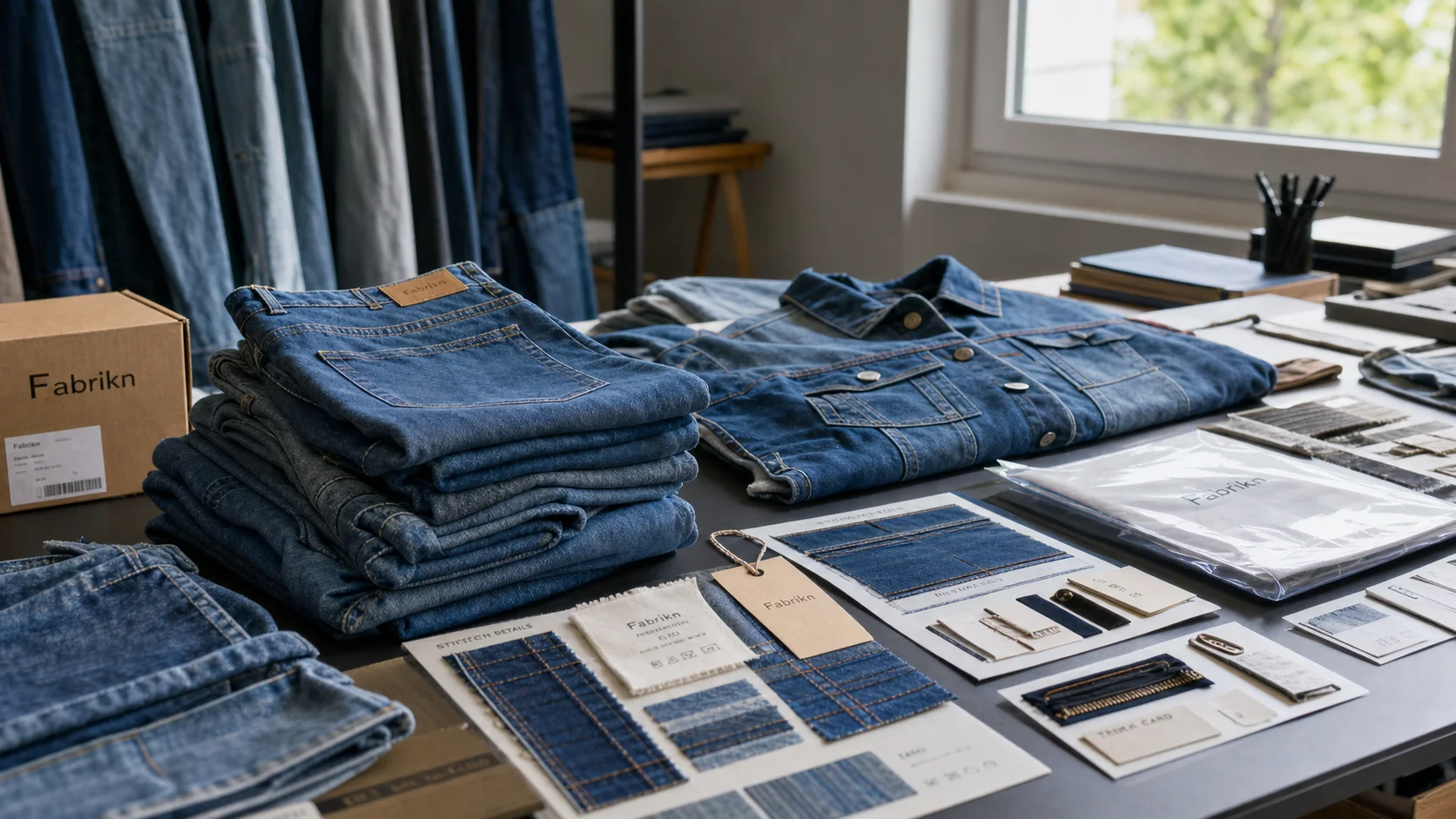
Custom Country of Origin Tags for Apparel compared by sample evidence, fabric or trim specs, MOQ, AQL terms, cost lines, delivery timing, and rework...
Fast answer: Custom Country of Origin Tags for Apparel: Tech Pack, Sample Gate, MOQ, and QC Terms should be judged by production evidence, not by a generic sourcing promise. The buyer needs sample proof, cost breakdowns, QC checkpoints, and delivery buffers in writing.
Ask for recent sample photos, measurement tolerances, fabric or print test assumptions, decoration test notes, packing examples, and a named inspection checkpoint. These details show whether the team can repeat an approved sample at bulk volume.
Separate garment cost, decoration, labels, packaging, sampling, testing, freight, and rush charges. Clear cost lines make it easier to reduce colorways, adjust size depth, or reserve more time for sampling.
At a denim factory outside Ho Chi Minh City, I watched an auditor stop a carton opening for one reason: the sewn-in label said Vietnam, the hang tag said “Made in China,” and the shipping invoice listed a third origin altogether. That single mismatch held 18,000 units for 11 days, and the brand paid $4,300 in relabeling plus air freight to recover the launch. Real job of custom country of origin tags for apparel: keep tiny paper and fabric details from turning into legal bills. Even though the woven label, produced on a Saurer Autoform 600 loom by a Guangzhou trim house and certified to OEKO-TEX Standard 100 and GOTS, clearly stated Vietnam, the hang tag from a Dhaka dye contractor listed China and the invoice from the Istanbul logistics partner claimed Bangladesh, so customs agents held the cartons while the brand sourced replacements. Replacing the tags meant ordering a new lot from the same Guangzhou supplier quoting $2.50–4.00 per unit at a 500 MOQ and an 18–22 business day lead time, which stretched the launch calendar even further.
For any manufacturer, factory, or supplier, origin errors aren’t rare edge cases. Across 200-plus factory visits, labeling mistakes triggered rework in about 1 out of 6 export orders, with customs holds or retailer chargebacks showing up most often on programs shipping 5,000 pieces or more. A $0.03 tag can become a $0.30 problem fast. Retailers check packaging against the commercial invoice. Customs officers compare the garment with the declared origin. If the documents disagree, the whole carton looks suspect. Even in WRAP- and BSCI-certified plants in Dhaka and Istanbul, where GRS-certified recycled polyester hang tags weave through servo-driven Stäubli 190 mm rapier looms, inconsistent paperwork still forces rework as often as twice per month.
But the trouble usually appears after the line is already finished. Buyers focus on fit, fabric, and color, then discover at packing that the care label omits fiber percentages, the country line is in the wrong language, or the brand forgot the RN number for the U.S. market. By then, cartons are sealed, the truck is booked, and relabeling means opening every polybag again. I have seen it on 2,500-unit capsule drops and on 120,000-unit basics programs. Different scale. Same pain. At a Guangzhou trim room, the ultrasonic cutter that ghosted the 120gsm satin label was still set to the previous job, so the origin line shifted into the seam allowance and the issue only showed up once the inspector cross-checked with the digital spectrophotometer.
Asia often treats labeling as a production detail. Factories in Mexico and parts of Eastern Europe tend to pull compliance into sampling earlier, especially for programs with 2–3 retail channels. And in Latin America, sewing lines and export paperwork are usually better linked, but subcontracted trim vendors still vary in print registration. In Istanbul and Dhaka, merchandising teams now require digital twin approvals triggered from the ERP system that also sequences the Saurer Autoform loom before any polybag hits the packing table. The pattern is simple: the tag looks tiny, yet it sits right between retailer acceptance, customs clearance, and consumer trust.
Low-cost trims invite false comfort. A label costing $0.015 to $0.04 may feel disposable, but if a retailer rejects the shipment, relabeling can jump to $0.12–0.25 per piece before labor, cartons, and freight even enter the math. Export-heavy programs feel that quickly. One mid-priced knitwear order lost 8 days because a factory used the wrong stitch placement for the origin label, which forced a second QC pass and a new packing list. Even at the WRAP-certified Guangzhou site, the heat-transfer adhesive cycle was dialed in at 170°C for 6 seconds, but the operator forgot to verify the pressure gauge, so the ink cracked after a third stretch test.
If your brand also sources private label clothing services, the compliance burden expands because origin tags have to line up with brand, fiber, and country claims across multiple styles. Same compliance burden. A woven tee and a technical jacket do not fail in the same way. One may need a softer neck label; the other may need a heat-transfer origin mark to avoid bulk. If the project includes cut and sew manufacturing, treat the origin tag spec like a sewing instruction, not a decoration.
When planning custom country of origin tags for apparel, buyers usually need four pieces of information on the label: fiber content, country of origin, size, and care instructions. And most buyers lock those specs into 100% ring-spun organic cotton twill or 70D nylon substrates that already carry OEKO-TEX Standard 100 approval, then choose between printed satin, woven, or heat-transfer constructions depending on the garment handle. In many programs, the brand name or RN details also appear, especially for the U.S. market. Basic stuff, sure. But the requirements change by destination. A shirt sold into California may need different label language than the same shirt sold into Paris, and a 500-piece run doesn't get a free pass just because the order is small.
For the U.S., country of origin has to be clear and durable, and the FTC expects fiber content and care guidance to match the garment construction. In the EU and UK, the language used on care and composition information matters more than many first-time buyers expect. Canada often pushes bilingual presentation, which means a label approved for Toronto may need a different print layout than one headed to Dallas. Three versions of the same tag? Common.
Origin claims are not always tied to the last sewing machine only. They can depend on where the last substantial transformation happens, which is why a fabric woven in Turkey, dyed in India, and cut and sewn in Mexico may carry a different origin statement than a brand assumes from the fabric roll alone. According to the U.S. Trade Commission and market access guidance, documentation must align with the actual manufacturing process, not marketing shorthand. Keep the paper trail from mill to final pack-out. In Istanbul, the QC team ties each label to its adhesive batch via barcode scanners linked to the Saurer Autoform loom so customs can see which machine applied the tag.
When I visited a knitwear plant in Tiruppur, a buyer asked for origin tags in four language versions across 9,000 units, each with a slightly different size break. Printing wasn't the problem. Approval was. A missing barcode field delayed everything by 5 days because the carton marking couldn't be finalized and the Mimaki TX300P-1800 printer had to rerun the artwork through its pigment ink cycle. For brands with low MOQs, that delay hurts more than the unit cost itself.
The failures I see most often are boring and expensive: blurry print, label text too small, wash instructions that vanish after 15 cycles, and stitching that tunnels into the fabric so badly the tag curls after the first wash. In one Turkish factory near Istanbul, a satin label looked perfect in sample form, then failed after enzyme wash tests because the ink faded at 20 washes, not 50, and the WRAP-compliant adhesive actually delaminated before the garment hit the retail floor. The buyer had to reorder 12,000 labels and shift the ship date by 2 weeks.
The cheapest tag often becomes the costliest after relabeling and air freight. Here’s what most people miss: a $0.02 savings on the tag can cost a lot more once relabeling, freight, and rush labor enter the equation.
A strong brief makes the supplier's job narrower and the quote more reliable. For custom country of origin tags for apparel, include the target customer, sales channel, expected order quantity, size range, decoration needs, packaging requirements, and delivery market. Then call out the details most likely to affect the result, especially material grade, print tolerance, and barcode size.
The brief should also explain what cannot change. Some brands care most about hand feel, some about price, some about launch timing, and some about retail compliance. When those priorities are not written down, suppliers tend to optimize for whatever is easiest to quote. Clear priorities help the factory make better tradeoffs before the first sample is cut or printed.
Ask the supplier to respond with assumptions, not just a price. A useful reply states MOQ, sample route, production capacity, inspection plan, packing method, and freight handoff. If the answer is vague, the project may still work, but it needs a tighter pre-production stage before money and calendar pressure build up.
The best time to catch problems is before the pre-production sample is approved. Check measurements, color, placement, material behavior, shrinkage, construction, labels, and packaging in the same review instead of approving each item in isolation. Many bulk issues are not caused by one dramatic mistake; they come from several small unchecked assumptions.
For custom country of origin tags for apparel, pay special attention to folding method, pack-out sequence, and retail compliance. These details often look minor in an email but become expensive once cutting, printing, sewing, packing, or shipping begins. A simple checklist with owner, due date, and approval status keeps the brand team and factory aligned.
Bulk production should not start until the supplier can explain how the approved sample becomes a repeatable production standard. That means reference sample storage, line instructions, inline checks, final inspection, and defect handling. A factory that can describe this process clearly is usually safer than one that only promises speed.
Price differences are useful only when the quotes cover the same work. Compare sample cost, material source, trims, decoration, packaging, testing, inspection, and freight assumptions. A low unit price can become expensive if it excludes items the brand needs before launch.
Timeline promises deserve the same scrutiny. Ask what happens if the first sample needs revision, whether materials are in stock, when the production slot is reserved, and how export packing is handled. The most reliable supplier is often the one that gives a realistic calendar instead of the fastest optimistic answer.
Before making the final decision, write down the specification, approval owner, delivery expectation, and the one or two risks that would cause the most trouble if missed. For custom country of origin tags for apparel, this usually means checking material grade, print tolerance, barcode size, and the support process after the order is placed.
This last review does not need to be complicated. It simply makes the decision easier to repeat, easier to explain, and easier to verify when the finished product or jewelry arrives.
One useful way to pressure-test the decision is to ask what would happen if the order had to be repeated in six months. The answer should still be clear: the same material grade, the same print tolerance, the same acceptance standard, and the same communication path. If a second order would depend on memory or guesswork, the first order is not documented well enough yet.
Another useful check is to separate preference from requirement. Preference is the look, wording, or finish the brand likes. Requirement is the measurement, tolerance, certificate, material, or delivery condition that cannot fail. Good buying decisions keep both visible, so the final choice is not pushed around by the last email, the cheapest quote, or the prettiest sample photo.
Finally, ask who owns each approval. A project with one accountable owner for sample review, one owner for final content or artwork, and one owner for delivery sign-off usually moves faster than a project where every decision is shared loosely across a team. Clear ownership reduces delays and makes the finished result easier to judge.