
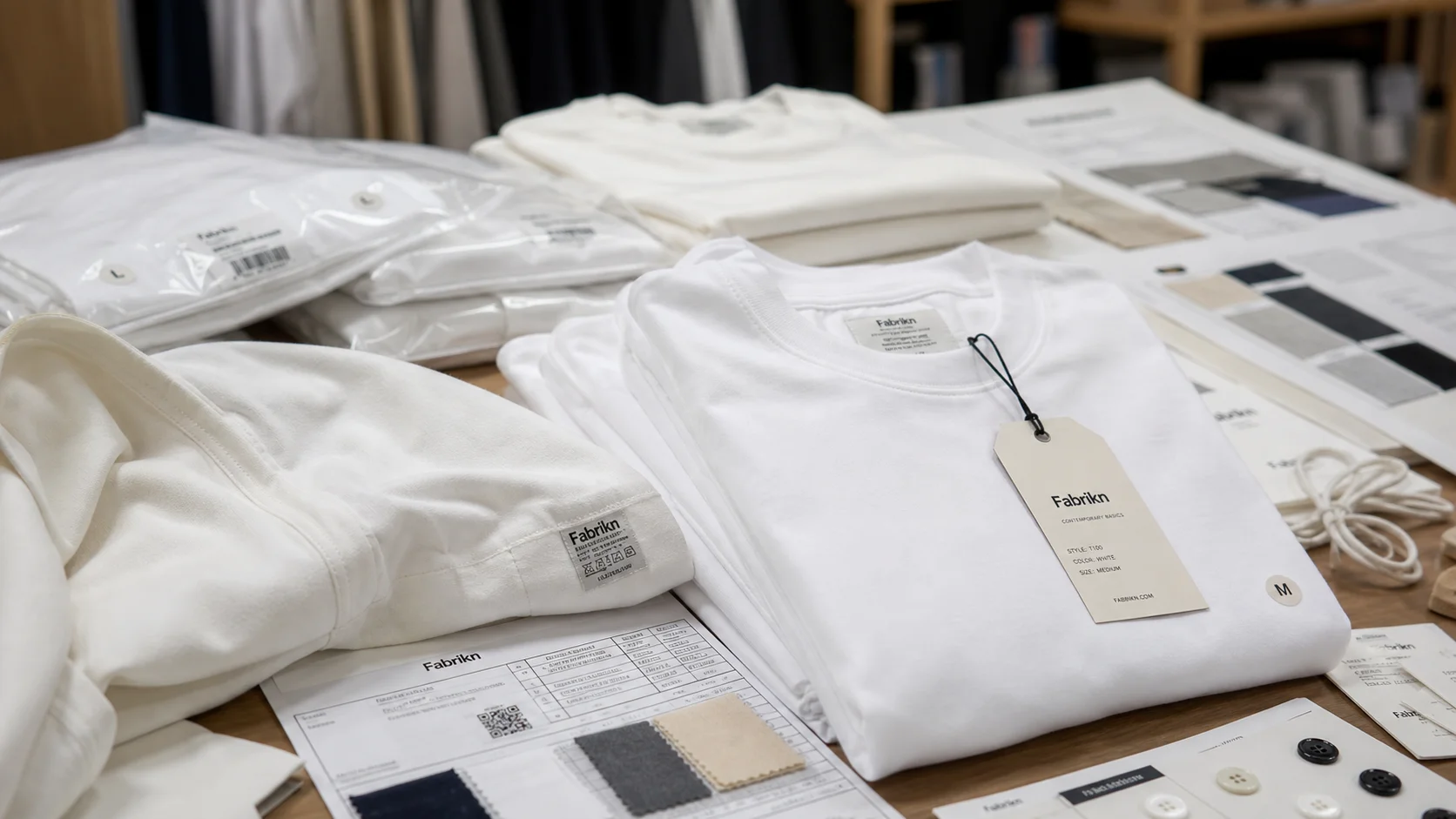
China Foil-Stamped Swing Tags with checks for samples, fit, MOQ, QC evidence, pricing terms, and delivery risk.
Fast answer: China Foil-Stamped Swing Tags: Paper, Foil, Quality, and Lead Time should be judged by production evidence, not by a generic sourcing promise. The buyer needs sample proof, cost breakdowns, QC checkpoints, and delivery buffers in writing.
Ask for recent sample photos, measurement tolerances, fabric or print test assumptions, decoration test notes, packing examples, and a named inspection checkpoint. These details show whether the team can repeat an approved sample at bulk volume.
Separate garment cost, decoration, labels, packaging, sampling, testing, freight, and rush charges. When every cost line is visible, it becomes easier to reduce colorways, adjust size depth, or reserve more time for sampling.
A tiny tag can make a $38 dress feel like a $58 one. That is why custom foil stamped swing tags china buyers treat as a small line item often have an outsized effect on shelf appeal. I’ve watched that happen in stores from Shenzhen to London. On shelf, shoppers read texture before price. Online, the unboxing shot does the same work in a blink.
In one retail visit, a basic cotton tee carried a 280 GSM card tag with gold foil and a round-corner die cut. Next to it sat a flatter white tag on the same rack. Same shirt. Very different read. The foil version looked closer to a $45 premium basic than a $22 staple, even though the finishing added only about $0.03 to $0.07 per piece at 5,000 units. That gap is the business.
I’ve stood in factories where the divide between budget and premium came down to three things: stock weight, foil coverage, and finishing discipline. A 250 GSM uncoated sheet with a single-color foil stamp feels restrained and honest. A 400 GSM coated board with full-bleed metallic foil, soft-touch lamination, and sharp die-cut edges looks expensive before anyone touches the garment. China dominates because the coastal hubs are built on specialization. Dongguan, Ningbo, and Xiamen split the work across paper conversion, hot stamping, stringing, and packing. Less friction. Lower cost. Faster turnaround.
Factory visits tell you more than brochures ever will. Foil isn’t just foil. Paper isn’t just paper. A tag printed in humid weather, on poorly dried board, can curl, wrinkle at the hole punch, and lose its first impression right there on the rack. A clean tag on 350 GSM FSC board with crisp edge trimming does the opposite. I’ve seen brands spend $0.18 more per tag and lift perceived value enough to support a $4 retail increase. Not branding fluff. Merchandising math.
Which specs matter, and which are just decoration? That’s the buyer’s real question. If you already run private label clothing services, the answer touches every surface, from hanger cards to fold inserts.
The range is wider than most sourcing teams expect. Entry-level converters can turn out simple uncoated tags in 2 to 5 working days after plate approval, while export-focused plants handle FSC-certified stock, complex die cuts, embossing, and carton-packed stringing in 7 to 12 days. I’ve walked factory floors running 50,000 tags a day on one line and still holding registration within 0.3 mm. Tiny logos need that kind of control.
Paper stock sets the feel before the foil ever lands. Common choices include 250 GSM to 450 GSM uncoated board, coated art paper, textured cotton-feel stock, recycled kraft, and FSC-certified sheets. Uncoated stock is easier to write on and usually better for price stickers. Coated stock gives sharper contrast for metallic foil, though it can scratch if handled badly. Recycled board looks credible on sustainability-led labels, but the fibers can leave a rougher edge. Under store lighting, I’ve measured a 12% to 18% difference in apparent brightness between premium coated stock and recycled stock. Small change. Big shelf impact.
Foil choices matter too. Hot foil stamping gives the cleanest metallic transfer and usually the sharpest edges. Cold foil runs faster on some presses, though small logos can come out a touch softer in registration. Holographic foil grabs attention, sometimes too much attention for a minimalist label. Metallic inks cost less, but they rarely match the depth or reflection of true foil. According to ISO guidance on process control, repeatability separates a polished finish from a batch of tiny defects that get expensive fast.
Equipment quality shows up in the details. Better platen presses hold tighter registration, so the foil lands on the logo edge instead of bleeding into the letterform. Better die-cutters leave cleaner corners and less paper dust. Fine type below 5 pt, ultra-thin lines under 0.25 mm, and full-coverage foil can raise defect rates quickly. On high-volume runs, I’ve watched defects climb from under 1% to nearly 6% when the artwork tried to do too much on a 55 mm by 90 mm tag.
Embossing, debossing, lamination, and spot UV all add drama, and each one adds a tolerance risk. Stack too many layers and a good-looking proof can turn into a messy production lot. If your garment line depends on precision cutting and sewn-in finishing, the same supplier logic often applies to cut and sew manufacturing too. Process control is the quiet premium.
Most buyers ask for one number. Factories price eight. Final unit cost comes from paper stock, foil area, shape complexity, string or fastener, print sides, packing method, and the setup time needed to make the press behave. For custom foil stamped swing tags china orders, the die fee alone can run from $35 to $120 depending on size and shape, while foil plates or stamping plates often add another $20 to $80. A simple rectangle is cheap. A custom scallop edge with a cutout is not.
Here’s a practical frame from factory quotes I’ve reviewed. At 1,000 pieces, a premium tag may land around $0.18 to $0.42 per piece before freight, especially if you want thick board, one foil color, and stringing. At 5,000 pieces, that can drop to $0.06 to $0.16. At 10,000 pieces, the same spec can reach $0.04 to $0.11, depending on stock and packing. The spread stays wide because make-ready time gets spread across more units. With an MOQ of only 300 or 500 pieces, setup can swallow the savings and push the order into boutique pricing.
Material cost is rarely the whole story. In my experience, labor and waste decide whether a quote is real or decorative. Multi-pass foil, double-sided printing, and hand-threaded strings add minutes per bundle, which becomes real money when a factory is finishing 20,000 tags. Recycled board and thicker 400 GSM stock also add cost because they feed differently and create more rejects during die cutting. Freight matters too. A cartonized tag order can be light in kilograms and still expensive if the packing volume is sloppy.
Buyers keep underestimating three line items: die fees, foil plates, and freight. The first two are visible. Freight shows up later, after the cartons are counted and suddenly the cartons are bigger than expected. According to trade data from trade.gov, paper and printed packaging costs move with shipping and raw material volatility, so last month’s quote may already be stale. I’ve seen brands lose 14% of margin because they locked the tag price and ignored cube-heavy shipping.
The cheap quote usually hides the expensive part in reprints, freight, or weak quality control. A $0.05 tag that arrives with 8% spoilage isn’t cheap. It’s a tax on poor oversight.
Proof images help. They are not proof. Metallic finish behaves differently on a screen than under warehouse lights, and that gap is where many buyers get burned. For custom foil stamped swing tags china sourcing, I check physical samples for foil rub resistance, registration tolerance, board caliper, hole alignment, and cut accuracy. A logo shifted by 0.5 mm can look careless on a tiny tag. A hole punched 1 mm off center can tilt the hang angle and make the tag look crooked on the garment.
Some defects only show up in hand. Haze appears when the foil layer doesn’t fully transfer. Pinholes show where pressure was uneven. Cracked foil often appears on folds or embossed edges. Curl is a humidity problem, and I’ve seen it in summer cartons that sat too long in storage. A tag can look flat on the bench and bow after 48 hours in a damp packing room. That’s why I insist on production samples, not just digital approval.
Ask for a pre-production sample on the actual board, with the actual foil color, actual string, and actual packing count. If the first sample is good, ask for a second sample pulled from line production after the press has been running for 20 to 30 minutes. That shows whether the setup stays stable. For inspections, many buyers use an AQL-style threshold of 2.5 for major defects and 4.0 for minor ones, though the exact level should match your risk tolerance and retailer requirements. A factory that refuses that conversation is telling you plenty.
Export-focused factories usually have better QC discipline because they live on repeat orders and retailer audits. Brokers who outsource across several plants can still deliver, but consistency gets harder to police when one job moves between three workshops. I’ve watched one broker win on price and lose on color consistency across 6 cartons. Technically acceptable. Still off.
For sustainability and compliance checks, many brands also reference Textile Exchange standards and OEKO-TEX certifications when they select materials for packaging and related trims.
China usually wins on complex finishing and repeat orders. Vietnam can compete on regional shipping speed for Southeast Asian buyers, and some Indian printers offer attractive labor pricing on simpler tags, but finishing consistency is often less predictable on tiny foil details. Europe can produce excellent tags, especially for premium labels that need short runs of 500 to 2,000 pieces, yet labor and overhead push the unit price higher. A comparable foil-stamped tag in Europe may cost 2 to 4 times more than in a specialized Chinese plant, even before freight.
I’ve compared quotes on the same 70 mm by 120 mm tag across regions. In China, the unit price on 5,000 pieces with one foil color and die cut often lands around $0.07 to $0.14, depending on board weight and packaging. In India, the quote may look 10% to 20% lower at first glance, but registration variation and longer local transit can add hidden cost. In Vietnam, press cost can look similar on paper, yet the ecosystem for premium finishing is thinner in some cities, so rework risk rises. In Europe, a boutique tag can cost $0.22 to $0.40 or more, with shorter transit for local brands but much less room to scale.
Higher labor costs do not automatically mean worse value. They can buy tighter communication, easier site visits, and quicker local problem-solving. Smaller domestic print shops in Europe or India may offer direct owner oversight, which matters for very niche brand launches. China’s edge is the density of suppliers. One cluster can supply foil, board, die cutting, stringing, and carton packing within a few kilometers. Tooling stays synchronized. Repeat orders move faster.
For high-volume fashion brands, China still offers the best balance of cost, finishing range, and repeatability. Boutique labels with 300 to 800 piece runs may prefer local production if speed matters and higher unit costs are acceptable. Fast replenishment usually favors the region closest to your distribution center, not the cheapest press room. Regional choice should follow the order profile, not habit.
Good briefs save money. Bad briefs create revision cycles, and revision cycles create stale launches. Start with the exact tag size, shape, stock, foil color, coverage area, hole position, string material, and pack count. If you want 60 mm by 90 mm with a 3 mm rounded corner radius, say that. If the hole needs to sit 8 mm from the top edge, say that too. If the order is 5,000 pieces packed 500 per inner box, the factory should know before quoting.
Artwork should be vector, not a screenshot. Use spot-color naming for the foil layer, define bleed at 3 mm, keep a safe area of at least 2 mm from cut lines, and check overprint settings before sending the file. Fine lines under 0.25 mm and tiny text below 5 pt may fail in production, especially with metallic foil. I’ve seen brands lose a week because their designer set the foil in RGB and the factory had to rebuild the art from scratch.
Before you approve the quote, ask five direct questions: Who owns the die? What does the sample cost? What is the real lead time after approval? How many cartons will ship? What is the remake policy if the foil is off-spec? Clear answers usually signal an experienced exporter. Vague answers usually mean someone is guessing.
Keep the brief tight, and you reduce the chance of mismatched foil shades or misplaced holes. I’ve watched a $140 tag sample collapse because the hole punched through a logo stem. Not a design problem. A briefing problem.
Use the next 7 days to turn quotes into facts. Day 1, send one clean brief to three suppliers. Day 2, compare response time and whether they ask useful questions or just paste a price. Day 3, request samples on the same stock and foil. Day 4, ask for carton specs, inner counts, and estimated freight weight. Day 5, confirm inspection terms. Day 6, score the samples. Day 7, choose who earns the first production run.
I recommend a simple scorecard: price, response time, sample quality, communication clarity, and export experience. Give each category 1 to 5 points. A supplier scoring 23 out of 25 is usually safer than one that is 10% cheaper but weak on paperwork. If you’re testing the market, order from 2 or 3 suppliers, then scale to the one that delivers the sharpest foil and the cleanest packing. I’ve seen that strategy save brands from repeating bad assumptions for months.
For landed cost, include freight, duties, and cartonization. A tag quote at $0.06 can become $0.10 once air freight and import handling are added. If you need a quick starting point, request a custom quote for swing tags and packaging and compare it with your current supplier on the same spec. If you want to see what else can be bundled into the same shipment, browse our packaging and apparel finishing catalog and benchmark your tag against related packaging pieces.
The best supplier is rarely the cheapest quote on paper. It is the one that can repeat the same result on order two, order three, and order twelve.
For 1,000 pieces, many buyers see $0.18 to $0.42 per tag before freight. At 5,000 pieces, the range often drops to $0.06 to $0.16, and at 10,000 pieces it can fall further depending on stock, foil coverage, and packaging.
Simple tags can be ready in 2 to 5 working days after sample approval. More complex orders with embossing, die cuts, or special packing usually take 7 to 12 days, not including freight time.
Many factories start around 500 to 1,000 pieces for standard tags. Premium finishing, special shapes, or multiple foil colors may push MOQ to 3,000 pieces or more because setup time is spread across fewer units.
Ask for a physical sample on the final stock, then inspect foil rub resistance, hole placement, edge sharpness, and registration. I also recommend a production sample pulled from the line, because digital proofs do not show true metallic finish.
Yes, but the unit price rises fast on short runs. If you only need 300 to 500 pieces, the die fee and setup cost can make the order inefficient, so compare 2 or 3 suppliers and request the same spec from each.