
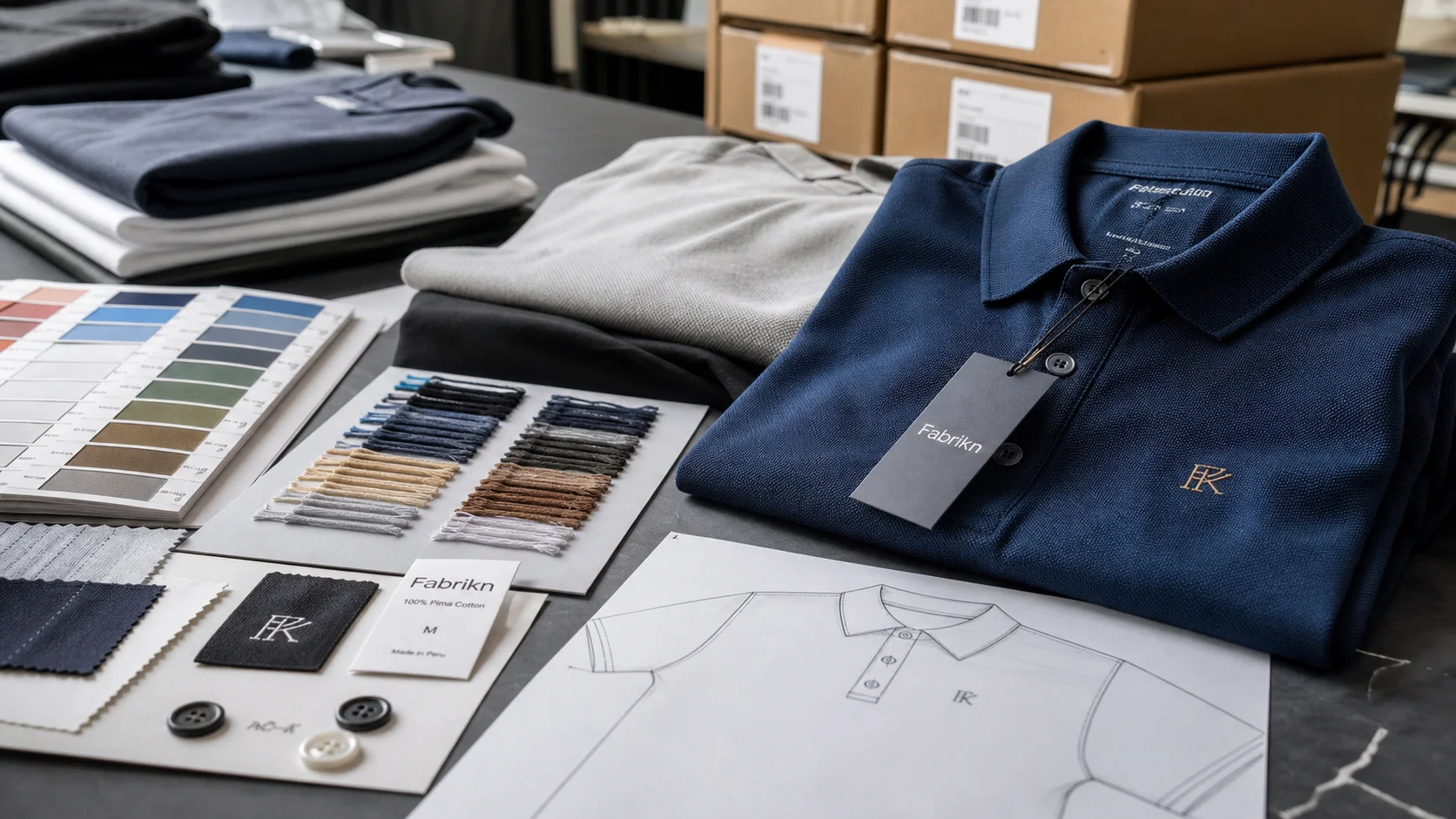
Clothing Brand Launch Hang Tags with checks for samples, fit, MOQ, QC evidence, pricing terms, and delivery risk.
Fast answer: Clothing Brand Launch Hang Tags: Paper, Print, Attachment, and Cost should be judged by production evidence, not by a generic sourcing promise. The buyer needs sample proof, cost breakdowns, QC checkpoints, and delivery buffers in writing.
Ask for recent sample photos, measurement tolerances, fabric or print test assumptions, decoration test notes, packing examples, and a named inspection checkpoint. These details show whether the team can repeat an approved sample at bulk volume.
Separate garment cost, decoration, labels, packaging, sampling, testing, freight, and rush charges. When every cost line is visible, it becomes easier to reduce colorways, adjust size depth, or reserve more time for sampling.
The first thing a shopper reads may be the smallest thing on the garment, and that is exactly why custom hang tags for clothing brand launch deserve real attention. A buyer has about three seconds at the rail. I have watched it happen at trade fairs in New York, Seoul, and Copenhagen: fingers slide, eyes pause, and one tag decides whether a garment gets lifted or ignored. Not decoration. A sales tool, a trust signal, and sometimes the difference between a $38 shirt and a $48 shirt moving off the rack.
In buyer perception tests I’ve reviewed, premium packaging can justify a 10-20% higher ticket price before the fabric has even been touched. That sounds irrational until you stand in front of a crowded rail and notice how often shoppers read the tag before they read the story on your website. The tag frames the product. It tells them if the brand is careful, if the fit will be good, and if the price is defensible.
I’ve seen regional differences too. Minimalist tags often outperform ornate tags in Scandinavia, where restraint reads as credibility. In parts of North America, denser brand copy performs better because it helps justify price and communicate product details that shoppers expect to see upfront. The same 90 x 50 mm tag can feel sparse in Oslo and reassuring in Toronto.
When I visited factories in Portugal and Vietnam, I saw a counterintuitive pattern: cheaper garments sometimes use heavier tags to signal value. A $12 tee with a 400 gsm board can look more premium than a $60 sweatshirt with flimsy paper. That does not mean you should fake quality. It means shoppers read weight, finish, and print clarity as proxies for the brand’s standards. I have seen brands raise perceived value by 15% simply by moving from a thin 300 gsm stock to a thicker board with cleaner cutting. Behind those decisions were presses in Guangzhou running Heidelberg Speedmaster sheets, applying Pantone-matched colors that stayed consistent across 10,000-piece runs.
For brands also building other categories, the tag logic changes slightly. A bra launch, for example, often needs more technical detail and softer visuals, which is why I sometimes compare tag hierarchy to custom bra manufacturing briefs, where support and comfort need to be communicated fast. Small surface. Large job.
Choosing custom hang tags for clothing brand launch starts with the right material and a realistic production plan. The stock you choose does more than hold ink. It changes how the garment feels before it is tried on. I’ve handled uncoated, coated, recycled, kraft, textured, and synthetic stocks across factories in Italy, India, and China, and each sends a different price message. Uncoated stocks feel tactile and honest. Coated boards sharpen photography and color blocks. Kraft leans earthy and casual. Textured papers carry a boutique cue, while synthetic stocks survive moisture, shipping abuse, and retail handling far better than standard paper.
Trade-offs sit everywhere. Recycled fiber content can range from 30% to 100%, but high recycled content often reduces brightness and can slightly soften print sharpness. A lot of buyers ask for foil, embossing, spot UV, or soft-touch coating without knowing the hidden cost. Foil and embossing each add tooling and make sense on higher-margin labels, not on a $22 tee. Soft-touch coating can improve perceived quality, but it may reduce recyclability, especially when paired with lamination. Mixed-material tags can lose fiber recovery in recycling streams by roughly 20-40% depending on adhesive and coating type.
Format matters as much as stock. Single-layer tags are cheapest and fastest. Folded tags give you two panels for story and compliance. Swing tags work well for denim, outerwear, and premium basics. Belly bands are useful when you want a refined first impression on folded knitwear. Dual-purpose care tags are efficient for babywear and intimates because they reduce SKU complexity and cut separate label steps, which matters for custom baby clothing manufacturing where compliance density is high.
Size affects cost, legibility, and durability. A 50 x 90 mm tag is economical and easy to punch, but it can feel cramped once you add fiber content, origin, and barcode. A 70 x 120 mm tag gives breathing room, yet it adds paper usage, freight weight, and a little more waste. On busy retail floors, oversized tags catch on hangers and fold over. That is a real defect, not a theoretical one. I have seen 8-10% more damage on oversized tags during warehouse packing.
If your brand is building a broader presentation system, align tag materials with clothing packaging solutions so the carton, tissue, and tag do not fight each other visually. Consistency sells better than improvisation.
According to Global Organic Textile Standard, GOTS-certified mills in Dhaka and Ho Chi Minh City monitor every batch of organic cotton and recycled cards for traceability, while OEKO-TEX Standard 100 and GRS (Global Recycled Standard) approvals confirm that inks, adhesives, and recyclable threads meet the same scrutiny. WRAP and BSCI audits keep worker and environmental practices in check, especially in Istanbul and Guangzhou, where the densest supply chains intersect. The same pressure extends to tag stock, inks, and coatings, even if the tag is tiny.
For custom hang tags for clothing brand launch, the best hang tag systems behave like a hierarchy, not a poster. Front of tag, back of tag, legal layer. That order keeps the design clean and keeps launch mistakes from turning into carton chaos. I start with one dominant element on the front: logo, collection name, or a price-line cue. The back carries origin, fabric, care, and the short brand sentence that tells a buyer what category they are holding.
Typography should follow price tier. For entry-level basics under $30, I favor simple sans serif type at 7-9 pt with heavy contrast and no fancy script. For mid-tier fashion at $40-$120, a serif accent or restrained display type can add character if legibility remains intact at arm’s length. Luxury tags can be more minimal, but they still need a reading path. Shoppers do not admire confusion.
A 20% increase in whitespace can improve readability without increasing size. I have tested this with brands that moved from dense copy blocks to cleaner spacing while keeping the same 70 x 100 mm format. The result was faster scanning at the rack and fewer misreads on fabric composition. That mattered most for textured knits and dark garments, where the eye already works harder.
Compliance should never be buried. Barcode placement belongs near the lower back edge or on a folded interior panel. QR codes can support traceability, sustainability claims, and product pages, but they need to be sized properly. I recommend 16-20 mm minimum for easy scanning, and batch IDs should sit close to the code if you want post-launch tracking by color, size, or factory lot. That is especially helpful for private label clothing services, where multiple capsules may share a base construction but differ in finish or trim.
On the production floor, I have seen art directors work alongside technicians running Komori and Heidelberg offset presses, while digital white toner machines from Ricoh handle small proof batches. Laser die cutters trim edges cleanly, and GBC laminators add soft-touch coatings or spot UV varnish for a tactile finish. When we expect a 10,000-piece run, a slide-fed GMI die cutter keeps tolerance within ±0.15 mm, which prevents hang tags from jamming conveyor belts or ripping at pack-out.
Data from ISO standards shows why precision matters. If your claim says recycled fiber, organic content, or traceable sourcing, your tag should be able to support the statement with documents that can survive a retailer audit.
Pricing custom hang tags for clothing brand launch is where many new brands get shocked. A quote that looks cheap on paper can become expensive once setup, proofs, waste, and shipping appear. I have seen starter runs priced at $2.50-4.00 per unit at 500 MOQ in Guangzhou when you ask for double-sided spot UV, and the same SKU drops to $1.65-2.20 per unit in Dhaka when you move to single-sided matte lamination and keep die cut complexity low. Mid-tier suppliers in Ho Chi Minh City often quote $3.00 per piece for 1,000 MOQ with numbered batch IDs and hot foil stamping, partly because they run Heidelberg presses with inline UV coating lines.
Supplier tiers matter. Tier-one partners in Guangzhou will demand engineering fees of $1,200-1,800 for embossing dies and custom metallic foils, but they deliver color proofs on approved Pantone chips, GOTS-compliant FSC board, and WRAP-certified finishing lines. Tier-two houses in Dhaka or Ho Chi Minh City can be faster—turning samples in 4-5 business days—but may not have inline QC to hold 0.1 mm tolerances. I’ve seen Istanbul-based shops offer luxe finishes such as engraved stainless steel grommets for $0.45 each, but they pair that with higher freight costs to the EU.
Factor in ancillary fees. A pre-production sample run with a Komori offset press can cost $220-400 depending on ink coverage and the number of refills because the print shop must flush the rollers between Pantone sets. Shipping from Guangzhou to Los Angeles averages $95 per carton, while Dhaka to Europe is about $135 per carton due to transshipment. Don’t forget import duties; hang tags classified under HS code 4821 can face tariffs of 3-6% depending on destination.
In every tier I audit, the cost drivers are labor, waste, and adhesives. A run of 5,000 tags with aqueous adhesives, die-cut edges, and spot foil will generate 8-12% waste. Tier-one partners tend to include that waste in the quote, while smaller shops expect it to fall on the brand. Ask suppliers to itemize: board (e.g., 350 gsm recycled, FSC/GRS certified), print (CMYK + Pantone), finishing (e.g., matte AQ coating, laser die cut), and packing (100 tags per polybag). That helps you compare apples to apples.
Lead times vary by location, but a reliable window is 18-22 business days for a standard hang tag run from approval to ship-ready if you are sourcing from Guangzhou or Ho Chi Minh City. That timeline includes 3-4 days for digital proofs, 5-7 days for offset printing on a Komori or Heidelberg press, 3 days for finishing (die-cut, foil, perforation) on a Bobst or GBC line, and 4-8 days for quality inspections plus packing. Rush orders under 10 business days are possible in Dhaka if you pay overtime, but expect premium rates and slightly higher defect rates.
Quality control involves both in-line checks and final inspection. I recommend a three-point QC plan: first, color density and registration checks on press; second, die-cut and hole placement verification using caliper gauges; third, final audit of copy, QR accuracy, and compliance marks on a 100% sample. If your brand is certified by GOTS or OEKO-TEX Standard 100, the tag supplier must show updated certificates and test reports for inks and adhesives from accredited labs in Guangzhou or Istanbul.
Most factories will operate under ISO 9001 protocols and capture NCR (non-conformance reports) in their ERP. Ask for those reports as part of your QA deliverables. Some shops in Dhaka even integrate barcode scanners to check each box of finished hang tags before the cartons hit the warehouse, ensuring your batch ID, color, size, and QR match the packing list.
Start with a detailed tech pack that includes dimensions, fold lines, barcode location, pantone references, and an approved sample. When you request quotes from suppliers in Guangzhou, Dhaka, or Istanbul, attach the same pack. If you want GRS or OEKO-TEX Standard 100 compliance, specify the certificate number and request the supplier’s latest audit summary; nothing slows a launch faster than chasing paperwork after the factory has cut boards.
Visit the floor if possible, even if it is once per year. In Ho Chi Minh City and Guangzhou, I have seen brands shift from digital approvals to on-site inspections paired with remote video walkthroughs. Require a WRAP or BSCI certification, because the labor standards impact not just the tag but your entire story. Make sure your supplier is using the right materials: 90% of my clients now specify GOTS-certified inks for organic collections, and most write “adhesive AB-12 water-based” or “acrylic UN-700” into the PO to prevent incompatible tapes.
Finally, set up hold points. Approve artwork, then approve a printed mock-up on actual board before mass production begins. Use a third-party inspector familiar with textile packaging—many operate in Istanbul and Guangzhou—and order at least two cartons as a pilot shipment. That prevents surprise reworks in a December launch when your mainline drop hits 3,000 units.
Guangzhou and Ho Chi Minh City offer the fastest turnaround for complex finishes, while Dhaka gives cost advantages for bulk polyester or kraft tags. Istanbul works well for European brands seeking lower duties and quick last-mile tweaks. Choose based on your finish, compliance needs, and shipping corridor.
Ask for GOTS, OEKO-TEX Standard 100, GRS, WRAP, and BSCI certificates depending on your sustainability story. Suppliers familiar with Textile Exchange and Global Standard paperwork can help ensure your claims are audit-ready.
Budget 18-22 business days for a standard run from Guangzhou or Ho Chi Minh City. If you’re working with a Dhaka supplier during peak season (November-March), add 5-7 days for capacity, and always confirm tooling readiness before the clock starts ticking.
Use exact specs in your RFQ—materials, finishes, quantities, packaging, and certifications. Request line-item quotes and ask for waste allowances. A $2.50-4.00 per unit rate at 500 MOQ should cover a regular offset run with standard finishes, but anything that pushes toward foils, embossing, or special adhesives should be quoted separately.
Include origin, fiber content, care instructions, batch/lot number, textile certifications, and QR codes for traceability. Consider adding size, country of manufacture, and even a mini story if space allows—just keep your hierarchy orderly.