
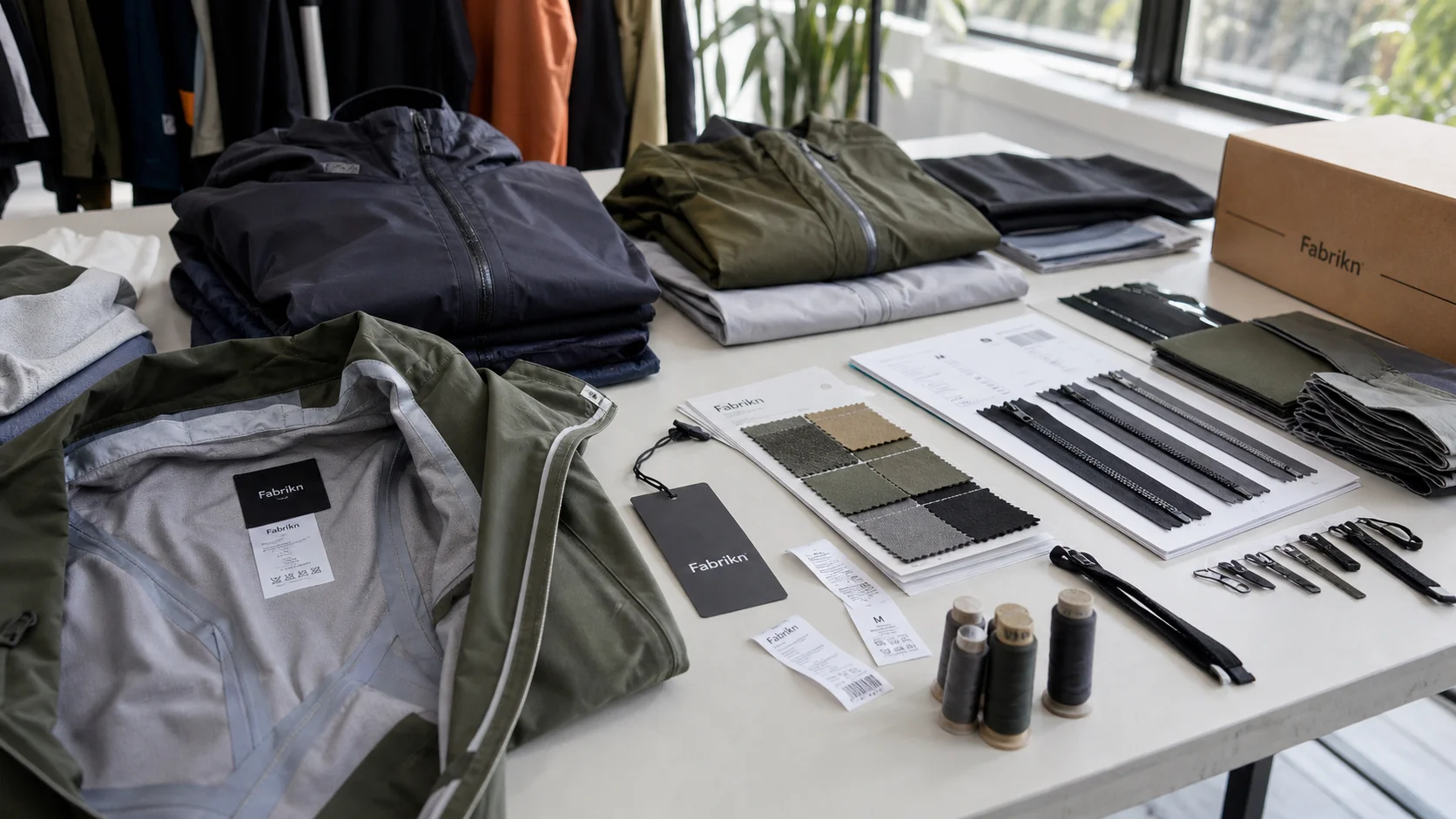
Outdoor Retail Brands Choose A Custom Jackets Supplier compared by sample evidence, fabric or trim specs, MOQ, AQL terms, cost lines, delivery timing, and...
Fast answer: Outdoor Retail Brands Choose A Custom Jackets Supplier: Sample Fit, Trim, AQL, and Delivery Risk should be judged by production evidence, not by a generic sourcing promise. The buyer needs sample proof, cost breakdowns, QC checkpoints, and delivery buffers in writing.
Ask for recent sample photos, measurement tolerances, fabric or print test assumptions, decoration test notes, packing examples, and a named inspection checkpoint. These details show whether the team can repeat an approved sample at bulk volume.
Separate garment cost, decoration, labels, packaging, sampling, testing, freight, and rush charges. Clear cost lines make it easier to reduce colorways, adjust size depth, or reserve more time for sampling.
How Outdoor Retail Brands Choose a Custom Jackets Supplier - Custom Clothing manufacturing guide
Outdoor retail buyers do not choose a custom jackets supplier on price alone. For brand orders, the real question is whether the factory can repeat fit, manage technical fabrics, protect margin, and ship on time without compromising performance. That matters even more in jackets than in basic knitwear because construction, weather resistance, trim quality, and size consistency all affect sell-through and returns.
For a custom jackets supplier for outdoor retail brand orders, the decision usually starts with the product brief: shell type, insulation level, target season, and the price band the retail team needs to hit. After that comes the hard work of testing samples, checking labelling and trim compatibility, and judging whether the supplier can support the brand’s launch calendar. A polished sales deck is not enough. The strongest suppliers show discipline in sampling, fabric sourcing, and production control.
If the sourcing team is still narrowing options, it helps to review a supplier’s broader capability first, including its services and company background on the about us page before requesting quotes or development work.
Outdoor retail jackets sit at the intersection of performance and merchandising. A style has to look clean on the rack, feel credible on the body, and survive practical use. That balance changes by category. A packable shell has different priorities than a insulated hiking jacket or a softshell for shoulder-season layering. A good supplier understands those differences and does not force one construction method across every program.
Retail brands usually need a supplier that can manage:
For outdoor retail, the supplier also needs enough process control to keep styles consistent across colorways and seasons. A buyer may accept small differences in a casual fashion jacket. That same tolerance is usually too wide for technical outerwear, where a minor change in shell fabric, coating, or insulation can shift performance and customer perception.
A practical sourcing rule: the more technical the jacket, the less useful a “lowest cost” quote becomes. The best decision is usually the supplier that can protect margin without creating hidden quality issues or launch delays.
The first filter is product fit. Not every outerwear factory is suitable for retail-grade custom jackets. Some are strong in basic woven garments, while others are better at technical assembly, bonded seams, or insulated constructions. Outdoor retail orders benefit from suppliers that can show direct experience with the jacket category the brand wants to sell.
Ask what types of jackets the supplier handles regularly: rain shells, softshells, fleece-lined jackets, insulated puffers, workwear-inspired outerwear, or hybrid performance styles. The construction methods matter. A supplier that understands seam sealing, baffle construction, or laminated fabrics is more likely to avoid expensive mistakes during production.
Fabric sourcing is often where jacket projects drift. The same style can behave very differently depending on coating, denier, knit backer, or insulation fill weight. A supplier should be able to explain what is standard, what is custom ordered, and where lead time may stretch if a mill or trim house needs to create something new.
Good suppliers do not rush the sample phase. They clarify the difference between development sampling, salesman samples, fit approval samples, pre-production samples, and final production confirmation. That sequence matters because outdoor jackets often need more than one round of adjustment for pattern, lining, hood shape, pocket placement, or zipper function.
A supplier’s response quality is a useful signal. Clear answers about construction tolerances, fabric substitutions, and production constraints usually indicate a more mature operation. Vague promises about “fast delivery” or “high quality” are less useful than a methodical explanation of what the factory can control and what depends on outside mills or trims.
The right partner should fit the brand’s launch model. A startup outdoor label may need smaller MOQs and a supplier open to development work. A larger retailer may care more about repeatability, audit readiness, and stable seasonal capacity. A supplier worth considering will be honest about where its own operating model fits best.
Selection Area What Good Looks Like Typical Risk if Ignored Product capability Relevant jacket constructions, not just general apparel Misbuilt samples and weak performance Fabric control Clear mill specs, coating details, and substitution rules Inconsistent handfeel or weather resistance Sampling process Defined sample stages with measurable approvals Delays and repeated revisions Production planning Realistic capacity and lead-time commitments Missed launch windows Retail readiness Labeling, packaging, and carton discipline Chargebacks or distribution issuesOutdoor retail brands usually judge jackets by performance first, then by aesthetics. That means the supplier has to support both. A well-cut jacket can still fail in the market if the fabric pills, zippers jam, or seam construction leaks in wet weather.
Shell fabric selection depends on use case. Lightweight ripstop or plain woven nylon may suit packable shells. Polyester softshells are common for active layers. Heavier woven fabrics can work for lifestyle outdoor jackets when abrasion resistance matters more than packability. Technical fabrics often rely on coatings or laminations, and those choices affect breathability, price, and lead time.
Water resistance is another key decision. A brand may choose a DWR finish for light rain protection, a PU coating for stronger barrier performance, or a laminated membrane for more technical applications. Each choice changes cost and handling. Buyers should ask for specific specs, not generic claims. Terms such as waterproof, water-resistant, and weather-resistant are not interchangeable in production terms.
Insulated jackets require careful attention to fill weight, loft consistency, and stitch control. Down and synthetic fills carry different commercial tradeoffs. Down can offer strong warmth-to-weight performance, but sourcing, ethics, and fill power consistency need more oversight. Synthetic insulation often simplifies care and supply continuity, though bulk and weight may be higher for the same warmth level.
Lining choice affects comfort, warmth, and cost. Mesh linings may help breathability in active jackets. Taffeta or brushed linings can improve handfeel and warmth retention. A supplier should state whether lining fabric is stock, mill-dyed, or custom matched to the shell color.
Retail buyers often focus on the main fabric and underweight trim quality. That is a mistake. Zippers, pullers, tape, snaps, toggles, drawcords, elastic, and seam tape can all create customer complaints if they are not specified carefully. A zipper that passes on paper can still feel stiff, catch at a storm flap, or look mismatched against the garment trim package.
For outdoor jackets, buyers should ask for the following in writing:
Sampling is where most jacket projects either gain control or lose time. Outdoor retail brands should treat sample approval as a gate process, not a box-ticking exercise. Each round needs a clear purpose.
The approval process should be tied to measurable comments. “Make it better” slows a project. A more useful comment reads: shorten front body by 1 cm, reduce hood depth, switch zipper puller finish, or adjust pocket angle for easier hand entry. Strong suppliers ask for this level of detail because it prevents avoidable revisions later.
Sample approval also helps expose weak points in a jacket before the order scales. A shell may look fine on a hanger but fail in wash testing, snag tests, or seam stress points once the team reviews it on body. Retail brands should budget enough time to correct those issues before production approval.
MOQ is one of the first commercial questions a buyer asks, and for good reason. The number affects risk, pricing, and assortment flexibility. For custom jackets, MOQ often depends on fabric type, color count, insulation, and trim sourcing. Typical ranges can vary widely, but many suppliers work somewhere from 300 to 1,000 pieces per color or style for development-friendly programs, while more technical or fully custom orders may require higher thresholds.
Smaller orders can be possible, but the cost structure may rise. Retail brands should judge the full landed economics, not the unit price alone. A lower MOQ can help test market response, yet a higher MOQ may deliver better fabric pricing and production efficiency if the item is core to the season.
Lead times for custom jackets are usually shaped by more than sewing capacity. The biggest drivers include fabric mill timing, custom dyeing, trim procurement, sample approval speed, and the complexity of the construction. A simple lightweight jacket may move faster than a taped-seam waterproof shell or a filled winter parka.
Typical planning windows often fall around 8 to 16 weeks for many standard programs after approvals, while more technical orders can take longer. Those ranges are only meaningful if materials are already available and revisions stay limited. If a brand needs custom fabric development, special zippers, or new packaging, the calendar should expand.
Buyers should ask suppliers to break lead time into stages:
This breakdown makes delays easier to diagnose. A factory that only promises a single delivery date without showing the path to that date gives the buyer too little control.
Jackets have more inspection points than many other apparel categories. The risk is not only visible defects. Retail failures can come from function problems, which are easier to miss in a quick visual check.
Retail brands should also watch for packing and carton risks. Compression can damage loft in insulated jackets, while poor folding can leave visible creases in shells. If hangtagging or polybag specs are wrong, distribution centers may reject the shipment or rework the packout at the brand’s cost.
Inspection plans should be written into the order. Many buyers use inline checks during production, final random inspection before shipment, and carton verification against approved packing instructions. That approach is more useful than a single end-of-line review because it finds problems while the factory can still correct them.
Choosing a supplier is partly a sourcing exercise and partly a tradeoff exercise. Every jacket order balances cost, performance, lead time, and commercial flexibility. A supplier that looks more expensive at quote stage may be cheaper in practice if it reduces sampling loops, defect rates, or missed delivery penalties.
Lower-cost suppliers may be suitable for simple outerwear if the style is not highly technical. Once a jacket needs weather protection, repeatable grading, or complex trim integration, price pressure can become counterproductive. The brand may save a few cents at the order stage and lose far more in returns, customer service, or markdowns.
Some buyers want quick changes during development. That flexibility can help a new collection take shape. It can also signal weak control if the factory changes direction too easily on critical specs. Brands should prefer suppliers that are flexible on design refinement but strict on final approval once the production standard is set.
Fast sampling is helpful only when it does not compromise accuracy. For jackets, a slightly slower but cleaner sample process often produces a better bulk run. A rushed approval that skips functional testing is usually the more expensive path.
Outdoor retail brands usually get better outcomes when supplier communication is structured from the start. A detailed tech pack is not optional. It should cover measurements, construction notes, fabric specs, trim references, color standards, label placement, packaging instructions, and any performance expectations that matter to retail.
Brands should also request written confirmations for anything that could be interpreted multiple ways. That includes seam finishing, zipper direction, hood construction, pocket depth, and whether the factory can source exact-match materials or only approved alternatives. The cheapest time to resolve ambiguity is before cutting.
It also helps to keep development decisions tied to merchandising reality. A jacket built for alpine use will not sell well if it feels too heavy for casual retail. A stylish streetwear outer layer may need lower technical complexity to stay on margin. The best supplier partnership supports the brand’s market position instead of pushing the same construction into every price point.
For brands preparing an initial order, a direct conversation with the factory can clarify fit, MOQ, and sampling expectations before too much time is spent on revisions. A quick route to that discussion is the contact us page, especially when the brief already includes reference styles and target quantities.
The best custom jackets supplier for outdoor retail brand orders is not simply the one with the lowest quote or the fastest promise. It is the supplier that can translate a product brief into repeatable production with controlled materials, realistic timing, and enough technical discipline to protect the brand in the market. That usually means judging the factory on process as much as output.
Buyers who spend more time on fabric specification, sample approvals, and inspection planning usually see fewer surprises later. That is especially true in outerwear, where small mistakes can affect warmth, fit, weather resistance, and sell-through all at once. A well-run supplier relationship gives the brand room to grow into reorders, seasonal updates, and new categories without rebuilding the sourcing process every time.
Get a free quote from Fabrikn — your trusted B2B clothing manufacturer with 10+ years of experience. MOQ as low as 200 pieces.
Get a Free Quote →MOQ varies by supplier, jacket complexity, and fabric setup. Many custom programs start around 300 to 1,000 pieces per style or color, while technical outerwear or fully custom fabric programs may require higher quantities. Small orders are sometimes possible, but pricing usually rises.
Many orders move in roughly 8 to 16 weeks after sample approval, but the actual timeline depends on fabric sourcing, trim availability, sample revisions, and construction complexity. Waterproof, insulated, or custom-dyed jackets often need more time.
A practical process usually includes development samples, fit samples, sales samples, pre-production samples, and a final approved reference sample. Each stage should answer a different question so production does not start on an unverified spec.
Key details include fiber content, denier, coating or lamination type, water resistance level, breathability, lining structure, and color consistency. If the jacket is insulated, fill weight and loft control also matter. The supplier should confirm these specs clearly before bulk production.
Common risks include zipper misalignment, seam tape failure, uneven stitching, color variation, poor insulation distribution, and packing errors. These problems can affect retail returns and customer satisfaction, so final inspection should include both visual and functional checks.
Not usually. Lowest price can work for simple styles, but outdoor jackets often need stronger control over fabric, trims, and construction. A slightly higher-cost supplier may deliver better value if it reduces defects, delays, and markdown risk.