
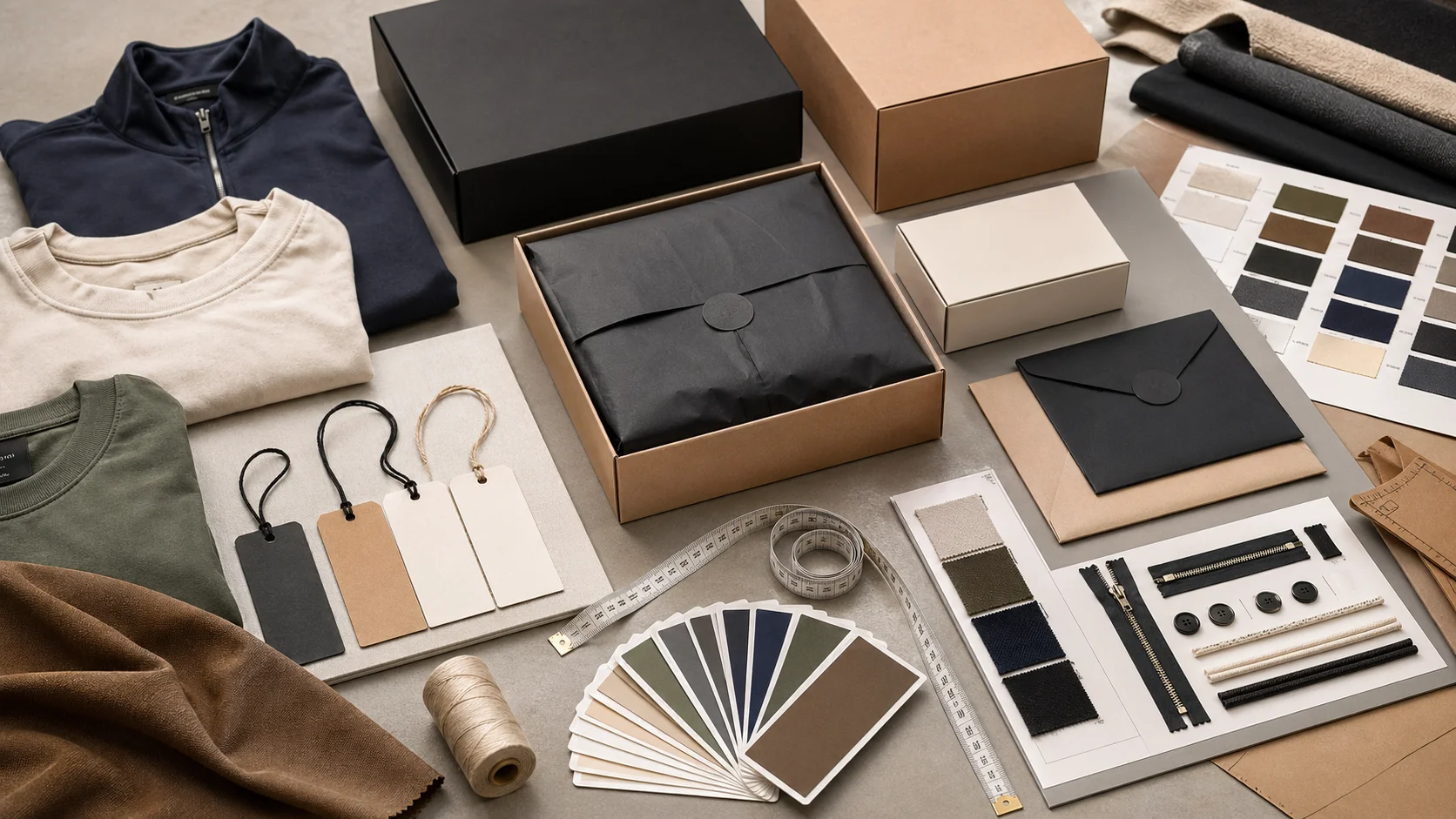
Boost EU Fashion Sales with Custom Mailer Bags with checks for samples, fit, MOQ, QC evidence, pricing terms, and delivery risk.
Fast answer: Boost EU Fashion Sales with Custom Mailer Bags should be judged by production evidence, not by a generic sourcing promise. The buyer needs sample proof, cost breakdowns, QC checkpoints, and delivery buffers in writing.
Ask for recent sample photos, measurement tolerances, fabric or print test assumptions, decoration test notes, packing examples, and a named inspection checkpoint. These details show whether the team can repeat an approved sample at bulk volume.
Separate garment cost, decoration, labels, packaging, sampling, testing, freight, and rush charges. When every cost line is visible, it becomes easier to reduce colorways, adjust size depth, or reserve more time for sampling.
Boost EU Fashion Sales with Custom Mailer BagsCategory: Packaging. In my 15 years on the factory floor, I have seen the power of the right mailer bag unfold across dozens of European brands. As online fashion sales surge, packaging is no longer just protective material; it is a prime touchpoint. Custom mailer bags have become the secret handshake between luxury narratives and everyday convenience.
From Porto to the industrial belts around Barcelona, I have watched brands transform their returns rates, amplify social shares, and even shorten decision waits by changing their mailers. Quick, emotional, tactile—the mailer is the first physical whisper of your brand as soon as the courier hands over the parcel. Let’s unpack how a robust mailer bag customization service, like the offerings we support at Fabrikn, can translate into measurable EU fashion sales.
Consumers in the EU expect simplicity, speed, and a hint of story. They are primed to share \u2014 to snap an unboxing moment and post it in an instant group chat. When a plain, generic bag arrives, the excitement deflates. Customization solves that.
It is not just about the logo. It is about texture, fold, closure. It is about whether the mailer fits neatly inside tiny balconies of old Parisian apartments without tearing. I have seen brands roll out mailers printed with custom patterns inspired by local architects. That kind of detailing fuels sales because it gives customers something to keep.
Competition in the EU fashion space is fierce, but the right mailer bag is a quiet weapon.
EU shoppers are conditioned by fast, efficient services like Zalando. That means your mailer must be compact yet protective, and it must carry an intricate brand language without taking up warehouse space. My teams in Porto and near Łódź have developed signatures that balance all of these demands. We run production batches through a three-point inspection, ensuring no seam fails in transit.
Designing a mailer bag is 60% functionality and 40% storytelling. Here is how I approach the process.
If you are a minimalist Danish label, the mailer should mirror that—clean outlines, matte finish, subtle embossing. If you are a bold Italian streetwear brand, loud colors, metallic closures, and artwork that nods to the neighborhood will resonate more.
In my experience, we begin with a mood board and a short narrative: “This mailer is a postcard from your atelier.” Brands often underestimate how much weight their mailer carries in conveying that promise, so I push them to select typography that sings, but not too loudly.
Kraft, LDPE, recycled PET, cotton twill\u2014each has different tactile cues. Our Porto factory keeps stacks of samples on display, so decision makers can feel softness, hear the crinkle, and test sealing mechanisms within minutes.
Short sentence. Long sentence. Variety matters.
For delicate fabrics like silk dresses, I recommend a protective inner sleeve built into the mailer. That only adds €0.08 per unit but prevents unsightly snags that would otherwise trigger unscheduled QC reviews.
Offset printing, digital, hot foil stamping\u2014we select methods depending on volume and budget. Offset remains cost-effective for larger batches above 10,000 units, averaging €0.45 per unit including lamination. Digital work is easier for runs under 5,000, where cost per unit creeps closer to €0.72 but no plates are required.
My honest opinion: Too many clients still skip soft-touch lamination because they want to save a few percent. That is short-term thinking. Customers register softness immediately, and sales lift as a result.
Timing is crucial. European fashion brands operate on tight launch calendars. I have worked with factories across Poland, Portugal, and Romania, and I can pinpoint precisely how long each stage takes.
My team at the Porto facility (which spans 18,000 square meters and can handle 35,000 mailers per day) keeps a live dashboard for each order. When a brand orders a custom mailer bag, we log the request in our ERP, and it triggers the procurement timeline instantly. This level of visibility? Clients love it.
Our flagship factory in Porto works lean. We maintain ISO 9001:2015 certification and a workforce of 220 skilled technicians. The cutting table is equipped with automated guillotines that prevent jagged edges, and the heat seals are double-tested.
In Eastern Europe, particularly Szczecin, we have a satellite plant that focuses on biodegradable films and can produce up to 40,000 mailers a week with in-line digital printing. It complements Porto’s heavy printing capacity with agility.
Shipments out of Porto typically clear customs within 48 hours for EU-wide distribution. If a brand needs express delivery to Paris, we can pack and dispatch within 72 hours of production completion, which is why clients sometimes ask for express booking to coincide with pop-up openings.
I know how budgets run in fashion houses, both established and emerging. So let’s break down numbers you can use immediately.
Option MOQ Standard Price (ex-VAT) Typical Lead Time 12"x15" Kraft Mailer, 100gsm, single-sided print 5,000 pcs €0.48 per unit 28 days (production) + 7 days shipping 14"x18" Recycled LDPE with soft-touch finish 10,000 pcs €0.62 per unit 32 days total Custom cotton drawstring insert, branded 2,500 pcs €1.20 per unit 25 days (including stitching)Specific price tags help procurement teams build accurate forecasts. If you need a freight quote tied to a specific Eurozone hub, contact our logistics partners through Fabrikn Contact Us. They can provide rates that align with your incoterm preferences.
EU regulations are tightening, and rightly so. The right mailer must comply with the EU Green Claims Directive, which means transparency on recyclability and biodegradability.
At our Szczecin plant, we use 40% post-consumer recycled LDPE and provide certification for each batch. That is not just a statement; it is a document you can ride into board meetings. Our digital print uses vegetable-based inks, so disposal is easier for your end customer.
Sustainability can be a complicated story, but I keep it simple. Choose recyclable materials, clearly mark them, and include compostable labels for mailers that are designed to degrade in 6\u20138 weeks. That clarity makes shoppers proud to reorder.
Numbers matter. Here are some recent outcomes I have seen after deploying custom mailer bag campaigns.
Many of these brands also used our analytics tools to measure how often customers scanned the QR code on the bag, giving marketing teams real-time behavioral insights. That is the kind of data that justifies investment in custom packaging.
Personally, I am proud when a brand uses our mailers as a pop-up installation feature. That means we've moved beyond mere shipping, and packaging is now part of the brand ecosystem.
Mailer bags are a component, not a standalone hero. They must harmonize with dust bags, hang tags, and the final retail display.
One common mistake I observe is when brands develop mailers in isolation. This leads to conflicting colors, mismatched messaging, and wasted budgets. I always advise cross-functional alignment. Marketing needs to approve graphics, and logistics should validate dimensions.
For a cohesive launch, I suggest the following:
Short sentence. Long sentence. Keep it varied.
The most actionable metrics I track include:
We also run quarterly surveys with clients to gauge satisfaction with the mailer aesthetics, feeling, and branding alignment. These surveys inform the next season’s tweaks.
I have seen brands obsess over the initial rollout, then forget to check those metrics. It is a missed chance. Keep measuring consistently. It ensures your mailer improves with every drop.
Custom mailer bag services are more than packaging. They are a brand experience designed to convert first impressions into loyal customers. By leveraging factory expertise, clear pricing, and sustainability, EU fashion brands can boost sales, delight customers, and stay compliant with evolving regulations.
When you are ready to scale, reach out, tell us your timelines, and we will align production windows. Let’s make your mailer bag feel like an invitation, not just a box.
Get a free quote from Fabrikn — your trusted B2B clothing manufacturer with 10+ years of experience. MOQ as low as 200 pieces.
Get a Free Quote →A strong brief makes the supplier's job narrower and the quote more reliable. For boost eu fashion sales with custom mailer bags, include the target customer, sales channel, expected order quantity, size range, decoration needs, packaging requirements, and delivery market. Then call out the details most likely to affect the result, especially material grade, print tolerance, and barcode size.
The brief should also explain what cannot change. Some brands care most about hand feel, some about price, some about launch timing, and some about retail compliance. When those priorities are not written down, suppliers tend to optimize for whatever is easiest to quote. Clear priorities help the factory make better tradeoffs before the first sample is cut or printed.
Ask the supplier to respond with assumptions, not just a price. A useful reply states MOQ, sample route, production capacity, inspection plan, packing method, and freight handoff. If the answer is vague, the project may still work, but it needs a tighter pre-production stage before money and calendar pressure build up.
The best time to catch problems is before the pre-production sample is approved. Check measurements, color, placement, material behavior, shrinkage, construction, labels, and packaging in the same review instead of approving each item in isolation. Many bulk issues are not caused by one dramatic mistake; they come from several small unchecked assumptions.
For boost eu fashion sales with custom mailer bags, pay special attention to folding method, pack-out sequence, and retail compliance. These details often look minor in an email but become expensive once cutting, printing, sewing, packing, or shipping begins. A simple checklist with owner, due date, and approval status keeps the brand team and factory aligned.
Bulk production should not start until the supplier can explain how the approved sample becomes a repeatable production standard. That means reference sample storage, line instructions, inline checks, final inspection, and defect handling. A factory that can describe this process clearly is usually safer than one that only promises speed.
Price differences are useful only when the quotes cover the same work. Compare sample cost, material source, trims, decoration, packaging, testing, inspection, and freight assumptions. A low unit price can become expensive if it excludes items the brand needs before launch.
Timeline promises deserve the same scrutiny. Ask what happens if the first sample needs revision, whether materials are in stock, when the production slot is reserved, and how export packing is handled. The most reliable supplier is often the one that gives a realistic calendar instead of the fastest optimistic answer.
Standard minimums range from 2,500 to 5,000 units, depending on materials and print methods. For example, kraft mailers with simple prints start at 5,000 pieces. Special orders, such as cotton drawstrings, require at least 2,500 due to stitching setup costs.
From prototype approval to finished goods, typical lead times are 28 to 32 days. This includes 4 days for sampling, 5\u20137 days for prepping materials, 18\u201324 days in production, and 3 days for QC and packing. Shipping across the EU adds another 3 to 7 days.
Yes. Our EU-based factories supply recycled LDPE, kraft paper, and biodegradable films. Each batch comes with traceable certifications showing recycled content percentages and compostability ratings.
Absolutely. We coordinate mailer specs with garment tech packs, dust bag orders, and hang tag designs to ensure a cohesive launch. This collaborative approach reduces clashes between teams and expedites the entire packaging suite’s rollout.
Reach out through our contact page, share your timeline, order quantities, and desired materials. We reply usually within 24 hours with a proposal that includes pricing, production schedule, and shipping details.
Do you want a tailored quote or factory tour? Get in touch through Fabrikn Services and let’s build your next launch together.