
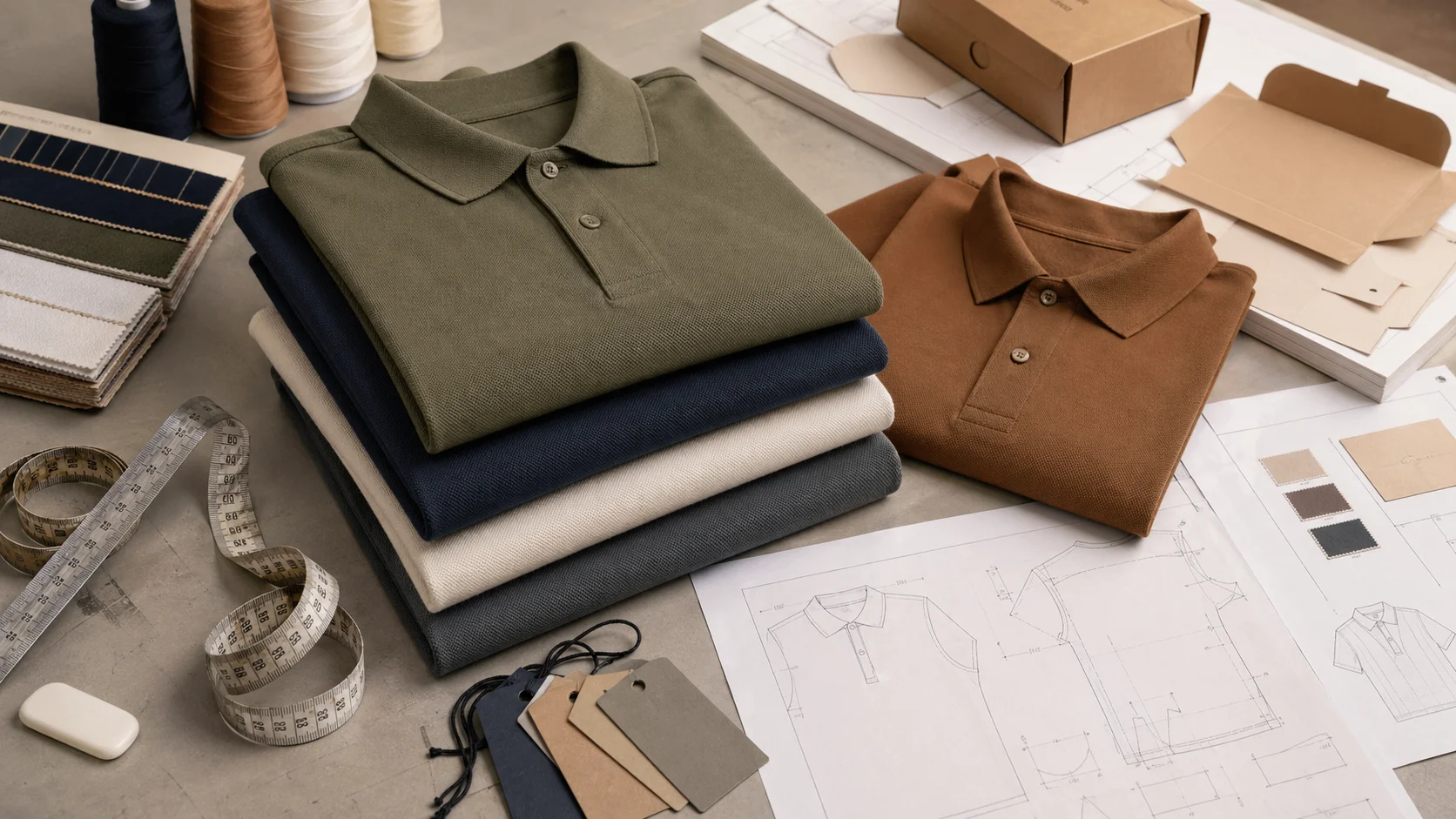
Clothing Launch Packaging Inserts with checks for samples, fit, MOQ, QC evidence, pricing terms, and delivery risk.
Fast answer: Clothing Launch Packaging Inserts: Message, Size, Paper, and Unboxing Impact should be judged by production evidence, not by a generic sourcing promise. The buyer needs sample proof, cost breakdowns, QC checkpoints, and delivery buffers in writing.
Ask for recent sample photos, measurement tolerances, fabric or print test assumptions, decoration test notes, packing examples, and a named inspection checkpoint. These details show whether the team can repeat an approved sample at bulk volume.
Separate garment cost, decoration, labels, packaging, sampling, testing, freight, and rush charges. When every cost line is visible, it becomes easier to reduce colorways, adjust size depth, or reserve more time for sampling.
One crushed collar can make a $280 blazer look like a bargain-bin mistake. I have watched that happen enough times to know the number is not theoretical: perceived value can drop 15% to 30% before a customer ever touches the fabric. So yes, custom packaging inserts for clothing launches matter from the first unboxing moment. They shape the first impression, protect the garment in transit, and quietly influence whether a launch feels worth $28 or $280.
In factory visits, the same mistake keeps showing up. A brand will spend $4.50 to $7.00 on a heavy box and then save pennies on a $0.18 insert that would have kept a collar crisp and a print centered. Nice box on the spreadsheet. Rough product in the wild. For premium tees, tailoring, and occasionwear, a properly cut insert prevents creases, hardware scuffs, and hanger marks that otherwise show up on the shop floor or in customer photos.
The unboxing moment is not fluff. It is a retail event compressed into 20 seconds. If a dress opens flat, the lining stays tucked, and the tissue holds the silhouette, the customer reads care into the brand. Returns can fall by 5% to 12% on fragile categories, especially when the launch includes embellished knits, satin skirts, or structured blazers. Giftability rises too. A package that opens cleanly is easier to give and easier to remember.
Different channels, different rules. A DTC brand selling a $28 tee needs speed, low labor, and inserts that survive parcel handling. A boutique launching a $120 blouse needs a stronger presentation layer, because the store buyer will judge the brand in the back room before the customer ever sees the rack. A wholesale line at $280 for a blazer needs packing integrity across cartons, cartons within pallets, and enough structural support to keep lapels from collapsing. One insert cannot do all three jobs well.
On factory floors, the pattern is obvious. Brands overpay for rigid cartons, magnetic closures, or oversized sleeves, then underinvest in the geometry of the insert itself. A well-cut board cradle, a folded tissue rail, or a simple neck support can save more damage than a luxury box ever will. If your product ships from Ho Chi Minh City at $1.20 to assemble and 3 to 5 days to pack, a smarter insert can cut repack time by 20% and lower claims enough to matter within a single launch cycle. Even in Dhaka, where labor is cheap, inserting a die-cut cradle before folding saves the line 6 seconds per unit and avoids costly rework. High-volume runs from Guangzhou or Istanbul often set these standards early, because local quality assurance teams track crease defects daily.
Stabilize the garment. Keep collars from collapsing. Protect buttons and trims. Hold matching pieces together so a top and skirt do not arrive separated. In audits, the gap between a generic pack-out and a disciplined one often shows up as 2 to 4 fewer defects per 1,000 units. Small on paper. Loud at 8,000 units, when the return center starts billing for every avoidable crease.
Protective insert design and display design are not the same thing, even if the best programs do both. A tissue cradle under a knit prevents stretching. A garment card keeps a logo tee flat. A belly band can hold a two-piece set together without bulky tape. A hangtag pocket keeps SKU and price data visible for store teams. Structured pieces sometimes need molded supports or board corners, but most apparel does not require theater. It requires discipline.
There is also a practical side that founders ignore. When inserts are designed well, pickers pack faster, with fewer decisions. I have timed 12 to 18 seconds saved per unit in some facilities because the fold sequence was obvious and the pieces nested naturally. On a 5,000-unit launch, that can save 17 to 25 labor hours. That is real money. It also reduces inconsistency between shifts, which matters when 2 or 3 people rotate through the same line.
Brand memory lives in the tactile details. Soft-touch board, uncoated kraft, a matte black belly band, or a blind emboss all send a signal before the garment is worn. Message placement matters too. If the card speaks before the product is visible, it feels forced. If it appears after the fold opens, it feels intentional. I have seen launch kits from brands using clothing packaging solutions where a 90 gsm tissue layer and a 350 gsm insert card did more work than a costly printed box sleeve.
The thing nobody tells you: the most effective inserts are often the simplest and lightest. A 1.5 mm board support or a single die-cut cradle can outperform a multi-part kit that looks luxurious but adds 60 to 90 grams, costs more to freight, and slows pack-out by 8 to 10 seconds per unit.
Material choice drives protection, print quality, cost, and what happens after the package is opened. Paperboard is the workhorse. At 300 to 500 gsm, it prints cleanly, folds predictably, and suits most tees, shirts, and lightweight knits. A custom insert produced by the right manufacturer or factory can be tuned for flat-fold apparel, while molded fiber cushions structured items better, though print detail is weaker and mold tooling can add 2 to 4 weeks to the first run. Corrugate protects heavier garments and ecommerce shipments well, yet it adds bulk. Textile wraps feel elevated, but they are often harder to standardize across 500-unit and 5,000-unit drops.
End-of-life matters, and the claims around it are often sloppy. FSC paperboard and recycled corrugate usually outperform plastic-heavy inserts for apparel launches because they fit existing recycling streams in many markets. According to OEKO-TEX, material transparency and chemical safety are central to credible textile supply chains, and packaging is increasingly judged by the same standard of proof. If a supplier cannot explain coating composition, ink system, or fiber content, I treat the sustainability claim as marketing copy, not evidence. That is why we ask for suppliers certified to GOTS, OEKO-TEX Standard 100, and GRS for fibers, and for facility-level certifications such as WRAP and BSCI before we even open a quotation in Ho Chi Minh City or Istanbul.
Regional sourcing changes the equation. In Guangzhou, 500 MOQ runs of white 350 gsm recycled kraft board with matte aqueous varnish can hit $2.50 to $4.00 per unit when a brand bundles die-cutting, scoring, and UV spot varnish on a Bobst die cutter line. In Dhaka, larger die spaces, Mitsubishi die-cutters, and Kallfass folding squares allow similar inserts at $2.70 to $3.80 per unit, despite longer freight. Ho Chi Minh City still rules for engineered molded fiber using automated pulp presses and Kovanci glue applicators, and Istanbul’s specialty board houses pair Heidelberg and Koenig & Bauer presses for foil stamping and embossing on limited runs. Each node sets different MOQ expectations and lead times—often 18 to 22 business days from approval to container, and 7 to 9 days once the goods hit a bonded warehouse for domestic distribution.
Finish choice should follow function, not vanity. Aqueous coating protects against scuffing without the recycling penalties of heavy lamination. Embossing adds tactility with almost no extra waste. Spot varnish can highlight a logo, but too much coverage complicates de-inking. Foil looks expensive, yet it can create downstream recycling headaches and extra spoilage if alignment drifts by 1 to 2 mm. I have watched teams specify foil for a wholesale launch only to reject 8% of the first batch because the brand mark shifted outside tolerance.
There is a sustainability math that matters at scale. Reducing insert weight by 25 grams across 20,000 units removes 500 kilograms from freight. On air shipments, that can mean a meaningful cost drop, and on parcel fulfillment it can save cube, not just weight. Recycled board has outperformed glossy alternatives on both cost and emissions when the launch requires a 2-3 month runway. Measured against GRS-certified supply chains, even a small weight drop can improve your carbon accounting when the brand reports annual sustainability metrics.
To understand true cost, compare material, finish, MOQ, and lead time by region. The table below shows a representative breakdown for a standard board insert, a molded fiber cradle, and a textile wrap for a premium knit. All quotes are based on a 2-color offset print from certified suppliers and include die-cutting and folding.
MaterialRegionMOQUnit CostLead TimeNotes 350 gsm recycled kraft boardGuangzhou500$2.50-4.0018-22 business daysBobst die-cut, aqueous coating, WRAP/BSCI facility Molded fiber cradle with cotton flockingHo Chi Minh City1,000$3.10-3.9020-24 business daysPulp press, hot air drying, OEKO-TEX Standard 100 compliant Textile wrap with linen-look printDhaka2,000$2.80-3.7022-28 business daysKomori digital press, GOTS-certified cotton inserts Structured board+foil badgeIstanbul500$3.60-4.5018-20 business daysHeidelberg Speedmaster, GRS-certified board, foil/emboss comboFreight and inland transport add to these costs. Guangzhou-origin cartons typically move through the Port of Shenzhen with 5-8 day delays, while Istanbul shipments require rail clearance to Europe. Always allocate 7% to 12% of landed cost for inland handling, customs, and duties.
Begin with a detailed garment brief: fabric weight, embellishment, size run, expected packing method (folded, hung, rolled). Pass this brief to your packaging engineer who will model the insert in CAD, determine scoring lines, and select the appropriate machines—usually a digital die cutter for prototyping and a flatbed die cutter for production. We specify Komori GLX UV printers for prototyping because they print directly onto 350 gsm boards with Kodak Flexographic inks, giving a true representation of final colorways.
Next, align the insert to the price point. At $28 retail, a simple 1.2 mm kraft cradle with a sewn-in care card offers the best protection without bloating freight. At $120 wholesale, a molded neck support coupled with a structured board and matte black belly band communicates refinement, and the added cost can often be recovered through reduced returns. At $280 and above, pair the insert with a hinged-lid box or a magnetic closure built on a Heidelberg fold line to ensure all components nest and protect simultaneously.
Channels dictate finishing. DTC brands need inserts that survive parcel drops from UPS, so we specify 50 N/m2 board stiffness and use a 3-step folding process approved by the quality team in Guangzhou. Boutique launches demand an elegant unboxing that can live on a boutique counter; we often add foil accents, blind deboss, or letterpress notes pressed with Chandler & Price platens. Wholesale deliveries require pallet-friendly kits with stackable inserts that maintain form within bulk cartons—this is where the geometry of nested trays or cradles matters most.
Step 1: Finalize garment and insert specs, including weight, finish, and messaging. Step 2: Share dielines and artwork with your packaging vendor and request a die-cut sample within 5 business days. Step 3: Approve the sample, send it to your pack-out center, and simulate a 10-unit pick-and-pack run to check sequence.
Plan for 18-22 business days from art approval to FOB when sourcing from Guangzhou or Istanbul, and slightly longer—22-26 business days—when choosing Dhaka or Ho Chi Minh City due to mold curing or extra compliance reviews. Keep a buffer for transportation: 7-10 days ocean transit from Vietnam to Los Angeles, 12-15 days from Istanbul to Rotterdam, and up to 30 days if customs slows down a Dhaka shipment.
Schedule pre-production quality inspections on day 12, and confirm the final run on day 15. This gives you time to manage defects, handle last-minute art tweaks, and stay within the launch window without sacrificing detail.
Expect $2.50-4.00 per unit at a 500 MOQ for a 350 gsm board insert produced in Guangzhou with aqueous finishes. Molded fiber cradles or textile wraps usually add another $0.50 to $0.80 per unit, depending on finishing and certifications.
Yes. Look for boards with GRS content, textile wraps made from GOTS cotton, and facilities that hold WRAP or BSCI certifications. OEKO-TEX Standard 100 validated inks and adhesives also ensure chemical safety throughout the unboxing experience.
Most certified suppliers will need 18-22 business days from artwork approval to FOB for paperboard inserts, with molded fiber or multi-part kits leaning toward the upper end. Always add 7-15 days for ocean transit and another 3-5 days for inland distribution if you plan on a launch in a different hemisphere.
Bobst die cutters and Heidelberg Speedmaster presses pair well with Komori UV or Mitsubishi digital presses for prototyping. Ensure your vendor can switch between hot foil stamping, embossing, and aqueous varnishes without incurring long setup times.
Start with structural protection—think neck supports, foam cradles, or board corners—then layer in presentation elements such as matte belly bands, letterpress notes, or embossed panels. This sequence keeps the garment safe while letting the tactile details reinforce the brand story.