
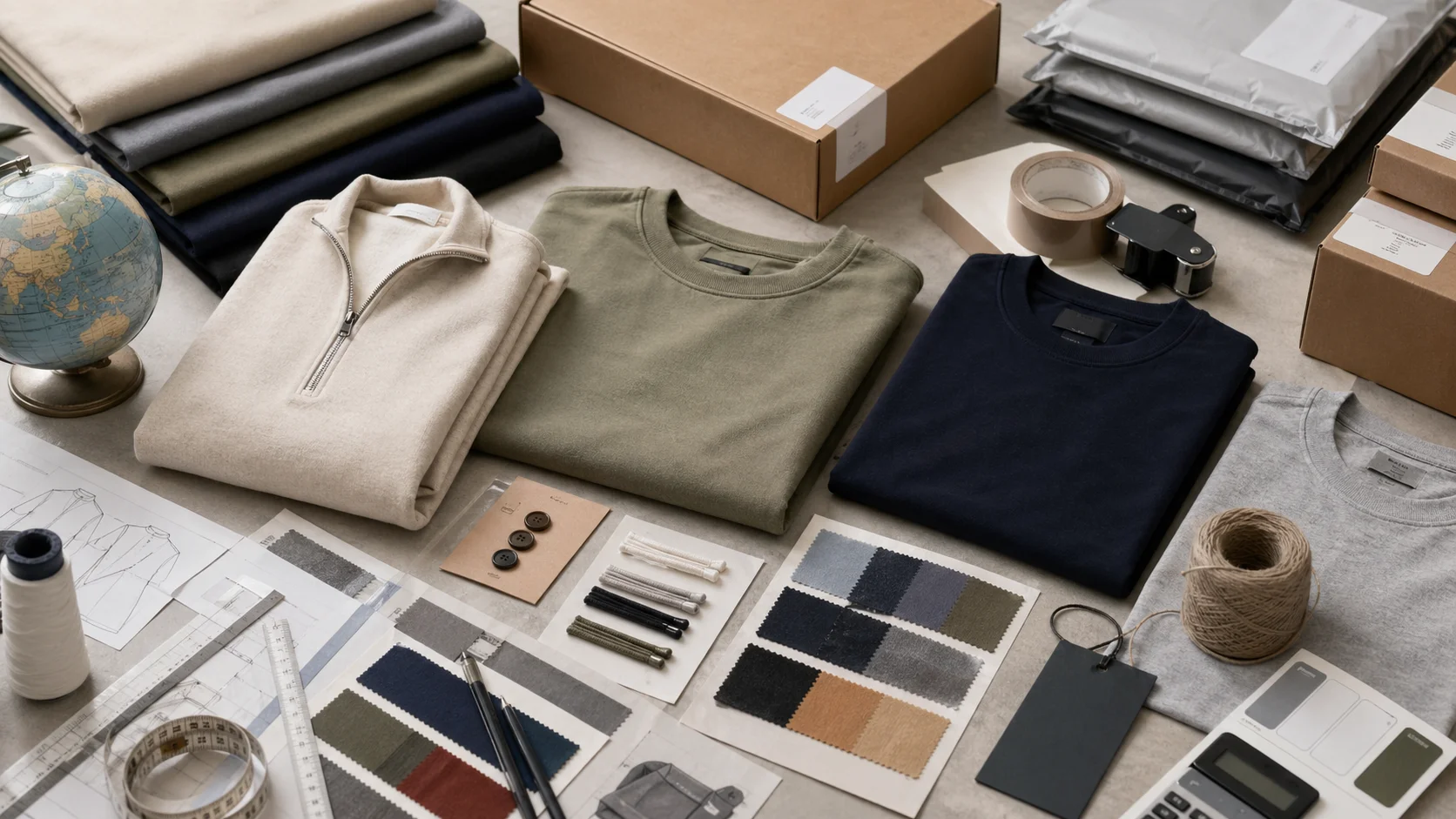
China Paper Mailer Bags for Clothing with checks for samples, fit, MOQ, QC evidence, pricing terms, and delivery risk.
Fast answer: China Paper Mailer Bags for Clothing: Material, Closure, Print, and MOQ should be judged by production evidence, not by a generic sourcing promise. The buyer needs sample proof, cost breakdowns, QC checkpoints, and delivery buffers in writing.
Ask for recent sample photos, measurement tolerances, fabric or print test assumptions, decoration test notes, packing examples, and a named inspection checkpoint. These details show whether the team can repeat an approved sample at bulk volume.
Separate garment cost, decoration, labels, packaging, sampling, testing, freight, and rush charges. When every cost line is visible, it becomes easier to reduce colorways, adjust size depth, or reserve more time for sampling.
A 12-cent poly mailer can look efficient right up until it starts costing you more than it saves. When returns dip, unboxing photos improve, and packaging starts doing real sustainability work instead of just talking about it, the math changes fast. For custom paper mailer bags for clothing brands china, the shift is commercial, not sentimental. If you are sourcing from a manufacturer, factory, or supplier in China, the decision usually comes down to performance, branding, and quality in the real world.
Across Guangdong, Zhejiang, and Fujian, the same pattern kept showing up in factory after factory. Garment bags, tissue, and hangtags were already moving through the line, so adding paper mailers did not require some massive reinvention. That matters. A plant with die-cutting, printing, and folding capability can usually turn out a basic custom paper mailer in 10-14 days. Add new tooling, and the schedule stretches to 3-4 weeks while samples get tweaked and tweaked again.
Premium brands are not switching just for optics. Retail packaging now pulls double duty: branding and sustainability proof. Paper gives a cleaner story at the parcel door. DTC basics use it to defend a modest price lift. Premium streetwear uses it to sharpen the sense of scarcity and texture. Boutique labels use it to make a $68 shirt feel deliberate before the customer even opens the bag.
The cost trade-off is real. Poly mailers still win on unit price, especially at 10,000+ units, and they are lighter in freight. But paper mailers can cut refund friction and prevent the small damage incidents that pile up fast — a zipper pull, a sharp hardware edge, a rough seam punching through thin plastic. I’ve seen brands lose more to avoidable complaints than they would have spent on better packaging.
Regional buying habits say plenty too. Discount apparel brands still chase the lowest landed cost and often stay with poly. Mid-tier labels are moving faster into paper mailers, especially in Europe and North America, where customers read packaging as part of product quality. In Asia, boutique brands and streetwear labels have been surprisingly quick to adopt paper because presentation feeds resale value and social media attention.
The catalog looks simple until you start checking the materials. Most suppliers can offer kraft paper, recycled paper, FSC-certified paper, laminated paper, and water-resistant coated options. I’ve seen common grammage ranges from 120 gsm to 250 gsm, with heavier stock used for structured premium mailers and lighter stock used for flatter garment shipments. In custom paper mailer bags for clothing brands china, the substrate decides most of the feel before the print even shows up.
Structural choices matter more than many buyers expect. Self-seal strips are standard, but not all adhesive behaves the same in summer freight lanes. Tear strips help reduce damage during opening, gussets make room for bulkier knitwear without puffing, and reinforced seams become essential once the bag is carrying more than one item. A single tee in a flat pack needs a different bag from a two-piece lounge set or a brushed-fleece hoodie.
Print method changes both the economics and the look. Flexo works well for larger runs and simple graphics, often from 5,000 units upward. Offset gives sharper detail, better image fidelity, and cleaner type, though the setup can raise cost on smaller runs. Digital is the practical route for samples or low MOQs, often 300-500 units, but exact color matching gets trickier when the job moves from screen to paper to shipping carton.
Here’s the part many people miss: a simpler one- or two-color design often looks more premium once folded and shipped than a crowded graphic surface. Heavy coverage can scuff in transit, especially on matte stocks and darker inks. I’ve seen a minimal black logo on natural kraft beat a fully printed design because it arrived clean, kept its shape, and looked intentional instead of busy.
That is why factory capability is not just about what sits in a brochure. The better packaging plants can coordinate with apparel work, including projects like custom bra manufacturing or nested accessory packing, because they understand how delicate product presentation affects the unboxing sequence. Fit, protection, speed — same language.
I compare quotes in four bands: 500, 1,000, 5,000, and 10,000 units. That is where setup charges stop hiding. A quote that looks cheap at 10,000 can turn expensive at 500 because plate fees, die cuts, and proofing eat the margin. For paper mailers, I’ve seen a plain kraft unit land near $0.18-$0.35 at scale, while a printed, coated, custom-sized bag can climb to $0.45-$0.95 depending on finish and thickness.
The main price drivers are predictable, but buyers still underweight them. Paper weight changes raw material cost. Coating changes both durability and recyclability. Size changes sheet utilization. Print colors change setup. Custom inserts, internal branding slips, and specialty glue all add cost. If the factory uses a stock die, the quote drops and the lead time improves. If you need a custom die, expect an extra 5-8 days before production starts.
Timeline should be mapped in stages, not guessed. Sample creation usually takes 3-7 days. Artwork confirmation may take another 2-4 days if the buyer is slow with dielines. Pre-production proofing often runs 1-3 days. Mass production can take 7-15 days for standard orders, and export transit adds 3-6 weeks depending on destination and shipping mode. Ocean freight is cheap. It is also patient.
Coastal packaging hubs such as Dongguan, Shenzhen, and Ningbo usually move faster than inland suppliers because they sit closer to paper mills, printing vendors, and port logistics. Inland plants can still compete on price, but the cheapest quote is not always the fastest or safest. In one project, a lower-cost inland supplier missed a shipment because their carton spec failed sea freight stacking tests; the coastal supplier had already solved that with a better corrugated outer pack and faster carton sourcing.
For brands that run private label fashion lines, packaging timing should be synced with production timing, not handled as an afterthought. I’ve seen labels using private label clothing lose two weeks because mailers were ordered after garment approval. That delay is avoidable. Packaging should enter the calendar before bulk cutting, not after the last hem is sewn.
A real manufacturer talks in process. A trader talks in promise. A hybrid operation can do both, but buyers should know which hat is on the table before asking for price stability. Real factories can show printing lines, die-cutting rooms, glue stations, and QC benches. Traders often forward questions and delay specifics. If you want reliable pricing on custom paper mailer bags for clothing brands china, you need to know who controls paper purchase, labor, and defect handling.
I ask for five proof points every time: production videos, recent export orders, material certificates, QC photos, and references from apparel clients. The factory should also show how it packs for sea freight, not just how it prints. A glossy sample means little if the outer carton collapses after 14 days on a humid dock or the adhesive strips lift in storage. Ask about production capacity and how the supplier manages repeat orders at bulk and wholesale levels.
Red flags are usually boring, which is exactly what makes them dangerous. Vague answers on GSM are a warning. No sample archive suggests weak repeatability. Inconsistent adhesive performance tells you the plant has not tested summer humidity properly. Unclear packaging for sea freight means the supplier is designing for the showroom, not the shipping lane. I’ve visited plants where mailers looked perfect on the table and failed after a 1-meter drop test.
Specialization matters too. Some factories excel at luxury presentation packaging, with crisp foil, rigid inserts, and higher-end finishes. Others are built for high-volume basics, fast changeovers, and tight cost control. If your brand ships knit sets or soft apparel that needs a softer hand feel, the supplier’s experience with cut-and-sew production can be a good signal, especially for brands also sourcing from cut and sew manufacturing.
The strongest plants usually work with apparel categories that are sensitive to presentation, including babywear and intimatewear. I have seen suppliers serving custom baby clothing manufacturing clients with unusually strict packaging controls, because those buyers care about odor, seal integrity, and carton cleanliness. That discipline translates well into mailer production.
Mailers fail most often because the size was guessed, not measured. I’ve seen brands order a bag sized for “tops” only to discover their folded hoodie is 32 cm x 26 cm x 5 cm, while the chosen mailer barely holds a tee stack. Oversized bags waste freight space. Under-sized bags spike return complaints and wrinkle the garment before the customer even opens the parcel. The right fit starts with actual folded dimensions, not SKU assumptions.
Strength specs should be written down, not implied. Ask for burst resistance, seam integrity, edge crush, moisture resistance, and adhesive peel performance. If the bag needs to cross humid ports or rainy last-mile networks, a basic kraft finish may not be enough. The factory should test how the closure performs after 24 hours in elevated humidity and after compression under a carton stack of at least 6-8 layers.
Branding can weaken durability when it turns too decorative. Heavy ink coverage, dark solids, foil, and complex coatings can reduce recyclability and create rubbing marks, especially if the mailers are packed tightly in master cartons. A cleaner layout with restrained color usage often survives transport better. It also photographs better when the customer posts the unboxing.
Before mass production, I want a test list: drop tests from 80-100 cm, compression checks, humidity exposure, and postal-simulation trials. Those trials should include corner impacts and repeated handling, not just one dramatic fall. A decent supplier will send the same sample through multiple abuse cycles and show where it wrinkles, tears, or lifts at the seal.
For brands that package lingerie, swim, or structured tops, paper mailers should be reviewed alongside product construction details. A label that already understands fit and stress points in custom bra manufacturing often brings better discipline to packaging specs too. Same with any line that needs precise folding, clean edges, and controlled opening.
Budget brands buy for landed cost. Mid-market brands buy for balance. Premium labels buy packaging as part of the product story. That difference changes the spec more than the logo does. For a budget line, recycled kraft, limited print, and stock sizing can keep the unit cost near the low end. For a premium line, thicker printed paper, refined fold lines, and cleaner finishing may be worth the extra $0.15-$0.40 per unit because the packaging supports a higher ticket price.
Recycled kraft often suits value-driven brands because it is honest, sturdy, and familiar. Mid-market labels tend to favor FSC-certified paper with one or two colors and a better seal. Premium apparel often uses coated or laminated finishes, but those choices must be weighed against recyclability claims and rubbing risk. A beautifully printed bag that scuffs in transit is just an expensive disappointment.
Buyers should verify sustainability claims with numbers, not adjectives. Ask for recycled content percentage, FSC certification, adhesive composition, and end-of-life recyclability in the target market. A bag that is recyclable in one country may not be collected efficiently in another. Data from the Global Organic Textile Standard ecosystem has also pushed brands to think more carefully about chain-of-custody claims, even though packaging is not the same as fabric. For broader packaging and sourcing guidance, see the U.S. International Trade Administration and OEKO-TEX for materials and compliance context.
The thing nobody tells you: some heavily decorated paper mailers generate more waste than minimalist options, even if they look greener at first glance. Extra foil, layered coatings, and complex laminations can make sorting harder and reduce the chance of proper recycling. In practice, a simpler mailer with less ink and fewer mixed materials often performs better across waste streams and shipping damage.
That is why product category matters. A brand selling essentials at $18-$28 cannot afford packaging bloat. A streetwear label selling limited runs at $70-$120 may use mailers as part of the story. A niche seasonal brand with low turnover should favor flexibility and short runs. I’ve seen sustainable positioning collapse when the packaging cost exceeds the garment margin by 12%-15%.
Start with dimensions, not design. Measure folded product sizes for your top 3-5 SKUs, then set a target landed cost before you contact suppliers. Request 3 quotes minimum, because one quote rarely reveals what the market is actually charging. Then order samples, approve artwork, lock QC specs, and stage production in that order. Reverse the sequence, and you will pay for it in reprints or missed launches.
Your spec sheet should include exact dimensions, paper weight, print colors, tolerances, seal type, carton packing requirements, and whether the mailer must survive a 1-meter drop. Add the folding method, adhesive type, and the outer carton count per box. The best spec sheets I have seen were only two pages long, but every line had a number attached.
Negotiation points are straightforward. Clarify MOQ, tooling ownership, replacement policy for defects, spare cartons, and payment terms for repeat orders. Many factories will move from 30/70 to 20/80 after a second order if QC is stable and communication is clean. Ask who owns the die if you leave. Ask how rework is billed. Ask whether the factory keeps color standards on file.
Before contacting suppliers, prepare three things: a size chart for your garments, reference packaging photos, and a target delivery window. Compare sample packs on feel, seal strength, print accuracy, and carton condition, not just on appearance. Place a test order of 500-1,000 units before any full production run above 5,000 units. That small batch tells you more about print consistency, transit durability, and factory discipline than any polished sales sheet ever will.
At scale, a basic kraft mailer can cost about $0.18-$0.35 per unit, while printed or coated versions often land around $0.45-$0.95. MOQ, paper weight, and finishing have the biggest impact. At 500 units, setup fees can matter more than the paper itself.
Samples usually take 3-7 days, and mass production for standard orders often takes 7-15 days. Add 3-6 weeks for export transit depending on route and shipping method. Coastal factories usually move faster because they sit closer to material suppliers and ports.
Ask for production videos, recent export orders, material certificates, QC photos, and references from apparel clients. Reliable factories can explain GSM, adhesive performance, and sea-freight packing without hesitation. If answers stay vague, that is usually a warning sign.
Yes, but verify the numbers. Check recycled content percentage, FSC certification, adhesive composition, and whether the structure is recyclable in your target market. A mailer with one or two materials is usually easier to recycle than a laminated design with foil and multiple coatings.
Many factories accept 500-1,000 units for sampling or small launches, while better pricing usually starts at 5,000 units. Some plants will quote lower, but setup charges can make very small runs inefficient. Always compare the total landed cost, not just unit price.