
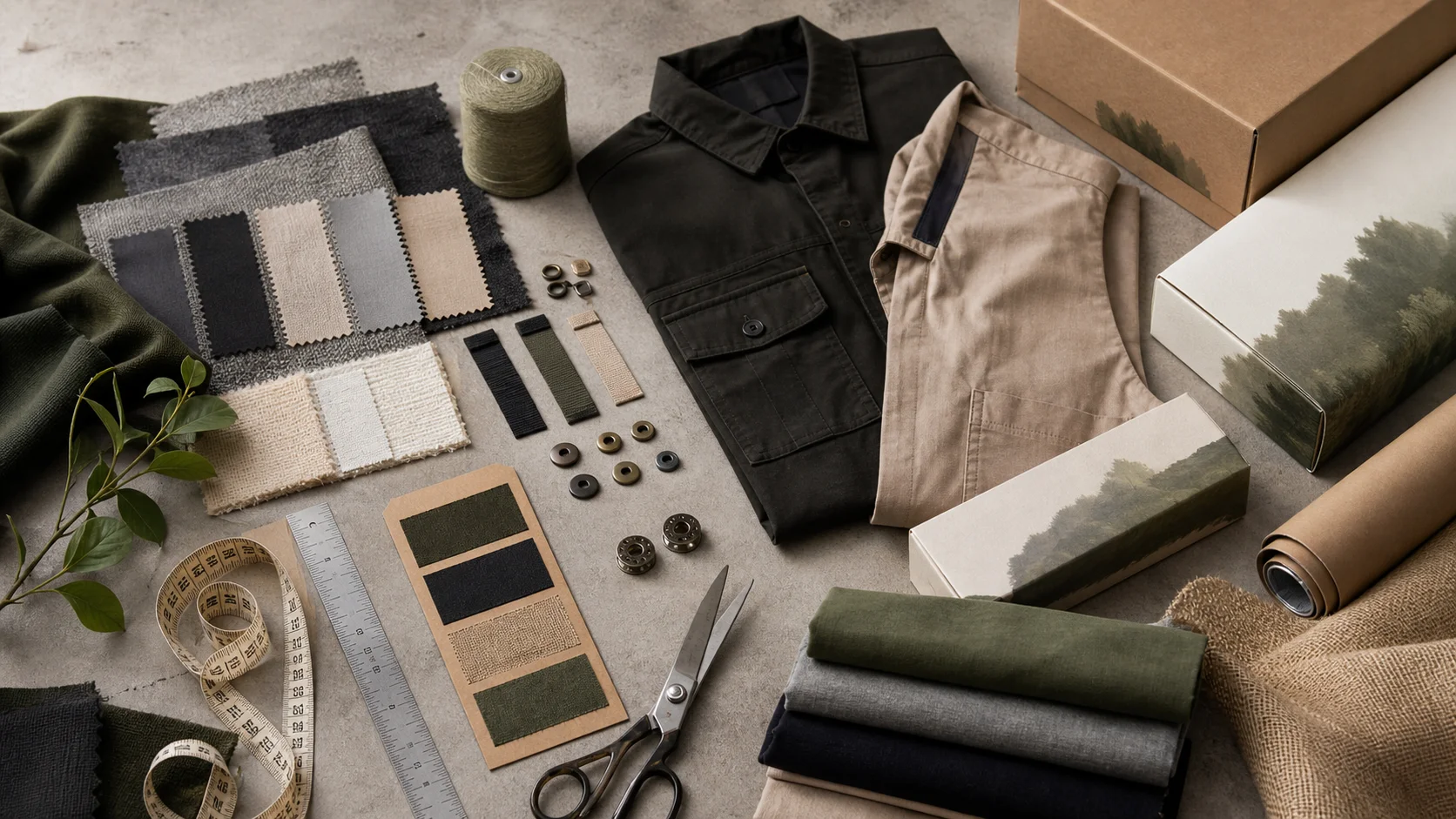
Custom Paper Sleeves for Folded Clothes with checks for samples, fit, MOQ, QC evidence, pricing terms, and delivery risk.
Fast answer: Custom Paper Sleeves for Folded Clothes: Fit, Cost, and Branding should be judged by production evidence, not by a generic sourcing promise. The buyer needs sample proof, cost breakdowns, QC checkpoints, and delivery buffers in writing.
Ask for recent sample photos, measurement tolerances, fabric or print test assumptions, decoration test notes, packing examples, and a named inspection checkpoint. These details show whether the team can repeat an approved sample at bulk volume.
Separate garment cost, decoration, labels, packaging, sampling, testing, freight, and rush charges. When every cost line is visible, it becomes easier to reduce colorways, adjust size depth, or reserve more time for sampling.
Folded basics get about three seconds on shelf before a buyer decides whether to touch them. That tiny window explains why custom paper sleeve packaging for folded clothes keeps replacing loose belly bands and flimsy poly bags in more stores every season. In London, Ho Chi Minh City, and Los Angeles, I’ve watched retail teams reset the same wall of tees three times in one morning because the stack went soft after twenty minutes of handling. The garment was fine. The presentation wasn’t.
Across factory visits in eight countries, the real shift has been control, not decoration. A sleeve stops a 280 gsm jersey tee from sliding out of line, keeps barcode placement visible, and cuts the little scuffs that happen when 200 pieces move through six hands and then get stacked again. Damage rates can fall from 4 to 5 percent to 1 to 2 percent in hosiery and lightweight knits when sleeves replace loose wrap, and shelf-facing consistency improves because every unit lands at the same folded width. For SKU-heavy basics, that consistency beats a glossy finish every time.
The price tier changes the brief. Premium DTC labels often ask for 350 to 450 gsm board, embossed logos, and a matte or soft-touch feel because they want the sleeve to help sell the product. Mass-market basics care more about stackability, 500-piece to 5,000-piece reorder speed, and a landed cost below $0.08 to $0.18 per unit. I’ve seen a brand spend $0.22 on a decorative sleeve and still lose money because packing slowed by twelve seconds. A simpler sleeve at $0.06 sometimes wins because the barcode reads cleanly and the packer closes it in one motion.
Here’s what most people miss: the plain sleeve can beat the fancy one when it improves stacking, barcode visibility, and labor speed at the same time. In one Vietnamese plant I visited, a plain FSC board sleeve with a 35 mm side panel cut carton rework by 18 percent versus a heavier coated version that looked richer but stuck together in humid conditions. That wasn’t a design win. It was a handling loss.
Sustainability only holds up when the spec is disciplined. A paper sleeve beats plastic overwrap only if the board weight makes sense, ink coverage stays controlled, and the finish still works for recycling in the target market. According to OEKO-TEX compliance guidance, restricted substances and coating choices still matter because “paper-based” can still carry chemistry that complicates compliance. Too many brands celebrate the switch, then quietly over-print the sleeve and add lamination that weakens recyclability.
A well-sized sleeve does three jobs at once: holds the fold, creates a clean facing, and cuts the time needed to replenish a shelf or open a master carton. In distribution centers I visited, standardized sleeve dimensions shaved six to ten seconds off each pick-and-pack cycle because the item didn’t need a second alignment check. On a 5,000-unit run, that’s not trivia. That’s labor hours.
Protection is narrower than people assume. Sleeves are not cartons. They do not stop crushing, rain, or long moisture exposure. They reduce scuffing, dust pickup, and friction from repeated handling. For a 180 gsm cotton tee, a sleeve can shield the printed chest area from abrasion. For socks and underwear, it keeps the pair from splitting apart in transit. For leggings and knitwear, it helps control edge roll and keeps SKU labeling visible when the product sits in 20-piece towers.
Category fit matters. T-shirts usually work well at 120 to 180 mm wide sleeves, depending on fold depth. Socks and underwear need tighter control because the product is small and can slip. Leggings often need a longer format, sometimes 280 to 320 mm, so the folded leg doesn’t poke out. Knitwear is trickier because the bulk shifts during transport; I’ve seen a 240 gsm merino sweater look neat in sample form, then expand by 8 to 12 mm after vacuum off-gassing and humidity changes. That’s where the sleeve earns its keep or fails.
There’s always a tradeoff. More coverage gives more structure, but it raises board usage and unit cost. Too little coverage, and the garment edges fray or slide during handling. Brands chasing a $0.05 saving often lose more in shop-floor time than they save on paper. A retail team fixing 300 misaligned facings per day is paying for that “saving” in payroll, not packaging.
I’ve worked with teams pairing sleeves with clothing packaging solutions because the packaging has to match the folding method, carton pack-out, and channel mix. A direct-to-consumer order with one folded tee is not the same as a wholesale replenishment carton with 24 units and barcode scanning at the warehouse door. The sleeve should serve the route the garment takes, not just the photo in the pitch deck.
Stock choice changes perception and performance. Uncoated kraft signals lower ink load, a matte natural feel, and easier recycling in most markets, but it can mute fine detail. Coated white board delivers sharp print fidelity and strong contrast for small SKU codes. Recycled board can be the right answer when a brand wants visible fiber content, though it may show speckling and a slightly uneven caliper. FSC-certified paper is often the cleanest documentary path for brands building a verified sustainability claim. According to Textile Exchange traceability resources, traceability claims matter as much as materials, because buyers increasingly ask where the fiber came from and how it was processed.
Finishing should follow the price point, not vanity. Matte coating works for budget basics and many mid-market labels because it cuts glare and keeps barcodes readable. Soft-touch feels expensive, but it raises cost and can complicate recycling. Aqueous coating is often a good middle ground because it gives scuff resistance without the plasticky look of heavier laminates. Embossing and spot varnish can help premium apparel, though I’d use them sparingly on small sleeves where excess finishing slows production and adds 5 to 9 percent to cost.
Closure details matter more than many buyers expect. Die-cuts speed assembly when operators can fold and tuck in one motion. Perforations help with controlled opening if the customer needs the garment quickly. Tear strips improve the unboxing feel, but they add tooling complexity and, in some factories, a one- to two-day setup penalty. Tuck tabs are fast on line, yet they must be sized precisely or the sleeve pops open in transit. For a 10,000-piece order, a small geometry error becomes a very visible defect rate.
Branding hierarchy should stay disciplined. Logo first, SKU second, legal text third. QR codes can sit on the back or bottom panel, but they should not fight the barcode or washing label. High-contrast typography beats decorative clutter. Minimal typography works for sustainable brands that want restraint. Bold color blocking suits fast fashion, where shelf impact comes from speed and volume. Boutique labels often win with quiet cues: one Pantone, one logo size, one message.
When a brand is building private label ranges, the sleeve has to sit beside the product story. I’ve seen brands pair it with private label clothing services so packaging, fit, and labeling all tell the same story from factory floor to shop floor. That alignment prevents the usual mismatch between the sleeve and the garment’s texture, finish, or wash instructions, especially when the fold originates in Dhaka and the sleeve is printed in Istanbul before arriving at a Ho Chi Minh City fulfillment center.
Cost transparency starts with the raw material. A supplier in Guangzhou will typically quote $2.50-4.00 per unit at 500 MOQ when using 350 gsm clay-coated board, flexo printing in four plates, and a shared Bobst folder gluer line. That price includes die cutting, embossing, and a 120-mm by 250-mm format tailored to a boxy tee. The same order on 100 percent recycled kraft might drop to $2.12 per unit but require additional ink density controls if the brand wants white text.
Every supplier stacks in variable costs. Pre-press, plate making, and color proofing on a Heidelberg Speedmaster XL 105 will add about $350 per job. Lamination, if required, adds another $0.12 per unit and is often run through a laminator with a solvent-free unit to preserve OEKO-TEX Standard 100 compliance. For sleeves that need GOTS-certified paperboard, the minimum order often jumps to 5,000 pieces, and the supplier will bill a verification fee to cover traceability audits.
When comparing quotes, look beyond the per-unit number. Suppliers in Istanbul often bundle warehousing near the port, delivering 18-22 business days total from signed approval—18 days for cutting and finishing, plus 3 to 4 days for export documentation and truck consolidation to the port. A Guangzhou partner might promise two-day sample turnaround but charge a 3 percent rush fee on production. In both cases, ask whether the units ship with WRAP or BSCI audit reports already on file, because that avoids last-minute compliance headaches.
For brands prioritizing circularity, suppliers with GRS certifications tend to manage recycled fiber intake better, tracking the exact kilograms of reclaimed pulp used per batch. That level of detail can spare you from an uncomfortable sustainability claim if the incoming fiber diverges from the spec by more than 2 percent.
Factory selection should factor in geography, capacity, and certifications. A Tier 1 supplier in Guangzhou with WRAP, BSCI, and OEKO-TEX Standard 100 audits can deliver consistent board weight and print quality, but they may only open small production windows for new clients. In contrast, a Dhaka facility with OEKO-TEX Standard 100 and GOTS capabilities may handle larger seasonal spikes because their flexo press line runs in three shifts. Ho Chi Minh City plants often offer superior humidity control for sleeves destined for tropical retail markets, reducing curling and registration drift.
Ask whether the factory runs inline finishing or ships panels to a third party. Inline folder gluers with die-cutting stations limit shipping touches and can hit 5,000 pieces in a 10-hour run with a 99.6 percent accuracy rate when magnetic die boards are calibrated daily. For complex builds, a factory with both a Heidelberg and a Roland die-cutter can switch from straight-edge sleeves to perforated tear strips in under 35 minutes.
Request paperwork early. WRAP, BSCI, and OEKO-TEX Standard 100 reports show labor, safety, and restricted substance controls. GOTS and GRS certifications confirm fiber origins and recycling percentages, which matter for premium athleisure brands selling in the EU and North America. Without them, customs may detain the shipment or force costly re-certification.
The cleanest timelines come from breaking the line into phases. Sample development usually takes 3 to 5 business days in Guangzhou or Istanbul using a digital press and manual creasing. Once the sleeve geometry is locked, plate making and full-production prepress sit around 4 business days, depending on whether you need a GRS-certified ink inspection. Press runs on Heidelberg Speedmaster XL 105 or Komori GLX take 5 to 7 days, followed by 2 days on the Bobst folder gluer and another 1 day for QC.
Packaging, palletization, and export packing take 2 to 3 days. Including air freight prep or sea consolidation, the total supplier-to-port window can be 18-22 business days if the supplier maintains a clean production calendar, as seen with a Ho Chi Minh City line producing sleeves for a European athleisure brand. Rush orders can slice that to 12-14 business days, but expect a 4 to 6 percent premium.
Start with a tech pack. Clearly call out folded garment dimensions, barcode placement, and any embossing or spot UV needs. Share the garment weight, fiber content, and target markets so the factory can select the right board (for example, 280 gsm recycled kraft for lightweight organic cotton or 420 gsm SBS with a matte aqueous finish for structured knitwear).
Request a prototype run in your intended material. Whether you source from Dhaka or Istanbul, insist on a GOTS or OEKO-TEX Standard 100 certificate copy for the board. If you plan to use recycled fiber, ask for the GRS batch slip to confirm the claimed percentage. Run the prototype through your folding machine—manual, automatic, or robotic—to validate that the sleeve tucks, wraps, and stays put under the same tension as your retail flow.
Once approvals are sealed, book the production slot and confirm there’s a quality gate for color, registration, and die score depth. Include a final check for BSCI and WRAP compliance paperwork so the supplier can issue a consolidated export pack.
Q: Can a paper sleeve handle humid logistics environments?
A: Yes, if the supplier uses board with humidity-resistant sizing and keeps coatings light. Many Ho Chi Minh City and Guangzhou lines run humidity-controlled warehouses and test sleeves at 65 percent relative humidity for 72 hours to make sure they don’t curl or peel.
Q: How much lead time do I need to qualify a new factory?
A: Expect 6 to 8 weeks from qualification to first shipment, assuming your brand requires certifications like GOTS, OEKO-TEX Standard 100, and WRAP. That includes audit review, sample approval, and a 18-22 business day production window.
Q: Are tear-resistant sleeves a good idea for leggings and activewear?
A: Yes, especially for products packed in 20-unit towers. Use 280 gsm board, spot varnish along the long edge, and finish on a Bobst folder gluer with a pneumatic creasing section so the tear strip doesn’t crack under tension.
Q: How do I keep costs under control while staying eco-conscious?
A: Focus on repeatable processes: print runs with Heidelberg or Komori presses, inline die cutting, and aqueous coating. Partner with a supplier offering GRS-certified recycled pulp to prove circularity while keeping per-unit costs in the $0.12 to $0.18 range for mass-market volumes.