
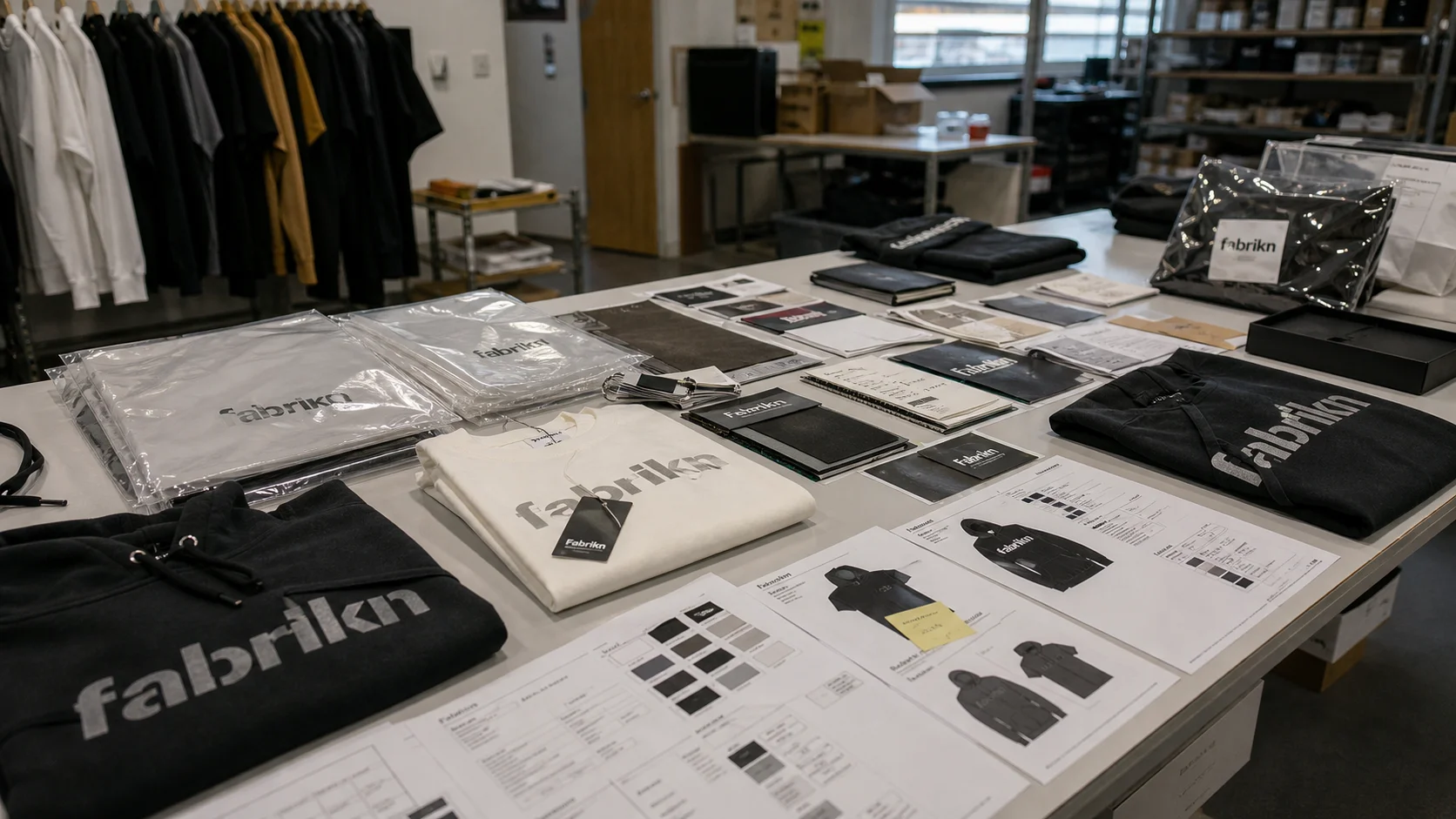
Wholesale Fashion Shipping Poly Bags with checks for samples, fit, MOQ, QC evidence, pricing terms, and delivery risk.
Fast answer: Wholesale Fashion Shipping Poly Bags: Film, Print, Specs, and Cost should be judged by production evidence, not by a generic sourcing promise. The buyer needs sample proof, cost breakdowns, QC checkpoints, and delivery buffers in writing.
Ask for recent sample photos, measurement tolerances, fabric or print test assumptions, decoration test notes, packing examples, and a named inspection checkpoint. These details show whether the team can repeat an approved sample at bulk volume.
Separate garment cost, decoration, labels, packaging, sampling, testing, freight, and rush charges. When every cost line is visible, it becomes easier to reduce colorways, adjust size depth, or reserve more time for sampling.
The first time a $48 blouse arrives with a torn outer bag, a scuffed hem, and a barcode buried under folded film, the packaging budget stops looking generous. That is exactly why custom poly bags for fashion shipping wholesale keeps coming up in procurement meetings for fashion brands.
Across more than 200 factory visits in eight countries, one lesson kept repeating: packaging is not cosmetic. Damage rates shift. Refund rates shift. Resale value shifts too, and the numbers are never subtle. A premium brand shipping silk shirts at $120 to $180 a unit often wants a 40-50 micron LDPE bag with a resealable flap; a mid-market denim label shipping 12 oz jeans in 1,000-piece drops may choose a simpler 30-35 micron bag with a printed SKU panel. Same garment? Sometimes. Same bag? Rarely.
In Bangladesh and Vietnam, the spec often changes by destination because humid routes demand better moisture control and retail-ready barcode windows. Portugal and Turkey tell a different story: lead time beats everything, so buyers accept simpler printing if the cartons can move in 5-7 days instead of 3-4 weeks. Transit risk changes the spec. Fast.
Dust. Abrasion. Light moisture. Custom poly bags for fashion shipping wholesale handle all three while adding tamper evidence and barcode visibility. They also let warehouse teams read sizing labels without squinting. Branding rides along too, and even a plain wholesale delivery feels more deliberate once the pack has a clean printed face. For ecommerce, that first visual cue still matters when a third party opens, sorts, and repacks the order.
Three factories taught me the same awkward lesson: the cheapest bag by unit price was the most expensive once rework, damage claims, and repacking labor were counted. A $0.028 plain bag that failed seal tests ended up costing more than a $0.041 branded bag that cut mispacks and shaved 12-15 minutes per 1,000 units from labor. Cheap is rarely cheap when operations get involved.
My buyer framework stays simple: protection first, then print quality, then sustainability claims I can verify, then lead time, then total landed cost. Miss one step, and the invoice looks better than the result.
At minimum, a spec for custom poly bags for fashion shipping wholesale should name the resin, thickness, closure, print method, and carton pack. LDPE gets picked for flexibility. HDPE shows up when buyers want a crisper hand feel. Recycled-content blends enter the conversation when a retailer asks for less virgin plastic. On factory floors, thickness shows up in microns and gauges, usually 25-80 depending on garment weight and shipping distance.
Closure style changes the experience quickly. Flap bags with adhesive strips work well for tees and knitwear. Zipper bags suit lingerie, swim, and premium basics that get opened and closed again. Hang holes help with retail display or final QC. Vent holes matter for outerwear and padded items, where trapped air turns cartons awkward and seal problems appear. Perforation helps high-speed packing lines separate bundles without a fight.
Use cases do not blur together. Tees and jersey tops often go into 30-35 micron LDPE with a simple label window. Denim may need a 40-50 micron bag because the fabric edge is rough and the weight is higher. Lingerie can use a smaller bag with a zipper. Outerwear usually needs a larger gusseted format. For ecommerce mail-ready kits, some factories print a warning line, a barcode, and a size block on the same face.
Print options range from one-color logos to full-coverage branding and bilingual warning copy. I have seen brands place QR codes 15 mm from the seal edge so scanners can read them without opening the pack. Tiny placement, real payoff. Artwork setup usually includes plate costs, often $60-180 per color for flexo printing, and sampling can add another $80-250 before production starts.
Wholesale ordering lives or dies on MOQ, artwork approval, production tolerances, and carton configuration. Asia usually brings broader customization and lower unit cost; nearshore suppliers often win on shorter transit, lower inventory risk, and smaller runs. A factory in Ho Chi Minh City quoted me 10,000-piece minimums with 2-3 week production. A Spanish supplier asked for 5,000 units and 7-10 days, but the unit price was nearly double.
If you are mapping packaging to product development, the bag spec should sit beside your private label clothing services file, not in a separate inbox thread. That is where errors multiply.
Prices move in layers. A cheap quote hides that. Plain poly bags for fashion can run $0.018-0.035 per unit at 10,000 pieces, depending on size and thickness. Add one-color custom printing, and many factories move to $0.030-0.055. Recycled-content versions often sit at $0.038-0.070 because PCR resin costs more and consistency is harder. Heavier-gauge branded bags, especially 50-80 microns with zipper or hang hole details, can reach $0.075-0.14 before freight.
Volume changes the math more than most buyers admit. A 3,000-piece run may absorb a $120-180 setup fee so heavily that unit cost looks inflated by 20-35 percent. At 20,000 pieces, that same setup disappears into the background, and the factory can spread film waste, print calibration, and carton packing across a bigger batch. Mixed-size orders bring their own headaches because each width, length, and print plate can trigger a separate line change.
Regional pricing drivers do not behave the same way. In Asia, resin access and labor rates often keep factory quotes low, but ocean freight, duties, and inland trucking can wipe out the advantage on smaller shipments. Europe brings higher labor, yet shorter transit and fewer customs surprises can reduce holding cost. Mexico and Eastern Europe make sense for brands replenishing weekly instead of quarterly. I have watched a $0.039 factory quote become a $0.061 landed cost after freight, duty, and warehouse holding were included.
Here is the cost stack I ask for in every quotation: sample cost, plate or setup cost, production cost per 1,000 units, and freight per 1,000 units. For a 10,000-piece order, a sample might cost $60-120, setup $80-240, production $320-700, and shipping $90-280 depending on mode and destination. Air freight can multiply the transport line by 4-6 times. That only makes sense when launch timing is on fire.
What ties cost to business results is the part procurement teams miss. A bag that prevents 2 percent of damage claims on a $28 average unit can save more than it costs. Cleaner presentation cuts repacking time. Better seal strength lowers retailer chargebacks. On a 5,000-unit seasonal drop, even a $0.012 difference per bag is only $60, but one avoided return wave can erase ten times that amount. Data from WTO, trade.gov, and trade agencies keeps showing the same thing: transport and border costs can dwarf small factory price differences, especially on lower-value shipments.
I often tell brands to pair wholesale packaging with production planning. If your garment line uses cut and sew manufacturing, cost the bag spec at the same time as the garment, not after the final sample shows up.
A good spec sheet stops expensive phone calls. I want flat width, gusset depth, length, film thickness, closure type, print area, carton count, and target packing method on one page. If the bag is meant for an automated pack line, say it. If the warehouse staff will hand-pack 800 units per day, say that too. A factory cannot guess speed requirements from a logo file.
Artwork errors are the easiest way to waste a shipment. Low-resolution logos blur on flexo plates. Color drift happens when a brand approves a Pantone swatch on screen and expects the same result on recycled resin. Bleed problems show up when a design touches the film edge. Compliance text has to stay readable after sealing, folding, and carton compression. I once saw a care instruction vanish under a barcode sticker because nobody mapped print zones first.
Warehouse speed depends on small mechanical details. Stackable bags are easier to count. Easy-open features save seconds on every carton. Perforated bundles reduce snagging. If you are shipping 15,000 units a week, saving even 2 seconds per bag returns nearly 8.3 labor hours over a month. That is not abstract. That is payroll.
Compliance checks should cover recycled-content labels, plastic reduction claims, and retailer-specific packaging rules. In Europe, some buyers require proof that the film meets local recycling guidance. In the US, retailer scorecards can reject vague claims that cannot be backed by resin documentation. ISO and testing references help here; the ISO site is useful for standards language, while regional retail rules often matter more than marketing copy.
For independent verification of materials and social responsibility claims, the Textile Exchange standards and preferred fiber guidance and OEKO-TEX certification resources are useful references for buyers comparing supplier documentation.
Before production gets the green light, ask for pre-production samples, inline photos, and carton drop-test evidence. I also ask for a seal strength check on at least 10 sample bags and a photo of the printed barcode at scan distance. If the supplier hesitates, that usually tells you enough. Silence is a signal.
Asia is still the scale play for custom poly bags for fashion shipping wholesale. Factory networks in China, Vietnam, and India can handle 10,000-200,000 unit orders with heavy customization, multiple print colors, and aggressive pricing. Lead times often land at 2-5 weeks after sample approval, though shipping can add another 2-6 weeks depending on destination. MOQ is commonly 5,000-10,000 pieces per SKU, and some plants prefer 20,000 when the print setup gets complex.
Europe is where shorter transit and tighter compliance expectations can justify a higher ex-factory price. Polish and Portuguese suppliers have quoted me 7-10 day production for 3,000-5,000 units, which helps when a seasonal colorway is selling faster than forecast. They may lose on unit cost, yet they can trim inventory exposure by 15-30 percent if the brand replenishes in smaller waves.
Local suppliers are the speed option. A domestic converter or supplier can deliver in 5-12 days, sometimes faster if the film is standard and the print is simple. MOQ can be as low as 1,000-2,500 pieces. That matters for capsule collections, influencer drops, and new brands testing demand. The tradeoff is plain: higher unit price, less customization, fewer resin options. Still, if you are holding six months of stock to save $0.01 per bag, the savings may not be real.
I visited one coastal Asian plant producing 60 million bags a year with excellent seal consistency and very low scrap. Then I visited a smaller European line that struggled with color matching across two print runs of the same SKU. Surprising? Sure. But big does not mean sloppy, and nearshore does not guarantee precision. Quality control comes from process discipline, not geography.
Choose by product type and demand pattern. If your basics sell steadily and replenishment is planned, Asia can make sense. If your fashion calendar changes every 30-45 days, Europe or local supply may keep you from overbuying. If your buyer team values compliance paperwork and shorter transit more than raw unit cost, that should drive the sourcing decision. Price alone is a weak compass.
Sustainability claims only matter when they can be checked. PCR content is measurable. Resin certification is measurable. Recyclability depends on local collection systems, not the wording on the carton. A bag marked recyclable in one market may be landfill in another if polyethylene recovery is weak. That is a packaging truth many brands still dodge.
Virgin resin, PCR blends, and downgauged film all carry tradeoffs. Virgin LDPE often gives the best seal consistency and clarity. PCR blends can reduce fossil input, but some factories report 5-15 percent more variation in thickness and opacity. Downgauging from 50 microns to 35 microns can cut material use by 30 percent, but only if the bag survives transit without tearing. A broken thinner bag is not sustainable. It is waste with better branding.
Compostable claims deserve extra skepticism. Unless your product moves through an industrial composting system with verified access, the claim can turn into little more than a marketing line. Fashion shipping rarely routes through that infrastructure at scale. Warehouse staff get confused. Consumers do too. I have seen compostable mailers sit for 9-12 months because the retailer did not want to explain disposal.
Numbers beat adjectives. A lighter bag can reduce resin use by 20-35 percent. Better fit can lower return damage. Fewer returns mean fewer replacement shipments, and those avoided miles may outweigh a small difference in resin composition. In one brand review, trimming bag weight by 4 grams across 100,000 units saved roughly 400 kilograms of plastic and lowered freight weight enough to shave a meaningful amount off transport costs.
My buyer checklist is strict. Ask for PCR percentage by batch, a resin declaration, evidence of local recycling compatibility, and any third-party certification the factory claims. Request a photo of printed sustainability statements on the actual bag, not just in the presentation deck. If the supplier cannot show batch-level proof, I treat the claim as unverified.
For buyers who want a wider product view while they compare packaging formats, browse our product catalog and map bag choices against garment category, not against slogans.
I start every rollout with a tight brief: define the use case, shortlist three suppliers, request samples, compare landed cost, test in the warehouse, and approve print only after physical checks. Ordinary sequence? Sure. But it stops the most common procurement mistake, which is ordering 50,000 pieces before a line worker has touched the bag.
A pilot order should cover 2-3 SKUs and 1-2 print variations. That gives enough variation to test sizing, barcode placement, and packing speed without locking too much cash into one spec. I usually want 500-2,000 pieces per variation for the pilot, depending on demand. If the supplier pushes for a massive minimum before testing, I pause.
Audit the factory with photos and documents, not promises. Ask for resin traceability, print registration checks, seal testing, and carton labeling review. If possible, request a live video of the packing line with the actual bag in use. I have seen seal failures appear only after cartons were stacked three high. Catch that in a sample room, not in a returns warehouse.
Risk management should be boring. Use phased buys. Keep safety stock for your core styles. Dual source high-volume bags if the SKU has year-round demand. A 70/30 split between two factories can protect you if one misses a ship date by 10-14 days. For seasonal colors, avoid overcommitting to a single print run until sell-through is clear.
Before you sign off, turn the work into a checklist: spec sheet approved, sample signed, carton count confirmed, print proof checked, freight quoted, and warehouse test complete. If you can answer those six items in writing, you have a repeatable procurement process instead of a packaging guess. That is the difference between a smooth replenishment cycle and another costly scramble for custom poly bags for fashion shipping wholesale.
Plain bags often cost $0.018-0.035 each at 10,000 pieces. One-color custom versions usually land around $0.030-0.055, while recycled-content or heavier-gauge branded bags can reach $0.075-0.14 before freight. Setup and sample fees may add $140-420 per project.
Asia commonly starts at 5,000-10,000 pieces per SKU, while European and local suppliers may accept 1,000-5,000 pieces. If you need multiple sizes or print versions, each variation can have its own MOQ, so ask for a combined quote early.
Sample approval usually takes 5-10 days. Production can take 2-5 weeks in Asia, 7-10 days in parts of Europe, and 5-12 days with local suppliers. Freight can add 1-6 weeks depending on air or ocean shipping.
Yes. Ask for batch-level PCR documentation, resin declarations, and any third-party certification. Then confirm whether the bag design matches local recycling rules in your destination market. A claim that cannot be traced to a batch should not be used on the pack.
If speed matters most, local or nearshore suppliers usually reduce transit uncertainty and inventory exposure. If you need lower unit cost and broader customization, Asia usually wins. The right choice depends on your SKU count, monthly volume, and how often you replenish.