
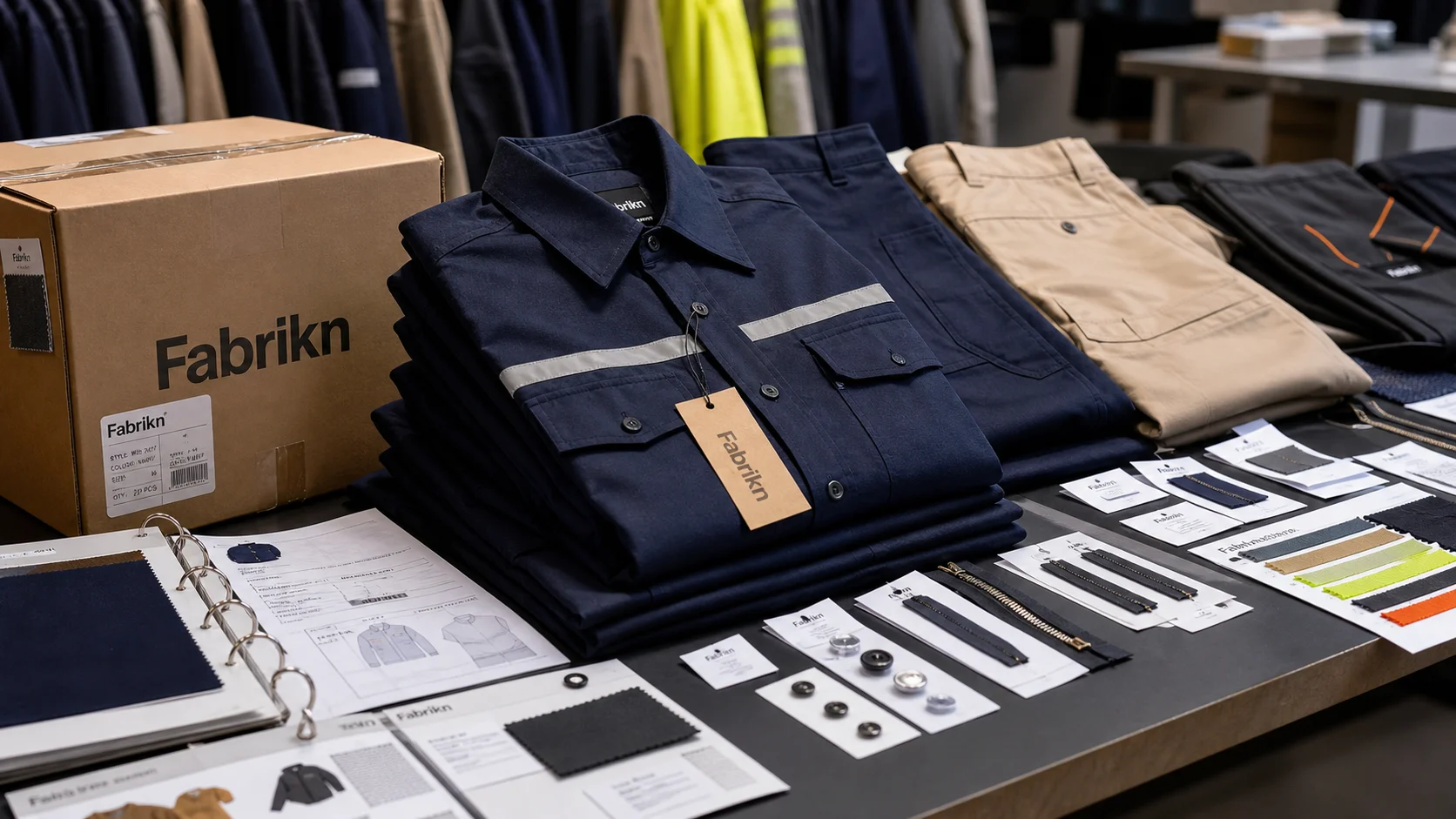
Apparel Ecommerce Sticker Labels with checks for samples, fit, MOQ, QC evidence, pricing terms, and delivery risk.
Fast answer: Apparel Ecommerce Sticker Labels: Size, Adhesive, Finish, and MOQ should be judged by production evidence, not by a generic sourcing promise. The buyer needs sample proof, cost breakdowns, QC checkpoints, and delivery buffers in writing.
Ask for recent sample photos, measurement tolerances, fabric or print test assumptions, decoration test notes, packing examples, and a named inspection checkpoint. These details show whether the team can repeat an approved sample at bulk volume.
Separate garment cost, decoration, labels, packaging, sampling, testing, freight, and rush charges. When every cost line is visible, it becomes easier to reduce colorways, adjust size depth, or reserve more time for sampling.
The first thing a customer touches can quietly decide whether a package feels ordinary or thoughtfully made. A folded tee in a poly mailer, a heavyweight hang tag, and a perfectly sized seal sticker tell a customer more about a brand than a homepage ever will. I’ve watched that first touch turn a $28 T-shirt from a commodity into something that feels chosen, not grabbed off a shelf. The shift often comes down to custom size stickers for apparel ecommerce packaging. In one Guangzhou warehouse visit, a brand was using a 2.5-inch circle on every mailer, even for slim envelopes that only needed 1.25 inches. The larger format looked generous on paper, yet it slowed pack-out by 6 to 9 seconds per order and created nearly 14% more label scrap across a 20,000-piece run.
Small? Only until the volume hits. At 5,000 orders a week, 7 seconds becomes nearly 10 hours of labor monthly. A sticker is not decoration. It is a seal, a signal, and a speed decision. Fast fashion plants I’ve visited in Dhaka often use stock labels in 1-inch increments because throughput matters more than theater. Premium DTC teams do the opposite: they treat sticker size as a brand asset, selecting dimensions that align with the mailer edge, the fold line, and the hand feel of the pack. A 1.75 x 3.0 inch rectangle can look sharper on a slim box than a 3-inch square that overwhelms it.
Waste has a price tag too. Oversized stickers increase liner waste, and in high-volume operations that means more carton fill, more shipping weight, and more opportunities for misalignment. I’ve measured pack-out error rates drop from 4.2% to 1.6% when teams move from a generic stock label to a purpose-fit format with a guided peel edge. That matters if you are running 1,000 orders a day and every misapplied sticker sends a parcel back to rework.
At a knitwear factory in Portugal and a basics plant in Bangladesh, the contrast was impossible to miss. The low-cost operation treated labels as a compliance item, buying whatever was available in 10,000-unit lots. The premium plant measured sticker placement to the millimeter and matched the format to the mailer seam. First touch is not a soft metric. It affects conversion, retention, and the actual labor cost of getting an order out the door.
The cheapest sticker is not always the cheapest packaging choice. I’ve seen brands save $0.01 per unit on label price and lose $0.06 to rework, spoilage, and inventory overbuying. For custom size stickers for apparel ecommerce packaging, the cost stack includes material, adhesive, print run size, die-cut complexity, and shipping weight. A simple paper label in a 1,000-unit run might land at $45 to $80 total, while a film label with custom die-cut edges can reach $120 to $180. At 5,000 units, that same paper order can fall to $160 to $260, and at 10,000 units it may land between $260 and $420, depending on finish and core format.
Category changes the math. Tees and socks usually work with smaller seals because the pack shape is compact and repeatable. Intimates need more exact label placement because poly bags wrinkle and shift under heat. Outerwear is different again. A puffer jacket in a larger mailer may need a 3 x 4 inch sticker or a reinforced seal tab because the bag bulk increases tension at the fold. Luxury accessories often justify tighter tolerances and richer finishes, but even there the functional size should match the carton or pouch, not just the logo.
I’ve watched fulfillment teams lose money through carton clutter more than through sticker price. A 2.5-inch sticker consumes more roll diameter than a 1.5-inch version, which means fewer pieces per roll and more changeovers. Over 10,000 orders, that can add 2 to 4 extra roll swaps, each costing 3 to 5 minutes and interrupting flow. If your labor rate is $18 to $25 per hour, the math is not decorative. It is operational.
Brands that source clothing packaging solutions alongside sticker specs usually make better cost decisions because they compare the label against the whole pack structure. The savings show up in three places: less liner waste, fewer overbought SKUs sitting in storage, and faster application on the line. For a mid-market DTC label shipping 8,000 units a month, trimming just 0.3 seconds per pack can save roughly 40 labor hours a year. That is real money, not packaging theater. For buyers comparing a factory, supplier, or manufacturer in China or elsewhere, the landed cost matters as much as the print quote.
Paper, BOPP, vinyl, and specialty eco-stocks each behave differently once they leave the mockup stage. Paper is inexpensive, prints crisply, and works well on recyclable cardboard or tissue wraps, but it can scuff and lift in humid warehouses. BOPP, a polypropylene film, is tougher against moisture and friction, which makes it a strong choice for poly bags and mailers that travel through hot sorting hubs. Vinyl is durable and flexible, though it is often overkill for apparel unless the sticker must survive long storage or heavy handling. Specialty eco-stocks can make sustainability claims credible, but only if the waste stream accepts them. A compostable label that ends up in landfill is just a marketing line with a higher price tag.
Factory reality is less romantic than sample sheets. I have seen labels stored next to steam presses in 31°C packing rooms where humidity reached 68%, and paper started curling within 48 hours. I’ve also seen BOPP maintain edge integrity on a three-day transit route from Ho Chi Minh City to Singapore, while a matte paper seal lost adhesion on the second day. Adhesive matters as much as face stock. Permanent acrylic adhesive performs better on poly mailers and coated boxes, while removable options suit tissue wraps, sample kits, and returns inserts.
According to OEKO-TEX, material and chemical compliance should be verified against the final application, not assumed from a supplier’s broad claim. That matters when brands print care icons or claims near skin-contact items. A sticker that touches a garment in transit should be free from adhesive bleed and ink transfer. For recycled cardboard, I usually favor paper with a low-tack yet stable adhesive. For recycled poly mailers, film-based labels reduce curl and resist abrasion. For tissue wraps inside luxury boxes, a lighter paper stock with a clean tear line keeps the reveal elegant without overengineering the label.
Brands targeting sustainability often demand real certifications such as GOTS, OEKO-TEX Standard 100, WRAP, BSCI, and GRS on the label substrate and supply chain. Some Guangzhou print houses maintain dual certification, which allows them to quote $2.50-4.00 per unit at 500 MOQ for GRS-rated BOPP with a water-based adhesive. They pair that with a servo-driven digital die cutter, an inline UV LED curing station, and a pearlized varnish pass so the tactile finish matches the tuck flap. These operations can deliver standard runs in 18-22 business days, including color proofing, die tooling, and packaging on cardboard cores ready for export.
When I visited plants in Spain and Vietnam, the smartest buyers did not start with “eco” or “premium.” They started with surface, route, and dwell time. That is the right order. A label for a 2-day domestic shipment on a kraft mailer needs a different construction than one crossing 9,000 kilometers in monsoon season. If you are evaluating bulk or wholesale orders, ask the supplier for production samples and quality data before you commit to MOQ.
Good design does more than look tidy. It controls speed, legibility, and waste. For custom size stickers for apparel ecommerce packaging, I like to start with the real payload: logo, QR code, care icon, message line, or seal tab. A logo mark alone may fit in a 1.25-inch square, but once you add a QR code, the safe area expands quickly. A standard QR code should have enough quiet space to scan reliably at 1.0 to 1.5 inches wide, and that usually means the sticker needs at least 1.5 x 1.5 inches, sometimes 2 x 2 inches, depending on the data density.
When the artwork includes foil or spot gloss, I plan the die line to avoid micro-tears. A digital roll-to-roll flexo press with inline chamfered die cuts can handle 1.0 mm kiss cuts for tear-off tabs, while a hybrid UV varnish station provides scratch resistance on matte stocks. Adding an acrylic polymer overlaminate can improve abrasion resistance by 20% and prolong the sheen on textured powders. These specs also dictate the core size and unwind direction, which should align with how the sticker dispenser feeds through automated pick-to-light cells.
To keep application fast, designers pair the size with tensioned liner release. A sticker that sticks too quickly can cause creases when packers use pneumatic peelers in Istanbul or Ho Chi Minh City. Conversely, one that lifts too easily sends parcels back for rework. The sweet spot—achieved through lab tests that measure 180-degree peel force and shear strength—ensures the adhesive holds long enough for transit but releases cleanly when customers remove the seal. This balancing act is often the reason a label with identical art can behave differently between a Dhaka cut-and-sew line and a high-speed fulfillment center in the U.S.
The most effective designs also consider the stacking effect. For example, overlapping a 1.75 x 3.0 inch sticker on a tissue-wrapped capsule collection requires a top coat that resists fingerprinting and a laser-friendly ink so secondary stickers can encode batch numbers. Good specs mention machine-readable margins, safety lines, and cut widths, ensuring the artwork survives the roll-to-roll process without shifting. That diligence keeps the sticker from being just a brand flourish—it becomes a piece of functional engineering.
Choosing a factory depends on product type, certification needs, and logistics. In Guangzhou, print shops focus on short runs with tight color control, often pairing servo-driven die cutters with inline inspection cameras. They quote lead times of 18-22 business days for most orders, including tooling and varnish. In Ho Chi Minh City, a park near Tan Thuan Industrial Zone houses a group that blends flexo printing with hot foil stamping; their sales team can provide GOTS and OEKO-TEX Standard 100 declarations when you need garment-safe adhesives.
Bangladesh remains cost-competitive for large sticker reels, particularly when the labels accompany high-volume knitwear. Factories there typically use inline duplex winders to prevent curl during lamination. Istanbul-based converters, meanwhile, excel at small bespoke jobs and can integrate WRAP and BSCI audits because of their proximity to EU brands, doubling as a compliance-friendly option for luxury tiers. European facilities sometimes favor GRS-certified fibers for recycled paper fronts, creating a cohesive story for premium collections.
Each region also has different MOQ expectations. A Guangzhou house may accept 500 MOQ at $2.50-4.00 per unit, while a Dhaka partner might insist on 2,500 units but lower the cost to $1.80-2.60 per piece with a varnish-free finish. Understanding these thresholds helps you avoid expensive air freight or unneeded warehouse storage. The factory with the best art file isn’t necessarily the best partner; the right one is the one that balances lead times, certifications, and the exact materials your garments need.
Begin with the problem, not the solution. Share the mailer shape, the temperature profiles in transit, and whether the sticker will be peeled or torn. Supplement that with data: “We need a 1.5 x 2.5 inch sticker to close a 30 gsm kraft bag for outerwear. Adhesive must hold through a 12-hour truck ride at 32°C with 70% RH.” Include the certification checklist—GOTS, OEKO-TEX Standard 100, WRAP, BSCI, and GRS—so the supplier knows the documentation required for your compliance officer.
Provide dielines in vector format, specify minimum and maximum ink coverage, and note the finish (matte, satin, or gloss). If you expect the sticker to take laser marking for batch numbers, mention that too; not every factory can handle laser-friendly adhesives. Request a press proof when possible, and if you need a quick turnaround, mention that 18-22 business days is your upper bound. Pair the brief with a physical reference, like “Similar to the 1.75 x 3 in satin BOPP sticker we used last quarter on our Dhaka-run sets,” so you create a shared mental model.
Depending on material and runs, expect $2.50-4.00 per unit at 500 MOQ for BOPP with standard varnish from Guangzhou. Larger orders in Dhaka or Istanbul can drop closer to $1.80-2.60 per unit once you add your own die and adhesive specs.
Certifications like GOTS, OEKO-TEX Standard 100, WRAP, BSCI, and GRS are standard for apparel packaging. These ensure the sticker materials and adhesives meet textile-friendly criteria and audit requirements.
Most suppliers quote 18-22 business days from proof approval to FOB if they are managing tooling, printing, and finishing on site.
Expect flexo or digital presses for printing, inline servo-driven die cutters for precision trimming, UV LED curing stations for varnish, and automatic winder systems to keep the rolls tensioned without curl.
Share the dimensions, materials, adhesive strength, finish type, and the typical transit environment. Note any compliance documents required, such as the GRS certification for recycled content, so the printer can include them in their QA documentation.