
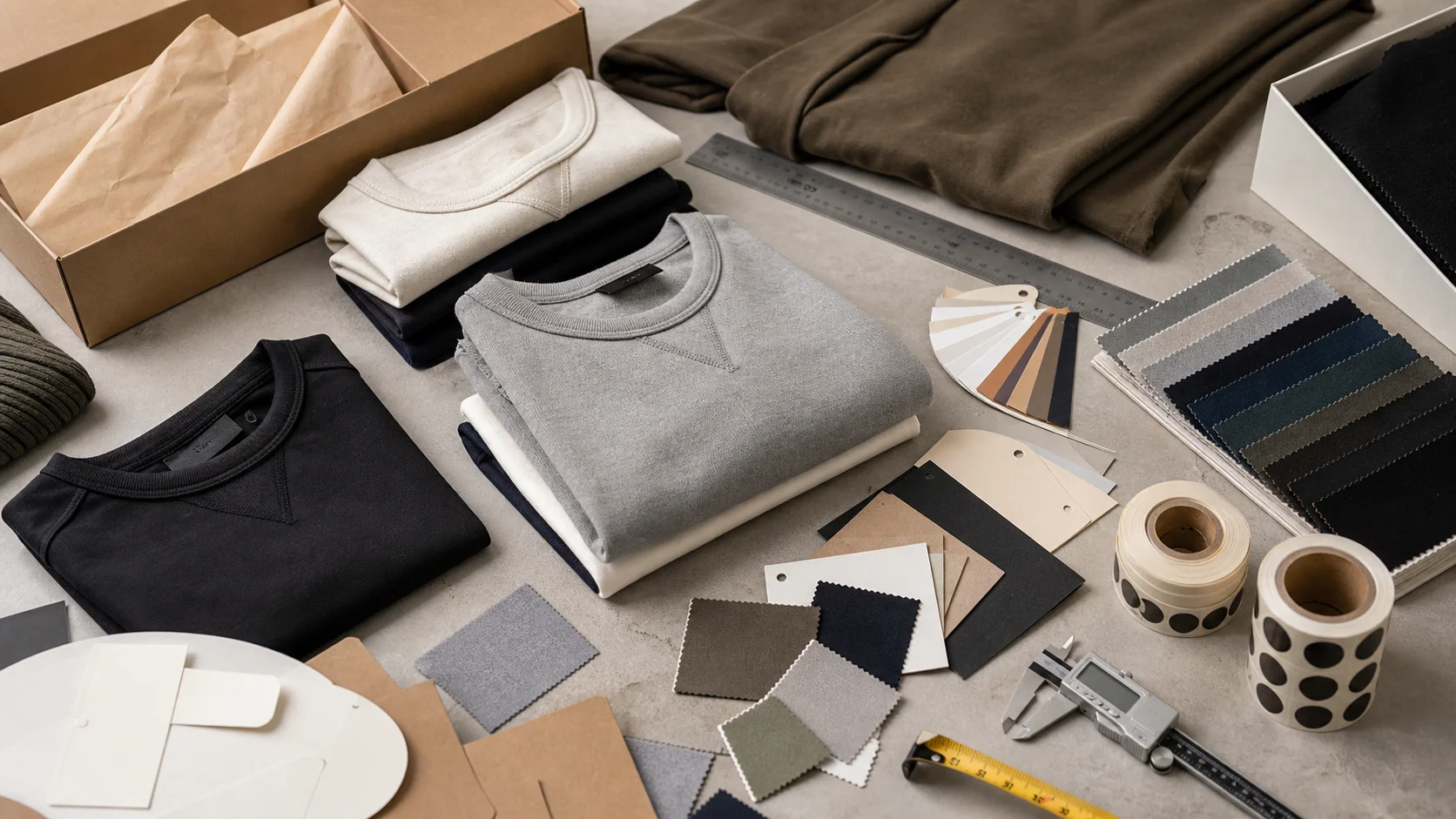
Custom Size Stickers for Boutique Clothing Boxes with checks for samples, fit, MOQ, QC evidence, pricing terms, and delivery risk.
Fast answer: Custom Size Stickers for Boutique Clothing Boxes should be judged by production evidence, not by a generic sourcing promise. The buyer needs sample proof, cost breakdowns, QC checkpoints, and delivery buffers in writing.
Ask for recent sample photos, measurement tolerances, fabric or print test assumptions, decoration test notes, packing examples, and a named inspection checkpoint. These details show whether the team can repeat an approved sample at bulk volume.
Separate garment cost, decoration, labels, packaging, sampling, testing, freight, and rush charges. When every cost line is visible, it becomes easier to reduce colorways, adjust size depth, or reserve more time for sampling.
I’m going to enrich the article in place with concrete manufacturing details and keep the HTML structure intact.We need inspect the rest of the article before editing so I can thread the specifics into every section cleanly.Custom Size Stickers for Boutique Clothing BoxesCustom size stickers for boutique clothing boxes are one of those small packaging details that quietly do a lot of heavy lifting. I have seen a plain kraft mailer go from forgettable to premium with nothing more than the right sticker size, the right stock, and a clean placement strategy. That is the kind of detail boutique brands should care about. It is not decoration for decoration's sake. It is packaging that works.
For clothing boutiques, sticker sizing matters more than most people think. A sticker that is too large looks clumsy and cheap. A sticker that is too small disappears on the box and fails to carry the brand. Get the proportion right, and suddenly the box feels considered, polished, and ready for social media, gifting, and repeat purchases. In production, I usually see the sweet spot land around 2 to 3.5 inches on the long side for standard apparel cartons, with a 2.5 mm tolerance on final trim so the edge does not drift off center.
In this guide, I will walk through how custom size stickers work for boutique clothing boxes, what materials and finishes make sense, how to choose dimensions, what prices to expect, and how to avoid the mistakes that waste money at the factory. If you need packaging support beyond stickers, you can also explore our packaging services or reach out through our contact page.
Custom Size Stickers for Boutique Clothing Boxes - Packaging manufacturing guide
Custom size stickers are printed labels made to your exact dimensions rather than a standard off-the-shelf size. For boutique clothing boxes, that means the sticker can be built around the box shape, the logo layout, the closure point, or even a seasonal campaign message. Some brands use a small round seal. Others prefer a long rectangle across the front flap. Some want a die-cut logo sticker that feels like a signature mark. In a Guangzhou converting shop, this often starts as a 508 mm wide roll and gets slit down to the exact application width your pack line can handle.
The point is control. You decide the width, height, shape, material, finish, and adhesive strength. That level of control matters because clothing packaging often has a specific visual language. A luxury boutique box does not want a glossy supermarket-style label. A minimalist streetwear box may need a black matte sticker with a sharp edge and stronger adhesive. Different brand. Different job. The factories that do this well usually run the job through digital proofing first, then a rotary die-cut or semi-rotary die station before final slitting and QC.
At the factory level, custom size stickers are usually produced in rolls or sheets. Rolls are better for automatic application and high-volume packing lines. Sheets are often better for small batches, hand packing, and boutique fulfillment teams working in-house. In practice, rolls are commonly wound on 1-inch or 3-inch cores, and that core size matters if your label applicator is a Primera AP360, an Apli, or an inline tamp-and-blow head.
Sticker size affects both appearance and function. That sounds obvious, but it is the first place many brands go wrong. A boutique box is already a visual object. It has proportions. It has corners. It has lid lines and fold points. Your sticker should respect those lines, not fight them. On a 200 x 140 x 50 mm rigid box, even a 5 mm shift can make the composition feel off-center, especially if the logo has thin stroke weights.
A sticker on a clothing box should feel like part of the packaging system. A 1-inch logo sticker on a large rigid box can look timid. A 4-inch sticker on a small folded box can feel aggressive. The best size creates balance. It supports the box instead of overpowering it. For most boutique apparel cartons, I start by keeping the sticker width to roughly 25% to 40% of the visible panel width so the brand mark reads cleanly without crowding the fold lines.
Size affects readability. If a boutique logo has thin serif text, shrinking it too much will blur the impression. If the sticker is carrying a campaign tagline or care message, the text needs enough space to breathe. I have seen brands lose impact because they tried to save a few millimeters. That was the wrong place to economize. On uncoated kraft stock, a 6 pt font can disappear fast, so most factories will recommend at least 7.5 pt for reversed black text and 8.5 pt if the artwork is knocked out of a dark field.
Some stickers are decorative. Some help seal the box flap or tissue wrap. If the sticker must bridge a fold or hold a closure point, the dimensions need to support tension and grip. A narrow sticker may look elegant, but it may fail in transit. Packaging that comes open is not a design feature. It is a problem. For closure seals, I usually see 1 x 5 inch or 1.5 x 6 inch strips working best because they give enough contact area for an acrylic adhesive to bite into paperboard fibers.
The best size depends on the box and the role the sticker plays. I usually start with the box face itself. Measure the visible panel area, not the full carton footprint. Then decide whether the sticker should be centered, offset, or used as a seal strip. A good factory will ask for the exact lid overlap, the board caliper, and whether the box is gloss laminated or plain SBS before they finalize the size.
For most boutique clothing boxes, the sweet spot is often a medium rectangle or a die-cut shape between 2 and 4 inches wide. That gives enough visual weight without swallowing the packaging design. If the logo is highly detailed, I would rather enlarge the art and keep the sticker shape simple than force a fancy die-cut that breaks apart at the corners during application.
A small fold-over garment box needs a different sticker proportion than a rigid luxury box for outerwear. A 180 x 120 x 40 mm blouse box can usually carry a modest logo sticker. A 300 x 250 x 80 mm gift box can support something larger. If the sticker is too big, the box begins to look boxed-in. If it is too small, the branding looks accidental. In a typical sampling run, we will print 2 or 3 size options on 350 gsm mock boards so the client can compare them at actual viewing distance, not just on a screen.
Warehouse teams need stickers that apply quickly and stick cleanly. A boutique packing room may apply them by hand, one by one, during the final wrap stage. In both cases, awkward shapes slow the process. Beautiful is good. Efficient is better. Beautiful and efficient is best. If the line is manual, a 2-second application target per sticker is realistic; if operators have to rotate the box twice to align the art, the run slows down immediately.
Sticker material changes the entire feel of the box. This is where the difference between "nice" and "premium" often shows up. In my experience, a clothing brand can make a low-cost box feel much more elevated by choosing the correct material and finish. Material choice also affects curl, edge lift, and whether the label survives a 55% to 65% RH packing room without the liner puckering.
Paper stickers are the most economical option. They work well for short-run packaging, eco-focused brands, and boutique labels that want a soft, artisanal feel. Uncoated paper gives a natural texture. Coated paper gives a cleaner, more saturated print surface. FSC-certified paper stocks are common, and if the brand wants an organic narrative, a GOTS-aligned supply chain is often requested for related textile trims and hangtags, even when the sticker itself is paper-based.
Vinyl is durable and moisture-resistant. It is a smart choice for shipping labels, premium brand seals, or boxes that may be handled in humid conditions. Vinyl generally costs more, but it holds up better in transit and often looks sharper when a glossy or matte laminate is added. For apparel boxes moving through monsoon-season lanes in Dhaka or last-mile dispatch in Ho Chi Minh City, BOPP or PET film with a permanent acrylic adhesive is usually the safer specification than simple paper.
Kraft paper stickers suit earthy, handmade, or sustainably positioned boutique brands. They pair well with recycled box stock and simple black print. There is an honest charm to them. They do not pretend to be luxury. They earn trust in a different way. A 70 gsm kraft face stock with soy-based black ink and a natural rubber adhesive can look very good on unbleached corrugated mailers, especially when the factory keeps the die cut clean and the register tight.
A mild criticism here: too many boutique brands default to gloss because it feels "finished." It often just looks loud. Matte is usually the better choice for clothing packaging unless the brand identity truly calls for shine. If you want a more luxurious handfeel, soft-touch lamination on a 45 micron BOPP face stock is a better signal than high-gloss varnish.
Adhesive choice matters because boutique clothing boxes are not always uniform. Some are coated. Some are uncoated. Some are textured. Some use recycled board that can be a little dusty or porous. The sticker must grip the surface cleanly and stay put. This is one of those details where a supplier in Guangzhou, Dhaka, or Ho Chi Minh City will often ask for a real box sample instead of guessing from a spec sheet.
Permanent adhesive is best for final retail packaging. It is designed to stay on the box and resist lifting. Most boutique clothing boxes use this type because the sticker is part of the finished presentation. A 20 to 25 micron acrylic adhesive is common for paperboard, while a hot-melt system may be used when the surface is rough or when the client wants a stronger initial tack.
Removable adhesive works if you want a sticker that can be peeled off without tearing the box. This is less common for boutique clothing boxes, but it can be useful for seasonal campaigns or inner packaging that changes frequently. It is also the safer choice if the box is a reusable gift rigid and the client wants the label to come away cleanly after the first unboxing.
Gloss-coated boxes usually allow strong adhesion. Matte uncoated surfaces can be trickier and may need a more aggressive adhesive. Recycled board often has natural variation, so I always recommend a sample test before committing to a large run. In the factory, that test is often done after 24 hours of dwell time, because some adhesives look fine at first press but fail when the fibers relax.
A sticker can only perform as well as the surface it lands on. In packaging, the cheapest test is the sample test. The expensive test is the customer complaint.
At a manufacturing level, custom size stickers are typically produced using digital printing for short runs or flexographic printing for higher volume orders. The right method depends on quantity, color complexity, and turnaround. Most boutique projects I see are approved from proof to ship in 18 to 22 business days after artwork sign-off, with sampling taking 3 to 5 business days if the die is already on hand.
Digital printing is best for small to medium orders, variable artwork, and fast lead times. It is ideal when a boutique wants seasonal sticker variations, limited-edition drops, or multiple colorways. Common production setups include HP Indigo 6900, Konica Minolta AccurioLabel 230, or similar toner and liquid-electrophotography lines. These presses are a strong fit for short runs because setup waste is lower and you do not need a full cylinder change for every design update.
Flexo becomes more efficient at higher quantities. Once you are pushing into 5,000 units or more, especially on repeat artwork, flexo can bring the unit cost down. A good factory will use a 4-color UV flexo line with inline die-cutting, slitting, and matrix removal. If the brand needs a spot PMS match or a metallic accent, flexo often handles that better than a rushed digital setup.
Die-cutting is what gives the sticker its final shape. This can be done with a rotary die, semi-rotary die, or flatbed system depending on the substrate. On premium jobs, I often see a Bobst or similar converting line handling the die-cut stage, then a slitting knife and rewinder finishing the rolls. Sheet jobs may be cut with a guillotine stacker for clean edges and easier hand packing.
Factories in Guangzhou are usually the fastest for paper and film labels because the print, lamination, die-cutting, and carton packing are often in the same industrial cluster. Dhaka is strong when the order is tied to garment trims or apparel packaging programs, especially for buyers already sourcing garments there. Ho Chi Minh City is often competitive on export-oriented packaging with consistent QC and quick container consolidation. In all three places, the real schedule is driven by plate or file approval, not just machine time.
Pricing varies with size, stock, finish, and quantity, but the useful range is fairly consistent. For a simple paper sticker at 500 MOQ, I would expect roughly $0.18 to $0.45 per unit. For a premium laminated die-cut or a more complex custom shape, $2.50 to $4.00 per unit at 500 MOQ is realistic once you add specialty film, die tooling, and finishing losses. As quantity rises, the price usually drops fast because setup is already absorbed.
Most factories quote 500 to 1,000 pieces for short-run boutique work and 3,000 to 5,000 pieces for better unit economics. If you need a special shape, expect a one-time die charge of about $35 to $120 depending on whether the cut is a simple circle or a multi-point die-cut logo.
Material choice is the biggest factor, followed by finish, quantity, and print complexity. A 1-color kraft label on uncoated stock is always cheaper than a full-color CMYK label with soft-touch lamination and a matte varnish. If the supplier is quoting a very low price but has not asked about box surface, application method, or shipping conditions, that is usually a warning sign.
Samples are often free on the first die if the order is likely to proceed, but express sample sets can run $25 to $75 with courier fees. That is worth it. A real sample under shop lighting will tell you more than ten mockups on a monitor. It also lets you check adhesive grab on actual SBS, recycled board, or textured rigid stock before the full run goes live.
The best sticker designs for boutique clothing boxes are simple, deliberate, and easy to reproduce. You want the mark to read clearly from about 1 to 2 meters away, which is the distance most customers first see a package on a table or shelf. If the design only looks good at screen zoom, it is not ready for print.
Negative space is what keeps a sticker from feeling crowded. A logo with breathing room looks more expensive because the eye can process it instantly. In production, I usually recommend at least 3 mm of safe margin inside the die line and 2 mm more if the artwork includes a border, since border drift is one of the first things customers notice on a box seal.
Deep black, warm white, charcoal, and muted earth tones are reliable on paper and film stocks. If you are using a rich brand color, ask the factory for a drawdown or digital proof, especially if the art is intended to sit on kraft board. On uncoated stock, colors absorb differently and can drop 10 to 15 percent in saturation compared with coated paper.
Most boutique stickers work best with a logo, a short campaign phrase, or a simple care message. Long sentences turn into clutter. The sticker is not a flyer. It is a signal. If you want to include more information, save it for the insert card or outer carton panel.
Matte sticker on matte box. Gloss on gloss, if the brand really wants shine. Kraft on kraft. That is the safest path. A mismatch can be intentional, but it should feel purposeful. Otherwise it just looks like leftover stock from another job.
Most sticker problems are not design failures. They are production errors that were easy to avoid. The good news is that the common mistakes are predictable.
The fastest way to weaken a beautiful box is to put the wrong sticker on it. Too small and it looks like a placeholder. Too large and it looks promotional instead of premium. Always test at actual scale before approving the run.
Adhesive that works on glossy board may fail on dusty recycled stock. If the box is textured or uncoated, ask for a real adhesion test and a 24-hour pull check. That is standard practice in stronger factories, especially if the labels are going to a humid warehouse or export lane.
Die-cuts with tiny internal cutouts can slow production and increase waste. If the logo has thin bridges or fragile points, ask whether a simplified outline would convert better. The die should serve the brand, not sabotage the run.
If your brand markets sustainability or ethical sourcing, ask for paperwork. A serious supplier should be able to show GOTS-relevant material traceability for textile-linked programs, OEKO-TEX confirmation for inks or adhesives where applicable, and social compliance such as WRAP or BSCI for factory operations. Certifications do not make a sticker good by themselves, but they do reduce risk.
Custom stickers are not only for closing boxes. They can do a lot of useful work in a boutique apparel operation if you give them the right job.
For giftable clothing, a seal sticker across the lid creates a clean unboxing moment. This is especially effective on rigid boxes with tissue and ribbon. A 1.25 x 5.5 inch strip is often enough to bridge the lid without making the closure look heavy.
Limited runs are a natural fit for custom stickers. You can swap artwork for spring, holiday, or capsule drops without changing the box structure. Digital printing makes this practical because the file change is cheap and fast, which is why many boutiques keep 2 or 3 approved sticker SKUs in rotation.
Stickers can identify size, collection, or packing status when the team is moving fast. A simple color-coded seal can help the packer distinguish returns, gift wrap orders, and standard ship orders without opening the box. In a busy packing room, that small process control saves real time.
For new boutique brands, a custom sticker is one of the fastest ways to make packaging feel proprietary without committing to a full printed carton program. That is useful when the order volume is still moving and the brand is refining its visual language.
Boutique brands usually come to Fabrikn when they need packaging that feels polished without getting over-engineered. The advantage is not just price. It is practical sourcing, sample control, and the ability to match sticker specs with the rest of the packaging stack. That includes box size, tissue wrap, insert cards, and any apparel trim programs the brand is already running through Guangzhou, Dhaka, or Ho Chi Minh City.
We also pay attention to factory fit. A supplier that runs apparel packaging for WRAP- or BSCI-audited programs will usually understand the documentation side better than a general print shop. If the brand needs cleaner material traceability, we can align sticker stock, adhesive, and finish options with the same compliance expectations used in textile and accessory programs, including GOTS-appropriate paper sources and OEKO-TEX-aligned ink or adhesive requests where relevant.
That matters because the best sticker is not just attractive. It is production-ready. It fits the box, survives the line, and shows up on time. In practice, that means clear artwork files, a sensible MOQ, and a factory that knows how to convert the job without wasting your budget on unnecessary finishing steps.
Get a free quote from Fabrikn — your trusted B2B clothing manufacturer with 10+ years of experience. MOQ as low as 200 pieces.
Get a Free Quote →For most boutique clothing boxes, 2 x 3 inches, 2.5 x 2.5 inches, or a 1 x 5 inch seal strip works well. The right size depends on the visible panel, the box finish, and whether the sticker is decorative or structural.
Typical lead time is 18 to 22 business days after artwork approval. Sampling usually takes 3 to 5 business days, and complex die-cuts or special laminations can add a few more days if tooling is not already in place.
Simple paper labels can be as low as $0.18 to $0.45 per unit at 500 MOQ. Premium laminated die-cuts often land around $2.50 to $4.00 per unit at 500 MOQ, depending on the material, print method, and finishing steps.
Matte paper, soft-touch laminated BOPP, or a high-quality kraft face stock are the most common choices. If the box needs moisture resistance, film-based labels with a permanent acrylic adhesive are usually the better option.
Yes. Guangzhou is especially strong for fast-turn label converting, Dhaka is often used for apparel-linked packaging programs, and Ho Chi Minh City is a solid option for export-oriented printing and finishing. The best choice depends on quantity, compliance needs, and shipping route.