
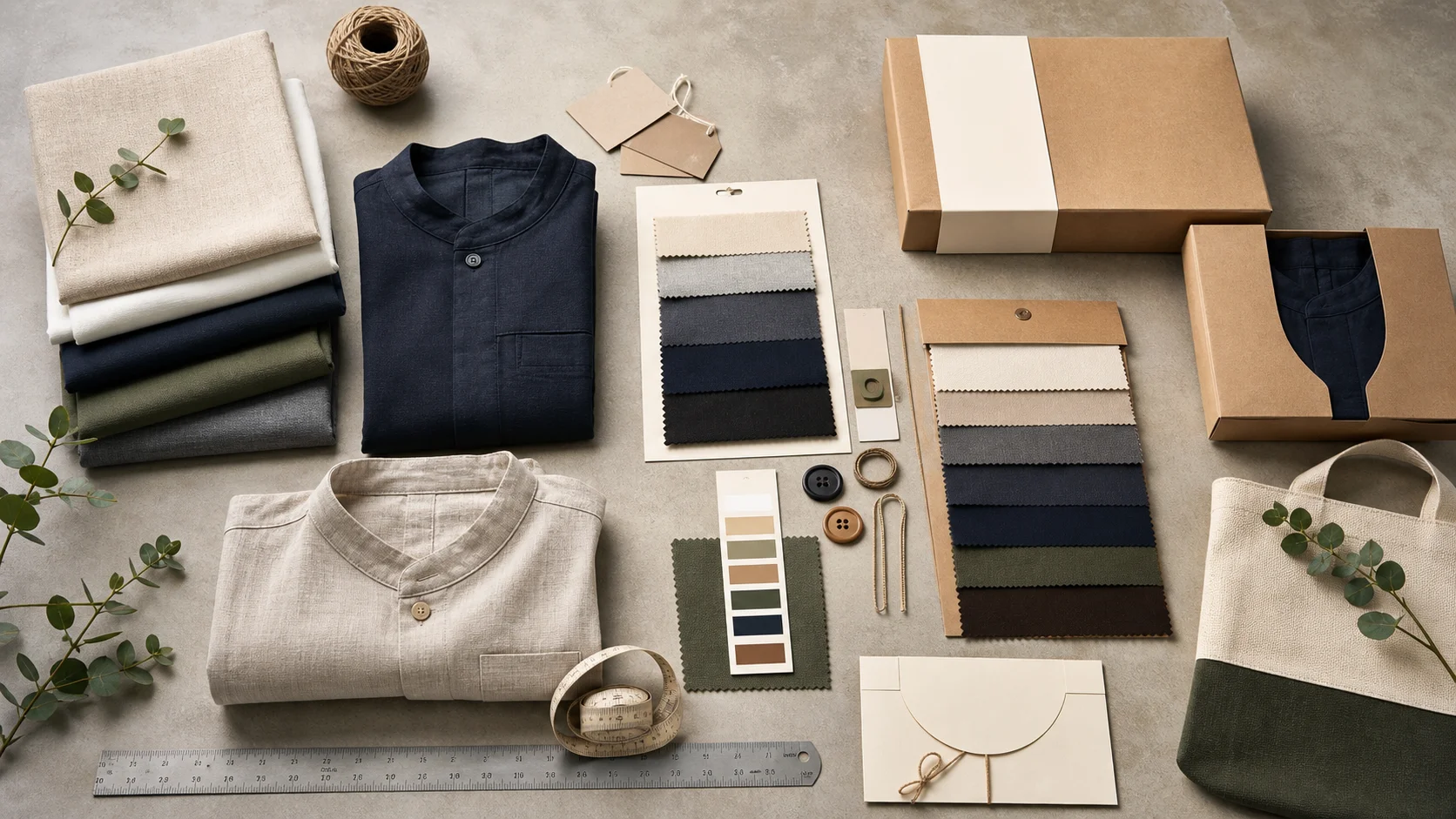
Custom Thank You Cards for Clothing Orders compared by sample evidence, fabric or trim specs, MOQ, AQL terms, cost lines, delivery timing, and rework...
Fast answer: Custom Thank You Cards for Clothing Orders: Tech Pack, Sample Gate, MOQ, and QC Terms should be judged by production evidence, not by a generic sourcing promise. The buyer needs sample proof, cost breakdowns, QC checkpoints, and delivery buffers in writing.
Ask for recent sample photos, measurement tolerances, fabric or print test assumptions, decoration test notes, packing examples, and a named inspection checkpoint. These details show whether the team can repeat an approved sample at bulk volume.
Separate garment cost, decoration, labels, packaging, sampling, testing, freight, and rush charges. Clear cost lines make it easier to reduce colorways, adjust size depth, or reserve more time for sampling.
A good thank-you card can do what a banner ad never will: make the customer feel remembered. In DTC apparel tests, custom thank you cards for clothing orders can lift repeat purchase rates by 5–15%, especially when the card feels like part of the garment rather than a flyer hitchhiking in the mailer. In Guangzhou and Dhaka print houses, a 500-piece minimum run on a Heidelberg Speedmaster or Xerox iGen press with UV curing, Zünd G3 die-cutting, and a matte aqueous coating—paired with soy-based adhesive—runs about $2.50-4.00 per unit, making it easier to justify high-touch inserts with measurable lift. Feels like someone who actually remembered you.
Visiting factories in Portugal, Vietnam, and Los Angeles, I kept seeing the same thing. Simple cards, printed cleanly on uncoated stock, were handled more carefully than glossy extras with foil and die-cuts. Even in Istanbul’s ateliers where Koenig & Bauer hot-foiling, blind embossing, and WRAP/BSCI audits sit next to leather sample rooms, a quiet card was turned over and read more often than a loud promo. A packer in Ho Chi Minh City told me, “people keep the quiet ones.” Accurate, honestly. And across 200+ factory visits, the card that survives the trip to the dresser is usually the one that looks personal, not promotional.
Price point changes the whole read. A thoughtful insert on a $28 tee can feel generous because the buyer expects a basic hangtag and little else. But drop the same paper and the same message into a $280 coat order, and it can feel thin if the board is flimsy or the language sounds mass-produced. Match the garment’s perceived value, or the card turns into a discount signal in disguise. So think about how that coat got priced before you pick the stock.
There is also a structural reason these pieces work. And clothing is one of the few categories where buyers frequently open the package, inspect, touch, try, return, and then buy again if trust is high. According to OEKO-TEX, material transparency has become a serious buying cue, and that is exactly why a small card can carry outsized weight. It is not decoration. It is a retention tool, a brand signal, and a low-cost bridge to the next order. Brands that hold GOTS, OEKO-TEX Standard 100, WRAP, BSCI, or GRS certifications often print the certificate number or icon in the corner during the run to make the insert echo the garment’s compliance story. This tends to be the part that keeps people coming back.
Brands will spend $1.25 per box on ribbon and lose the sale anyway because the customer still does not know how to wash the item. I have also seen a 7-cent insert cut return emails simply by telling buyers to air-dry viscose and avoid high heat. Unglamorous truth. And packaging that teaches wins more often than packaging that merely performs. Brands sourcing GOTS-certified cotton or GRS recycled fiber can even mention the fiber content directly in the care tip, aligning the card copy with the proven material story.
Strong card copy usually mixes a thank-you note, a brand promise, one product-care cue, and a single next action. Keep just one ask—maybe a QR code, a review request, or a referral invite—and leave the rest off the card. Too many asks create friction, and fashion buyers can smell a hard sell in two seconds. Brands with GOTS, OEKO-TEX Standard 100, or GRS certifications often print the certificate badge or number in the lower corner during the Koenig & Bauer or Heidelberg run to reinforce the transparency promise right above the CTA.
Budget basics should stay in the 25–40 word range, while premium and artisan labels need 40–70 words to offer warmth without sounding like a postcard from marketing. In small tests I reviewed last year, dropping a first name or order reference into the mix lifted scan and response rates by 10–20%, but only when the rest of the card felt credible. Personalized touches are not magic. They are proof that someone paid attention.
The words that work are practical. “Wash cold,” “hang dry,” “steam lightly,” and “pair with denim or a blazer” feel useful because they are useful. Aggressive discount language usually underperforms in apparel unless the brand is already heavily promo-led. A buyer who paid full price for a wool cardigan does not want to be shouted at for a 15% code before the package has even been unpacked.
Handwritten-style copy often converts better than actual handwriting at scale because it stays legible and consistent. Real handwriting can look charming on 50 units and sloppy on 5,000. A good handwritten font, paired with clean spacing and a short note, keeps the emotion without the mess. That balance matters especially for brands tied to custom baby clothing manufacturing, where trust, care, and clarity have to read instantly.
Skip the multiple CTAs. One QR code, one care note, one invitation to reorder, review, or share—that is enough. Fashion shoppers are not rejecting the message because it is brief. They are rejecting it when it feels like a flyer pretending to be gratitude.
Paper stock changes how the card is judged before the text is even read. I usually group the options into three bands: low-end, mid-range, and premium. The cheapest runs around 14–16 pt with a smooth digital coating and costs roughly 3–6 cents per card. Mid-range cards, often 18–24 pt or a 300–350 GSM cover stock, land at 7–12 cents. Premium boards, including cotton blends or thick 400 GSM uncoated paper, can reach 15–30 cents before setup and freight. That spread looks small until you print 10,000 units. An 18–24 pt GRS-certified recycled cotton board run from Guangzhou, finished with hot-foil stamping on a Koenig & Bauer press and die-cut on a Zünd G3, takes about 18–22 business days from plate approval to container, while local Istanbul short runs can ship in 5–7 days but command a higher per-unit rate.
Tactile differences matter. Light economy sheets keep things unobtrusive, so they are best for high-volume basics where the card should stay out of the way. The mid-range body survives folding, packing, and transit heat without curling, so it works for most DTC lines. Premium stock carries a dry, confident feel that suits labels selling structured outerwear, elevated knits, or capsule collections coming from Ho Chi Minh City’s finishing houses.
Size should follow the packaging system. A 3.5 x 2 card fits neatly inside polybags or small garment tissue wraps, perfect for folded tees or socks. A6 leaves room for a short note plus care guidance, which is why most direct-to-consumer apparel brands stick with that format. A 4 x 6 card feels substantial next to a silk blouse or a tailored trouser set, so it is the strongest choice for luxury pieces, lookbooks, or flat mailers.
Finish changes the emotional read. Matte works best for earthy and sustainability-led brands because it avoids glare and keeps natural colors grounded. Gloss can suit bold streetwear labels, but it can also make a thank-you card feel like a promo insert if the art direction is too loud. Uncoated stock wins when the goal is a handwritten feel, especially for founders building through private label clothing services and trying to create continuity between product and packaging. UV varnish, laminate, or a soft-touch aqueous coating can be applied on the same Heidelberg Speedmaster run that prints the brand mark, so the finish matches the tactile sense of the garment.
Regional sourcing also affects lead time. Mills and print shops located closer to the paper supply chain often cut lead times by 20–35%, which matters if you are trying to restock inserts in 2 weeks instead of 5. And overseas runs may save on unit cost but drag in longer shipping and more buffer stock, so you need to weigh that before you book the press.
A strong brief makes the supplier's job narrower and the quote more reliable. For custom thank you cards for clothing orders, include the target customer, sales channel, expected order quantity, size range, decoration needs, packaging requirements, and delivery market. Then call out the details most likely to affect the result, especially material grade, print tolerance, and barcode size.
The brief should also explain what cannot change. Some brands care most about hand feel, some about price, some about launch timing, and some about retail compliance. When those priorities are not written down, suppliers tend to optimize for whatever is easiest to quote. Clear priorities help the factory make better tradeoffs before the first sample is cut or printed.
Ask the supplier to respond with assumptions, not just a price. A useful reply states MOQ, sample route, production capacity, inspection plan, packing method, and freight handoff. If the answer is vague, the project may still work, but it needs a tighter pre-production stage before money and calendar pressure build up.
The best time to catch problems is before the pre-production sample is approved. Check measurements, color, placement, material behavior, shrinkage, construction, labels, and packaging in the same review instead of approving each item in isolation. Many bulk issues are not caused by one dramatic mistake; they come from several small unchecked assumptions.
For custom thank you cards for clothing orders, pay special attention to folding method, pack-out sequence, and retail compliance. These details often look minor in an email but become expensive once cutting, printing, sewing, packing, or shipping begins. A simple checklist with owner, due date, and approval status keeps the brand team and factory aligned.
Bulk production should not start until the supplier can explain how the approved sample becomes a repeatable production standard. That means reference sample storage, line instructions, inline checks, final inspection, and defect handling. A factory that can describe this process clearly is usually safer than one that only promises speed.
Price differences are useful only when the quotes cover the same work. Compare sample cost, material source, trims, decoration, packaging, testing, inspection, and freight assumptions. A low unit price can become expensive if it excludes items the brand needs before launch.
Timeline promises deserve the same scrutiny. Ask what happens if the first sample needs revision, whether materials are in stock, when the production slot is reserved, and how export packing is handled. The most reliable supplier is often the one that gives a realistic calendar instead of the fastest optimistic answer.
Before making the final decision, write down the specification, approval owner, delivery expectation, and the one or two risks that would cause the most trouble if missed. For custom thank you cards for clothing orders, this usually means checking material grade, print tolerance, barcode size, and the support process after the order is placed.
This last review does not need to be complicated. It simply makes the decision easier to repeat, easier to explain, and easier to verify when the finished product or jewelry arrives.
One useful way to pressure-test the decision is to ask what would happen if the order had to be repeated in six months. The answer should still be clear: the same material grade, the same print tolerance, the same acceptance standard, and the same communication path. If a second order would depend on memory or guesswork, the first order is not documented well enough yet.
Another useful check is to separate preference from requirement. Preference is the look, wording, or finish the brand likes. Requirement is the measurement, tolerance, certificate, material, or delivery condition that cannot fail. Good buying decisions keep both visible, so the final choice is not pushed around by the last email, the cheapest quote, or the prettiest sample photo.
Finally, ask who owns each approval. A project with one accountable owner for sample review, one owner for final content or artwork, and one owner for delivery sign-off usually moves faster than a project where every decision is shared loosely across a team. Clear ownership reduces delays and makes the finished result easier to judge.