
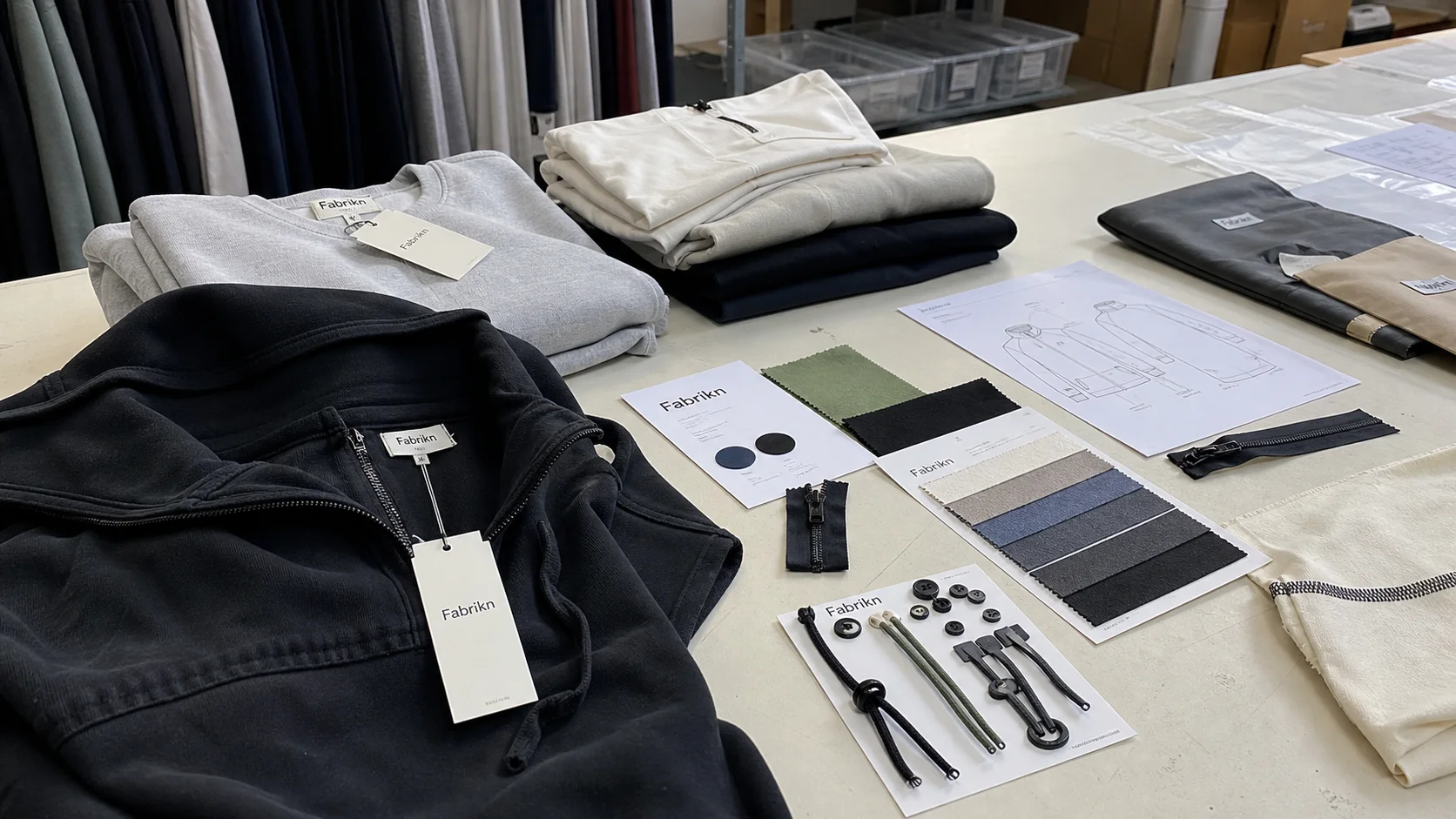
Eco Friendly Clothing Packaging China Supplier 2025 compared by sample evidence, fabric or trim specs, MOQ, AQL terms, cost lines, delivery timing, and...
Fast answer: Eco Friendly Clothing Packaging China Supplier 2025: Material, Print, MOQ, and QC Terms should be judged by production evidence, not by a generic sourcing promise. The buyer needs sample proof, cost breakdowns, QC checkpoints, and delivery buffers in writing.
Ask for recent sample photos, measurement tolerances, fabric or print test assumptions, decoration test notes, packing examples, and a named inspection checkpoint. These details show whether the team can repeat an approved sample at bulk volume.
Separate garment cost, decoration, labels, packaging, sampling, testing, freight, and rush charges. Clear cost lines make it easier to reduce colorways, adjust size depth, or reserve more time for sampling.
I’ve watched a perfectly polished eco friendly clothing packaging china supplier quote crumble the moment a cutter, a moisture test, and a trash audit entered the room. In Guangzhou’s Baiyun district, where a Komori Lithrone 640 prepress feeds a Bobst folder-gluer and a hot-melt adhesive pot on a two-shift line, the sample set looked sharp on paper at $0.18 per mailer; and the real landed cost climbed past $0.31 once rework, extra cartons, and a 7% damage rate on humid coastal shipping lanes showed up. Cheap is easy. Shipping is where the truth comes out.
Across more than 200 factory visits in eight countries, the same pattern kept surfacing in Guangdong, Dongguan, Ningbo, and inland hubs three to four hours from port access, including secondary suppliers in Dhaka, Ho Chi Minh City, and Istanbul. And suppliers promised 30% to 100% recycled content, yet finished output often landed closer to 12% to 40% after mill certificates, resin lot records, and trim waste checks. MOQ 500 sounded friendly until a brand needed three colors, two box sizes, and one extra insert; and suddenly the real minimum was 2,000 units. Paper, plastic, and compostables all fail in different ways. The claim sheet rarely says which way. And I have seen factories where the “recycled content” was mostly dust (yes, that means I ask to see the scraps too), so the GRS certificates felt like party favors.
Luxury labels usually overspecify. They ask for 450 GSM rigid boxes, matte lamination, magnetic closures, and foil logos that make recycling harder and raise cost by 18% to 35%. And mass-market brands often swing the other way: thin mailers, no compression testing, then 4% to 9% more returns because corners split or tissue soaks up moisture. I’ve seen a kraft mailer beat a compostable film simply by surviving a 14-day monsoon lane without swelling. But in my experience, nothing proves a concept like seeing a mailer stack through a monsoon lane once; the other option looked pretty on a board but disintegrated before customs.
Here’s the part that gets missed: a greener material can create more waste if die-cutting is sloppy, print registration slips, or the pack travels 1,200 km in a format that needs a secondary shipper. In a Zhejiang factory, mushroom fiber inserts were rejected because the tool change on the Bobst 106 die cutter produced 11% scrap, wiping out the material’s carbon advantage. Packaging is not decoration. It’s margin control, brand signal, and compliance proof. And for broader packaging planning, I often point brands to clothing packaging solutions for apparel brands that connect format choice to shipping reality.
I start with traceability, not brochures. Because a supplier who can't tell you where the adhesive comes from is hiding more than just trade secrets. A real audit checks where fiber came from, which ink system was used, what adhesive chemistry sits in the seam, how much electricity the line consumes per 1,000 units, and how scrap gets sorted. In a solid factory—often the ones in Guangzhou that run two Komori presses and a Heidelberg Speedmaster for UV coatings—the answers come back in ten minutes. But in a weak one, staff rummage through WeChat photos and old spreadsheets for half an hour and still cannot tell you which pallet came from which mill. That’s your warning sign.
FSC helps when the paper source is credible, but it does not guarantee low waste or strong labor controls. ISO 14001 tells me a factory has an environmental management system; still, I ask how much trim waste the line generates per run. GRS is useful for recycled material claims, though I verify chain-of-custody records and input-output ratios because recycled content gets overstated. GOTS belongs on textile-based packaging like cotton wraps, OEKO-TEX Standard 100 covers inks and adhesives, and I make sure the WRAP and BSCI reports match the floor’s overtime sheets. Compostability labels are narrow too. A compostable film may pass in a lab, yet a consumer in Milan or Los Angeles may have nowhere to dispose of it properly.
According to Textile Exchange, material claims need traceable inputs and clear terminology. And on the floor, I look at machine counts, shift patterns, defect rates, and QC checkpoints for carton compression, seal strength, and print alignment. A factory with six box-making machines running two shifts sounds far more believable than one claiming 8,000 units a day with one aging line and one subcontractor.
Red flags show up fast: inconsistent batch color, mixed waste streams, vague recycled-content claims, and too much reliance on subcontractors for die-cutting or lamination. I once visited a Ningbo plant that quoted 95% line efficiency, but the scrap bins told a different story: one for clean paper, one for adhesive-backed rejects, one for printed waste, all full before noon. The sample sheet looked polished. The floor did not. And it drives me crazy when the story only matches the polished sample (like hearing a pep talk before a boxing match).
So I use a practical scorecard. I rank an eco friendly clothing packaging china supplier on five points: material traceability, production capacity, test results, sustainability documentation, and quote transparency. Score each from one to five. Anything below 18 out of 25 needs caution. Anything below 15 gets a pass from me. Last year I worked with a brand that used this method and cut packaging defects from 6.2% to 1.8% in two production cycles. It honestly does work better because brands actually start demanding real QC data instead of pretty slides.
Paper still does most of the heavy lifting. Recycled paper mailers, kraft boxes, and corrugated shippers win on print quality, shelf appeal, and recycling access in most markets. And a 200-gram kraft mailer usually ships lighter than a laminated carton and can shave $0.02 to $0.05 per parcel on freight, depending on route and carton count. Recycled content of 30% to 100% is common, but performance still depends on fiber length and coating choices. In my experience, corrugated with moisture-resistant sizing applied on a BOBST VISION machine or a mono-material poly mailer is the safest bet when the route is humid and the brand wants a clean story.
Recycled plastic has a place too. Mono-material poly mailers with 50% to 100% PCR content can work for knitwear, basics, and low-friction e-commerce orders. They resist moisture better than paper on humid routes, especially between South China and Southeast Asia. PLA, by contrast, looks elegant in a pitch deck and far less convincing in shipping lanes. It needs industrial composting in many cases, and that infrastructure is limited. If the destination market lacks it, the material choice becomes a branding exercise rather than a disposal solution.
But mushroom fiber, cotton-based wraps, and textile pouches suit premium gifting, accessories, and limited runs, yet they carry higher unit costs, usually two to four times more than paper. They also raise shipping weight and can complicate print consistency. For a luxury shirt line using 180 GSM tissue and a rigid box, that may be acceptable. For a mass DTC program shipping 20,000 units a month, it usually is not. I’d rather see a strong kraft box with water-based ink than an overdesigned compostable pack that falls apart before it reaches the customer. And the pack actually arrives in one piece.
Climate matters. On humid coastal routes, I favor corrugated with moisture-resistant sizing and pay attention to how the panels stack so the glue lines stay tight. But on dry inland lanes, a lighter poly mailer or a kraft envelope keeps freight down and still looks sharp. Do a quick route test and you’ll skip the prettiest material that crumbles before it ships.
A strong brief makes the supplier's job narrower and the quote more reliable. For eco friendly clothing packaging china supplier 2025, include the target customer, sales channel, expected order quantity, size range, decoration needs, packaging requirements, and delivery market. Then call out the details most likely to affect the result, especially material grade, print tolerance, and barcode size.
The brief should also explain what cannot change. Some brands care most about hand feel, some about price, some about launch timing, and some about retail compliance. When those priorities are not written down, suppliers tend to optimize for whatever is easiest to quote. Clear priorities help the factory make better tradeoffs before the first sample is cut or printed.
Ask the supplier to respond with assumptions, not just a price. A useful reply states MOQ, sample route, production capacity, inspection plan, packing method, and freight handoff. If the answer is vague, the project may still work, but it needs a tighter pre-production stage before money and calendar pressure build up.
The best time to catch problems is before the pre-production sample is approved. Check measurements, color, placement, material behavior, shrinkage, construction, labels, and packaging in the same review instead of approving each item in isolation. Many bulk issues are not caused by one dramatic mistake; they come from several small unchecked assumptions.
For eco friendly clothing packaging china supplier 2025, pay special attention to folding method, pack-out sequence, and retail compliance. These details often look minor in an email but become expensive once cutting, printing, sewing, packing, or shipping begins. A simple checklist with owner, due date, and approval status keeps the brand team and factory aligned.
Bulk production should not start until the supplier can explain how the approved sample becomes a repeatable production standard. That means reference sample storage, line instructions, inline checks, final inspection, and defect handling. A factory that can describe this process clearly is usually safer than one that only promises speed.
Price differences are useful only when the quotes cover the same work. Compare sample cost, material source, trims, decoration, packaging, testing, inspection, and freight assumptions. A low unit price can become expensive if it excludes items the brand needs before launch.
Timeline promises deserve the same scrutiny. Ask what happens if the first sample needs revision, whether materials are in stock, when the production slot is reserved, and how export packing is handled. The most reliable supplier is often the one that gives a realistic calendar instead of the fastest optimistic answer.
Before making the final decision, write down the specification, approval owner, delivery expectation, and the one or two risks that would cause the most trouble if missed. For eco friendly clothing packaging china supplier 2025, this usually means checking material grade, print tolerance, barcode size, and the support process after the order is placed.
This last review does not need to be complicated. It simply makes the decision easier to repeat, easier to explain, and easier to verify when the finished product or jewelry arrives.
One useful way to pressure-test the decision is to ask what would happen if the order had to be repeated in six months. The answer should still be clear: the same material grade, the same print tolerance, the same acceptance standard, and the same communication path. If a second order would depend on memory or guesswork, the first order is not documented well enough yet.
Another useful check is to separate preference from requirement. Preference is the look, wording, or finish the brand likes. Requirement is the measurement, tolerance, certificate, material, or delivery condition that cannot fail. Good buying decisions keep both visible, so the final choice is not pushed around by the last email, the cheapest quote, or the prettiest sample photo.
Finally, ask who owns each approval. A project with one accountable owner for sample review, one owner for final content or artwork, and one owner for delivery sign-off usually moves faster than a project where every decision is shared loosely across a team. Clear ownership reduces delays and makes the finished result easier to judge.