
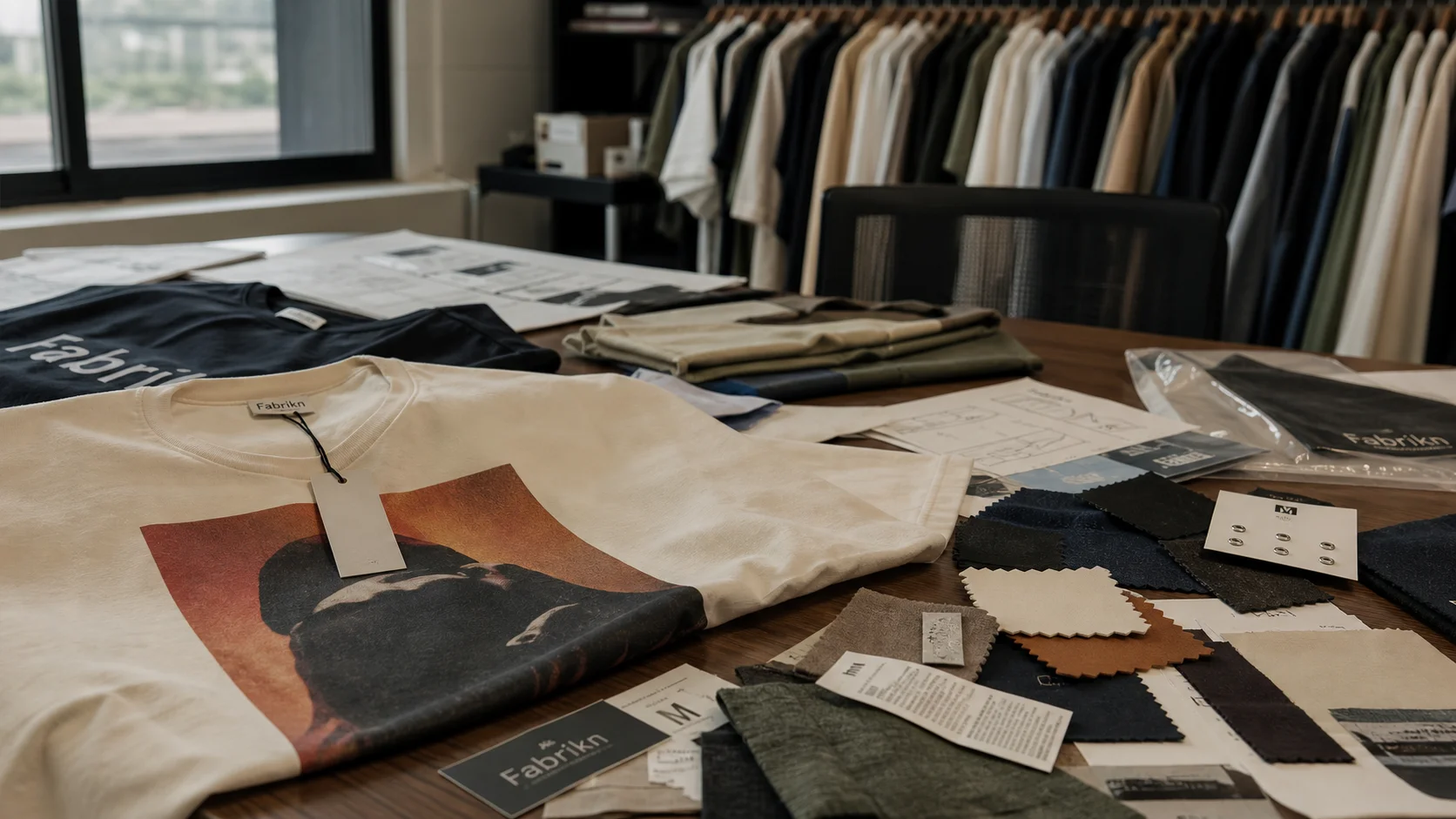
Foil-Stamped Clothing Hang Tags with checks for samples, fit, MOQ, QC evidence, pricing terms, and delivery risk.
Fast answer: Foil-Stamped Clothing Hang Tags: Paper Stock, Foil, Attachment, and MOQ should be judged by production evidence, not by a generic sourcing promise. The buyer needs sample proof, cost breakdowns, QC checkpoints, and delivery buffers in writing.
Ask for recent sample photos, measurement tolerances, fabric or print test assumptions, decoration test notes, packing examples, and a named inspection checkpoint. These details show whether the team can repeat an approved sample at bulk volume.
Separate garment cost, decoration, labels, packaging, sampling, testing, freight, and rush charges. When every cost line is visible, it becomes easier to reduce colorways, adjust size depth, or reserve more time for sampling.
A tiny tag can change the way a garment is priced before anyone touches the fabric. I have watched that happen on a sales floor more than once, and a foil stamped clothing hang tags supplier china buyers choose often decides whether the piece reads as premium or merely expensive. In Guangzhou’s Panyu district and the surrounding Foshan belt, I saw brands use hang tags as a quiet profit tool: better paper stock, cleaner foil, sharper cuts, and a mass-market tee suddenly looked deliberate. A boutique capsule with 500 MOQ might demand $2.50-4.00 per unit when the tag is paired with a 420 GSM textured board and a custom laminated ribbon, while a 40,000-piece outdoor program can get the per-tag cost down to $0.04 through reused dies and repeat foil plates.
China still dominates because the supply chain is compressed. Paper mills, die makers, foil converters, and finishing lines sit within a few hours of each other in the main export hubs like Guangzhou and Chengdu. According to U.S. Commercial Service trade guidance, lead-time pressure and manufacturing density remain decisive factors for export buyers, and that tracks with what I saw on the ground. A premium tag can cost $0.04-$0.18 per piece at volume, while a boutique run of 500 pieces may land at $0.22-$0.60 because setup, plates, and packing eat the margin first. Once sea freight to Los Angeles or Rotterdam is added, the transit alone takes 18-22 business days, which is why coastal factories in Guangzhou and Shenzhen will even pre-book containers to keep the clock from ticking.
That spread matters across regions and price points. In Dhaka or Ho Chi Minh City, I have seen excellent garment stitching, but tag finishing often gets outsourced to a local converter, which adds 7-12 days and weakens control. Istanbul-based converters can hit European lead times, yet the cost of foil and matched dies sits roughly 10%-15% higher than a comparable Guangzhou run because of smaller rolls and fewer multi-shift crews. China sits in the middle: enough tooling depth for luxury foil, enough paper choice for private label, and enough scale to keep the per-tag cost from swallowing the margin.
Here’s what most people miss: some mid-tier Chinese plants produce cleaner foil registration than higher-priced boutique printers. That sounds backward, but it isn’t. Repetition does it. A factory running 200,000 tags a month often calibrates faster than a studio charging three times as much for artisanal attention. I have seen 0.3 mm alignment on a mid-volume line and 1.0 mm drift in a prettier showroom sample. The tag is small, but weak board, sloppy die cutting, or poor foil adhesion can make an otherwise strong garment look undercooked.
A serious factory does much more than print. The chain starts with substrate selection, then moves through file prep, plate or die production, foil stamping, hole punching, printing, finishing, packing, and carton labeling. The best lines keep these steps under one roof or within a short logistics loop, which cuts handling damage and saves 3-5 days on a typical order. I have seen suppliers lose an entire week because the foil work went to a subcontractor 40 kilometers away. Guangzhou plants typically use Komori or Heidelberg Speedmaster presses paired with Bobst hot-stamping towers, while newer lines in Zhejiang bring in digital Zund cutters for prototyping and automatic ultrasonic string trimmers for the braided cords.
Material choice changes both feel and pricing. Coated paper is the cheapest, usually $0.03-$0.08 per tag at scale. Kraft paper sits close to that, but looks more earthy and works well for denim or outdoor labels. Textured board and recycled stock can add $0.01-$0.05 per piece. Black card and specialty grey board are used for luxury capsules, especially when paired with gold foil or blind embossing. For clothing packaging solutions, I often see brands combine a tag with tissue, stickers, and a fold card so the whole package feels intentional. A 350 GSM cotton-rag board with embedded mica particles feels stiff enough to survive a shipping line yet still accepts fine detail in a cold foil pass.
Foil choices matter more than most buyers expect. Metallic gold and silver remain the standard, but holographic foils, matte foils, and pigment foils can shift the tone from classic to experimental. A simple single-sided foil tag is one cost tier. Add embossing, UV varnish, or serial numbering, and you can push the unit cost up 20%-45%. Variable data, including SKU codes or QR numbers, adds another layer of setup control. According to ISO standards and quality guidance, process consistency and documented tolerances matter when repeatability affects brand-facing components like labels and tags.
I ask a foil stamped clothing hang tags supplier china factory five things every time: is foil stamping in-house or outsourced, what is the MOQ, how many proof rounds are included, how do they control color from one lot to the next, and what happens if the first 1,000 pieces fail? The failure points are predictable. Foil flaking, warped tags, off-center holes, and weak string attachment show up fast. A tag can look fine in a stack and fail once it is tied to a 420 GSM coat or a 180 GSM jersey tee.
Unit price is only the headline. I compare quotes by setup, material, finish, and risk. A factory quoting $0.05 per tag on 5,000 pieces may be more expensive than one quoting $0.08 if the first supplier adds $180 in plate fees, $120 in die fees, and a $95 carton charge that never appeared in the email. Inland China plants often price 8%-15% lower than coastal hubs, but coastal factories can cut freight and turnaround by 2-4 days. That matters if your launch date is fixed and the garments are already in a warehouse.
The real cost drivers are paper weight, foil coverage, embossing depth, Pantone printing, die complexity, finishing, and packing. A 350 GSM tag with full-front foil and matte lamination costs more than a 300 GSM tag with a small logo stamp, even if the artwork is similar. Luxury tags can also require tighter color control, which means more rejects. For private label clothing services, the difference between a neat tag and a sloppy one can affect return rates, especially if the brand sells at $28-$60 retail and the packaging carries part of the perceived value.
Low-MOQ orders distort the first quote. At 500 pieces, setup might represent 30%-50% of the total. At 10,000 pieces, the same setup becomes almost invisible. I have seen brands order 800 pieces, approve a rushed proof, then pay for a second run because the foil shade looked too brassy next to the garment trim. That kind of mistake can add $250-$600 once air freight and rework are included. If the tag is tied to cut and sew manufacturing, the packaging delay can also hold the whole PO.
Timeline matters as much as cost. A standard sequence looks like this: 1-2 days for artwork confirmation, 2-4 days for sample making, 3-5 days for die and plate prep, 4-8 days for production, 1-2 days for drying or curing, and 5-12 days for freight depending on mode. Sea freight is cheaper, often by 60%-80% versus air, but it adds 10-20 days. For a brand in a 6-week launch window, that gap is brutal. A 2,000-piece order that ships from Guangzhou via Ningbo to the Port of Long Beach takes 18-22 business days on average, so coordinating packing and the garment PO is vital.
Compare luxury and standard tags separately. A standard tag for a 2,000-piece run might land around $0.06-$0.12. A luxury hang tag with embossing and foil can reach $0.20-$0.55. The lower number is not always the better deal, because an inferior board may curl after 48 hours in humid transit. That is how a $300 savings turns into a warehouse headache and a relabeling charge.
I never approve a supplier without objective checks. Ask for vector artwork, bleed of 2-3 mm, separated foil layers, and font sizes no smaller than 5.5 pt for body copy to ensure legibility. Check that the registration pin from the Heidelberg press locks into the die every time, and confirm run-to-run torque values on the Bobst hot foil head. The factory should run foil adhesion tests with a 3M tape pull and verify edge finish with a Mitutoyo gauge to confirm 0.3 mm tolerance. The stringing line should use ultrasonic seaming plus a heat-sealed lock or lockstitch knot to guarantee nothing loosens during transport.
Insist on certifications. Global brands pushing sustainability want to see GOTS for organic cotton papers, OEKO-TEX Standard 100 for inks and adhesives, WRAP or BSCI for ethical labor, and GRS for recycled content. Good factories maintain the documents on site and can show you stamping schedules, machine maintenance logs, and color-matching trials to prove the process is repeatable. That is how a run of 500 luxury tags maintains the same foil density as a 20,000-piece basic order.
Sampling should go through at least three stages: digital proof, physical print, and pre-production. The final check should ride on the same line as the production run, with an operator logging time, humidity, and die temperature. When one factory in Guangzhou sent me a batch with a 0.8 mm lift on the foil edge, their operator logged the humidity spike, recalibrated the plate, and reran the job in 4 hours. That is the kind of responsive quality control that keeps a hang tag from undermining a capsule drop.
Large brands tend to work with Tier 1 suppliers in Guangzhou and Shenzhen that hold WRAP, BSCI, and ISO 9001, because the paperwork simplifies audits. Mid-sized brands, the ones doing 5,000-15,000 units a season, often source from Qingdao or Wuxi for slightly lower labor rates but insist on OEKO-TEX Standard 100 or GRS materials, especially for kidswear or intimates. Indie labels with 500-2,000 tags may look to smaller lines near Ho Chi Minh City or Istanbul to keep tooling fees peculiar and still get creative finishes—provided the factory can deliver a matched foil swatch on the first round.
When budget dictates, I lean on hybrid sourcing. The tag body can be manufactured in Guangzhou, where the Heidelberg/Johnson die lines live, while finishing like foil, emboss, and serial numbering run in the same facility. That combination keeps the per-tag cost stable; a typical balanced order lands between $0.08 and $0.16 per luxury tag at 2,000 units, with a $275 amortized die cost and a $1.25 per tag premium for foil lamination. If you push the MOQ to 10,000, the die cost falls to $0.04 per tag, which allows you to swap in a higher GSM board or color-matched string.
Smaller brands should also think about geography. Pulling tags from Guangzhou keeps air and sea freight predictable, while sourcing from Dhaka or Ho Chi Minh City may introduce a 4-6 day buffer for customs clearance because the hang tag often crosses borders post-production. Istanbul offers quick access to EMEA markets, but few factories there have the machine depth to match a full cold foil stack. Match your sourcing partner to the complexity of the finish you need and the certifications your customers expect.
The biggest mistake is evaluating only the per-tag price. Another is assuming the MOQ is flexible; some factories quote $0.05 per tag at 5,000 MOQ but charge $0.25 per tag with the same tooling at 500 MOQ. Missing certification checks is a close third—buyers find out after the fact that the plant lacks GOTS or OEKO-TEX compliance, which derails a sustainable capsule. Finally, ignoring color control or not verifying foil build-up leads to inconsistent rolls and a need for a second pass, which can add $350-$700 for re-foil, die, and labor.
Many buyers overlook the logistics overlay. When tags ship from Guangzhou to Los Angeles, the factory will need 5-7 days to produce and 18-22 business days for sea transit, so you are looking at a minimum of a month from approval to warehouse receipt. Add one more week for customs, carton unloading, and QC, and you are at 7 weeks. Not factoring in these steps usually results in shaving off sampling time, which increases risk.
These steps ensure the tag arrives as beautifully as the clothing it accompanies, and that you don’t end up paying for expedited freight because the QC inspection flagged a loose knot.
Most Chinese suppliers ask for 2,000-5,000 pieces to cover dies, foil, and setup. However, if you are willing to pay $2.50-4.00 per unit at 500 MOQ with a balanced paper/foil stack, you can still access premium finishes. That fee amortizes tooling and labor, and some factories even offer a credit toward the next order when you hit 10,000 units.
Allow 18-22 business days for sea freight from Guangzhou to the U.S. West Coast, plus 7-10 days for in-country handling. Fast-track air shipment takes 5-8 business days but costs roughly 3-4x sea freight. Build your timeline around these windows before locking in your garment production and launch.
Solid suppliers maintain documentation for GOTS, OEKO-TEX Standard 100, WRAP, BSCI, and GRS, especially when working with sustainable brands. They keep certificates onsite and can produce audit trails showing the batch number of the recycled board and the ink’s non-toxic composition. This level of transparency protects both your brand and the retailer who will scan the tag.
Yes. A modern plant will run foil stamping, UV varnish, embossing, and stringing on the same line or in adjacent modules that communicate through a factory execution system. Look for automatic ultrasonic knotters or heat-sealing heads paired with CNC eyelet machines to make sure every cord is consistent, even when you switch from cotton cord to nylon rope for outerwear.
Depending on your market, certifications like WRAP or BSCI prove ethical labor practices; GOTS, OEKO-TEX Standard 100, and GRS back your sustainability claims; and ISO 9001 or ISO 14001 demonstrates consistent quality and environmental management. Request copies of the certificates and confirm their expiration dates before signing the contract.