
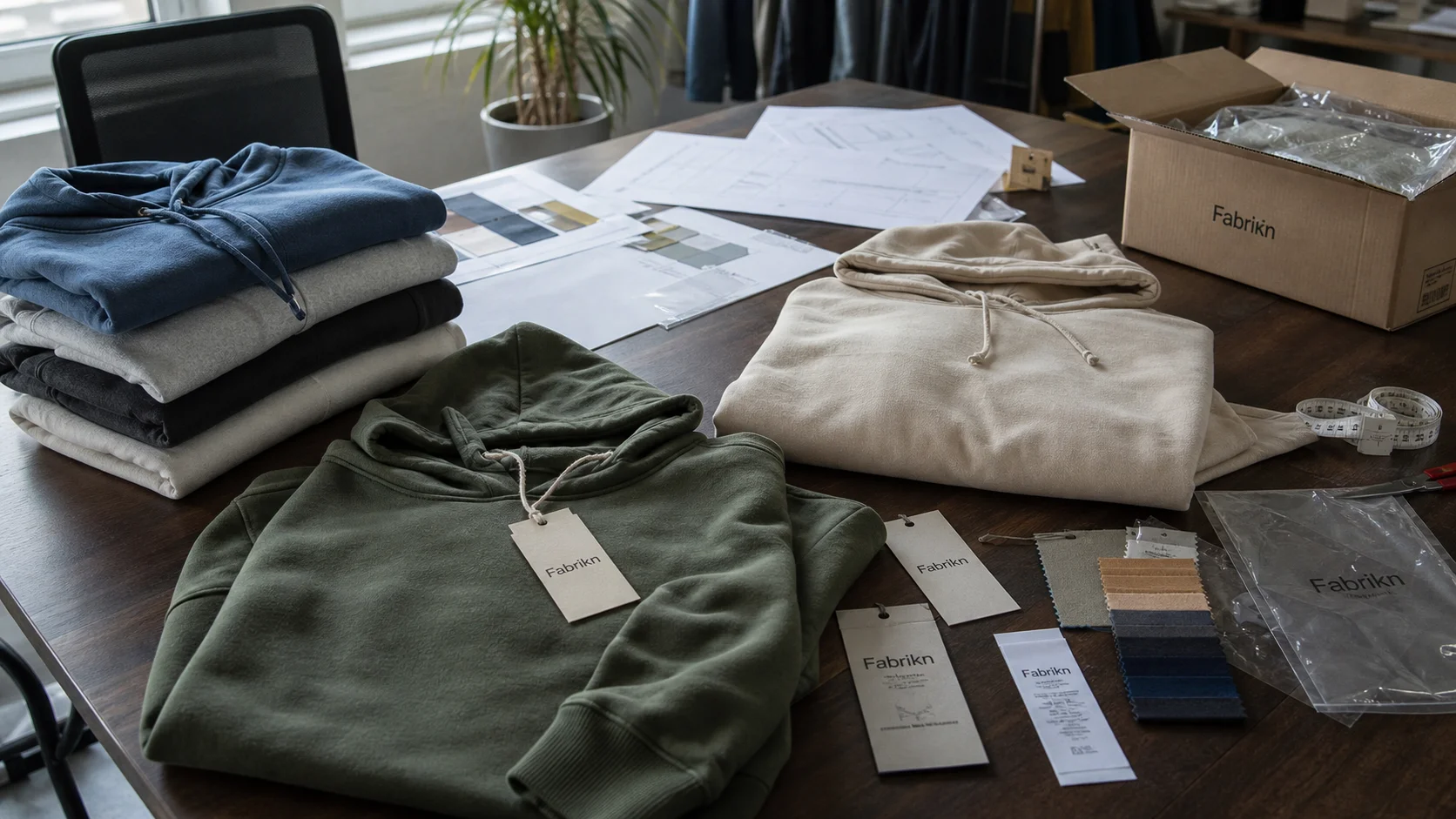
Foil Stamped Hang Tags for Premium Apparel Brands compared by sample evidence, fabric or trim specs, MOQ, AQL terms, cost lines, delivery timing, and...
Fast answer: Foil Stamped Hang Tags for Premium Apparel Brands: Material, Print, MOQ, and QC Terms should be judged by production evidence, not by a generic sourcing promise. The buyer needs sample proof, cost breakdowns, QC checkpoints, and delivery buffers in writing.
Ask for recent sample photos, measurement tolerances, fabric or print test assumptions, decoration test notes, packing examples, and a named inspection checkpoint. These details show whether the team can repeat an approved sample at bulk volume.
Separate garment cost, decoration, labels, packaging, sampling, testing, freight, and rush charges. Clear cost lines make it easier to reduce colorways, adjust size depth, or reserve more time for sampling.
I’ve watched a buyer lift a tag, drag a thumb across the foil, and decide in under three seconds whether the garment belongs on a premium rack. After more than 200 factory visits across eight countries, the same mistake kept popping up—brands obsessed over stitch density, then treated foil stamped hang tags for premium apparel brands like an afterthought. That’s backwards. And a foil stamped hang tag is the first physical proof of price.
Luxury retail is tactile. Metallic foil grabs light. And thick paper pushes back against the bend test. A clean edge signals control, and control reads as value. Shoppers do not sit there calculating quality; they infer it. In premium apparel, that inference can support a $128 shirt as easily as a $28 accessory, especially in gifting, influencer mailers, and e-commerce unboxing. Trade data from World Trade Organization reports show apparel margins getting squeezed worldwide, which leaves packaging as one of the few controllable places to signal value without changing the garment spec.
Designer labels I’ve seen use 600 gsm board with blind embossing and gold foil to justify a $450 price point. Contemporary brands at $140 often get the same lift from a cleaner 400 gsm tag, one foil hit, and a neat cotton string. DTC premium brands, especially the ones selling French terry 320 GSM hoodies or enzyme-washed tees, do better when the tag feels like a gift card instead of a receipt. And private label gets stranger. A $38 knit can read closer to $68 if the tag feels expensive, while a high-end garment with almost no branding can look unfinished.
Right there at the point of first touch, that gap matters most.
When the tag feels considered, the whole product reads as more intentional. Brands that pair good packaging with disciplined content often see stronger add-to-cart rates and more social sharing from unboxing videos. One category manager estimated a 6% lift in conversion on a seasonal drop after upgrading the hang tag system. And packaging was the only change.
In sourcing rounds spanning Guangzhou to Dhaka, Ho Chi Minh City to Istanbul, I’ve watched buyers greet the same stack of tags with very different expectations depending on whether the work was done in a high-throughput hot foil house or a boutique artisan cut from a convertible vacuum die in Istanbul’s leather district. And these locations deliver not just price, but access to specific adhesives, hand-creased veneers, and ribbon threading workflows that change the narrative before the garment is even picked up.
A proper tag has six parts: substrate, foil, die-cut shape, string or ribbon, eyelet, and protective finish. Ink stays off unless it actually helps. Most premium apparel tags do their job between 350 gsm and 600 gsm paper, with 400 gsm landing at the sweet spot for stiffness versus cost. Drop below 300 gsm and the tag can curl. Go too thick and the fold line cracks unless the supplier scores it well.
Hot foil stamping presses metalized film with heat and pressure, and it usually gives sharper detail, especially on logos with fine serifs and thin borders. Cold foil transfer applies adhesive and then foil. It’s faster on some runs, better for long print lines, and less forgiving when the artwork gets tiny. A factory in Vietnam showed me a seven-day hot foil run and a four-day cold foil run; the hot foil looked cleaner, while the cold process made sense only when the design had broader coverage and a tight schedule. Both runs relied on Heidelberg Stahlfolder presses for scoring and Komori Lithrone UV offset presses for the base ink, and a vacuum-assisted die-cutter from Bobst that ensures corners stay crisp.
Texture changes the whole read. And soft-touch lamination with silver foil creates a dark, velvety contrast that feels expensive in hand. Uncoated cotton stock with blind embossing reads more restrained, more editorial. I have also seen emboss plus spot UV used well on premium private label clothing, especially when the brand wants a quieter signal than full metallic shine. Best results come from matching the finish to the garment category, not the mood board. On a recent drop, tags for an Italian wool blend coat used matte carbon board sourced from a mill in Milan, while athletic sets shipped from Ho Chi Minh City ran a 5-micron water-based varnish over metallic foil to prevent peeling in humid warehouses.
Factories run into three recurring issues: tight registration, foil breakage on textured stock, and waste from overcomplicated artwork. If the foil sits more than 0.5 mm off the print mark, the eye catches it. Rough recycled papers make breakage worse. A design with three foil colors, two emboss levels, and a die shape with sharp internal corners can push waste rates from 3% to 12%. And on a 20,000-piece order, that matters.
Same discipline used in cut and sew manufacturing should apply here: fewer variables, better consistency, less panic on the press floor.
Pricing shifts fast with volume. For 1,000 tags, the quotes I’ve seen fall between $0.28 and $0.95 per piece depending on paper, foil coverage, and whether tooling is included. Push to 5,000 units and that range often tightens to $0.12 to $0.38. Hit 20,000 units and well-managed programs can fall to $0.06 to $0.18 per tag, but the real cost hides in setup: foil plates, die-cut tooling, samples, shipping. MOQ also matters, because a factory or supplier with a higher minimum order quantity can change the economics of a custom program quickly.
But for truly bespoke projects, such as those combining GOTS-certified organic cotton cords or OEKO-TEX Standard 100-approved laminates, expect quotes in a higher band—$2.50-4.00 per unit at 500 MOQ with sourced cotton twine, die setup, and double-sided foil coverage. That still beats a rushed, lower-quality tag that loses foil registration and requires rework. Lead times vary by location: Guangzhou and Ho Chi Minh City typically run 18-22 business days for sample-to-ship, while Istanbul and Dhaka may need 22-28 days because of customs batches and slower tooling procurement.
China usually offers the lowest unit price on larger runs, especially above 10,000 pieces, because press capacity and paper sourcing are efficient. And India can be highly competitive on labor and some paper stocks, though sample cycles stretch to five to 10 days when artwork revisions pile up. Vietnam is strong for mid-size orders and shorter lead times, often 10 to 20 days for repeat work. Europe tends to price higher, but freight, customs timing, and lower reject rates can narrow the gap on small runs under 3,000 units. For trade and customs context, see U.S. International Trade Administration guidance on global sourcing and trade.
Budgets get distorted in the handoff between quote and purchase order. Buyers price the tag only, then forget the foil plate, the custom die, stringing, kitting, overrun allowance, storage, and the third proof after a color correction. A gold foil plate may add $60 to $180. A custom die can add $80 to $250. Pantone matching sometimes adds $25 to $75. Stringing labor can be another $0.015 to $0.05 per tag. If the factory charges for carton storage, add that too. And on a 5,000-piece order, these “small” lines can add 18% to 32%.
A cheaper quote often turns expensive after reproofs, freight delays, and reject rates are counted. I have watched a partner tack on two extra weeks and a rush fee once the foil plate had to be remade because registration shifted.
A strong brief makes the supplier's job narrower and the quote more reliable. For foil stamped hang tags for premium apparel brands, include the target customer, sales channel, expected order quantity, size range, decoration needs, packaging requirements, and delivery market. Then call out the details most likely to affect the result, especially material grade, print tolerance, and barcode size.
The brief should also explain what cannot change. Some brands care most about hand feel, some about price, some about launch timing, and some about retail compliance. When those priorities are not written down, suppliers tend to optimize for whatever is easiest to quote. Clear priorities help the factory make better tradeoffs before the first sample is cut or printed.
Ask the supplier to respond with assumptions, not just a price. A useful reply states MOQ, sample route, production capacity, inspection plan, packing method, and freight handoff. If the answer is vague, the project may still work, but it needs a tighter pre-production stage before money and calendar pressure build up.
The best time to catch problems is before the pre-production sample is approved. Check measurements, color, placement, material behavior, shrinkage, construction, labels, and packaging in the same review instead of approving each item in isolation. Many bulk issues are not caused by one dramatic mistake; they come from several small unchecked assumptions.
For foil stamped hang tags for premium apparel brands, pay special attention to folding method, pack-out sequence, and retail compliance. These details often look minor in an email but become expensive once cutting, printing, sewing, packing, or shipping begins. A simple checklist with owner, due date, and approval status keeps the brand team and factory aligned.
Bulk production should not start until the supplier can explain how the approved sample becomes a repeatable production standard. That means reference sample storage, line instructions, inline checks, final inspection, and defect handling. A factory that can describe this process clearly is usually safer than one that only promises speed.
Price differences are useful only when the quotes cover the same work. Compare sample cost, material source, trims, decoration, packaging, testing, inspection, and freight assumptions. A low unit price can become expensive if it excludes items the brand needs before launch.
Timeline promises deserve the same scrutiny. Ask what happens if the first sample needs revision, whether materials are in stock, when the production slot is reserved, and how export packing is handled. The most reliable supplier is often the one that gives a realistic calendar instead of the fastest optimistic answer.
Before making the final decision, write down the specification, approval owner, delivery expectation, and the one or two risks that would cause the most trouble if missed. For foil stamped hang tags for premium apparel brands, this usually means checking material grade, print tolerance, barcode size, and the support process after the order is placed.
This last review does not need to be complicated. It simply makes the decision easier to repeat, easier to explain, and easier to verify when the finished product or jewelry arrives.
One useful way to pressure-test the decision is to ask what would happen if the order had to be repeated in six months. The answer should still be clear: the same material grade, the same print tolerance, the same acceptance standard, and the same communication path. If a second order would depend on memory or guesswork, the first order is not documented well enough yet.
Another useful check is to separate preference from requirement. Preference is the look, wording, or finish the brand likes. Requirement is the measurement, tolerance, certificate, material, or delivery condition that cannot fail. Good buying decisions keep both visible, so the final choice is not pushed around by the last email, the cheapest quote, or the prettiest sample photo.
Finally, ask who owns each approval. A project with one accountable owner for sample review, one owner for final content or artwork, and one owner for delivery sign-off usually moves faster than a project where every decision is shared loosely across a team. Clear ownership reduces delays and makes the finished result easier to judge.