
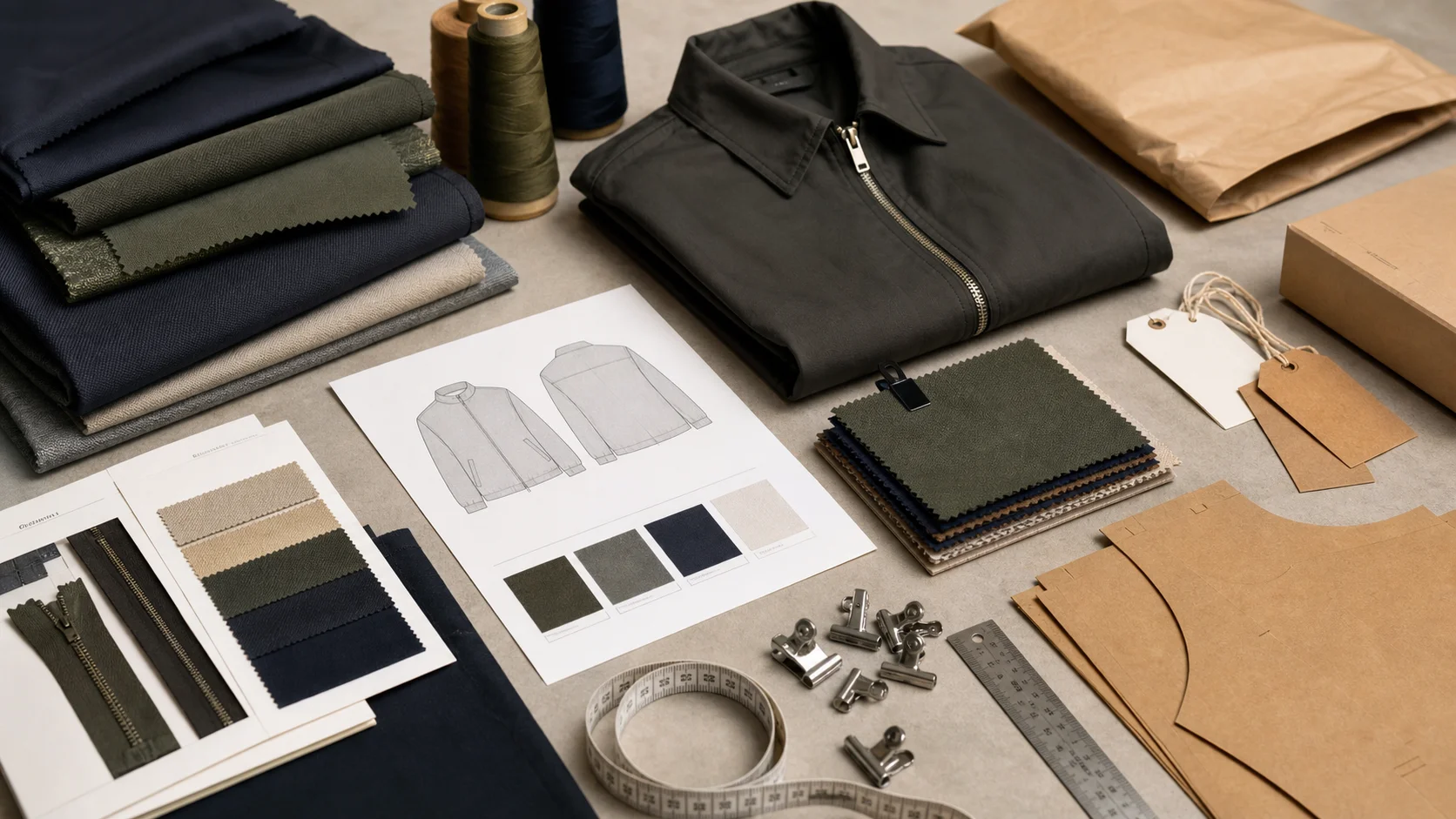
Foil Stamped Hang Tags for Premium Clothing with checks for samples, fit, MOQ, QC evidence, pricing terms, and delivery risk.
Fast answer: Foil Stamped Hang Tags for Premium Clothing: Design and Cost should be judged by production evidence, not by a generic sourcing promise. The buyer needs sample proof, cost breakdowns, QC checkpoints, and delivery buffers in writing.
Ask for recent sample photos, measurement tolerances, fabric or print test assumptions, decoration test notes, packing examples, and a named inspection checkpoint. These details show whether the team can repeat an approved sample at bulk volume.
Separate garment cost, decoration, labels, packaging, sampling, testing, freight, and rush charges. When every cost line is visible, it becomes easier to reduce colorways, adjust size depth, or reserve more time for sampling.
Buyers decide faster than most brands would like to admit. In London, Seoul, and Milan, I’ve watched a hand hover over a rail, stop at a tag, and settle the question in three seconds flat. That tiny pause is the whole game. Foil stamped hang tags for premium clothing still matter because they provide the first physical proof of value before anyone feels the fabric.
The numbers are blunt. In store tests I’ve reviewed, small packaging upgrades can move a product from bridge pricing into the premium bracket by 8% to 15%, even when the garment itself stays the same. A $28 T-shirt with a clean foil tag reads differently from the same shirt in plain offset print. At $68 to $120, the tag has to match the promise. Below that, the effect is weaker, though it still shows up when the brand story is tight.
Foil works because it throws back light in a way flat ink never will. Ink absorbs. Foil reflects. That flash signals care, and care signals margin. I’ve seen it across premium, mid-premium, and bridge labels. Premium buyers expect restraint. Mid-premium buyers want a visible upgrade. Bridge labels often push shine too far and end up louder, not richer.
Some of the most expensive-looking tags I’ve handled were made on 350 gsm paperboard with one foil color and a matte lamination. By contrast, overspecified 600 gsm stocks with heavy embossing looked stiff and less refined. In a factory in Guangdong, a converter put two samples side by side. The cheaper one—$0.11 per tag for 5,000 units—looked sharper than the $0.19 version because the design respected the material.
That’s the point. Foil stamping works best when design, substrate, and finishing are planned together, not added at the end like decoration. The tag should behave like part of the garment system, which is why brands serious about clothing packaging solutions usually treat it as a technical component, not a bonus. For brands sourcing in bulk, the right custom hang tags can lift perception without inflating production waste.
Paper choice decides whether foil looks crisp or muddy. On press, I’ve watched the same gold foil stamp cleanly on 300 gsm coated board and then fail on a fibrous stock with too much tooth. No romance there. Surface physics. Smoothness, coating chemistry, fiber direction, and thickness all shape how much pressure the die needs and how clean the foil releases.
For premium fashion, 300 gsm to 450 gsm is the range I see most often. Below 250 gsm, tags can feel flimsy once punched and strung. Above 500 gsm, you risk an overbuilt look unless the garment itself is structured, like outerwear or heavy knitwear. Coated stocks give bright, sharp foil. Uncoated papers create a softer edge, which often suits quiet luxury better than high-gloss retail drama.
Cotton paper has worked beautifully on capsule collections priced at $95 to $240, especially with blind emboss and one small foil mark. FSC-certified paperboard is a practical middle ground for labels producing 2,000 to 20,000 units. Textured stock can look expensive with less artwork because the material does part of the work. Black card with metallic foil still lands well, but only if the foil area stays restrained. Recycled kraft with silver or champagne foil can support sustainable stories, though the finish needs to stay minimal or it drifts into craft-store territory.
Regional differences matter. Several Asian suppliers I visited excel at dense, high-gloss foil on coated board, especially for 4-color printed backs and tight registration. Many European converters lean the other way: softer cotton stocks, muted foil, more negative space. Neither is better. Different price signals, different buyers. According to OEKO-TEX, material transparency and chemical compliance sit inside the wider sourcing conversation, especially for brands making environmental claims on tags and tickets.
Durability is where many tag specs fall apart. Foil can scuff at folded corners, crack along die-cut edges, and chip around punched holes if the stock is too rigid or the lamination too slick. Rounded corners reduce edge wear. Reinforced holes help on heavier garments. A tag that survives 8 weeks in a showroom does not always survive 8 months in stock rotation, which is why I always ask factories to show rub tests, not just pretty samples. That matters just as much for custom baby clothing manufacturing lines, where soft handling and safety constraints raise the bar even higher.
Less foil usually looks more premium. Full-surface shine can flatten hierarchy and make even a $180 sweater feel promotional. The tags that read most luxuriously tend to use 8% to 20% foil coverage, not 70% to 100%. That leaves room for the garment to speak. It also gives the eye somewhere to rest, which matters on a crowded rail where buyers are scanning 20 to 40 styles in a minute.
Hierarchy should be obvious at arm’s length. Brand name first. Product type second. Size and care information third. Sustainability claims and QR codes should sit lower in the stack, never competing with the logo. I’ve seen beautiful tags ruined by a giant recycled-content badge or a QR block that looks like a shipping label. If the brand sells at $48, the tag should not behave like a compliance sheet.
Foil color choice is not limited to gold and silver. Champagne foil gives warmth without shouting. Rose gold can work for women’s occasionwear at $110 to $260. Black foil is quiet and intelligent on white or stone stock. Holographic effects are risky unless the brand sits clearly in streetwear. Blind emboss can beat foil if the paper stock is thick enough and the logo has a confident shape.
Legibility testing should happen under retail lighting and on product photography sets. A tag that reads well at 500 lux in a showroom may disappear at 3000K warm light or glare in an e-commerce image. I always test three distances: 30 cm for in-hand inspection, 1.5 m for rack presence, and a camera preview from a phone at 45 degrees. If the logo loses definition in any of those views, the artwork needs adjustment.
Factory details can make or break the design. Very fine lines, hairline serifs, and tiny border rules may fail unless the artwork meets the supplier’s minimum detail standard, which differs by process and region. A cold foil line that looks perfect in Adobe Illustrator may break on press if the die pressure is too high or the foil release is inconsistent. For brands building private label clothing services, I tell them to simplify the system before they stylize it. A strong tag does not beg for attention. It earns it with clarity.
Pricing for foil stamped tags looks simple until the add-ons start stacking. Traditional foil stamping on 350 gsm board usually sits around $0.08 to $0.22 per tag at 5,000 units, depending on coverage, die size, and finish. Digital foil can run higher on small quantities, often $0.18 to $0.45 per tag for 500 to 1,000 pieces, but it avoids some plate and setup costs. Emboss-only tags may cost less in materials, yet a custom die still adds $40 to $150 upfront. Standard print finishes can land at $0.04 to $0.12, though they often deliver less perceived value for premium garments.
The real cost drivers are easy to spot once you’ve seen enough quotes. Setup fees. Die cost. Foil area coverage. Number of colors. Paper stock. Die-cut shape. Lamination. Spot varnish. Stringing. And the little costs that push a quote from reasonable to painful. A square tag is cheaper than a custom shape. One foil color is cheaper than two. Matte laminate is usually cheaper than soft-touch, but soft-touch can rescue a simple design by making it feel expensive in hand.
Quantity changes everything. At 500 pieces, a factory may quote $0.36 to $0.70 per unit because the setup is spread across a tiny run. At 10,000 pieces, that same tag can fall to $0.09 to $0.19. The cheapest quote is not always cheapest after finishing add-ons. I’ve reviewed orders where a low base price turned into the highest total once stringing, holes, carton inserts, and freight were added. That happens often with brands underordering the first season.
Regional economics also shift the equation. China typically offers lower tooling and strong finishing capacity. India can be highly competitive on labor-intensive manual assembly. Turkey often lands in the middle, with good access to Europe and respectable turnaround on medium runs. Eastern Europe may cost more per unit, yet freight and lead time can narrow the gap for brands shipping into the EU. Data from the WTO shows how trade flows and transport dependencies continue to shape landed cost decisions, even for small packaging components. For brands seeking a foil stamped hang tag manufacturer, comparing factory capability against landed cost is more useful than chasing the lowest line item.
I use a simple pricing framework. Compare unit cost at the same quantity. Confirm setup fees separately. Ask for freight on the same Incoterm. Add a 3% to 7% wastage allowance for press spoilage and transit damage. Then request a second quote for an alternate stock and finish. A brand that sells knit polos at $78 and jackets at $220 should not judge a tag only by unit price. It should judge the full effect on margin and shelf perception. If your product sits inside a broader cut and sew manufacturing program, the tag cost should match the garment complexity, not be guessed in isolation. For foil stamped hang tags for premium clothing ordered wholesale or in bulk, MOQ decisions should also be tied to seasonal sell-through, not just supplier quotes.
A realistic timeline starts at artwork, not at the factory gate. File prep usually takes 1 to 3 days if the brand has clean vector files and final copy. Proofing adds 1 to 2 days. Die-making can take 2 to 5 days, depending on the complexity of the shape and whether the finish is hot foil, cold foil, or emboss. Sampling often takes another 3 to 7 days, especially if the client wants multiple foil shades or paper options.
For a simple foil tag, I usually see 10 to 18 days from approval to shipment. Add embossing, custom shape cutting, laminated surfaces, or multi-layer construction, and that stretches to 18 to 28 days. Export transit can add 3 to 25 days depending on origin, carrier, and destination. Air freight cuts time but can add 15% to 40% to logistics cost, which matters on small runs with tight launch windows.
Revisions are the hidden delay. A logo moved 2 mm, a QR code resized, or a color specification changed from champagne to rose gold can push the job back 2 to 4 days. Rushed approvals create rework at the die stage, which is where mistakes get expensive. In one factory in Dongguan, humidity delayed foil release for 36 hours because the stock absorbed moisture overnight. In another in northern Italy, a paper shortage forced the team to substitute a similar board at the last minute, and the feel changed enough that the buyer rejected the lot.
Press registration slows schedules more than clients expect. If the foil needs to align with a printed logo, a numbered swing ticket, or a barcode, the first setup pass may fail and require adjustment. Summer humidity, winter dryness, and paper availability all affect production stability. I advise brands to lock samples at least 4 to 6 weeks before launch and to keep a 7 to 10 day buffer for freight and customs. Seasonal collections do not forgive optimism. Planning does.
I start every audit with equipment, not promises. Ask what press type the factory runs, which foil ranges they stock, and whether they own the die-making equipment or outsource it. A converter with in-house finishing can fix problems faster. A trading company may be fine for simple orders, but complex finishes need direct factory communication or instructions get diluted across emails and spreadsheets.
Then ask for sample evidence. Not one glamorous card. Three. One on coated board, one on uncoated stock, and one on a textured substrate if your design calls for it. Press capability should match your intended run size, whether that is 1,000 pieces or 50,000. Larger plants often handle volume better and offer more stable QC on repeated runs. Smaller specialist shops may produce finer detail on short runs of 300 to 2,000 units. Both can be right.
Inspection points are straightforward. Foil sharpness. Registration. Color consistency. Edge cutting. Hole punching. Adhesive residue if there is a layered build. Carton packing. Ask to see how they stack tags so the foil does not scuff in transit. I’ve rejected batches where the tag itself was fine but the packing caused 12% visible damage before arrival. That is not a design problem. It is a process problem.
Compliance and sustainability questions should be direct. Is the paper certified? How is waste handled? Are foil remnants collected or discarded? Can the supplier support recycled-paper claims without overstating recyclability? Metallic finishes may complicate end-of-life claims, so the brand should avoid exaggeration. According to Textile Exchange and the U.S. Commercial Service, materials transparency and trade documentation are increasingly part of buyer scrutiny, even for smaller branded components, and hang tags are not exempt from that pressure.
I also ask whether the factory has experience serving adjacent categories. A shop that can manage packaging for formalwear may not be right for kidswear, where softness and safety matter more. A partner that understands private label clothing services usually understands brand consistency across labels, tags, and packaging better than a generic print broker. The best supplier is usually the one whose production process is clear, repeatable, and honest about MOQ and quality control.
Start with the brand position, not the artwork. Decide whether the tag should feel quiet, fashion-led, technical, or giftable. Then choose the paper and foil level to match that position. Request samples from at least 3 factories using the same spec sheet. If one quote is dramatically cheaper, inspect the stock, die quality, and finishing steps before celebrating the savings.
I recommend a one-page technical brief. Include size, paper stock, foil color, hole style, artwork files, quantity, target delivery date, and packing method. Add exact numbers where possible: 60 x 90 mm, 350 gsm FSC board, champagne foil, round hole 5 mm, quantity 5,000, delivery in 21 days. That level of detail cuts misunderstandings fast.
When reviewing pre-production samples, place the tag against the actual garment. A tag that suits a brushed wool coat may feel too heavy on a 160 gsm jersey tee. Check it under shop lighting and camera lighting. Test any barcode or QR code if used. If your line includes babywear or soft knits, coordinate with the rest of the pack, especially if the products come from custom baby clothing manufacturing runs where tactile comfort and safety are non-negotiable.
Before mass production, confirm the launch checklist: photography approved, hangers and strings ready, retail merchandising brief signed off, carton counts matched, and shipping windows booked. A tag should arrive with the garment, not after it. Premium hang tags succeed when they look inevitable, not ornamental. For brands comparing foil stamped hang tags for premium clothing across China and other sourcing hubs, the best result usually comes from balancing custom design, quality, and production discipline rather than chasing the lowest quote.
For 5,000 units, traditional foil stamped tags often land around $0.08 to $0.22 each, depending on stock, coverage, and die-cut complexity. Smaller runs of 500 to 1,000 pieces can rise to $0.18 to $0.70 per tag once setup fees are spread across fewer units.
Paper stocks in the 300 gsm to 450 gsm range usually hold foil well. Coated board gives sharper metallic edges, while uncoated cotton or textured papers create a softer, more editorial finish. The best choice depends on the garment price and brand position.
Simple foil tags usually take 10 to 18 days from approval to shipment. Custom shapes, embossing, or multi-layer builds can stretch that to 18 to 28 days. Add 3 to 25 days for freight, depending on shipping method and destination.
Sometimes, but it depends on the paper base and the amount of metallic foil. Paper-heavy tags with minimal foil are easier to position as recyclable than heavily laminated or fully foil-covered tags. Brands should avoid broad environmental claims unless the supplier can support them.
Ask about press type, foil options, paper library, minimum detail limits, sample process, QC checks, and whether they make dies in-house. Also confirm setup fees, wastage allowance, MOQ, and packing method. Those details affect both quality and landed cost.