
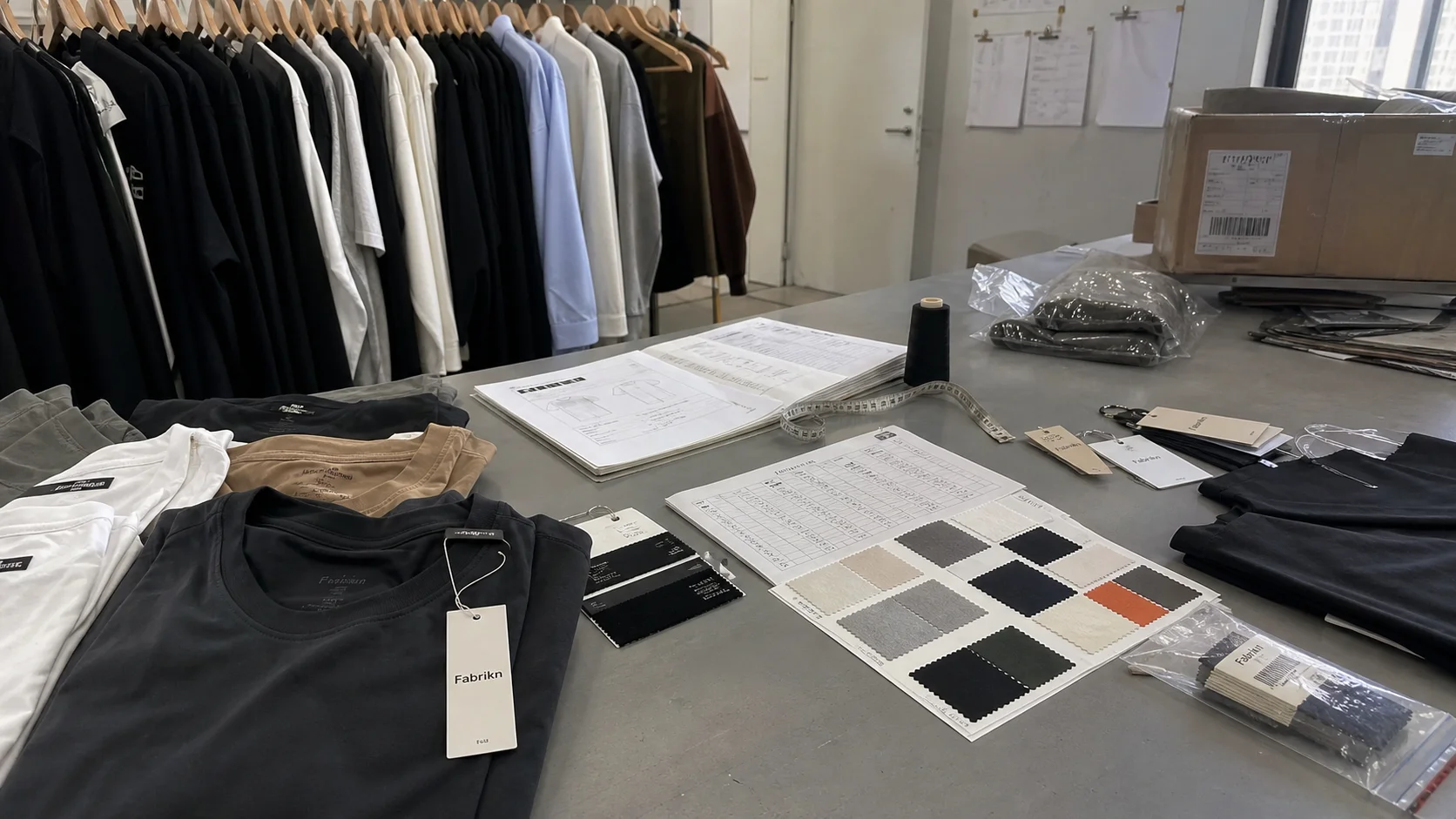
FSC Certified Paper Clothing Boxes with checks for samples, fit, MOQ, QC evidence, pricing terms, and delivery risk.
Fast answer: FSC Certified Paper Clothing Boxes: Costs, Claims, and QC should be judged by production evidence, not by a generic sourcing promise. The buyer needs sample proof, cost breakdowns, QC checkpoints, and delivery buffers in writing.
Ask for recent sample photos, measurement tolerances, fabric or print test assumptions, decoration test notes, packing examples, and a named inspection checkpoint. These details show whether the team can repeat an approved sample at bulk volume.
Separate garment cost, decoration, labels, packaging, sampling, testing, freight, and rush charges. When every cost line is visible, it becomes easier to reduce colorways, adjust size depth, or reserve more time for sampling.
Packaging audits used to feel like housekeeping. Now they can stop an order cold. In the last 18 months, brands, marketplaces, and regulators have started asking for FSC paperwork on fsc certified paper clothing boxes with the same intensity they once reserved for fiber content and factory compliance. A recycled-content claim may sound clean, but it does not prove where the virgin fiber came from, who handled it, or whether the chain stayed intact between mill and box plant. That gap matters when one carton can carry a luxury blouse, a $12 basic tee, or a $180 knit set.
When I visited the Bobst 1020E die-cutter at a plant in Guangzhou's Baiyun district, watched the operator feed 350 gsm C1S sheets peeled off a Heidelberg CX102 UV press, and saw embossing done on a Kolbus UV coater, the pattern was familiar. Premium fashion houses wanted embossing, soft-touch varnish, and a rigid feel pressed on an MBO folder-gluer, justifying a $4.50 box. Mid-market basics wanted a flatter, cheaper structure produced on a Dongguan-based glue line with 0.55 mm kraft and Bostik hot melt adhesives, landing at $0.28 to $0.55 per unit. DTC brands sat in the middle, using packaging as a values signal because they know customers read the box before they read the hangtag. The shelf effect is real. A good carton says “considered.” A flimsy one says “cost-cutting.”
Retailers scrutinize clothing boxes more than many buyers expect because they sit in customer view, travel through warehouses, and are often opened before the garment is worn. In Ho Chi Minh City, I saw an HP Indigo-printed sample run pass through a local 3D folding simulator before it went to the shelf—print registration, soy-based coating, stiff board edges, and even the closure strength were measured because a $0.34 box beat a $0.70 mailer not just on look but on performance. That kind of detail gets noticed. It also gets audited.
Some low-cost boxes look greener on the shelf than they are on paper. During a factory visit near Dhaka’s Savar industrial zone, a supplier showed me a kraft carton with pale ink coverage and a recycled aesthetic, but the board failed a basic edge crush test, the glue line was inconsistent, and the FSC traceability stopped at the sample room. The box looked sustainable. The paperwork did not survive inspection.
FSC certification covers the origin and traceability of the paper fiber, not every step inside the box plant. That distinction trips up buyers constantly. A supplier can hold an FSC chain-of-custody certificate and still produce non-certified SKUs on the same line if the inventory, invoices, and labeling are not separated correctly. The box is not certified by appearance. It is certified by documented control.
There are three labels buyers should know. FSC 100% means all virgin fiber comes from FSC-certified forests. FSC Mix combines FSC-certified material with controlled or recycled sources. FSC Recycled uses reclaimed fiber, usually post-consumer and pre-consumer waste. I ask for the certificate number, scope, and invoice wording on every order, then I cross-check the product group against the exact carton style. That takes 10 minutes. It can save a 10,000-unit mistake.
Paper grade matters too. A kraft-look board may use virgin liner, recycled core, or a mix of both. A rigid box for a premium shirt might use 1.5 mm grayboard wrapped with 157 gsm art paper, while a foldable apparel carton may use 350 gsm C1S or 400 gsm natural kraft. Coating changes the story fast. Matte aqueous coating keeps the box recyclable in many cases, but lamination can complicate fiber recovery even when the paper is FSC certified. Buyers often confuse “certified paper” with “fully recyclable packaging.” Those are not identical claims.
In addition to the FSC certificates from the pulp mill, I look for labels tied to textile compliance programs like GOTS or OEKO-TEX Standard 100 when the apparel inside is already certified. I also ask if the box plant maintains WRAP or BSCI audits and whether it can provide a GRS claim for reclaimed fiber and adhesives. These certifications reassure retail compliance teams that the packaging line—whether it’s running a Bobst Mastercut 106 for die-cutting or a Kolbus hot foil press—is governed by the same social and environmental standards as the sewing floor.
According to FSC International, chain-of-custody systems depend on documented transfer points, not vague environmental language. In practice, I request three things before approval: the FSC certificate, a sample invoice showing the claim language, and a packing list tied to the same product code. If any one of those uses a different SKU name, I slow the order down.
I’ve seen suppliers with excellent printing and weak traceability, and I’ve seen the reverse. The box plant in Poland had immaculate documentation but rough finishing on one dieline because the folding tolerances were too tight. The plant in Guangzhou had beautiful folding and poor claim discipline. Certification protects the forest claim. It does not magically correct a bad production floor.
Cost depends on format, region, and order size. For a 3,000-piece run, FSC-certified foldable apparel boxes often land around $0.32 to $0.78 per unit, depending on print, board weight, and finishing. Plastic mailers can drop to $0.08 to $0.22, while plain corrugate cartons may sit near $0.18 to $0.40. At 30,000 pieces, the FSC box gap usually narrows by 12% to 25% because setup costs spread out. Small brands pay more per box. Large brands buy down the premium.
In Guangzhou’s Baiyun district, a plant offering foil stamping, tactile varnish, and rigid construction quotes $2.50-4.00 per unit at a 500 MOQ; that price reflects the Kolbus hot foil press, the Bostik PUR adhesives, and the manual quality gate needed to meet that level of finish. Once the same supplier runs 1,500 units with the same tool, the per-unit price drops to about $1.80 because the Bobst 1060 FFG die-cutter can stay fed for 48 hours. An Istanbul-based facility in Tuzla, which prides itself on embossing and Turkish leatherette wraps, has slightly higher MOQs but still competes at $1.80-2.10 for 3,000 units thanks to existing die sets and shared freight consolidations with adjacent home textiles production.
Paper boxes outperform plastic on retail perception almost every time. They photograph better, stack better on a shelf, and carry a stronger brand signal for premium tees, shirting, and children’s apparel. I’ve seen a $28 blouse boxed in FSC Mix board outsell the same blouse in a clear poly mailer simply because the packaging matched the price point. The customer reads the box as care. That matters in stores and in unboxing videos.
Plastic still wins in moisture resistance. If a shipment is moving through humid ports, rainy last-mile routes, or warehouses with poor dehumidification, a poly mailer or a coated carton can reduce edge swelling and scuffing. Plain corrugate wins on impact protection for heavier knitwear, denim, and multipacks. The trade-off is presentation. A brown shipper is efficient, but it rarely sells the same story as a printed apparel box.
Lead time is different too. Plastic mailers can be turned in 7 to 14 days if film and print plates are ready. FSC-certified paper boxes usually need 18 to 22 business days for sampling and production on the die-cut, folder-gluer, and finishing lines, then another 20 to 35 days for ocean freight from Guangzhou, Ho Chi Minh City, or Istanbul depending on origin. Changeovers are slower on paper because die-cutting, gluing, and finishing require cleaner setup and tighter quality control. The more complex the fold, the more time you lose.
A cheaper carton can cost more after returns if crush rates rise by even 2% to 3%. I watched one mid-market brand save $0.06 per unit by moving to lighter board, then lose more than $14,000 in resale value because damaged boxes pushed return rates up. Packaging is not just a unit-cost line. It is part of loss prevention.
Buyers often speak in marketing language. Factories speak in measurements. If you want fsc certified paper clothing boxes that arrive flat, open cleanly, and survive stacking, you need to specify board caliper, burst strength, glue area, coating, and tolerance in writing. For folded apparel cartons, I usually ask for a caliper range of 0.40 to 0.60 mm on light cartons and higher for rigid formats. Compression targets should be stated too, especially if pallets will be stacked six to eight high.
Design affects pack-out speed more than many sourcing teams expect. A box with a tight tuck flap can add 2 to 4 seconds per unit in the warehouse, which becomes real labor cost at 5,000 units a day. A wider glue flap may improve closure but reduce usable interior space. If the box is for premium outerwear, I’ll accept a slower fold because presentation matters. For basic tees, I want speed, not ceremony. That is the trade.
In factory inspections, I see the same defects repeatedly: weak corners that open after 10 to 15 cycles, inconsistent fold memory that prevents the lid from sitting square, off-register print that makes logos drift by 1.5 to 2 mm, and poor glue adhesion that fails in humid storage. None of those defects look dramatic in a sample room. They become obvious on a line. That is why pre-production sampling is essential.
That is why pre-production sign-off includes a 10-point specification: board caliper, burst strength, glue bead width, lamination method, press color density, packing configuration, and the finishing machine in play (I prefer to know if they will use a Bobst Vitero 12 for hot stamping or a manual Kolbus foil press). I also record the adhesive brand (Bostik 1127, Henkel PUR 9730, or H.B. Fuller Eco-Bond), the curing temperature in the IR dryer, and whether the vacuum clamping jig is the same used for the production run. A change in any of those variables without my knowledge can change the box’s feel, even if the paper is still FSC certified.
In Guangzhou, a plant offering foil stamping, soft-touch aqueous coating, and rigid construction quotes $2.50-4.00 per unit at a 500 MOQ because the Kolbus hot foil press, the Bostik PUR adhesives, and manual quality gates all add to the cost. Once the same supplier runs 1,500 units with the same tool, the per-unit price drops to about $1.80 because the Bobst 1060 FFG die-cutter can stay fed. Dhaka-based factories usually expect 1,000-unit minimums for flat mailer boxes because their die-cutters run in batches of 1,200 sheets, and they charge $0.38 to $0.62 per unit depending on ink coverage.
For premium rigid cases, Istanbul’s Tuzla corridor offers 3,000-unit MOQs with a $1.80-2.10 pricing band because they can bundle leatherette wraps and hot stamping across several brands on the same Kolbus line, spreading freight and tooling costs across the package. Ho Chi Minh City hosts smaller format specialists who can drop to 2,500-unit MOQs but increase the per-unit spend by $0.05 to $0.10 if the order includes cold foil, embossing, or additional inserts.
Sample and production lead times also vary. Allow 18 to 22 business days for sampling and approvals when the plant runs through die-making, printing, folding, gluing, and inspection before stacking the cartons into pallets. Production then takes another 12 to 18 business days, plus 20 to 35 days of ocean freight from Guangzhou, Ho Chi Minh City, or Istanbul depending on the port. Air freight is reserved for critical launches, while consolidated LCL containers and barge drayage keep costs manageable.
Pay attention to ancillary charges: foiling plates, die blocks, and color proofs. A reusable die block that costs $250 to $320 in Ho Chi Minh City can amortize across several launches, but cheaper die-making in Dhaka may force you to rent a new block every season. Shipping decisions matter too. A full 40-ft container from Guangzhou to Long Beach costs roughly $3,200 today, while a similar shipment from Istanbul to Rotterdam can approach $2,800 but adds inland trucking if your warehouse is in Milan or Manchester.
Auditing a supplier goes beyond checking a certificate PDF. Start with the standard documents: FSC chain-of-custody, mill scope (that should include the producer’s name and location such as Guangzhou, Dhaka, Ho Chi Minh City, or Istanbul), and the invoice wording that matches your SKU and order quantity. Ask for the corresponding GOTS or OEKO-TEX Standard 100 references if the apparel is certified, and insist the box plant has active WRAP or BSCI audits plus a GRS claim on reclaimed fiber runs so the social and environmental story is cohesive.
Then walk through the line, or if you can’t visit, request a video of each production step: sheet cutting on the Bobst 1060, printing on the Heidelberg CX102, lamination on the Kolbus Vareo, and glue application on MBO folder-gluers. Confirm that the same adhesive (Bostik, Henkel, or H.B. Fuller) is logged for that order, that curing times and temperatures are recorded, and that tooling (die block, foil plate) numbers are marked on the job cards.
Quality control should include physical tests: we check edge crush strength, burst strength, and glue pull tests on each batch, as well as finish evaluations for gloss, registration, and slip resistance. When auditors arrive, demand to see the FSC paperwork tied to the specific board roll. If the supplier cannot show that the same lot number produced your carton, it’s a red flag. The best plants will show you both the environmental documentation and the physical process, and they will welcome a short audit of their machines and operators.
1. Benchmark your last order. Pull costs per unit, board specs, adhesives used, and lead times from Guangzhou, Ho Chi Minh City, Dhaka, or Istanbul. Compare those against your current cardboard weight, die-cutting setup, and finishing machines.
2. Request updated quotations with detailed process breakdowns. Ask suppliers for their compliance certificates (FSC, GOTS, OEKO, WRAP, BSCI, GRS), the machines running your run (Bobst, Kolbus, Heidelberg), and a list of materials (board caliper, adhesives, coatings).doc
3. Test one SKU through a sample program that mimics the production line. Validate that the box can be stacked six high, that the fold stays crisp, that the closure resists 10 cycles, and that the glue holds up in humid storage.
4. Build a preferred supplier list with at least two qualified vendors in different locations. Mixing Guangzhou and Istanbul or Dhaka mitigates geopolitical risk and keeps freight options open.
Q: How can I tell if a supplier’s FSC claim is real?
A: Cross-check the certificate number with FSC’s online database, ensure the scope includes the specific box style, and confirm the invoice mentions the same SKU. Ask for photos of the die-cut, print, and glue line to validate the process matches the documentation.
Q: Should the packaging supplier align with textile certifications like GOTS or OEKO?
A: Yes, especially for brands already certified. A supplier that holds GOTS or OEKO references, along with WRAP/BSCI or GRS, shows the same supply chain diligence on the packaging as on the garments.
Q: What is a reasonable production lead time?
A: Plan for 18-22 business days for sampling and pre-production checks, another 12-18 business days for the full run, and 20-35 days for sea freight depending on whether the goods ship from Guangzhou, Ho Chi Minh City, Dhaka, or Istanbul.